
#FactCheck-President Murmu’s Independence Day Address Altered with Fake Audio
Executive Summary:
A video is going viral on social media with the claim that President Droupadi Murmu has allegedly demanded an independent inquiry into the loss of Rafale jets. In the video clip, Murmu can allegedly be heard saying that India should investigate the reasons behind the loss of the aircraft and learn from its mistakes. A research by the research wing of the CyberPeace revealed that the viral video has been tampered with. President Droupadi Murmu had made no such statement.
Claim:
A video being shared on social media claims that President Droupadi Murmu has demanded the formation of an independent commission to investigate the causes behind the loss of India’s Rafale aircraft. In the viral video, Murmu can allegedly be heard stating that such an inquiry would help India avoid similar failures in the future.
https://archive.ph/UbLYj#selection-295.0-295.214
https://x.com/InsiderWB/status/2088669027258552509

Fact Check
During the research, we first conducted a customized keyword search using terms like "President Murmu", "Rafale jets", and "inquiry". During this search, we found no reliable media reports or official statements confirming the claim that President Droupadi Murmu had demanded an independent probe into the loss of Rafale aircraft. Upon performing a reverse image search on keyframes of the viral video, we found the original video of President Droupadi Murmu’s address to the nation uploaded on the official YouTube channel of the President of India on August 14, 2026. This address was delivered on the eve of India's 80th Independence Day. In the original video, President Murmu can be seen speaking in the exact same outfit and against the same background as visible in the viral clip. However, a review of the complete speech revealed no mention of Rafale aircraft or any demand for an independent inquiry into their alleged loss.
https://www.youtube.com/watch?v=BggdVYCyH6c

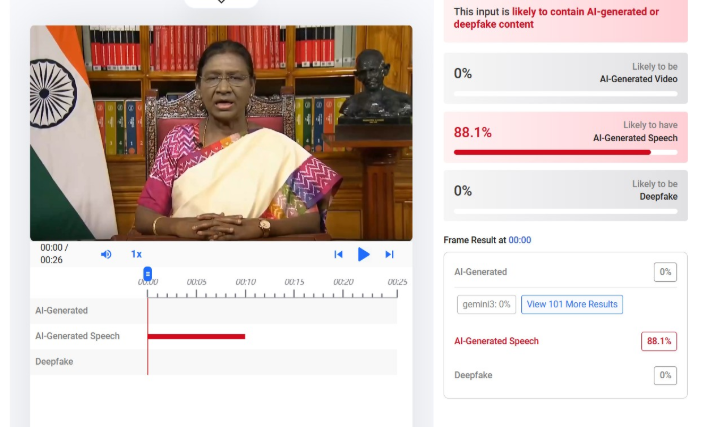
Following this, we analyzed the viral clip using several AI detection tools. Hive Moderation indicated a high probability that the video contained AI-generated or deepfake content.
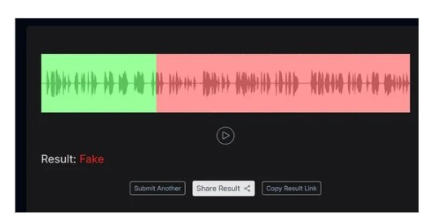
Meanwhile, Resemble AI flagged the audio as fake.
Conclusion
The statement regarding an independent probe into the alleged loss of Rafale aircraft in the viral video has been falsely attributed to President Droupadi Murmu. The clip appears to be manipulated using AI-generated video and audio. There is no such statement in the President's original Independence Day address.

Related Blogs

Executive Summary
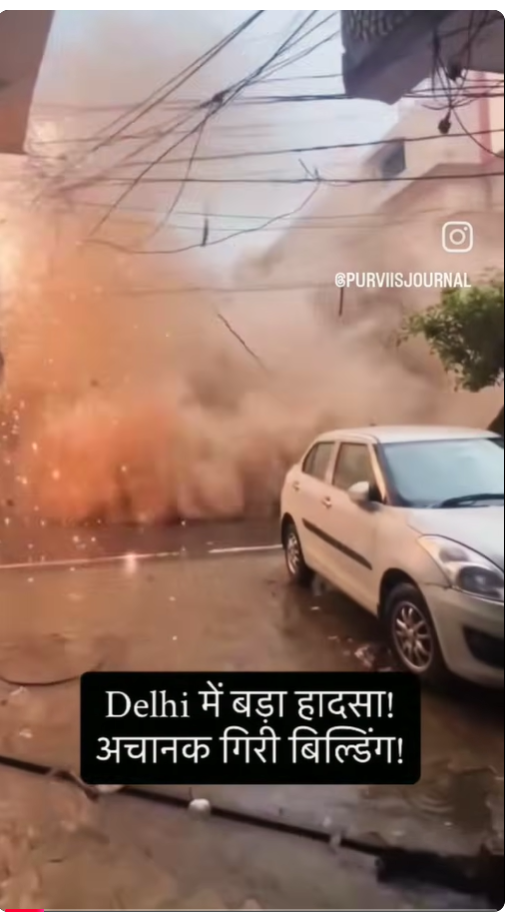
A video showing a building collapse is going viral on social media. It is being shared as footage of a tragic incident that took place in Satya Niketan, Delhi. The video is accompanied by claims that it shows the building collapse in Satya Niketan. However, a research by CyberPeace’s Research Wing found that the viral video is not from the incident in Satya Niketan, Delhi. The research revealed that the video is actually from Moradabad, Uttar Pradesh, where a building collapsed on September 5, 2026. Clear similarities were found between the viral video and visuals from the incident in Moradabad. This confirms that an old video is being shared on social media with a false context, linking it to the incident in Satya Niketan, Delhi.
Claim:
A user shared the viral video on YouTube with the caption: “Major accident in Delhi! A five-storey building collapsed.”
https://www.youtube.com/shorts/1qeW-pFoMd4
Fact Check
While investigating the viral video, we conducted a reverse image search using its keyframes. This led us to the same video, which was uploaded on an Instagram account on September 5, 2026. The text visible in the video identified the location as Moradabad, Uttar Pradesh.
https://www.instagram.com/p/Dc54OW2SOh3/

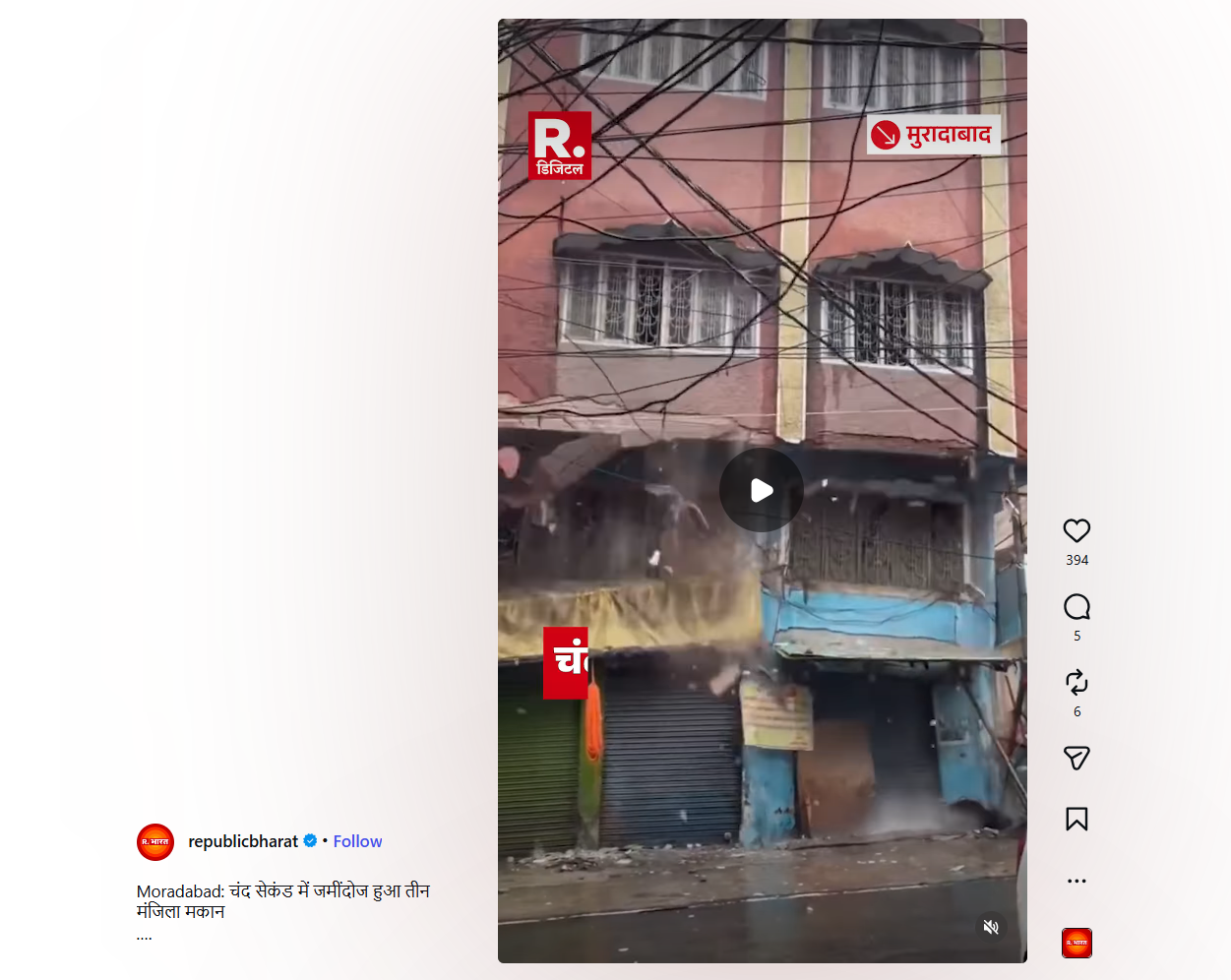
In the next stage of our research, we found the video on Republic Bharat’s Instagram channel, where it was also identified as being from Moradabad.
https://www.instagram.com/reels/Dc8XTlpgaRL/
Based on the information gathered above, a keyword search led us to a report published by Dainik Bhaskar on September 5, 2026. The report also contained visuals matching those seen in the viral video. According to the Dainik Bhaskar report, on September 5, 2026, a four-storey dilapidated building collapsed in the Mughalpura area of Moradabad amid heavy rain, triggering panic in the area. However, the administration had sealed the building a day earlier after assessing its condition. The incident took place at around 3 p.m. The building was owned by a man named Sarfaraz Ali.
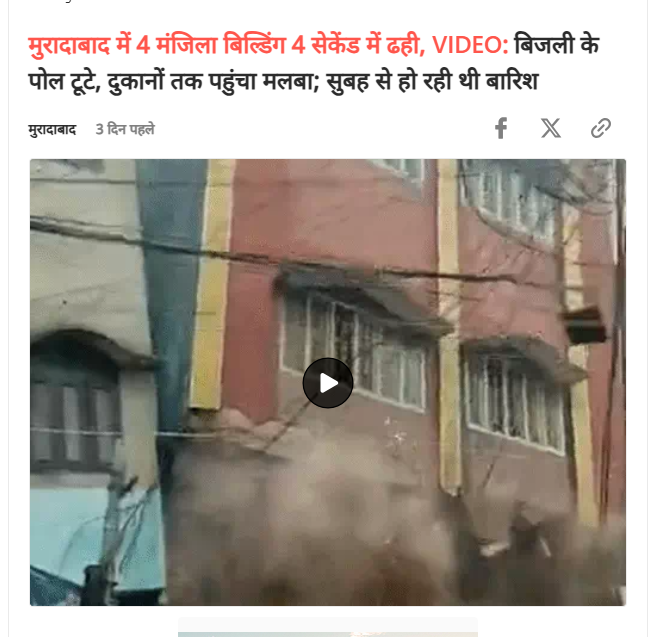
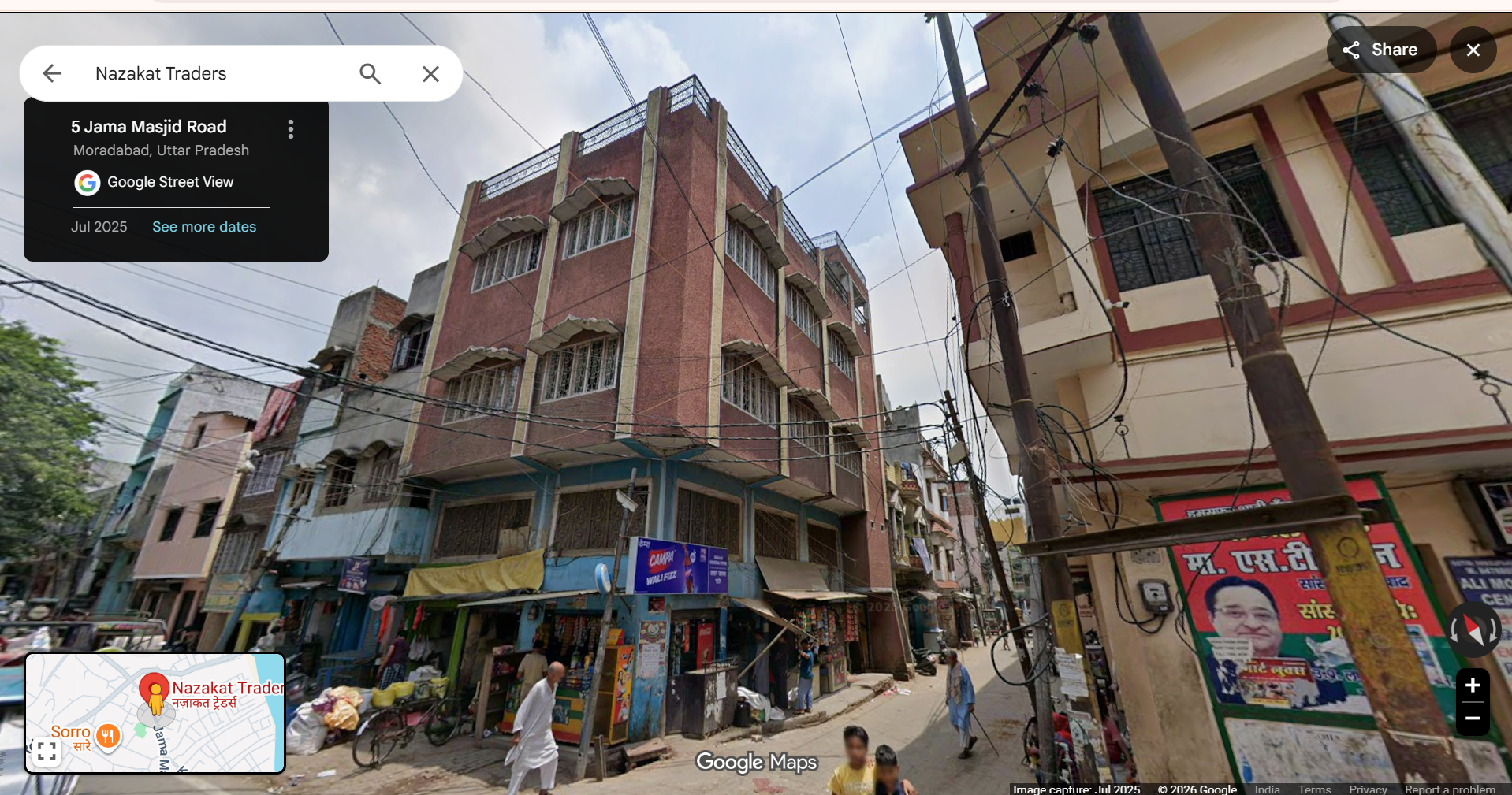
In our research, we also tried to geolocate the building seen collapsing in the viral video. We found that the building was located near Guiyan Bagh on Jama Masjid Road in Moradabad. The location can be seen in the image below.
Conclusion
The evidence gathered during our research clearly establishes that the video being circulated as footage of the tragic building collapse in Satya Niketan, Delhi, is not from Delhi. Our findings show that the viral video actually captures the collapse of a dilapidated four-storey building in the Mughalpura area of Moradabad, Uttar Pradesh, on September 5, 2026, amid heavy rainfall. The video was traced to multiple sources that identified the location as Moradabad, and further verification through media reports and geolocation confirmed that the visuals correspond to the same incident. Therefore, the viral video is being shared with a false context by incorrectly linking an incident in Moradabad to the building collapse in Satya Niketan, Delhi.

Executive Summary
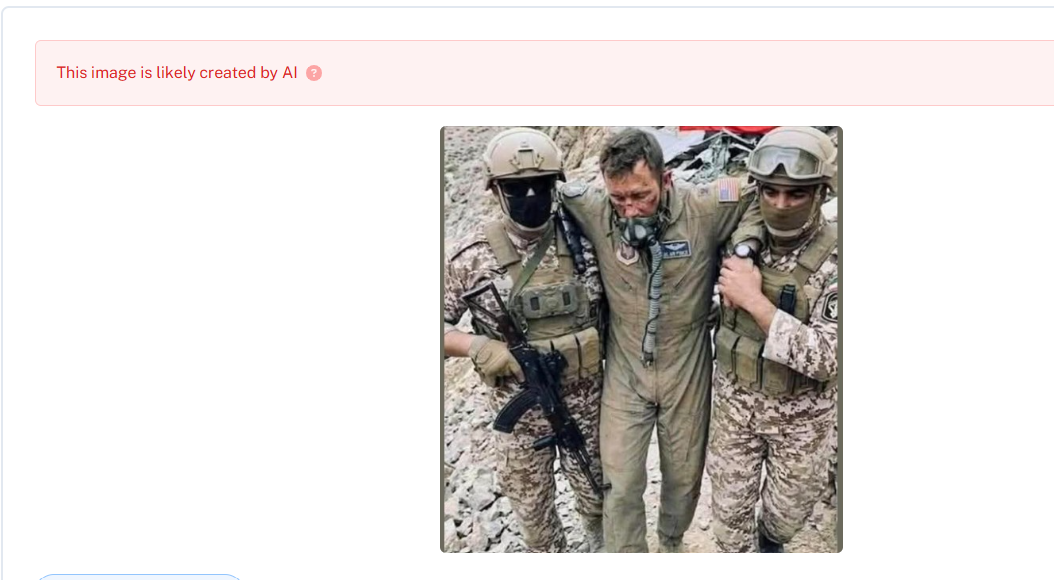
A claim is circulating on social media that the U.S. military successfully rescued a missing crew member of an F-15E fighter jet in Iran. Along with this claim, a photo is being widely shared, allegedly showing the rescued U.S. airman after the high-risk operation. However, researches reveal that the viral image is not authentic and has been generated using artificial intelligence tools.
The Claim
On April 6, 2026, a social media user named “July Gaytan” shared the viral image with the caption: “Here is the photo of the U.S. airman being rescued yesterday in Iran.”
The post quickly gained traction, with many users believing it to be genuine.
- https://www.facebook.com/photo/?fbid=1724007721903888&set=a.116284172676259
- https://perma.cc/URM4-KEJA
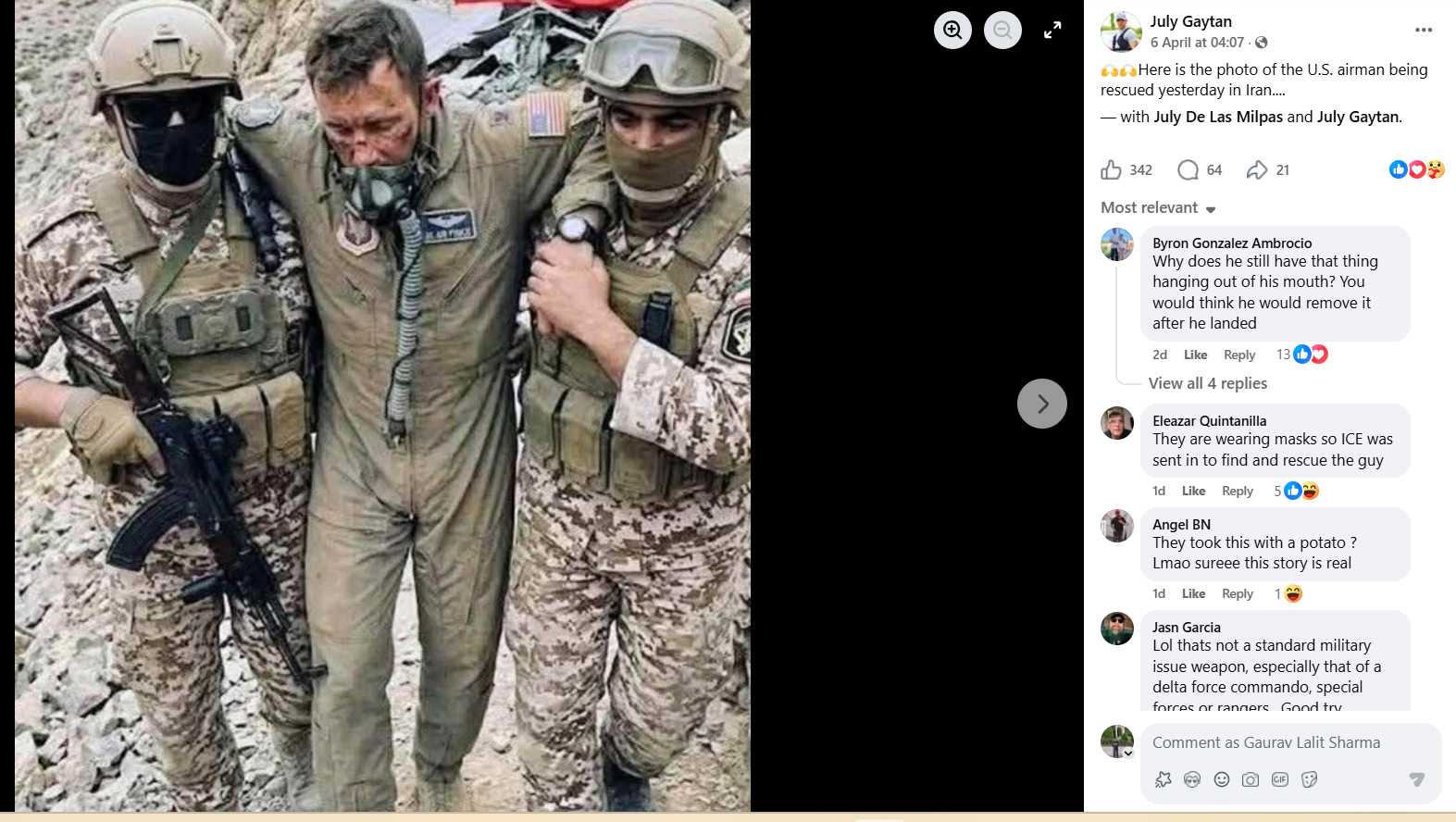
Fact Check
Despite extensive searches, no credible media report or official source has published any real image of the rescued crew members. This raised suspicion about the authenticity of the viral photo. Hive Moderation analysis indicated a 100% probability that the image was generated using Google’s Gemini AI.
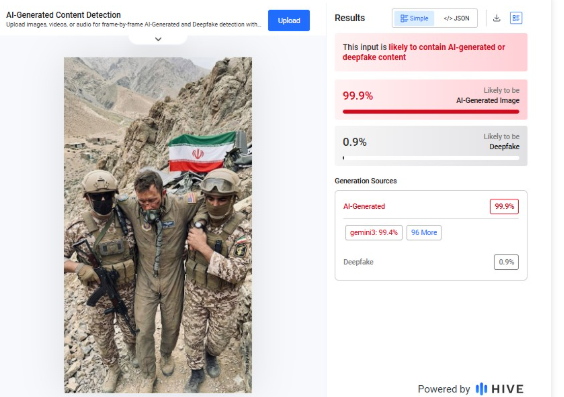
A second scan using Undetectable AI also concluded that the image is AI-generated.
Reports indicate that a U.S. Air Force F-15E Strike Eagle was shot down in Iran. The aircraft had two crew members on board: a pilot and a Weapon Systems Officer (WSO).
- The pilot was rescued shortly after the incident.
- The WSO was initially missing and remained inside Iranian territory in an injured condition.
- The U.S. later carried out a high-risk rescue operation and successfully evacuated the WSO from Iran.
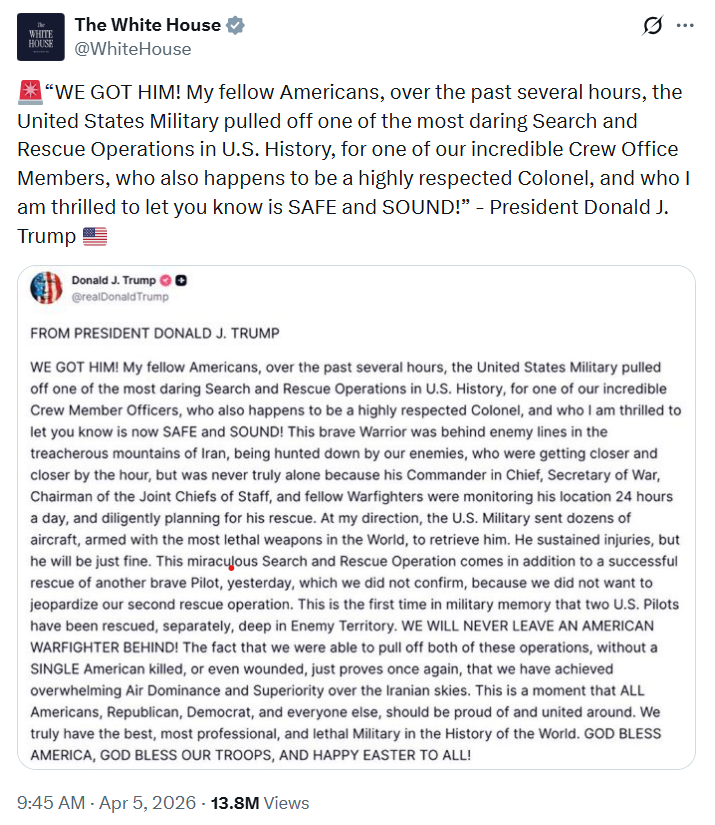
U.S. President Donald Trump also confirmed the “brave and risky” rescue mission in a detailed post on his platform, Truth Social. The statement was further shared by the official White House account.
- https://x.com/WhiteHouse/status/2040644451513598220?s=20
Conclusion
The viral image claiming to show a rescued U.S. airman in Iran is not real. It has been created using AI tools, likely Google’s Gemini. While it is true that the U.S. conducted a high-risk operation to rescue the missing crew member, no authentic image of the rescue or the personnel has been publicly released.
.webp)
Executive Summary:
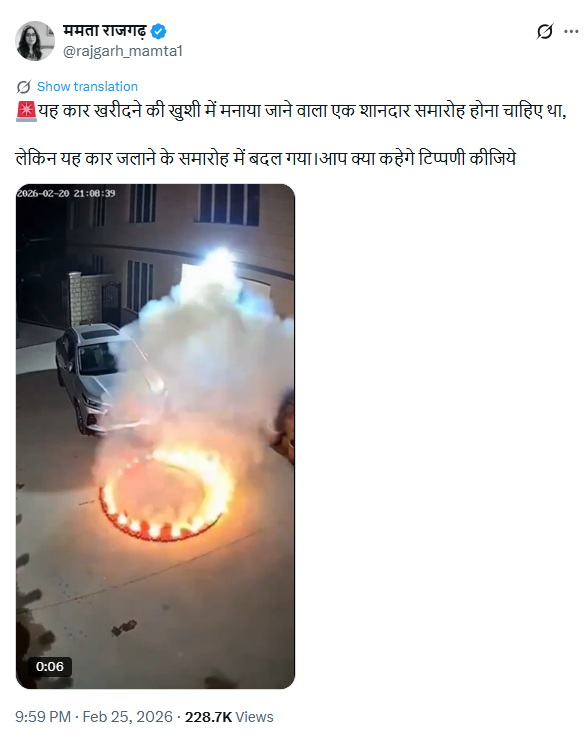
A video showing a car catching fire is rapidly going viral on social media. In the clip, a family can be seen bursting firecrackers in front of a newly purchased car. Moments later, the vehicle also appears to catch fire. The video is being shared with the claim that the family was celebrating the purchase of a new car with fireworks, which accidentally led to the vehicle going up in flames. Many users are circulating the clip as footage of a real incident. However, an research by the CyberPeace found that the video is not from a real-life event but has been created using Artificial Intelligence (AI).
Claim
On February 25, 2026, an X user named “Mamta Rajgarh” shared the viral video with the caption:“This was supposed to be a grand celebration for buying a new car, but it turned into a ceremony of burning the car. What do you say? Comment below.”
- Post link: https://x.com/rajgarh_mamta1/status/2026696175311786408?s=20
- Archived link: https://perma.cc/22AA-KBS4
Fact Check:
To verify the claim, we conducted a keyword search on Google but found no credible news reports supporting the alleged incident. Upon closely examining the video, we noticed several technical inconsistencies. The car’s number plate is unclear, a common flaw often seen in AI-generated content. Additionally, the sequence of events appears unnatural — the firecrackers seem to extinguish first, and only after a delay does the car suddenly catch fire. These irregularities raised suspicion that the video may have been artificially generated. To further verify, we analyzed the clip using AI detection tools. Hive Moderation indicated a 98.7 percent likelihood that the video was generated using Artificial Intelligence.
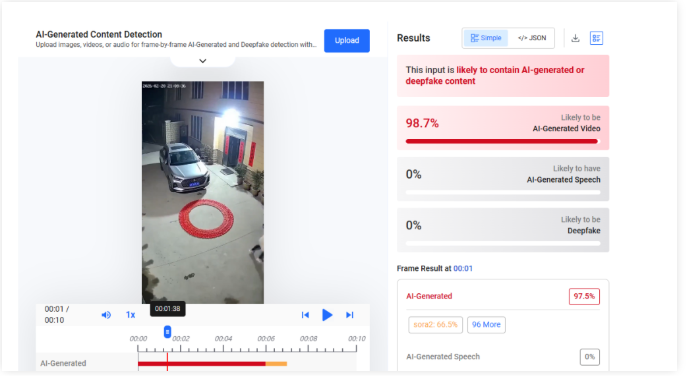
Another AI detection tool, Undetectable.ai, suggested a 77 percent probability that the video was AI-generated.
Conclusion
Our research confirms that the viral video does not depict a real incident. It has been created using Artificial Intelligence and is being misleadingly shared as genuine footage.
