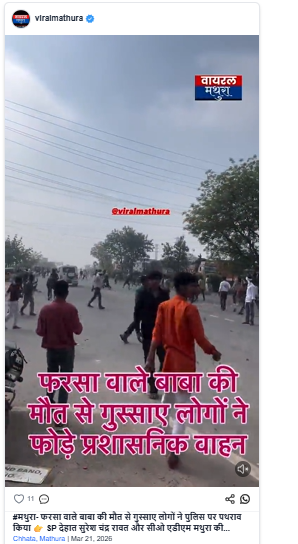
#FactCheck- Viral Image of Rescued U.S. Airman in Iran is AI-Generated
Executive Summary
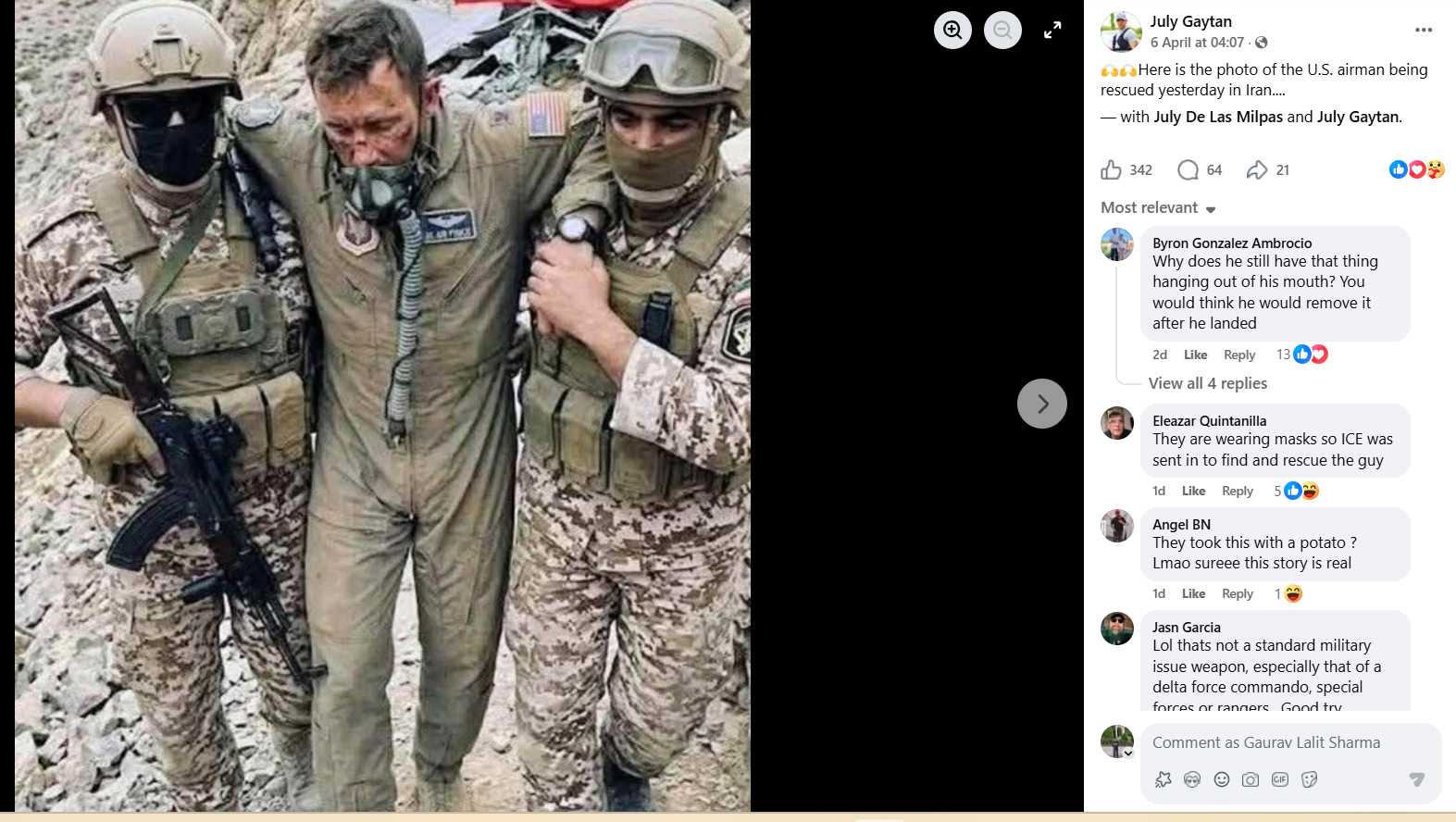
A claim is circulating on social media that the U.S. military successfully rescued a missing crew member of an F-15E fighter jet in Iran. Along with this claim, a photo is being widely shared, allegedly showing the rescued U.S. airman after the high-risk operation. However, researches reveal that the viral image is not authentic and has been generated using artificial intelligence tools.
The Claim
On April 6, 2026, a social media user named “July Gaytan” shared the viral image with the caption: “Here is the photo of the U.S. airman being rescued yesterday in Iran.”
The post quickly gained traction, with many users believing it to be genuine.
- https://www.facebook.com/photo/?fbid=1724007721903888&set=a.116284172676259
- https://perma.cc/URM4-KEJA
Fact Check
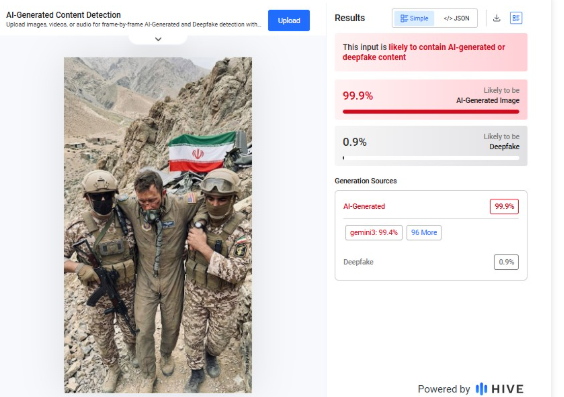
Despite extensive searches, no credible media report or official source has published any real image of the rescued crew members. This raised suspicion about the authenticity of the viral photo. Hive Moderation analysis indicated a 100% probability that the image was generated using Google’s Gemini AI.
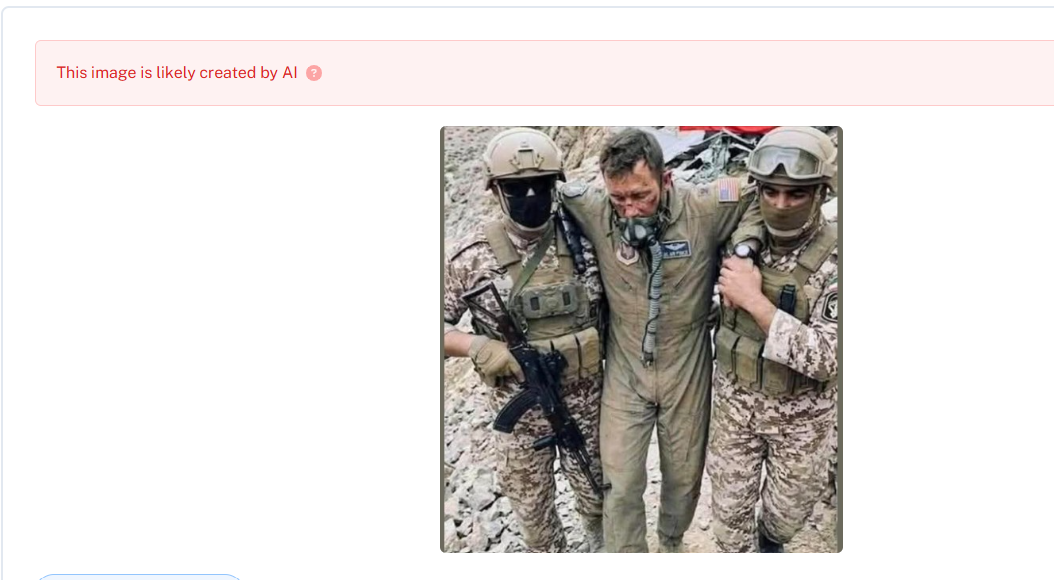
A second scan using Undetectable AI also concluded that the image is AI-generated.
Reports indicate that a U.S. Air Force F-15E Strike Eagle was shot down in Iran. The aircraft had two crew members on board: a pilot and a Weapon Systems Officer (WSO).
- The pilot was rescued shortly after the incident.
- The WSO was initially missing and remained inside Iranian territory in an injured condition.
- The U.S. later carried out a high-risk rescue operation and successfully evacuated the WSO from Iran.
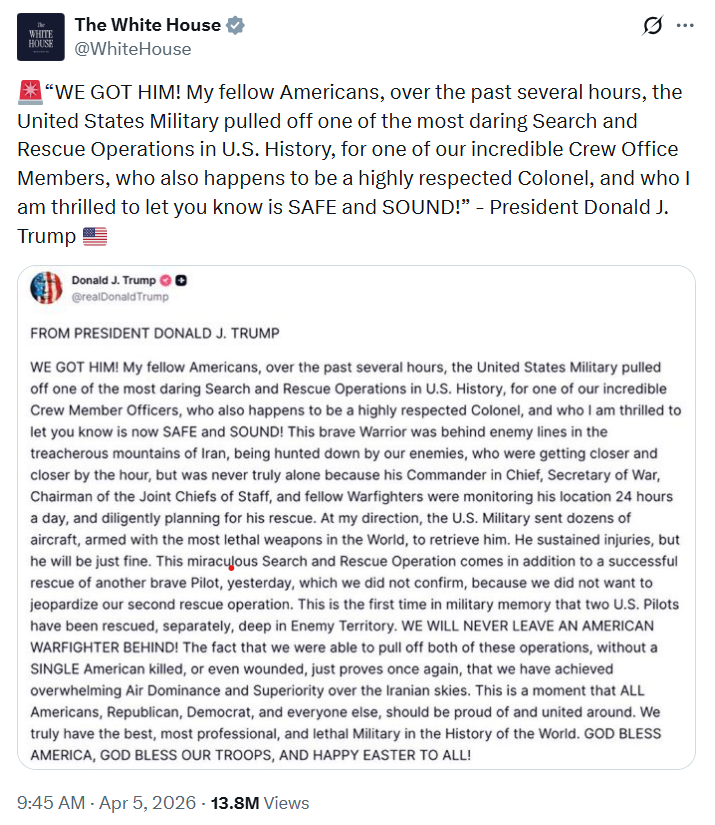
U.S. President Donald Trump also confirmed the “brave and risky” rescue mission in a detailed post on his platform, Truth Social. The statement was further shared by the official White House account.
- https://x.com/WhiteHouse/status/2040644451513598220?s=20
Conclusion
The viral image claiming to show a rescued U.S. airman in Iran is not real. It has been created using AI tools, likely Google’s Gemini. While it is true that the U.S. conducted a high-risk operation to rescue the missing crew member, no authentic image of the rescue or the personnel has been publicly released.
Related Blogs
Introduction
In the digital era, where technology is growing rapidly, the role of Artificial Intelligence (AI) has been making its way to different corners of the world. Where nothing seems to be impossible, technology and innovation have been moving conjointly and once again, and such innovation is in the limelight with its groundbreaking initiative known as “Project Groot”, which has been announced by the AI chip leader “Nvidia”. The core of this project is the fusion of technology with AI and robotics, where a humanoid can be produced with the capability to understand the natural language and interact with it to further learn from the physical environment by observing human actions and skills. Project Groot aims to assist humans in diverse sectors such as Healthcare and so on.
Humanoid robots are based on NVIDIA’s thor system-on-chip (SoC). The thor powers the intelligence of these robots, and the chip has been designed to handle complex tasks and ensure a safe and natural interaction between humans and robots. However, a big question arises about the ethical considerations of privacy, autonomy and the possible replacement of human workers.
Brief Analysis
Nvidia has announced Project GR00T, or Generalist Robot 00 Technology, which aims to create AI-powered humanoid robots with human-like understanding and movement. The project is part of Nvidia's efforts to drive breakthroughs in robotics and embodied AI, which can interact with and learn from a physical environment. The robots built on this platform are designed to understand natural language and emulate movements by observing human actions, such as coordination, dexterity, and other skills.
The model has been trained on NVIDIA GPU-accelerated simulation, enabling the robots to learn from human demonstrations with imitation learning and from the robotics platform NVIDIA Isaac Lab for reinforcement learning. This multimodal AI system acts as the mind for humanoid robots, allowing them to learn new skills and interact with the real world. Leading names in robotics, such as Figure, Boston Dynamics, Apptronik, Agility Robotics, Sanctuary AI, and Unitree, are reported to have collaborated with Nvidia to leverage GR00T.
Nvidia has also updated Isaac with Isaac Manipulator and Isaac Perceptor, which add multi-camera 3D vision. The company also unveiled a new computer, Jetson Thor, to aid humanoid robots based on NVIDIA's SoC, which is designed to handle complex tasks and ensure a safe and natural interaction between humans and robots.
Despite the potential job loss associated with humanoid robots potentially handling hazardous and repetitive tasks, many argue that they can aid humans and make their lives more comfortable rather than replacing them.
Policy Recommendations
The Nvidia project highlights a significant development in AI Robotics, presenting a brimming potential and ethical challenges critical for the overall development and smooth assimilation of AI-driven tech in society. To ensure its smooth assimilation, a comprehensive policy framework must be put in place. This includes:
- Human First Policy - Emphasis should be on better augmentation rather than replacement. The authorities must focus on better research and development (R&D) of applications that aid in modifying human capabilities, enhancing working conditions, and playing a role in societal growth.
- Proper Ethical Guidelines - Guidelines stressing human safety, autonomy and privacy should be established. These norms must include consent for data collection, fair use of AI in decision making and proper protocols for data security.
- Deployment of Inclusive Technology - Access to AI Driven Robotics tech should be made available to diverse sectors of society. It is imperative to address potential algorithm bias and design flaws to avoid discrimination and promote inclusivity.
- Proper Regulatory Frameworks - It is crucial to establish regulatory frameworks to govern the smooth deployment and operation of AI-driven tech. The framework must include certification for safety and standards, frequent audits and liability protocols to address accidents.
- Training Initiatives - Educational programs should be introduced to train the workforce for integrating AI driven robotics and their proper handling. Upskilling of the workforce should be the top priority of corporations to ensure effective integration of AI Robotics.
- Collaborative Research Initiatives - AI and emerging technologies have a profound impact on the trajectory of human development. It is imperative to foster collaboration among governments, industry and academia to drive innovation in AI robotics responsibly and undertake collaborative initiatives to mitigate and address technical, societal, legal and ethical issues posed by AI Robots.
Conclusion
On the whole, Project GROOT is a significant quantum leap in the advancement of robotic technology and indeed paves the way for a future where robots can integrate seamlessly into various aspects of human lives.
References
- https://indianexpress.com/article/explained/explained-sci-tech/what-is-nvidias-project-gr00t-impact-robotics-9225089/
- https://medium.com/paper-explanation/understanding-nvidias-project-groot-762d4246b76d
- https://www.techradar.com/pro/nvidias-project-groot-brings-the-human-robot-future-a-significant-step-closer
- https://www.barrons.com/livecoverage/nvidia-gtc-ai-conference/card/nvidia-announces-ai-model-for-humanoid-robot-development-BwT9fewMyD6XbuBrEDSp

Executive Summary:
A video clip featuring Prime Minister Narendra Modi and the newly elected Bharatiya Janata Party (BJP) national president, Nitin Nabin, is going viral on social media. In the clip, PM Modi is seen apparently pushing Nitin Nabin, prompting claims that Nabin had accidentally stepped between the Prime Minister and the camera, after which Modi allegedly pushed him out of the frame. CyberPeace’s research found that the viral clip is misleading and cropped. The original, unedited video shows Prime Minister Modi gesturing for Nitin Nabin to move ahead and offer floral tributes to the statues of Bharatiya Jana Sangh founder Syama Prasad Mukherjee and Pandit Deendayal Upadhyaya at the BJP headquarters in Delhi. It is pertinent to note that on 20 January 2026, BJP leader Nitin Nabin was elected as the party’s national president. Several senior BJP leaders, including Prime Minister Narendra Modi, were present at the event. During his address, PM Modi remarked, “Nitin Nabin ji is my boss, and I am a party worker.” The statement received widespread attention, following which multiple videos linking to the remark began circulating on social media. A Facebook user shared the viral clip with a Hindi caption alleging that despite calling himself a “party worker,” PM Modi pushed his “boss” out of the camera frame. The post further mocked the position of BJP president, claiming it to be merely ceremonial. (Archived link)
To verify the claim, we conducted a reverse image and video search, which led us to a longer version of the video uploaded on news agency INS’s official X handle on 20 January 2026. The caption stated that PM Modi, BJP president Nitin Nabin, Defence Minister Rajnath Singh, Home Minister Amit Shah, Union Minister Nitin Gadkari and senior leader J.P. Nadda paid tributes to Syama Prasad Mukherjee and Pandit Deendayal Upadhyaya at the BJP headquarters.

In the full video, PM Modi and Nitin Nabin are seen walking together. PM Modi then requests Nitin Nabin to proceed first for the floral tribute, placing his hand on Nabin’s back as a gesture to move forward. The viral clip selectively cuts this moment out of context and loops it to create a misleading impression. The complete footage clearly shows that PM Modi asked Nitin Nabin to offer tributes first, after which other leaders followed. There is no indication whatsoever that Nitin Nabin was pushed out of the camera frame, as claimed in the viral posts. We also found the live broadcast of the ‘Bharatiya Janata Party Sangathan Parv’ on BJP’s official YouTube channel. The same visuals appear at the end of the live stream, further confirming that PM Modi was merely gesturing for Nitin Nabin to proceed first.
Additionally, photographs available on Nitin Nabin’s official X handle show him offering floral tributes ahead of PM Modi, who is seen standing behind and waiting.

Conclusion:
CyberPeace research confirms that the viral clip has been cropped and shared with a false narrative. In the original context, Prime Minister Narendra Modi was respectfully inviting BJP national president Nitin Nabin to move ahead and pay tributes, not pushing him out of the camera frame.

Introduction
In an era when misinformation spreads like wildfire across the digital landscape, the need for effective strategies to counteract these challenges has grown exponentially in a very short period. Prebunking and Debunking are two approaches for countering the growing spread of misinformation online. Prebunking empowers individuals by teaching them to discern between true and false information and acts as a protective layer that comes into play even before people encounter malicious content. Debunking is the correction of false or misleading claims after exposure, aiming to undo or reverse the effects of a particular piece of misinformation. Debunking includes methods such as fact-checking, algorithmic correction on a platform, social correction by an individual or group of online peers, or fact-checking reports by expert organisations or journalists. An integrated approach which involves both strategies can be effective in countering the rapid spread of misinformation online.
Brief Analysis of Prebunking
Prebunking is a proactive practice that seeks to rebut erroneous information before it spreads. The goal is to train people to critically analyse information and develop ‘cognitive immunity’ so that they are less likely to be misled when they do encounter misinformation.
The Prebunking approach, grounded in Inoculation theory, teaches people to recognise, analyse and avoid manipulation and misleading content so that they build resilience against the same. Inoculation theory, a social psychology framework, suggests that pre-emptively conferring psychological resistance against malicious persuasion attempts can reduce susceptibility to misinformation across cultures. As the term suggests, the MO is to help the mind in the present develop resistance to influence that it may encounter in the future. Just as medical vaccines or inoculations help the body build resistance to future infections by administering weakened doses of the harm agent, inoculation theory seeks to teach people fact from fiction through exposure to examples of weak, dichotomous arguments, manipulation tactics like emotionally charged language, case studies that draw parallels between truths and distortions, and so on. In showing people the difference, inoculation theory teaches them to be on the lookout for misinformation and manipulation even, or especially, when they least expect it.
The core difference between Prebunking and Debunking is that while the former is preventative and seeks to provide a broad-spectrum cover against misinformation, the latter is reactive and focuses on specific instances of misinformation. While Debunking is closely tied to fact-checking, Prebunking is tied to a wider range of specific interventions, some of which increase motivation to be vigilant against misinformation and others increase the ability to engage in vigilance with success.
There is much to be said in favour of the Prebunking approach because these interventions build the capacity to identify misinformation and recognise red flags However, their success in practice may vary. It might be difficult to scale up Prebunking efforts and ensure their reach to a larger audience. Sustainability is critical in ensuring that Prebunking measures maintain their impact over time. Continuous reinforcement and reminders may be required to ensure that individuals retain the skills and information they gained from the Prebunking training activities. Misinformation tactics and strategies are always evolving, so it is critical that Prebunking interventions are also flexible and agile and respond promptly to developing challenges. This may be easier said than done, but with new misinformation and cyber threats developing frequently, it is a challenge that has to be addressed for Prebunking to be a successful long-term solution.
Encouraging people to be actively cautious while interacting with information, acquire critical thinking abilities, and reject the effect of misinformation requires a significant behavioural change over a relatively short period of time. Overcoming ingrained habits and prejudices, and countering a natural reluctance to change is no mean feat. Developing a widespread culture of information literacy requires years of social conditioning and unlearning and may pose a significant challenge to the effectiveness of Prebunking interventions.
Brief Analysis of Debunking
Debunking is a technique for identifying and informing people that certain news items or information are incorrect or misleading. It seeks to lessen the impact of misinformation that has already spread. The most popular kind of Debunking occurs through collaboration between fact-checking organisations and social media businesses. Journalists or other fact-checkers discover inaccurate or misleading material, and social media platforms flag or label it. Debunking is an important strategy for curtailing the spread of misinformation and promoting accuracy in the digital information ecosystem.
Debunking interventions are crucial in combating misinformation. However, there are certain challenges associated with the same. Debunking misinformation entails critically verifying facts and promoting corrected information. However, this is difficult owing to the rising complexity of modern tools used to generate narratives that combine truth and untruth, views and facts. These advanced approaches, which include emotional spectrum elements, deepfakes, audiovisual material, and pervasive trolling, necessitate a sophisticated reaction at all levels: technological, organisational, and cultural.
Furthermore, It is impossible to debunk all misinformation at any given time, which effectively means that it is impossible to protect everyone at all times, which means that at least some innocent netizens will fall victim to manipulation despite our best efforts. Debunking is inherently reactive in nature, addressing misinformation after it has grown extensively. This reactionary method may be less successful than proactive strategies such as Prebunking from the perspective of total harm done. Misinformation producers operate swiftly and unexpectedly, making it difficult for fact-checkers to keep up with the rapid dissemination of erroneous or misleading information. Debunking may need continuous exposure to fact-check to prevent erroneous beliefs from forming, implying that a single Debunking may not be enough to rectify misinformation. Debunking requires time and resources, and it is not possible to disprove every piece of misinformation that circulates at any particular moment. This constraint may cause certain misinformation to go unchecked, perhaps leading to unexpected effects. The misinformation on social media can be quickly spread and may become viral faster than Debunking pieces or articles. This leads to a situation in which misinformation spreads like a virus, while the antidote to debunked facts struggles to catch up.
Prebunking vs Debunking: Comparative Analysis
Prebunking interventions seek to educate people to recognise and reject misinformation before they are exposed to actual manipulation. Prebunking offers tactics for critical examination, lessening the individuals' susceptibility to misinformation in a variety of contexts. On the other hand, Debunking interventions involve correcting specific false claims after they have been circulated. While Debunking can address individual instances of misinformation, its impact on reducing overall reliance on misinformation may be limited by the reactive nature of the approach.
.png)
CyberPeace Policy Recommendations for Tech/Social Media Platforms
With the rising threat of online misinformation, tech/social media platforms can adopt an integrated strategy that includes both Prebunking and Debunking initiatives to be deployed and supported on all platforms to empower users to recognise the manipulative messaging through Prebunking and be aware of the accuracy of misinformation through Debunking interventions.
- Gamified Inoculation: Tech/social media companies can encourage gamified inoculation campaigns, which is a competence-oriented approach to Prebunking misinformation. This can be effective in helping people immunise the receiver against subsequent exposures. It can empower people to build competencies to detect misinformation through gamified interventions.
- Promotion of Prebunking and Debunking Campaigns through Algorithm Mechanisms: Tech/social media platforms may promote and guarantee that algorithms prioritise the distribution of Prebunking materials to users, boosting educational content that strengthens resistance to misinformation. Platform operators should incorporate algorithms that prioritise the visibility of Debunking content in order to combat the spread of erroneous information and deliver proper corrections; this can eventually address and aid in Prebunking and Debunking methods to reach a bigger or targeted audience.
- User Empowerment to Counter Misinformation: Tech/social media platforms can design user-friendly interfaces that allow people to access Prebunking materials, quizzes, and instructional information to help them improve their critical thinking abilities. Furthermore, they can incorporate simple reporting tools for flagging misinformation, as well as links to fact-checking resources and corrections.
- Partnership with Fact-Checking/Expert Organizations: Tech/social media platforms can facilitate Prebunking and Debunking initiatives/campaigns by collaborating with fact-checking/expert organisations and promoting such initiatives at a larger scale and ultimately fighting misinformation with joint hands initiatives.
Conclusion
The threat of online misinformation is only growing with every passing day and so, deploying effective countermeasures is essential. Prebunking and Debunking are the two such interventions. To sum up: Prebunking interventions try to increase resilience to misinformation, proactively lowering susceptibility to erroneous or misleading information and addressing broader patterns of misinformation consumption, while Debunking is effective in correcting a particular piece of misinformation and having a targeted impact on belief in individual false claims. An integrated approach involving both the methods and joint initiatives by tech/social media platforms and expert organizations can ultimately help in fighting the rising tide of online misinformation and establishing a resilient online information landscape.
References
- https://mark-hurlstone.github.io/THKE.22.BJP.pdf
- https://futurefreespeech.org/wp-content/uploads/2024/01/Empowering-Audiences-Through-%E2%80%98Prebunking-Michael-Bang-Petersen-Background-Report_formatted.pdf
- https://newsreel.pte.hu/news/unprecedented_challenges_Debunking_disinformation
- https://misinforeview.hks.harvard.edu/article/global-vaccination-badnews/