
#FactCheck: Old Jerusalem Clash Video Falsely Shared as Chaos at Tel Aviv Airport
Executive Summary
A video is being widely shared on social media showing a group of people clashing near a counter. The clip is being claimed to be from Ben Gurion Airport in Tel Aviv, Israel. Users allege that panic caused by Iranian missile threats has led people to try to flee the country, resulting in chaos and fights over flight tickets. However, a research by the CyberPeace found the claim to be false. Our findings reveal that the video is not related to the recent tensions and is actually from 2025.
Claim:
The viral video is being shared with the claim that chaos has erupted at Tel Aviv’s airport, with people trying to leave Israel due to Iranian attacks. An X user named “AjjuShane Experience (@AjjuShane)” shared the video with the caption: “We need tickets, we need flights, we want to leave Israel. We will not stay here until Iranian missiles crush us. Clashes are now happening at Tel Aviv’s Ben Gurion Airport.”
Post link:
- https://x.com/AjjuShane/status/2032584953112965238
- https://x.com/AjjuShane/status/2032584953112965238

Fact Check:
To verify the claim, we extracted keyframes from the video and conducted a reverse image search on Google. During the research , we found the same video on a Facebook page named Ynet, where it was shared on July 20, 2025.
- https://www.facebook.com/share/p/1NgTmpaZCs/
- https://www.facebook.com/share/p/1NgTmpaZCs/
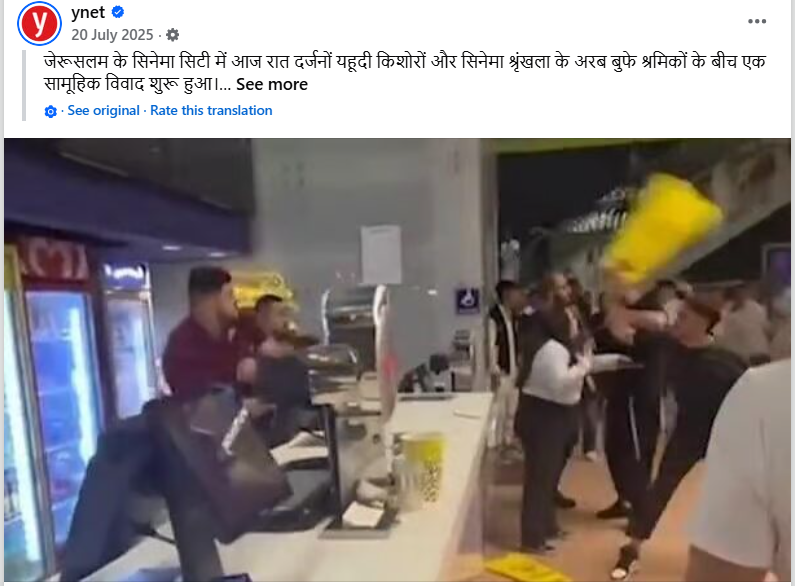
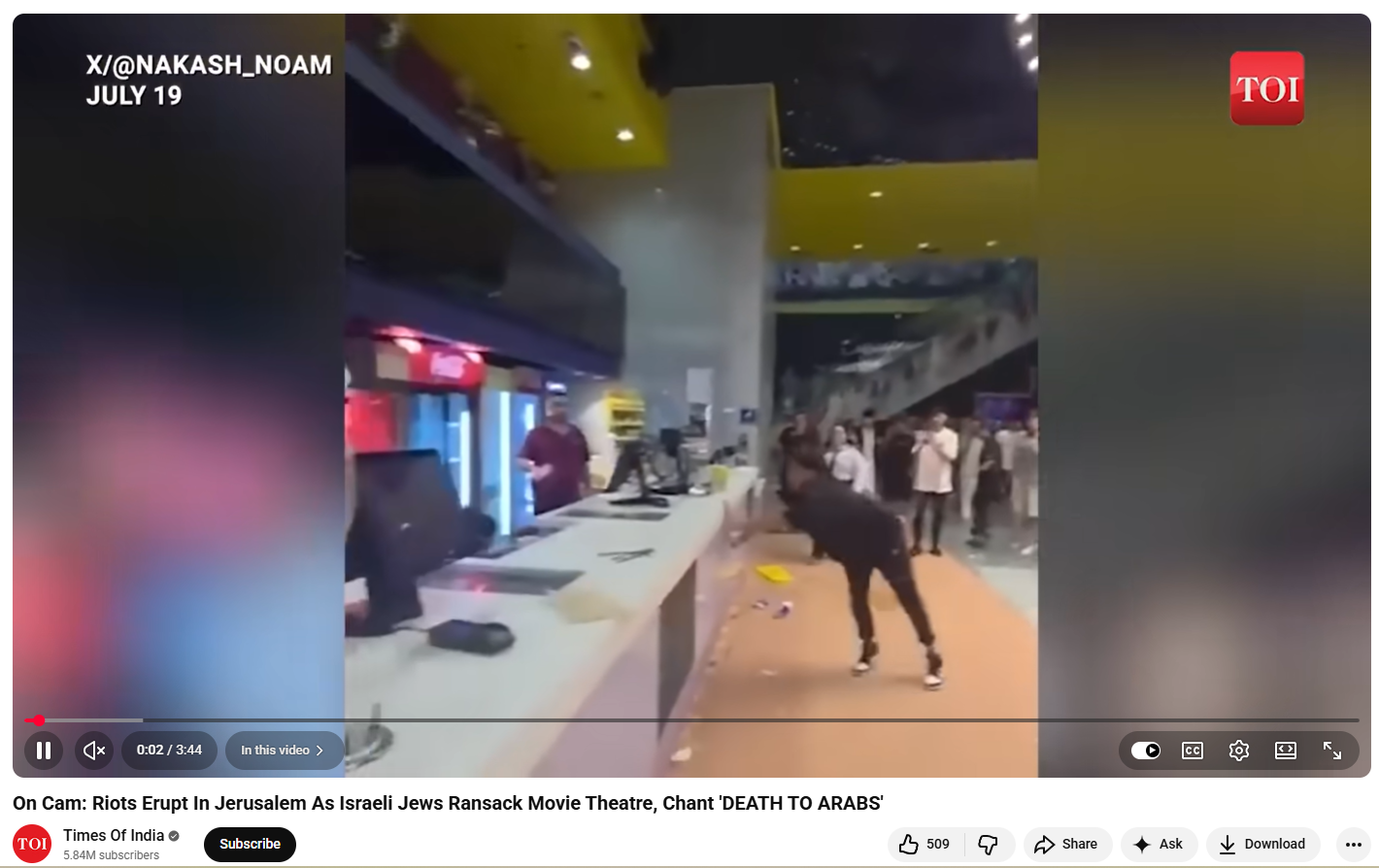
The video carried a caption in Hebrew. Upon translation, it stated that the incident took place at “Cinema City” in Jerusalem, where dozens of Jewish youths clashed with Arab cafeteria workers. The visuals showed youths vandalizing property and throwing objects at staff members, while staff retaliated. Some individuals sustained minor injuries, but no serious harm was reported. We also found the same video on the YouTube channel of The Times of India, published on July 20, 2025. The caption mentioned that anti-Arab riots broke out inside a Cinema City theatre in Jerusalem on July 19, showing youths vandalizing the premises and clashing with Arab employees.
Conclusion:
Our research clearly shows that the viral video is from 2025 and unrelated to any recent Iran-Israel tensions. It is being misleadingly shared as a recent incident from Tel Aviv airport.

Related Blogs

Executive Summary:
The internet is a nest of scams and there's much need to be careful with predatory ideas that prey on the naïve people. Within the recent days, a malicious campaign has emerged falsely alleging 28 day free recharge by courtesy of the Prime Minister Narendra Modi. This blog seeks to analyze the tactics used by this scam in luring the victims and give an overview on how one can identify and keep away from such fraudulent activities.
Claim:
In view of the increasing support for the BJP 2024 election, a rumor has allegedly claimed that the Prime Minister Narendra Modi offering a free recharge with a validity period of up-to twenty eight days at cost of ₹239 to all Indian users. The message encourages the users to click on a given link in order to redeem the free recharge, pointing out that this offer is valid until January 26th of 2024.
The Deceptive Journey:
- Insecure Links:The research begins with a suspicious link (http://offerintro[.]com/BJP2024), without any credibility that honest sites use to protect the user information. We should keep in mind that the links which aren’t secure may easily lead to phishing and other cyber threats.
- Multiple Redirects:When users click the link, they are immediately directed through a series of links. This common tactic used by scammers is designed to hide the true origin of their fraudulent scheme, making it difficult for users' efforts to identify the malicious activity.
- False Promises and Fake Comments:The landing page has a banner of the Prime Minister Narendra Modi that makes it look like this is an official channel and hence authentic. Further, false comments can be also included to compliment the alleged initiative. But remember that genuine government announcements are made through legal channels, not by the shady websites.
- Mobile Number Request:As the next step, the users enter their mobile numbers in the specified field. True initiatives never really need the personal information to pass through unofficial lines. This is actually a trick that scammers use to acquire the important information.
- Share to Activate:Once a user has entered the mobile number, he/she is prompted to share the link with others in order to “activate” promised free recharge. This method is most often used by scammers for spreading their fraudulent message beyond the targeted victim.
- Fake Progress Display:When the users have done their part by sharing the link, a false recharge in progress bar is shown to make them believe that it has started. But the consumers are unwittingly playing a part in the fraud.
- Recharge Completion Pop-up:The last stage of fraud includes a pop-up saying that the recharge is done; leaving users with the false belief that they have benefited from a legitimate government initiative.
What we Analyze :
- It is important to note that at this particular point, there has not been any official declaration or a proper confirmation of an offer made by the Prime Minister or from their government. So, people must be very careful when encountering such messages because they are often employed as lures in phishing attacks or misinformation campaigns. Before engaging or transmitting such claims, it is always advisable to authenticate the information from trustworthy sources in order to protect oneself online and prevent the spread of wrongful information.
- The campaign is hosted on a third party domain instead of any official Government Website, this raised suspicion. Also the domain has been registered in very recent times.

- Domain Name: offerintro[.]com
- Registry Domain ID: 2791466714_DOMAIN_COM-VRSN
- Registrar WHOIS Server: whois.godaddy[.]com
- Registrar URL: https://www.godaddy[.]com
- Registrar: GoDaddy[.]com, LLC
- Registrar IANA ID: 146
- Updated Date: 2023-06-18T20:37:20Z
- Creation Date: 2023-06-18T20:37:20Z
- Registrar Registration Expiration Date: 2024-06-18T20:37:20Z
- Name Server: ANAHI.NS.CLOUDFLARE.COM
- Name Server: GARRETT.NS.CLOUDFLARE.COM
CyberPeace Advisory:
- Stay Informed: Beware of the scams and keep yourself updated through authentic government platforms.
- Verify Website Security: Do not get engaged with any insecure HTTP links but focus on URLs that have secure encryption (HTTPS).
- Protect Personal Information: However, be cautious when sharing personal information – especially in a non-official channel.
- Report Suspicious Activity: If you discover any scams or fraudulent activities, report it and the relevant sites to help avoid others from being defrauded of their hard earned money.
Conclusion:
Summing up, Prime Minister Narendra Modi Free Recharge fraud is an excellent illustration that there is always some danger within cyberspace. The way of the method, from insecure links and also multiple redirects to false promises and really data collection make it clear that internet users should be more careful. The importance of staying up-to-date with what is happening in this new digital world, verifying credibility and also privacy are paramount. By being cautiously aware, the people can keep themselves safe from such fraudulent acts and also play a role in ensuring security even for an online world. Remember that an offer which is in a perfect world should be illegal. Therefore, after doing a thorough research we found this campaign to be fake.
Executive Summary
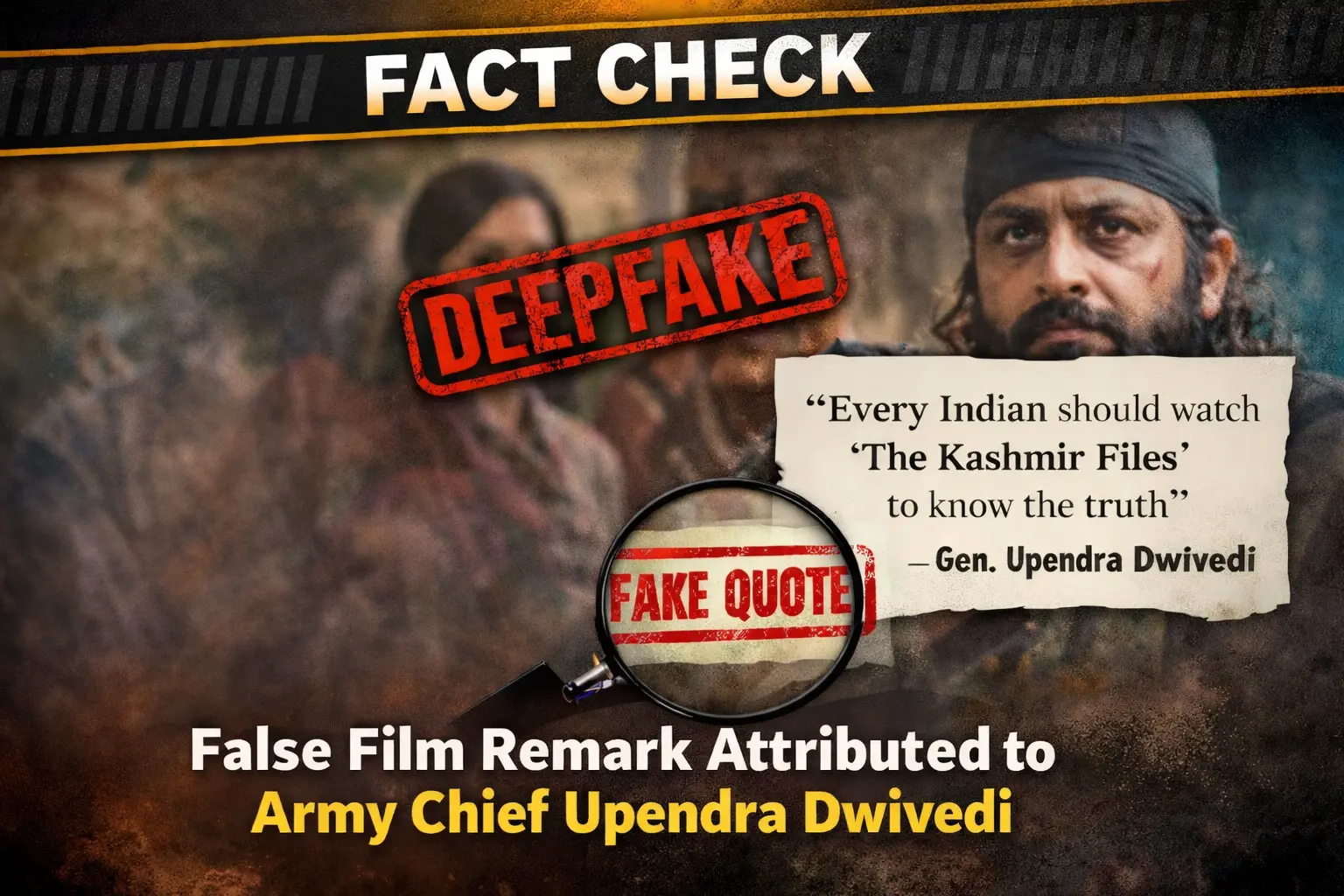
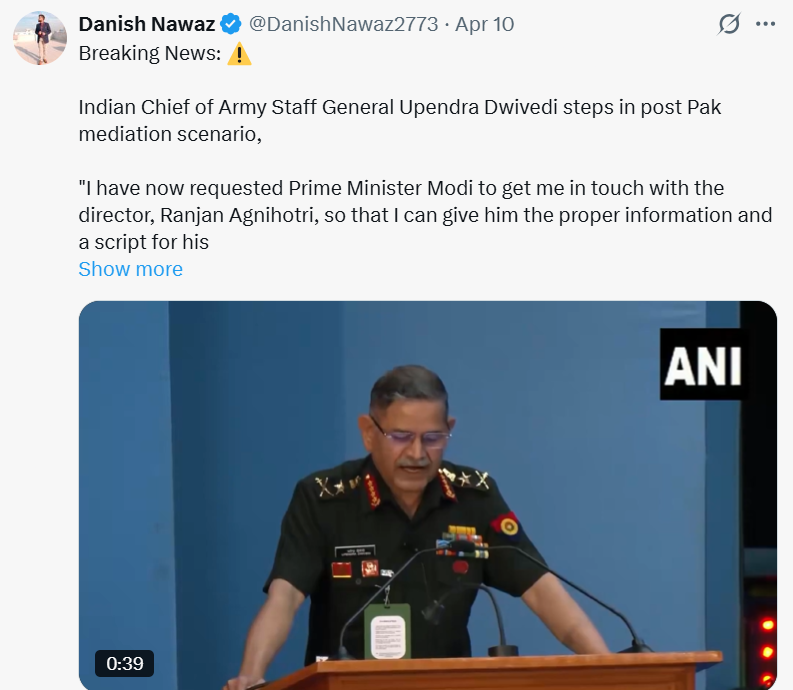
A video circulating on social media, shared by a Pakistani account, claims to show Indian Army Chief General Upendra Dwivedi making a controversial statement. In the clip, he is allegedly heard saying that he requested Prime Minister Narendra Modi to connect him with film director Ranjan Agnihotri so he could provide inputs and a script for a movie on “Operation Sindoor.”
However, research by CyberPeace has found that the viral video is an AI-generated deepfake. General Upendra Dwivedi has made no such statement.
Claim
A Pakistani user shared the viral video on X (formerly Twitter) on April 10, 2026, making the above claim.
Post links:
- https://x.com/DanishNawaz2773/status/2042312967811973225?s=20
- https://archive.ph/kAwoR
Fact Check
To verify the claim, we conducted keyword searches on Google but found no credible media reports supporting it. Further research led us to the original video posted on the X account of ANI. In this authentic clip, General Upendra Dwivedi is seen speaking at the ‘Ran Samwad’ seminar held in Bengaluru.
In the original video, he discusses the operational aspects of “Operation Sindoor,” including ground intelligence, cyber and electronic warfare inputs, Pakistan’s behaviour, and the challenges of a two-front scenario. There is no mention whatsoever of Pakistan mediation, Prime Minister Modi, Ranjan Agnihotri, any movie script, or a film based on Operation Sindoor.
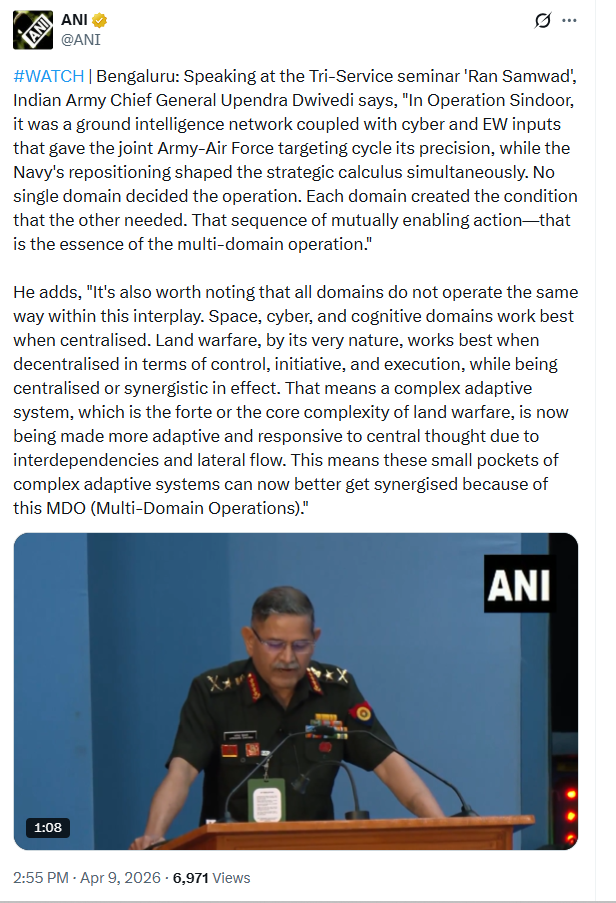
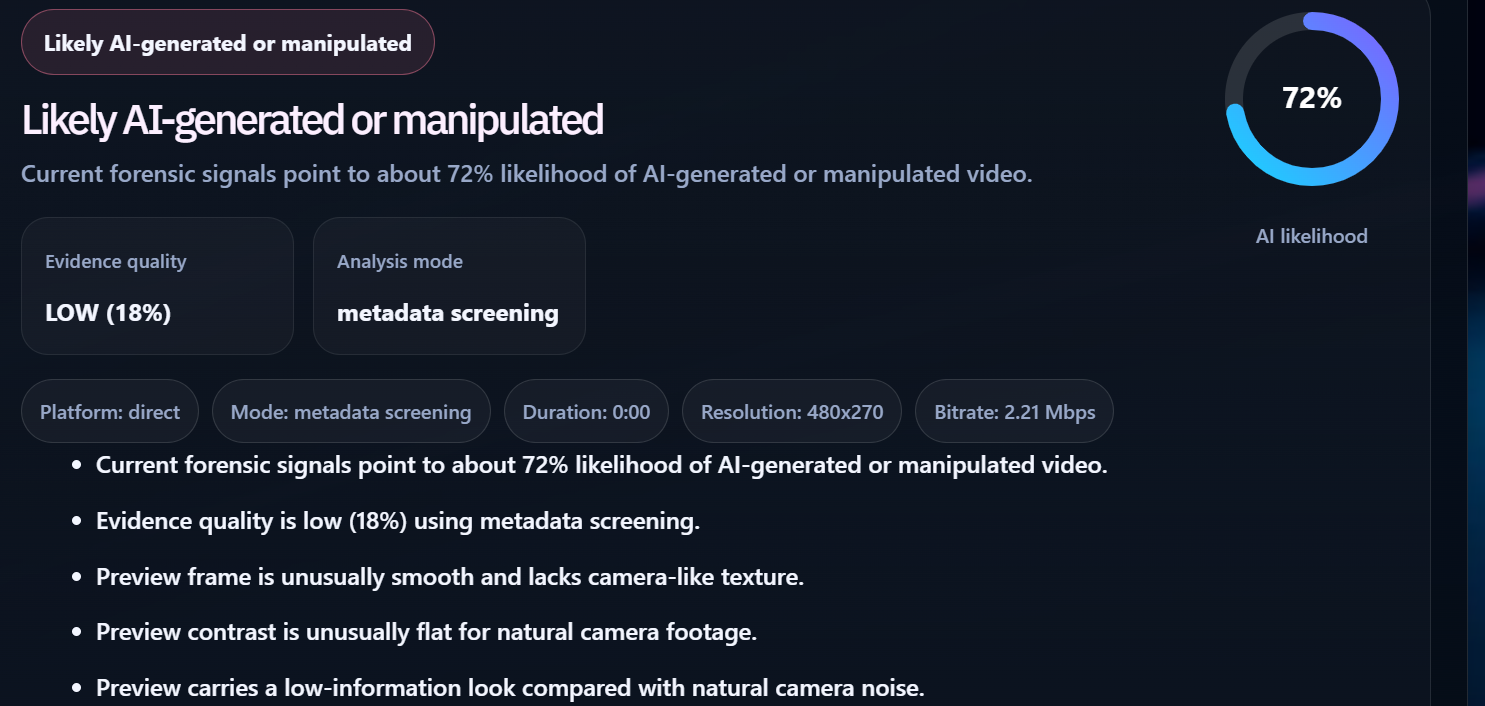
This clearly indicates that the viral clip has been manipulated and taken out of context. The video was further analyzed using the AI detection tool DetectVideo AI, which indicated a 72% probability that the content is AI-generated. This strongly supports the conclusion that the video is a deepfake.
Conclusion
The viral claim is false. The video featuring General Upendra Dwivedi has been digitally altered using AI techniques to insert fabricated statements. The original footage is from the ‘Ran Samwad’ seminar in Bengaluru, where he spoke about military strategy and multi-domain operations, not about any film or director. There is no evidence to suggest that he made any statement regarding contacting a filmmaker or contributing to a movie script. The inclusion of such references in the viral clip is entirely fabricated. This case highlights how AI-generated deepfakes are increasingly being used to spread misinformation, especially in sensitive contexts involving the military and international relations. Viewers are advised to rely on verified sources and exercise caution before sharing such content.
.webp)
Introduction
In July 2025, the Digital Defence Report prepared by Microsoft raised an alarm that India is part of the top target countries in AI-powered nation-state cyberattacks with malicious agents automating phishing, creating convincing deepfakes, and influencing opinion with the help of generative AI (Microsoft Digital Defence Report, 2025). Most of the attention in the world has continued to be on the United States and Europe, but Asia-Pacific and especially India have become a major target in terms of AI-based cyber activities. This blog discusses the role of AI in espionage, redefining the threat environment of India, the reaction of the government, and what India can learn by looking at the example of cyber giants worldwide.
Understanding AI-Powered Cyber Espionage
Conventional cyber-espionage intends to hack systems, steal information or bring down networks. With the emergence of generative AI, these strategies have changed completely. It is now possible to automate reconnaissance, create fake voices and videos of authorities and create highly advanced phishing campaigns which can pass off as genuine even to a trained expert. According to the report made by Microsoft, AI is being used by state-sponsored groups to expand their activities and increase accuracy in victims (Microsoft Digital Defence Report, 2025). Based on SQ Magazine, almost 42 percent of state-based cyber campaigns in 2025 had AIs like adaptive malware or intelligent vulnerability scanners (SQ Magazine, 2025).
AI is altering the power dynamic of cyberspace. The tools previously needing significant technical expertise or substantial investments have become ubiquitous, and smaller countries can conduct sophisticated cyber operations as well as non-state actors. The outcome is the speeding up of the arms race with AI serving as the weapon and the armour.
India’s Exposure and Response
The weakness of the threat landscape lies in the growing online infrastructure and geopolitical location. The attack surface has expanded the magnitude of hundreds of millions of citizens with the integration of platforms like DigiLocker and CoWIN. Financial institutions, government portals and defence networks are increasingly becoming targets of cyber attacks that are more sophisticated. Faking videos of prominent figures, phishing letters with the official templates, and manipulation of the social media are currently all being a part of disinformation campaigns (Microsoft Digital Defence Report, 2025).
According to the Data Security Council of India (DSCI), the India Cyber Threat Report 2025 reported that attacks using AI are growing exponentially, particularly in the shape of malicious behaviour and social engineering (DSCI, 2025). The nodal cyber-response agency of India, CERT-In, has made several warnings regarding scams related to AI and AI-generated fake content that is aimed at stealing personal information or deceiving the population. Meanwhile, enforcement and red-teaming actions have been intensified, but the communication between central agencies and state police and the private platforms is not even. There is also an acute shortage of cybersecurity talents in India, as less than 20 percent of cyber defence jobs are occupied by qualified specialists (DSCI, 2025).
Government and Policy Evolution
The government response to AI-enabled threats is taking three forms, namely regulation, institutional enhancing, and capacity building. The Digital Personal Data Protection Act 2023 saw a major move in defining digital responsibility (Government of India, 2023). Nonetheless, threats that involve AI-specific issues like data poisoning, model manipulation, or automated disinformation remain grey areas. The following National Cybersecurity Strategy will attempt to remedy them by establishing AI-government guidelines and responsibility standards to major sectors.
At the institutional level, the efforts of such organisations as the National Critical Information Infrastructure Protection Centre (NCIIPC) and the Defence Cyber Agency are also being incorporated into their processes with the help of AI-based monitoring. There is also an emerging public-private initiative. As an example, the CyberPeace Foundation and national universities have signed a memorandum of understanding that currently facilitates the specialised training in AI-driven threat analysis and digital forensics (Times of India, August 2025). Even after these positive indications, India does not have any cohesive system of reporting cases of AI. The publication on arXiv in September 2025 underlines the importance of the fact that legal approaches to AI-failure reporting need to be developed by countries to approach AI-initiated failures in such fields as national security with accountability (arXiv, 2025).
Global Implications and Lessons for India
Major economies all over the world are increasing rapidly to integrate AI innovation with cybersecurity preparedness. The United States and United Kingdom are spending big on AI-enhanced military systems, performing machine learning in security operations hubs and organising AI-based “red team” exercises (Microsoft Digital Defence Report, 2025). Japan is testing cross-ministry threat-sharing platforms that utilise AI analytics and real-time decision-making (Microsoft Digital Defence Report, 2025).
Four lessons can be distinguished as far as India is concerned.
- To begin with, the cyber defence should shift to proactive intelligence in place of reactive investigation. It is not only possible to detect the adversary behaviour after the attacks, but to simulate them in advance using AI.
- Second, teamwork is essential. The issue of cybersecurity cannot be entrusted to government enforcement. The private sector that maintains the majority of the digital infrastructure in India must be actively involved in providing information and knowledge.
- Third, there is the issue of AI sovereignty. Building or hosting its own defensive AI tools in India will diminish dependence on foreign vendors, and minimise the possible vulnerabilities of the supply-chain.
- Lastly, the initial defence is digital literacy. The citizens should be trained on how to detect deepfakes, phishing, and other manipulated information. The importance of creating human awareness cannot be underestimated as much as technical defences (SQ Magazine, 2025).
Conclusion
AI has altered the reasoning behind cyber warfare. There are quicker attacks, more difficult to trace and scalable as never before. In the case of India, it is no longer about developing better firewalls but rather the ability to develop anticipatory intelligence to counter AI-powered threats. This requires a national policy that incorporates technology, policy and education.
India can transform its vulnerability to strength with the sustained investment, ethical AI governance, and healthy cooperation between the government and the business sector. The following step in cybersecurity does not concern who possesses more firewalls than the other but aims to learn and adjust more quickly and successfully in a world where machines already belong to the battlefield (Microsoft Digital Defence Report, 2025).
References:
- Microsoft Digital Defense Report 2025
- India Cyber Threat Report 2025, DSCI
- Lucknow based organisations to help strengthen cybercrime research training policy ecosystem
- AI Cyber Attacks Statistics 2025: How Attacks, Deepfakes & Ransomware Have Escalated, SQ Magazine
- Incorporating AI Incident Reporting into Telecommunications Law and Policy: Insights from India.
- The Digital Personal Data Protection Act, 2023
