
#FactCheck-Old China Skyscraper Fire Video Falsely Shared as Attack on Iran’s IRGC Headquarters
Executive Summary
A video showing a massive fire in a high-rise building is being widely shared on social media. The footage shows a tall building engulfed in flames with thick smoke rising from it. Users are circulating the video with multiple claims. Some social media users claim that the video is from Tehran, Iran, where Israel allegedly carried out an attack on the headquarters of the Islamic Revolutionary Guard Corps (IRGC). Others are sharing the same video as an alleged strike by the United States Air Force on the IRGC headquarters. CyberPeace Research Wing’s research found the claim to be misleading. The video is not related to any Israeli or U.S. military strike on Iran’s IRGC. In reality, it shows a massive fire that broke out in a skyscraper in Changsha, China, in 2022.
Claim
On Facebook, a user shared the viral video on 3 July 2026, claiming: “Israel has carried out a massive attack on IRGC headquarters in Tehran, Iran. The headquarters has been destroyed in the strike.” The post link, archive link, and screenshots are provided below.
https://archive.ph/7BknH
https://www.facebook.com/watch/?v=1530020795436530

Fact Check
During verification, we extracted keyframes from the viral video and performed a reverse image search using Google Lens. The research led us to the same footage uploaded on the official YouTube channel of Hindustan Times on 16 September 2022. According to the video description, the incident shows a massive fire at a high-rise building in Changsha, China, not any military strike in Iran.
https://www.youtube.com/watch?v=Cphle9wkjCE
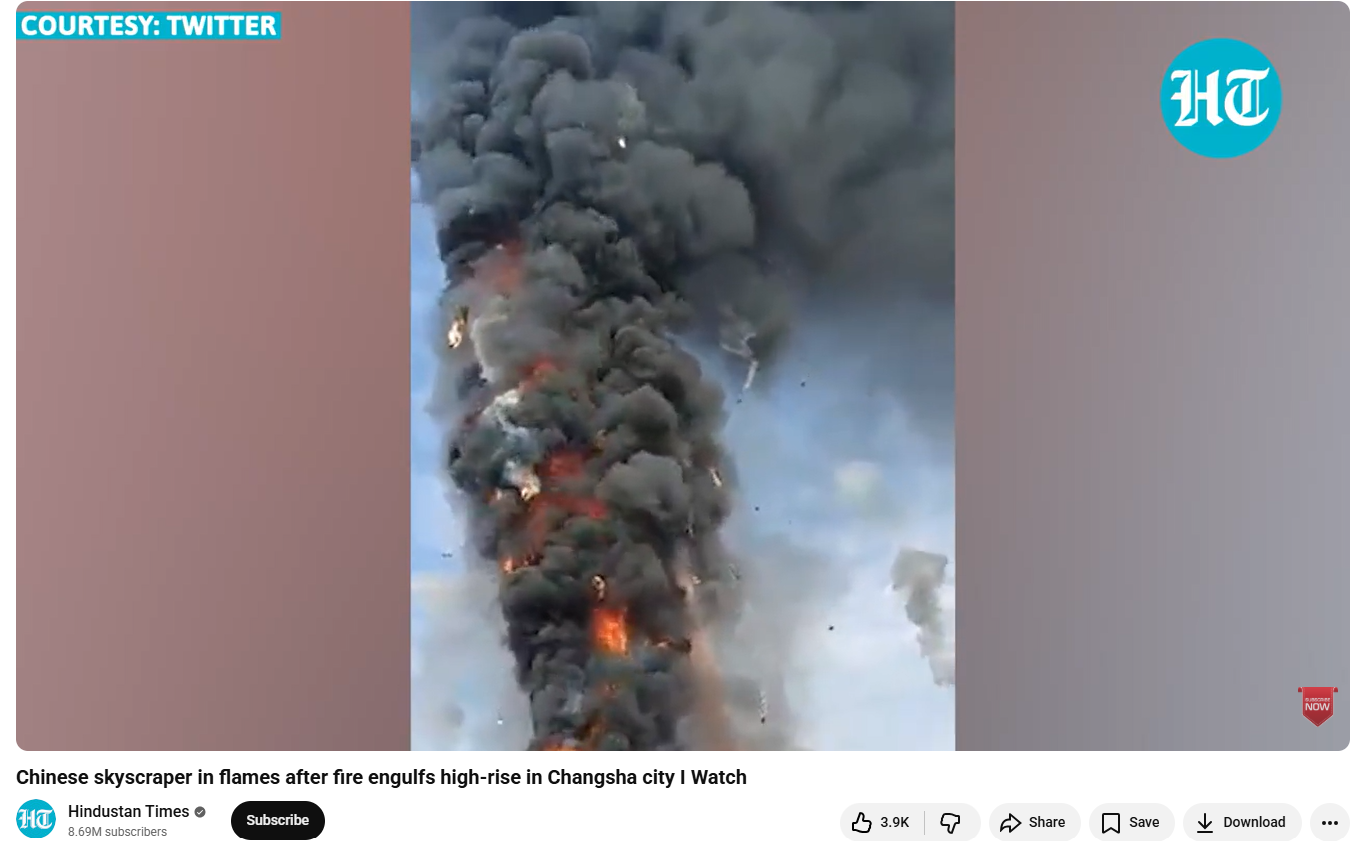
The video description states that the incident took place in a 42-storey building in Changsha, which housed the offices of the state-owned telecommunications company China Telecom. Authorities had initially confirmed that no casualties were reported. Further research led us to a report published on The Guardian website three years ago, which also contained visuals matching the viral footage.
https://www.theguardian.com/world/2022/sep/16/major-fire-breaks-out-at-skyscraper-in-changsha-china
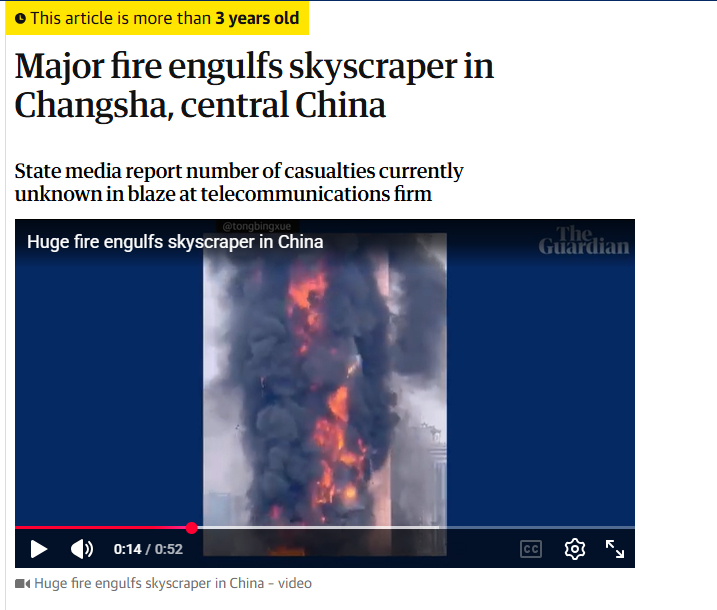
According to The Guardian report, the 42-storey, 218-metre-high building was constructed in 2000 and is located near a major ring road. The report also confirmed that there were no reported fatalities in the incident.
Conclusion
The research clearly found that the viral video does not show an Israeli or U.S. attack on Iran’s IRGC headquarters. The footage is from a massive fire that broke out in a skyscraper in Changsha, China, in 2022. Therefore, the claim being circulated on social media is false and misleading.

Related Blogs

Introduction
The Ministry of Electronics and Information Technology (MeitY) issued an advisory on March 1 2024, urging platforms to prevent bias, discrimination, and threats to electoral integrity by using AI, generative AI, LLMs, or other algorithms. The advisory requires that AI models deemed unreliable or under-tested in India must obtain explicit government permission before deployment. While leveraging Artificial Intelligence models, Generative AI, software, or algorithms in their computer resources, Intermediaries and platforms need to ensure that they prevent bias, discrimination, and threats to electoral integrity. As Intermediaries are required to follow due diligence obligations outlined under “Information Technology (Intermediary Guidelines and Digital Media Ethics Code)Rules, 2021, updated as of 06.04.2023”. This advisory is issued to urge the intermediaries to abide by the IT rules and regulations and compliance therein.
Key Highlights of the Advisories
- Intermediaries and platforms must ensure that users of Artificial Intelligence models/LLM/Generative AI, software, or algorithms do not allow users to host, display, upload, modify, publish, transmit, store, update, or share unlawful content, as per Rule 3(1)(b) of the IT Rules.
- The government emphasises intermediaries and platforms to prevent bias or discrimination in their use of Artificial Intelligence models, LLMs, and Generative AI, software, or algorithms, ensuring they do not threaten the integrity of the electoral process.
- The government requires explicit permission to use deemed under-testing or unreliable AI models, LLMs, or algorithms on the Indian internet. Further, it must be deployed with proper labelling of potential fallibility or unreliability. Further, users can be informed through a consent popup mechanism.
- The advisory specifies that all users should be well informed about the consequences of dealing with unlawful information on platforms, including disabling access, removing non-compliant information, suspension or termination of access or usage rights of the user to their user account and imposing punishment under applicable law. It entails that users are clearly informed, through terms of services and user agreements, about the consequences of engaging with unlawful information on the platform.
- The advisory also indicates measures advocating to combat deepfakes or misinformation. The advisory necessitates identifying synthetically created content across various formats, advising platforms to employ labels, unique identifiers, or metadata to ensure transparency. Furthermore, the advisory mandates the disclosure of software details and tracing the first originator of such synthetically created content.
Rajeev Chandrasekhar, Union Minister of State for IT, specified that
“Advisory is aimed at the Significant platforms, and permission seeking from Meity is only for large platforms and will not apply to startups. Advisory is aimed at untested AI platforms from deploying on the Indian Internet. Process of seeking permission , labelling & consent based disclosure to user about untested platforms is insurance policy to platforms who can otherwise be sued by consumers. Safety & Trust of India's Internet is a shared and common goal for Govt, users and Platforms.”
Conclusion
MeitY's advisory sets the stage for a more regulated Al landscape. The Indian government requires explicit permission for the deployment of under-testing or unreliable Artificial Intelligence models on the Indian Internet. Alongside intermediaries, the advisory also applies to digital platforms that incorporate Al elements. Advisory is aimed at significant platforms and will not apply to startups. This move safeguards users and fosters innovation by promoting responsible AI practices, paving the way for a more secure and inclusive digital environment.
References
- https://regmedia.co.uk/2024/03/04/meity_ai_advisory_1_march.pdf
- https://economictimes.indiatimes.com/tech/technology/govts-ai-advisory-will-not-apply-to-startups-mos-it-rajeev-chandrasekhar/articleshow/108197797.cms?from=mdr
- https://www.meity.gov.in/writereaddata/files/Advisory%2015March%202024.pdf

Executive Summary
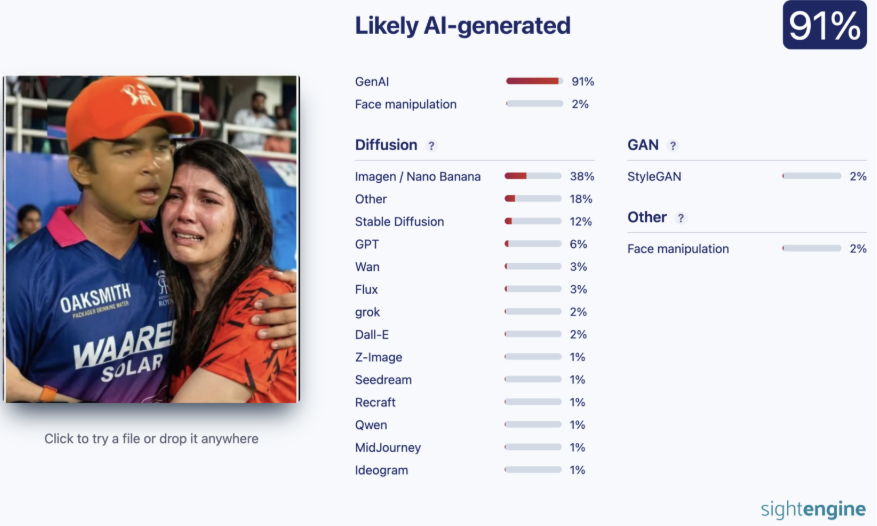
A picture allegedly showing Sunrisers Hyderabad (SRH) owner Kavya Maran emotionally hugging young cricketer Vaibhav Suryavanshi has gone viral on social media. The image is being shared as a genuine photograph from a cricket-related event, with users claiming that Kavya Maran was seen embracing Vaibhav Suryavanshi. However, CyberPeace Research Wing research found the claim to be false. No credible news reports, official statements, or authentic photographs support the incident depicted in the viral image.
Claim
A Facebook user shared the viral image with the caption: “Kavya Maran Hug Vaibhav Suryavanshi 🥰🔥 #cricketnews #RRvsSRH” The link to the post and its screenshot are provided below.

Fact Check
During the research, we found no credible news reports, official statements, or authentic images confirming that Kavya Maran hugged Vaibhav Suryavanshi as shown in the viral picture. To further verify the image, it was analysed using AI detection tools, including Sightengine and Hive Moderation. Both tools indicated a high probability that the image was generated using Artificial Intelligence. The findings suggest that the viral photograph is not a genuine image captured at a real event but a digitally created visual.

Conclusion
Our research found that the viral image showing Kavya Maran emotionally hugging Vaibhav Suryavanshi is not authentic. The picture was generated using AI and does not depict a real incident.
Introduction
China is on the verge of unveiling a new policy that will address how Artificial Intelligence (AI) influences employment. On January 27, 2026, the Ministry of Human Resources and Social Security (MOHRSS) announced it would publish a paper on the contribution of AI to the labour and employment markets. The policy will include provisions to help impacted industries, expand assistance to young workers and graduates, and come up with interdisciplinary training programmes to equip individuals with jobs in an AI-enabled economy. The authorities have stressed that AI does not kill jobs but changes them, and education will be needed to assist employees in adjusting to the changes.
This announcement reflects a more proactive policy on AI-based changes in labour, showing that China intends to sustain economic modernisation through AI, as well as social stability. It also depicts wider international issues concerning the rate of automation and the necessity of considering labour and training policy.
AI and the Changing Nature of Work
AI is transforming work content and nature in industries. AI systems enhance the productivity of various functions, including data processing, logistics, and customer service, although they alter the nature of tasks carried out by humans. Extant studies indicate that although AI can automate routine activities, new occupations that require complex thinking, management of artificial intelligence, and skills related to people, including empathy, creativity, and problem-solving, may be generated.
This is the key nuance in the policy framing of China. Authorities point out that AI does not always result in massive unemployment. Instead, it transforms jobs and necessitates workers to change to new task profiles. This perspective is in line with the recent reports of the world research organisations, which predict the effects of AI as transformational and not necessarily destructive. As an example, the World Economic Forum Future Jobs Report 2023 observes that the change in technology will introduce new jobs that were not there 10 years ago, and retraining and upskilling will be instrumental in accessing those opportunities.
Key Components of China’s Policy Response
China’s forthcoming policy is expected to focus on three main areas that address both current workforce needs and future readiness.
Support for Key Industries
The policy will offer targeted assistance to sectors where artificial intelligence is gaining pace. Industries like advanced manufacturing, high-tech services, and online logistics will also get specialised assistance to assist companies in using AI to complement human labour and not just to replace it. The Chinese government tries to balance industrial upgrading with employment by channelling resources to the growth areas.
Assistance for Youth and Graduates
The youth and the recent graduates are entering a labour market that is changing rapidly. The policy aims to increase the support services to this population by career counselling, internships, and training programmes correlated with changing employer demands. According to a study by McKinsey Global Institute, the young workforce all over the globe can face disproportionate disruption in case the prospects of training are scarce, making initial career backing imperative.
Interdisciplinary Talent Development
The Chinese strategy focuses on interdisciplinary training that blends knowledge of domains and AI literacy and digital illiteracy. This is indicative of the realisation that hybrid skills are required in the future. The Organisation for Economic Cooperation and Development suggests that workers who can make it through the technical and non-technical elements of work will stand a better chance of winning in the AI age.
These components show that China’s strategy is not simply to protect existing jobs but to help workers transition to roles that leverage AI’s strengths.
Economy, Stability and Strategic Modernisation
The policy is an attempt to control technological transition as part of wider economic planning. It is an indication that the government regards AI as a structural change rather than an external shock that can be predicted and influenced by policy.
This is in contrast to some other reactions to labour markets in other countries, where the reactionary approach has been seen as a reaction to the job losses that have already become reality. The initiative by China implies that there should be a change in the manner in which one can expect change instead of reacting to change.
Global Comparisons and Shared Challenges
Governments worldwide are testing the options to adapt to the work effects of AI. The European Union is considering the individual learning account and portable training benefits, which would assist workers to gain access to reskilling opportunities in the course of their careers. In the US, there is a concerted effort by the public-private partnerships to match the development of the workforce with technological implementation.
The strategy of China has some of these components, but it stands out due to its incorporation with national planning processes. China wants the adoption of AI to help it achieve the common good and not division by connecting the workforce policy to the overall innovation and economic purpose.
Meanwhile, the issue of balancing the supply of labour with the demand of technology is a challenge of its own to countries with older populations and relatively smaller working forces. The timing and design of policy are particularly significant in China, as there is a large labour force and continuous changes in demography.
Practical Challenges and Risks
The success of China’s emerging policy will depend on effective implementation. Several practical issues will require careful attention:
Ensuring Equitable Access to Training
The labour force in China is diversified, and it goes through technology zones in cities and other rural areas. It will be paramount to make sure that the opportunity of upskilling is extended to all workers across the spectrum to prevent the further worsening of regional inequalities. Research conducted on reskilling across the globe shows that rural and low-income groups tend to lack access to training, despite the availability of programmes.
Aligning Training with Labour Demand
The programme of upskilling should be related to the market requirements. Disconnected training is prone to resulting in the production of skills that are obsolete or not applicable in actual work settings. Experience in emerging economies indicates that the involvement of employers in the training design enhances placement success on the part of the learner.
Private Sector Participation
The policy needs to be translated into employment outcomes with the help of private companies. Incentives to make firms invest in worker training, internships, and apprenticeships will enable workers to shift to AI-augmented jobs with ease.
A Model for AI Workforce Policy
The Chinese policy can serve as an example for other countries that want to balance technological advancement and labour market security. It acknowledges the fact that the effect of AI on employment is not only a technical or an economic problem but also a social challenge. Through foregrounding training, support, and coordinated action, China aims to create a future where people are ready to change and not lose their jobs to this change.
This strategy can be agreed with the suggestions of international organisations like the World Bank and the OECD, which insist on the idea of lifelong learning and flexibility of labour markets, as well as proactive investment in human capital as the main aspects of the labour policy in the future.
Conclusion
Artificial intelligence will continue to reshape work around the world. China’s forthcoming policy, which emphasises support, training and strategic integration of AI into labour markets, reflects a proactive and holistic view of technological transition. Other countries could benefit from studying this approach, especially in terms of linking workforce development with innovation goals.
By anticipating disruption and investing in people as well as technology, policymakers can help ensure that AI becomes a driver of shared economic opportunity rather than a source of exclusion. The balance between innovation and employment will shape not only economic outcomes but also social cohesion in the years ahead.
References
