
#FactCheck: AI-Generated Video Falsely Claims MEA Spokesperson Randhir Jaiswal Was Questioned Over Eating Nuts During BRICS Summit
Executive Summary
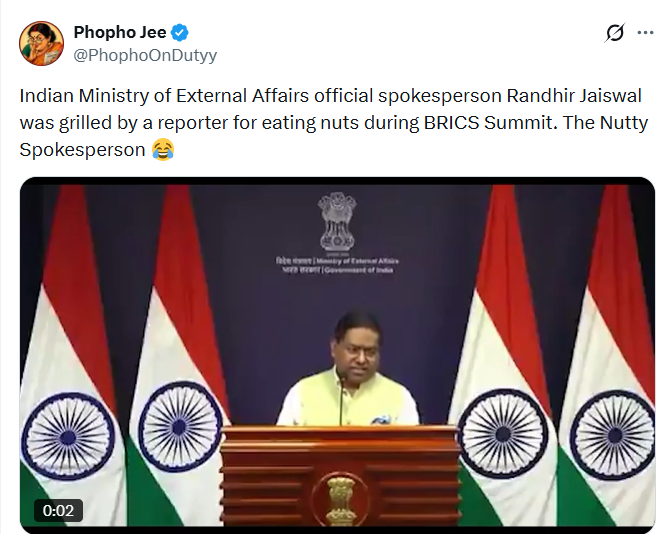
A video is being shared on social media with the claim that Ministry of External Affairs spokesperson Randhir Jaiswal was seen eating nuts during the BRICS Summit. The post claims that a reporter questioned him about eating nuts during the event. The video is also being shared with the sarcastic caption, “The Nutty Spokesperson.” Through the post, an attempt is being made to suggest that a reporter questioned Randhir Jaiswal about eating nuts during a press briefing. CyberPeace Research found that in the original video, Ministry of External Affairs spokesperson Randhir Jaiswal was responding to a question about Pakistan’s announcement of a 7 million Pakistani rupee bounty on Jaish-e-Mohammed chief Masood Azhar. Jaiswal addressed the announcement during the regular media briefing held on September 15, 2026. In his response, Jaiswal said that such announcements by Pakistan were not new and that the country should take concrete action against terrorism. However, the video being circulated on social media has been digitally edited using the original footage to falsely suggest that a reporter had questioned Jaiswal about eating nuts.
Claim:
During the BRICS Summit, a reporter questioned Ministry of External Affairs spokesperson Randhir Jaiswal about eating nuts and confronted him over it.
https://x.com/PhophoOnDutyy/status/2099940769876640084?s=20
Fact Check
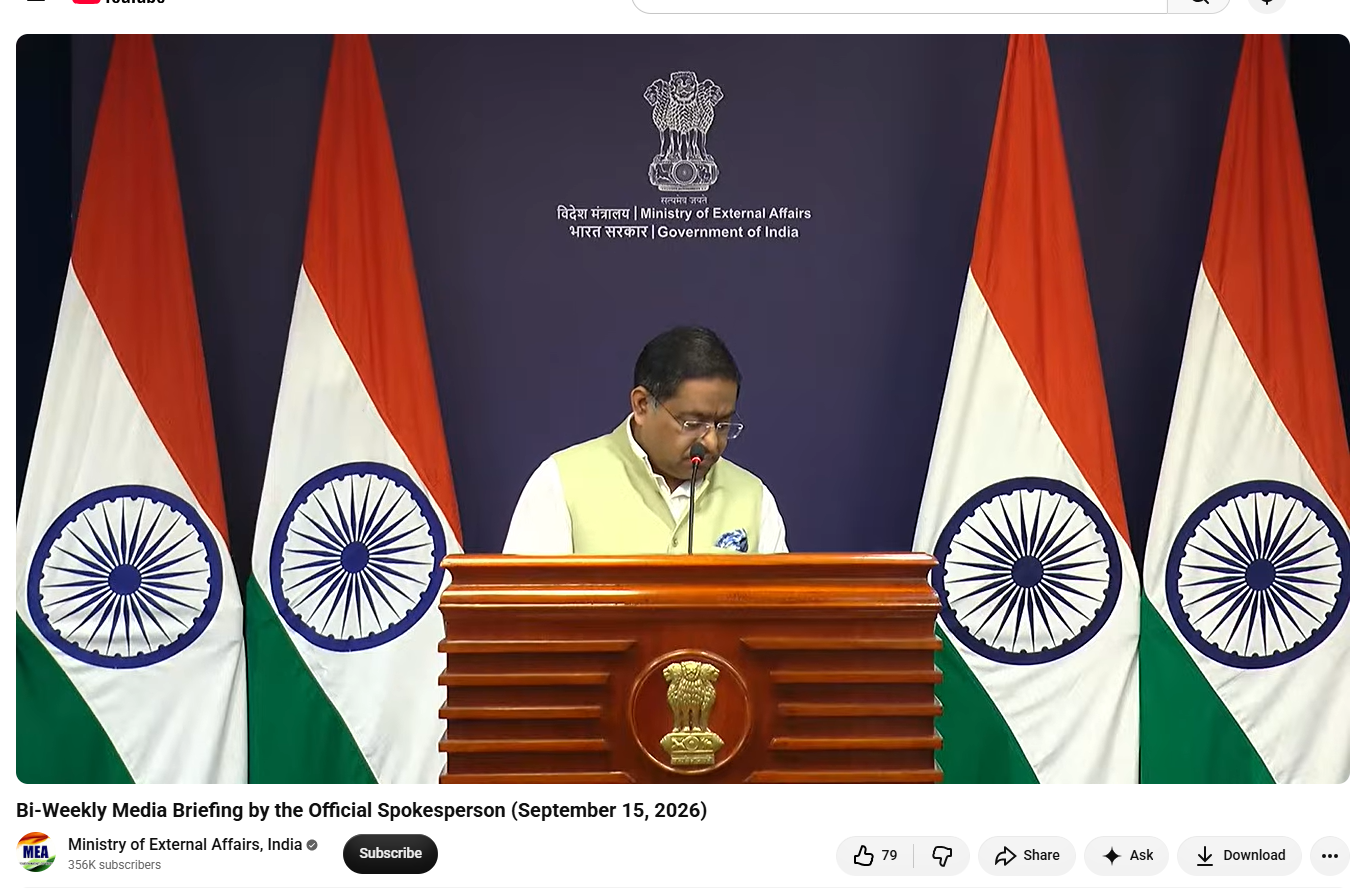
To verify the claim, we conducted a Google search using relevant keywords. During the search, we did not find any credible media report supporting the claim.As part of our research, we conducted a reverse image search of keyframes from the video. We found the original video on the YouTube channel of the Ministry of External Affairs, India. In the original video, Randhir Jaiswal was responding to a question about Pakistan’s announcement of a 7 million Pakistani rupee bounty on Masood Azhar.The reporter does not question Jaiswal about eating nuts anywhere in the original video. This establishes that the original footage has been edited and presented with a false context. Therefore, the claim being circulated on social media is false.
https://www.youtube.com/live/dw-qqLolRgc
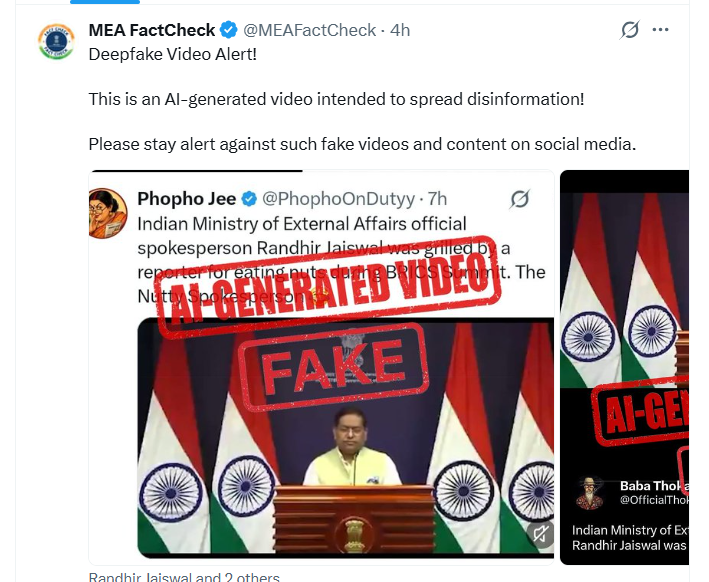
As part of our further research, we checked the official X account of MEA FactCheck. It also identified the video as AI-generated.
https://x.com/MEAFactCheck/status/2100076244805255501?s=20
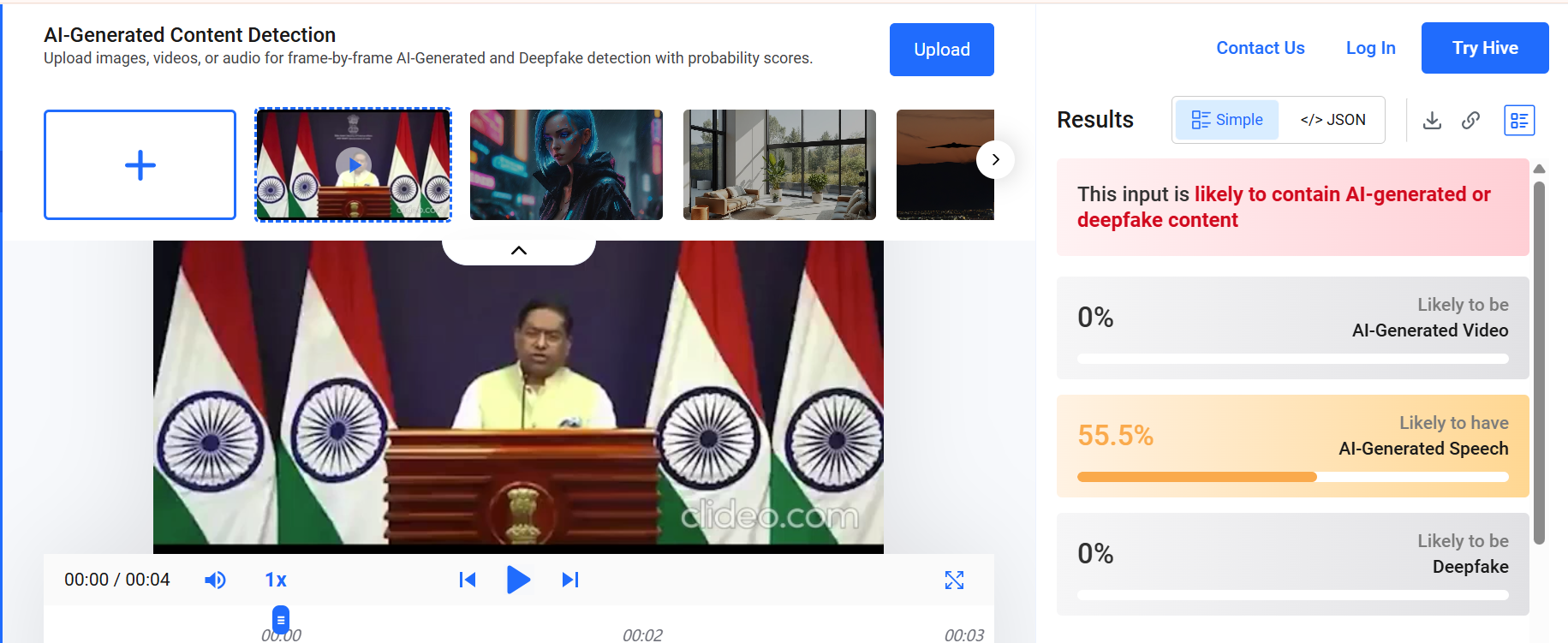
The video was scanned using the AI detection tool Hive Moderation. According to the results, the video has a 55% probability of being AI-generated.
Conclusion
Our research found that the video being shared on social media is fake and edited. In the original video, Ministry of External Affairs spokesperson Randhir Jaiswal was responding to a question about Pakistan’s announcement of a 7 million Pakistani rupee bounty on Masood Azhar.At no point in the original video does the reporter question Jaiswal about eating nuts.
The footage being circulated has been digitally manipulated and presented in a different context. The official X account of MEA FactCheck also identified the video as AI-generated. Therefore, the claim that Jaiswal was questioned by a reporter about eating nuts is false and misleading.

Related Blogs

Introduction
The G7 nations, a group of the most powerful economies, have recently turned their attention to the critical issue of cybercrimes and (AI) Artificial Intelligence. G7 summit has provided an essential platform for discussing the threats and crimes occurring from AI and lack of cybersecurity. These nations have united to share their expertise, resources, diplomatic efforts and strategies to fight against cybercrimes. In this blog, we shall investigate the recent development and initiatives undertaken by G7 nations, exploring their joint efforts to combat cybercrime and navigate the evolving landscape of artificial intelligence. We shall also explore the new and emerging trends in cybersecurity, providing insights into ongoing challenges and innovative approaches adopted by the G7 nations and the wider international community.
G7 Nations and AI
Each of these nations have launched cooperative efforts and measures to combat cybercrime successfully. They intend to increase their collective capacities in detecting, preventing, and responding to cyber assaults by exchanging intelligence, best practices, and experience. G7 nations are attempting to develop a strong cybersecurity architecture capable of countering increasingly complex cyber-attacks through information-sharing platforms, collaborative training programs, and joint exercises.
The G7 Summit provided an important forum for in-depth debates on the role of artificial intelligence (AI) in cybersecurity. Recognising AI’s transformational potential, the G7 nations have participated in extensive discussions to investigate its advantages and address the related concerns, guaranteeing responsible research and use. The nation also recognises the ethical, legal, and security considerations of deploying AI cybersecurity.
Worldwide Rise of Ransomware
High-profile ransomware attacks have drawn global attention, emphasising the need to combat this expanding threat. These attacks have harmed organisations of all sizes and industries, leading to data breaches, operational outages, and, in some circumstances, the loss of sensitive information. The implications of such assaults go beyond financial loss, frequently resulting in reputational harm, legal penalties, and service delays that affect consumers, clients, and the public. The increase in high-profile ransomware incidents has garnered attention worldwide, Cybercriminals have adopted a multi-faceted approach to ransomware attacks, combining techniques such as phishing, exploit kits, and supply chain Using spear-phishing, exploit kits, and supply chain hacks to obtain unauthorised access to networks and spread the ransomware. This degree of expertise and flexibility presents a substantial challenge to organisations attempting to protect against such attacks.

Focusing On AI and Upcoming Threats
During the G7 summit, one of the key topics for discussion on the role of AI (Artificial Intelligence) in shaping the future, Leaders and policymakers discuss the benefits and dangers of AI adoption in cybersecurity. Recognising AI’s revolutionary capacity, they investigate its potential to improve defence capabilities, predict future threats, and secure vital infrastructure. Furthermore, the G7 countries emphasise the necessity of international collaboration in reaping the advantages of AI while reducing the hazards. They recognise that cyber dangers transcend national borders and must be combated together. Collaboration in areas such as exchanging threat intelligence, developing shared standards, and promoting best practices is emphasised to boost global cybersecurity defences. The G7 conference hopes to set a global agenda that encourages responsible AI research and deployment by emphasising the role of AI in cybersecurity. The summit’s sessions present a path for maximising AI’s promise while tackling the problems and dangers connected with its implementation.
As the G7 countries traverse the complicated convergence of AI and cybersecurity, their emphasis on collaboration, responsible practices, and innovation lays the groundwork for international collaboration in confronting growing cyber threats. The G7 countries aspire to establish robust and secure digital environments that defend essential infrastructure, protect individuals’ privacy, and encourage trust in the digital sphere by collaboratively leveraging the potential of AI.
Promoting Responsible Al development and usage
The G7 conference will focus on developing frameworks that encourage ethical AI development. This includes fostering openness, accountability, and justice in AI systems. The emphasis is on eliminating biases in data and algorithms and ensuring that AI technologies are inclusive and do not perpetuate or magnify existing societal imbalances.
Furthermore, the G7 nations recognise the necessity of privacy protection in the context of AI. Because AI systems frequently rely on massive volumes of personal data, summit speakers emphasise the importance of stringent data privacy legislation and protections. Discussions centre around finding the correct balance between using data for AI innovation, respecting individuals’ privacy rights, and protecting data security. In addition to responsible development, the G7 meeting emphasises the importance of responsible AI use. Leaders emphasise the importance of transparent and responsible AI governance frameworks, which may include regulatory measures and standards to ensure AI technology’s ethical and legal application. The goal is to defend individuals’ rights, limit the potential exploitation of AI, and retain public trust in AI-driven solutions.
The G7 nations support collaboration among governments, businesses, academia, and civil society to foster responsible AI development and use. They stress the significance of sharing best practices, exchanging information, and developing international standards to promote ethical AI concepts and responsible practices across boundaries. The G7 nations hope to build the global AI environment in a way that prioritises human values, protects individual rights, and develops trust in AI technology by fostering responsible AI development and usage. They work together to guarantee that AI is a force for a good while reducing risks and resolving social issues related to its implementation.
Challenges on the way
During the summit, the nations, while the G7 countries are committed to combating cybercrime and developing responsible AI development, they confront several hurdles in their efforts. Some of them are:
A Rapidly Changing Cyber Threat Environment: Cybercriminals’ strategies and methods are always developing, as is the nature of cyber threats. The G7 countries must keep up with new threats and ensure their cybersecurity safeguards remain effective and adaptable.
Cross-Border Coordination: Cybercrime knows no borders, and successful cybersecurity necessitates international collaboration. On the other hand, coordinating activities among nations with various legal structures, regulatory environments, and agendas can be difficult. Harmonising rules, exchanging information, and developing confidence across states are crucial for effective collaboration.
Talent Shortage and Skills Gap: The field of cybersecurity and AI knowledge necessitates highly qualified personnel. However, skilled individuals in these fields need more supply. The G7 nations must attract and nurture people, provide training programs, and support research and innovation to narrow the skills gap.
Keeping Up with Technological Advancements: Technology changes at a rapid rate, and cyber-attacks become more complex. The G7 nations must ensure that their laws, legislation, and cybersecurity plans stay relevant and adaptive to keep up with future technologies such as AI, quantum computing, and IoT, which may both empower and challenge cybersecurity efforts.
Conclusion
To combat cyber threats effectively, support responsible AI development, and establish a robust cybersecurity ecosystem, the G7 nations must constantly analyse and adjust their strategy. By aggressively tackling these concerns, the G7 nations can improve their collective cybersecurity capabilities and defend their citizens’ and global stakeholders’ digital infrastructure and interests.

Executive Summary
A video showing protesters and smoke rising from an area is being widely shared on social media with the claim that it depicts violent protests in Nepal over demands to declare the country a Hindu nation. The CyberPeace Research Wing found that the claim is false. The viral video is actually from the Gen-Z protests in Nepal in September 2025 and is unrelated to the recent demands for a Hindu state.
Claim
Following reports of communal violence in Nepal in July 2026, an organisation submitted a memorandum to Home Minister Soodan Gurung, calling for discussions on declaring Nepal a Hindu nation. Against this backdrop, a video showing protesters and smoke has gone viral on social media. A Facebook user, ‘New Buzz’, shared the video on August 5, 2026, with the caption:
"Protests and discussions are being seen in several places in Nepal over the demand for a Hindu nation. People have different views on this issue. One should reach a conclusion only on the basis of official decisions and credible information."
https://www.facebook.com/reel/27872198842449234
https://ghostarchive.org/archive/P89Qo

FactCheck:
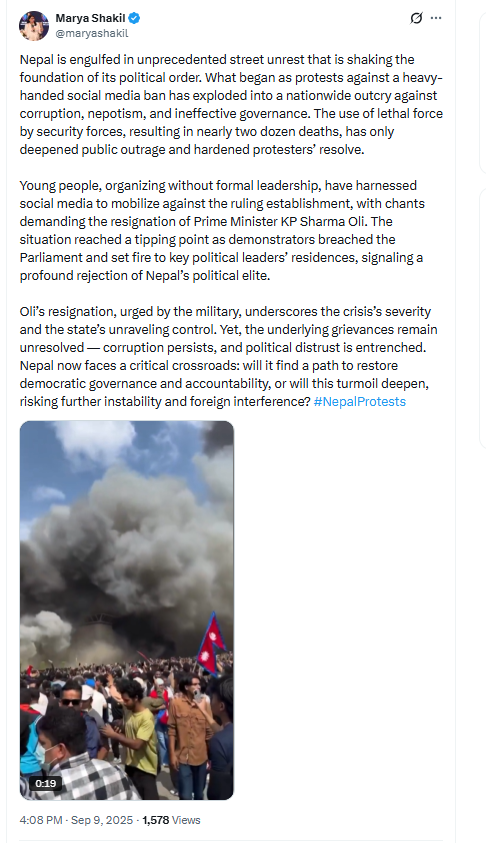
To verify the claim, we extracted keyframes from the viral video and conducted a reverse image search using Google Lens. The search led us to a post by India Today journalist Marya Shakil on X, dated September 9, 2025. She had shared the same video and identified it as footage from the Gen-Z protests in Nepal against corruption
https://x.com/maryashakil/status/1965364156992782723?s=20
We also found a related news report on the NBC News YouTube channel, published on September 9, 2025. The video report also identified the footage as being from the protests in Nepal..
https://www.youtube.com/watch?v=PXnhHoH0XKE

Conclusion
The viral claim is false. The video being shared as footage of violent protests in Nepal over the demand for a Hindu nation actually dates back to the September 2025 Gen-Z protests against corruption. Although an organisation submitted a 13-point memorandum to Nepal's Home Minister following the July 2026 communal violence, including a demand for discussions on declaring Nepal a Hindu nation, the viral video is unrelated to that development.

Executive Summary:
Recently, CyberPeace faced a case involving a fraudulent Android application imitating the Punjab National Bank (PNB). The victim was tricked into downloading an APK file named "PNB.apk" via WhatsApp. After the victim installed the apk file, it resulted in unauthorized multiple transactions on multiple credit cards.
Case Study: The Attack: Social Engineering Meets Malware
The incident started when the victim clicked on a Facebook ad for a PNB credit card. After submitting basic personal information, the victim receives a WhatsApp call from a profile displaying the PNB logo. The attacker, posing as a bank representative, fakes the benefits and features of the Credit Card and convinces the victim to install an application named PNB.apk. The so called bank representative sent the app through WhatsApp, claiming it would expedite the credit card application. The application was installed in the mobile device as a customer care application. It asks for permissions such as to send or view SMS messages. The application opens only if the user provides this permission.

It extracts the credit card details from the user such as Full Name, Mobile Number, complain, on further pages irrespective of Refund, Pay or Other. On further processing, it asks for other information such as credit card number, expiry date and cvv number.


Now the scammer has access to all the details of the credit card information, access to read or view the sms to intercept OTPs.
The victim, thinking they were securely navigating the official PNB website, was unaware that the malware was granting the hacker remote access to their phone. This led to ₹4 lakhs worth of 11 unauthorized transactions across three credit cards.
The Investigation & Analysis:
Upon receiving the case through CyberPeace helpline, the CyberPeace Research Team acted swiftly to neutralize the threat and secure the victim’s device. Using a secure remote access tool, we gained control of the phone with the victim’s consent. Our first step was identifying and removing the malicious "PNB.apk" file, ensuring no residual malware was left behind.
Next, we implemented crucial cyber hygiene practices:
- Revoking unnecessary permissions – to prevent further unauthorized access.
- Running antivirus scans – to detect any remaining threats.
- Clearing sensitive data caches – to remove stored credentials and tokens.
The CyberPeace Helpline team assisted the victim to report the fraud to the National Cybercrime Portal and helpline (1930) and promptly blocked the compromised credit cards.
The technical analysis for the app was taken ahead and by using the md5 hash file id. This app was marked as malware in virustotal and it has all the permissions such as Send/Receive/Read SMS, System Alert Window.


In the similar way, we have found another application in the name of “Axis Bank” which is circulated through whatsapp which is having similar permission access and the details found in virus total are as follows:


Recommendations:
This case study implies the increasingly sophisticated methods used by cybercriminals, blending social engineering with advanced malware. Key lessons include:
- Be vigilant when downloading the applications, even if they appear to be from legitimate sources. It is advised to install any application after checking through an application store and not through any social media.
- Always review app permissions before granting access.
- Verify the identity of anyone claiming to represent financial institutions.
- Use remote access tools responsibly for effective intervention during a cyber incident.
By acting quickly and following the proper protocols, we successfully secured the victim’s device and prevented further financial loss.
