
#FactCheck-Old Bihar Video Falsely Linked to Jantar Mantar Protest Over NEET Paper Leak
Executive Summary
A video is being widely shared on social media with the claim that a person attempted to set a Thar vehicle on fire during the ongoing protest at Jantar Mantar. CyberPeace Research Wing’s research found that the viral video is not from Jantar Mantar, Delhi. The footage is from Gaya, Bihar, where some people allegedly attempted to set a vehicle on fire after a collision involving a Thar and other vehicles on July 16.
Claim:
A 23-second video is being shared on Facebook claiming to show a person attempting to set a Thar vehicle on fire during the ongoing NEET paper leak protest at Jantar Mantar in Delhi. In the video, a man can be seen trying to ignite the vehicle, while police personnel intervene and stop him. However, the crowd continues to attempt to set the vehicle on fire.
https://www.facebook.com/reel/1575765261002644

Fact Check:
To verify the claim, we extracted keyframes from the viral video and conducted a reverse image search. During the research, we found the same video uploaded on the News18 YouTube channel on July 18, 2026. The caption accompanying the video identified the incident as being from Bihar.
https://www.youtube.com/shorts/fzAPajxyi3A

Further, a keyword search led us to a report published by Dainik Bhaskar on July 16, 2026. The report contained visuals matching the viral video, along with the statement of the person seen in the viral footage.

According to the report, the incident took place in Gaya, Bihar, after a collision between a Thar vehicle and other vehicles. Following the accident, some people gathered at the spot and allegedly attempted to set the vehicle on fire.
Conclusion:
CyberPeace Research Wing’s fact check found the viral claim to be misleading. The video does not show an incident from the ongoing Jantar Mantar protest in Delhi. The footage is from Gaya, Bihar, where a Thar vehicle was involved in a collision with other vehicles on July 16, following which some people attempted to set the vehicle on fire.

Related Blogs

Introduction
Indian Cybercrime Coordination Centre (I4C) was established by the Ministry of Home Affairs (MHA) to provide a framework for law enforcement agencies (LEAs) to deal with cybercrime in a coordinated and comprehensive manner. The Indian Ministry of Home Affairs approved a scheme for the establishment of the Indian Cyber Crime Coordination Centre (I4C) in October 2018. I4C is actively working towards initiatives to combat the emerging threats in cyberspace and it has become a strong pillar of India’s cyber security and cybercrime prevention. The ‘National Cyber Crime Reporting Portal’ equipped with a 24x7 helpline number 1930, is one of the key components of the I4C.
On 10 September 2024, I4Ccelebrated its foundation day for the first time at Vigyan Bhawan, New Delhi. This celebration marked a major milestone in India’s efforts against cybercrimes and in enhancing its cybersecurity infrastructure. Union Home Minister and Minister of Cooperation, Shri Amit Shah, launched key initiatives aimed at strengthening the country’s cybersecurity landscape.
Launch of Key Initiatives to Strengthen Cybersecurity
- Cyber Fraud Mitigation Centre (CFMC): As a product of Prime Minister Shri Narendra Modi’s vision, the Cyber Fraud Mitigation Centre (CFMC), was incorporated to bring together banks, financial institutions, telecom companies, Internet Service Providers, and law enforcement agencies on a single platform to tackle online financial crimes efficiently. This integrated approach is expected to minimise the time required to streamline operations and to track and neutralise cyber fraud.
- Cyber Commando: The Cyber Commandos Program is an initiative in which a specialised wing of trained Cyber Commandos will be established in states, Union Territories, and Central Police Organizations. These commandos will work to secure the nation’s digital space and counter rising cyber threats. They will form the first line of defence in safeguarding India from the growing cyber threats.
- Samanvay Platform: The Samanvay platform is a web-based Joint Cybercrime Investigation Facility System that was introduced as a one-stop data repository for cybercrime. It facilitates cybercrime mapping, data analytics, and cooperation among law enforcement agencies across the country. This will play a pivotal role in fostering collaborations in combating cybercrimes. Mr. Shah recognised the Samanvay platform as a crucial step in fostering data sharing and collaboration. He called for a shift from the “need to know” principle to a “duty to share” mindset in dealing with cyber threats. The Samanvay platform will serve as India’s first shared data repository, significantly enhancing the country’s cybercrime response.
- Suspect Registry: The Suspect Registry Portal is a national-level platform that has been designed to track cybercriminals. The portal registry will be connected to the National Cybercrime Reporting Portal (NCRP) which aims to help banks, financial intermediaries, and law enforcement agencies strengthen fraud risk management. The initiative is expected to improve the real-time tracking of cyber suspects, preventing repeat offences and improving fraud detection mechanisms.
Rising Digitalization: Prioritizing Cybersecurity
The number of internet users in India has grown from 25 crores in 2014 to 95 crores in 2024, accompanied by a 78-foldincrease in data consumption. This growth is echoed in the number of growing cybersecurity challenges in the digital era. With the rise of digital transactions through Jan Dhan accounts, Rupay debit cards, and UPI systems, Shri Shah underscored the growing threat of digital fraud. He emphasised the need to protect personal data, prevent online harassment, and counter misinformation, fake news, and child abuse in the digital space.
The three new criminal laws, the Bharatiya Nyaya Sanhita (BNS), Bharatiya Nagrik Suraksha Sanhita (BNSS), and Bharatiya Sakshya Adhiniyam (BSA), which aim to strengthen India’s legal framework for cybercrime prevention, were also referred to in the address bythe Home Minister. These laws incorporate tech-driven solutions that will ensure investigations are conducted scientifically and effectively.
Mr. Shah emphasised popularising the 1930Cyber Crime Helpline. Additionally, he noted that I4C has issued over 600advisories, blocked numerous websites and social media pages operated by cybercriminals, and established a National Cyber Forensic Laboratory in Delhi. Over 1,100 officers have already received cyber forensics training under theI4C umbrella.
In response to the regional cybercrime challenges, the formation of Joint Cyber Coordination Teams in cybercrime hotspot areas like Mewat, Jamtara, Ahmedabad, Hyderabad, Chandigarh, Visakhapatnam and Guwahati was highlighted as a coordinated response to local cybercrime hotspot issues.
Conclusion
With the launch of initiatives like the Cyber Fraud Mitigation Centre, the Samanvay platform, and the Cyber Commandos Program, I4C is positioned to play a crucial role in combating cybercrime. The I4C is moving forward with a clear vision for a secure digital future and safeguarding India's digital ecosystem.
References:
● https://pib.gov.in/PressReleaseIframePage.aspx?PRID=2053438

Introduction
On March 12, the Ministry of Corporate Affairs (MCA) proposed the Bill to curb anti-competitive practices of tech giants through ex-ante regulation. The Draft Digital Competition Bill is to apply to ‘Core Digital Services,’ with the Central Government having the authority to update the list periodically. The proposed list in the Bill encompasses online search engines, online social networking services, video-sharing platforms, interpersonal communications services, operating systems, web browsers, cloud services, advertising services, and online intermediation services.
The primary highlight of the Digital Competition Law Report created by the Committee on Digital Competition Law presented to the Parliament in the 2nd week of March 2024 involves a recommendation to introduce new legislation called the ‘Digital Competition Act,’ intended to strike a balance between certainty and flexibility. The report identified ten anti-competitive practices relevant to digital enterprises in India. These are anti-steering, platform neutrality/self-preferencing, bundling and tying, data usage (use of non-public data), pricing/ deep discounting, exclusive tie-ups, search and ranking preferencing, restricting third-party applications and finally advertising Policies.
Key Take-Aways: Digital Competition Bill, 2024
- Qualitative and quantitative criteria for identifying Systematically Significant Digital Enterprises, if it meets any of the specified thresholds.
- Financial thresholds in each of the immediately preceding three financial years like turnover in India, global turnover, gross merchandise value in India, or global market capitalization.
- User thresholds in each of the immediately preceding 3 financial years in India like the core digital service provided by the enterprise has at least 1 crore end users, or it has at least 10,000 business users.
- The Commission may make the designation based on other factors such as the size and resources of an enterprise, number of business or end users, market structure and size, scale and scope of activities of an enterprise and any other relevant factor.
- A period of 90 days is provided to notify the CCI of qualification as an SSDE. Additionally, the enterprise must also notify the Commission of other enterprises within the group that are directly or indirectly involved in the provision of Core Digital Services, as Associate Digital Enterprises (ADE) and the qualification shall be for 3 years.
- It prescribes obligations for SSDEs and their ADEs upon designation. The enterprise must comply with certain obligations regarding Core Digital Services, and non-compliance with the same shall result in penalties. Enterprises must not directly or indirectly prevent or restrict business users or end users from raising any issue of non-compliance with the enterprise’s obligations under the Act.
- Avoidance of favouritism in product offerings by SSDE, its related parties, or third parties for the manufacture and sale of products or provision of services over those offered by third-party business users on the Core Digital Service in any manner.
- The Commission will be having the same powers as vested to a civil court under the Code of Civil Procedure, 1908 when trying a suit.
- Penalty for non-compliance without reasonable cause may extend to Rs 1 lakh for each day during which such non-compliance occurs (max. of Rs 10 crore). It may extend to 3 years or with a fine, which may extend to Rs 25 crore or with both. The Commission may also pass an order imposing a penalty on an enterprise (not exceeding 1% of the global turnover) in case it provides incorrect, incomplete, misleading information or fails to provide information.
Suggestions and Recommendations
- The ex-ante model of regulation needs to be examined for the Indian scenario and studies need to be conducted on it has worked previously in different jurisdictions like the EU.
- The Bill should be aimed at prioritising the fostering of fair competition by preventing monopolistic practices in digital markets exclusively. A clear distinction from the already existing Competition Act, 2002 in its functioning needs to be created so that there is no overlap in the regulations and double jeopardy is not created for enterprises.
- Restrictions on tying and bundling and data usage have been shown to negatively impact MSMEs that rely significantly on big tech to reduce operational costs and enhance customer outreach.
- Clear definitions of "dominant position" and "anti-competitive behaviour" are essential for effective enforcement in terms of digital competition need to be defined.
- Encouraging innovation while safeguarding consumer data privacy in consonance with the DPDP Act should be the aim. Promoting interoperability and transparency in algorithms can prevent discriminatory practices.
- Regular reviews and stakeholder consultations will ensure the law adapts to rapidly evolving technologies.
- Collaboration with global antitrust bodies which is aimed at enhancing cross-border regulatory coherence and effectiveness.
Conclusion
The need for a competition law that is focused exclusively on Digital Enterprises is the need of the hour and hence the Committee recommended enacting the Digital Competition Act to enable CCI to selectively regulate large digital enterprises. The proposed legislation should be restricted to regulate only those enterprises that have a significant presence and ability to influence the Indian digital market. The impact of the law needs to be restrictive to digital enterprises and it should not encroach upon matters not influenced by the digital arena. India's proposed Digital Competition Bill aims to promote competition and fairness in the digital market by addressing anti-competitive practices and dominant position abuses prevalent in the digital business space. The Ministry of Corporate Affairs has received 41-page public feedback on the draft which is expected to be tabled next year in front of the Parliament.
References
- https://www.medianama.com/wp-content/uploads/2024/03/DRAFT-DIGITAL-COMPETITION-BILL-2024.pdf
- https://prsindia.org/files/policy/policy_committee_reports/Report_Summary-Digital_Competition_Law.pdf
- https://economictimes.indiatimes.com/tech/startups/meity-meets-india-inc-to-hear-out-digital-competition-law-concerns/articleshow/111091837.cms?from=mdr
- https://www.mca.gov.in/bin/dms/getdocument?mds=gzGtvSkE3zIVhAuBe2pbow%253D%253D&type=open
- https://www.barandbench.com/law-firms/view-point/digital-competition-laws-beginning-of-a-new-era
- https://www.linkedin.com/pulse/policy-explainer-digital-competition-bill-nimisha-srivastava-lhltc/
- https://www.lexology.com/library/detail.aspx?g=5722a078-1839-4ece-aec9-49336ff53b6c
Introduction
" सर्वे भवन्तु सुखिनः, सर्वे सन्तु निरामयाः " May all be happy, may all be free from suffering. This timeless invocation reflects a vision of collective well-being, where progress is meaningful only when shared, and protection extends to every individual in society. This very philosophy lies at the heart of Corporate Social Responsibility, which seeks to ensure that growth is not isolated or unequal, but inclusive, ethical, and mindful of the broader social good.
At its core, Corporate Social Responsibility is not merely a statutory obligation, it is a reflection of a deeper ethical commitment, an acknowledgement that growth must carry with it a sense of duty towards society. In many ways, CSR embodies the idea that progress without responsibility is incomplete, and that corporations, as key actors shaping modern life, must help safeguard the very communities they engage with.
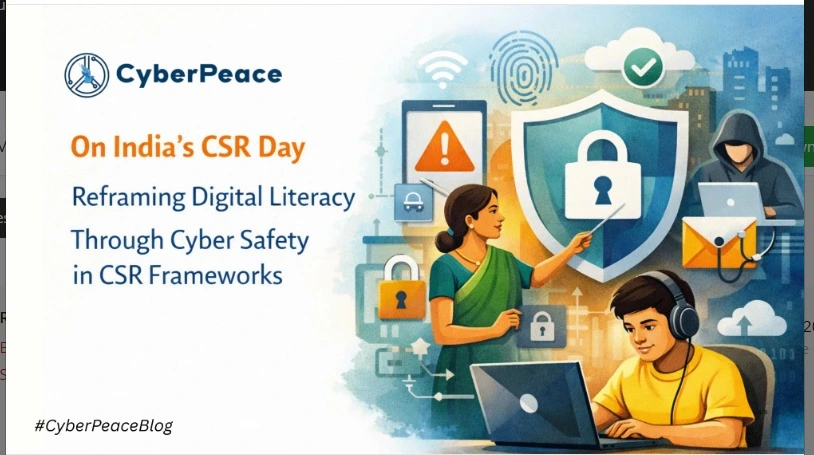
Reframing Digital Literacy Through Cyber Safety in CSR Frameworks
In India, this moral vision has been given a legal structure under the Companies Act, 2013, CSR Schedule VII, which mandates certain classes of companies to allocate a portion of their profits towards socially beneficial activities. Section 135 of the Act requires companies meeting specified financial thresholds to undertake CSR initiatives, guided by principles of inclusivity, sustainability, and social welfare. The underlying values are clear, CSR is intended not as charity, but as a strategic and accountable contribution to societal development.
Schedule VII of the Act further outlines the broad areas that qualify as CSR, including “Education and Digital Literacy”, gender equality, rural development, and measures for reducing inequalities. Within this framework, promoting “digital literacy” has increasingly been recognised as a legitimate and necessary CSR activity, especially in the context of a rapidly digitising society like India.
However, the current understanding of digital literacy within CSR remains incomplete. It often emphasises access and usage, teaching individuals how to navigate digital platforms, use devices, and engage with online services. What remains insufficiently addressed is the question of safety. In an environment where cyber fraud, data breaches, online harassment, and identity theft are becoming increasingly common, digital literacy without cyber awareness risks becoming a partial and potentially harmful intervention.
Embedding cyber awareness and capacity building within ‘digital literacy’ in explicit form is therefore not optional, it is essential. This includes equipping individuals with the ability to recognise online threats, protect personal data, understand digital consent, and respond effectively to cyber risks. It also requires recognising that vulnerable populations, including first-time internet users, women, and marginalised communities, often face disproportionate exposure to cyber harm.
“It is pertinent to note that Cybersecurity awareness training is relevant to CSR but is not yet consistently implemented as an explicit CSR activity. It is often included indirectly within digital literacy programs, highlighting the need for a more structured, progressive and integrated approach.”
Given this reality, there is a strong case for explicitly recognising cyber awareness as a distinct and integral component of CSR activities, rather than treating it as an implicit subset of digital literacy. Doing so would not only align CSR with contemporary societal risks but also ensure that corporate interventions move beyond enabling access to actively ensuring safety.
In a digital society, empowerment without protection is incomplete. If CSR is to truly reflect its foundational values, it must evolve to address not just the opportunities of the digital age, but also its risks.
Why Cyber Safety Must Be Central to CSR
The current state of digital ecosystems, which used to operate as secondary systems, now functions as essential systems that support government operations, banking systems, educational institutions, and social communication. The digital environment has its vulnerabilities, which create direct dangers for people in society. The elderly, first-time internet users, and rural communities face higher cyber threat risks because they often lack knowledge and protective resources on responsible use. The implementation of CSR initiatives that provide digital access to these groups, along with how to handle risks, will create greater benefit for their safety. Organisations must encourage the implementation of cyber safety training in their CSR programs because doing so will create value while fulfilling their ethical obligations. The empowerment process needs to achieve complete success, which protects people from any potential dangers according to the "do no harm" principle.
Key Components of CyberPeace-Aligned Digital Literacy
To make CSR initiatives more effective and future-ready, organisations should incorporate the following elements into their digital literacy programs:
- Cyber Awareness and Risk Recognition: The training program teaches participants how to recognise typical security threats, which include phishing attacks and scams, deepfake technology and misinformation.
- Data Protection and Privacy Literacy: The program teaches users how to protect their personal information, together with the process of giving consent and the methods used to handle their online presence.
- Responsible Digital Behaviour: The program teaches people how to use the internet responsibly by showing them how to make ethical decisions that require both respect and accountability while understanding the legal consequences of their actions.
- Incident Response and Reporting Mechanisms: The program teaches users about cyber incident response, which includes all reporting methods and available support resources.
- Inclusion-Focused Design: The program develops specific solutions which protect various demographic groups from their particular vulnerabilities while maintaining accessibility and essential programmatic relevance.
Policy and Institutional Alignment
The integration of cyber safety into corporate social responsibility lets organisations achieve their national objectives, which include:
- Strengthening digital trust and resilience
- Supporting safe digital inclusion initiatives
- Complementing the efforts of institutions working on cybersecurity awareness and capacity building
The structured approach requires organisations to execute three specific steps, which include:
- Partnering with cybersecurity organisations and civil society
- Developing standardised cyber awareness modules
- The organisation will use behavioural change indicators to evaluate its impact instead of relying on access metrics.
The Way Forward
Digital-era Corporate Social Responsibility needs to transition from its present state of providing access to digital resources toward establishing secure online platforms for users. The understanding of digital literacy needs to shift from its current status as a technical ability toward its new definition as a social competency that encompasses safety, responsibility and resilience training.
Companies need to understand their digital transformation obligations because their digital transformation efforts require them to handle all associated risks. The implementation of cyber safety within corporate social responsibility frameworks will enable organisations to develop a secure and trustworthy digital environment that includes all users.
Conclusion
The implementation of corporate social responsibility needs to fulfil its core mission of creating societal benefits through inclusive practices that span all current digital possibilities and their associated security threats. The field of digital literacy requires a new framework that combines digital safety practices with its existing educational materials.
The digital safety practice ensures that people obtain essential knowledge and skills that enable them to use digital resources securely when they access online content. The process of accomplishing shared community prosperity needs to establish a framework that benefits every person through social advancement and the protection of their rights.
References
- https://upload.indiacode.nic.in/schedulefile?aid=AC_CEN_22_29_00008_201318_1517807327856&rid=79
- https://www.allresearchjournal.com/archives/2025/vol11issue4/PartF/11-5-60-511.pdf
- https://www.unesco.org/en/dtc-finance-toolkit-factsheets/corporate-social-responsibility-csr
- https://www.investopedia.com/terms/c/corp-social-responsibility.asp
- https://digitalmarketinginstitute.com/blog/corporate-16-brands-doing-corporate-social-responsibility-successfully
- https://www.imd.org/blog/sustainability/csr-strategy/
