
#FactCheck-Manipulated audio falsely attributes remark on Pakistan-Türkiye-Saudi Arabia alliance to PM Modi
Executive Summary
A video circulating widely on social media purportedly shows Prime Minister Narendra Modi referring to the recently signed defence agreement involving Pakistan, Saudi Arabia and Türkiye during his Independence Day address from the Red Fort.
The clip carries an alleged statement in which Modi is heard saying that he had previously discussed the possibility of Pakistan, Saudi Arabia and Türkiye coming together with Israeli Prime Minister Benjamin Netanyahu. He is further purportedly heard claiming that Netanyahu had said the Gulf countries and Iran would be made to fight each other and eventually eliminated. The voice attributed to Modi allegedly concludes that his assessment had proved correct and that those involved were now looking for a way out of the situation.
An research by the CyberPeace Research Wing’s Research Wing found that the viral clip is misleading. The audio has been digitally altered and superimposed on footage from Modi’s Independence Day address. The alleged remarks do not feature in the Prime Minister’s original speech.
Claim
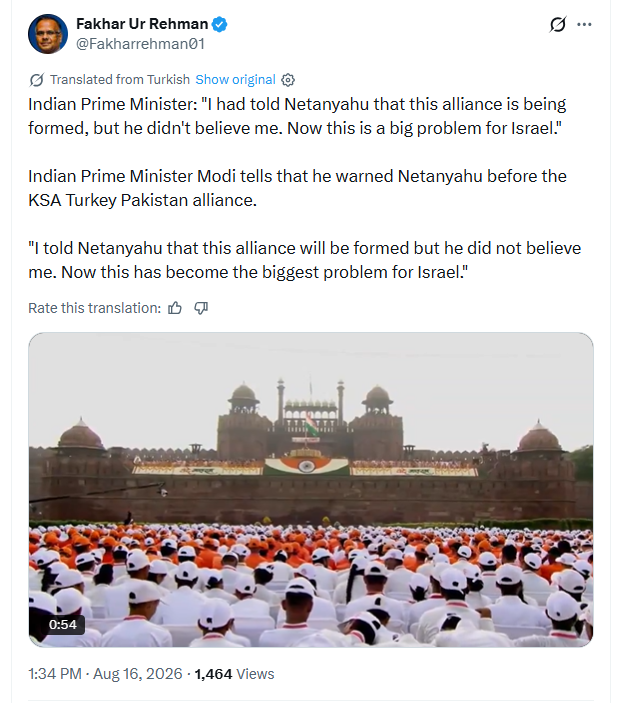
On August 16, Pakistan-based journalist Fakhar Ur Rehman (@Fakharrehman01) shared the video on X, claiming it showed Modi discussing the defence pact between Pakistan, Saudi Arabia and Türkiye during his Independence Day speech from the Red Fort. The accompanying video purportedly shows Modi saying that he had spoken to Netanyahu about the possibility of the three countries forming an alliance. According to the alleged remarks, Netanyahu had said that the Gulf nations and Iran would be encouraged to fight one another and eventually eliminated.
The speaker, purportedly Modi, is then heard saying that his prediction had turned out to be correct and that the parties involved were now worried about finding a way out of the situation.
https://x.com/Fakharrehman01/status/2088899788788117899?s=20
Fact Check
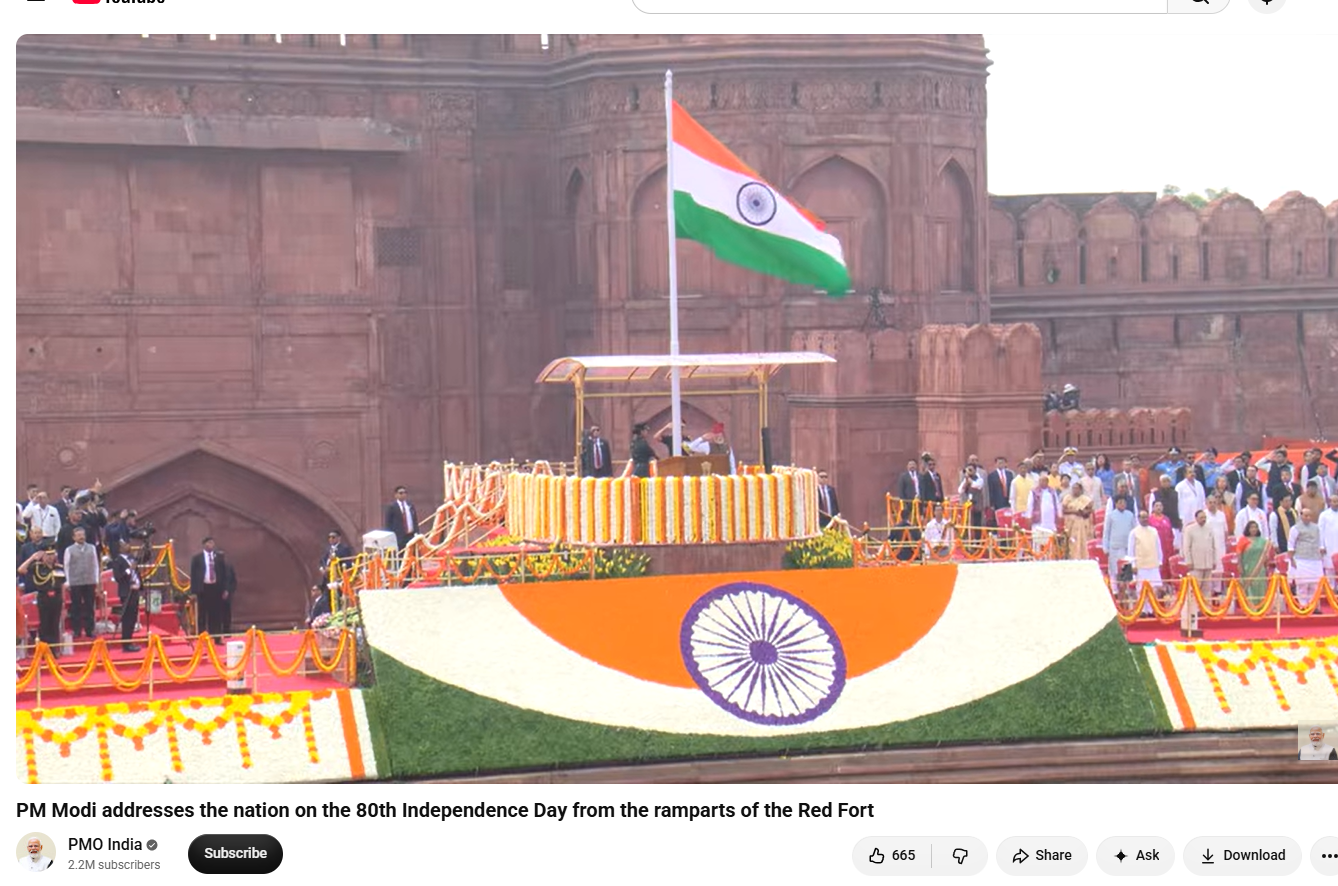
To verify whether the remarks were actually made by Modi, the Desk first searched Google using a combination of relevant keywords and looked for the complete recording of his Independence Day address. The search led to the official YouTube channel of the Prime Minister’s Office (PMO India), which carries the full recording of Modi’s speech uploaded on August 15, 2026. The Desk reviewed the entire one-hour-and-39-minute video and found no instance in which Modi made the statements heard in the viral clip. The absence of the alleged remarks from the original recording raised concerns that the audio had been added or modified.
https://www.youtube.com/watch?v=aDHjd3GUU7Y
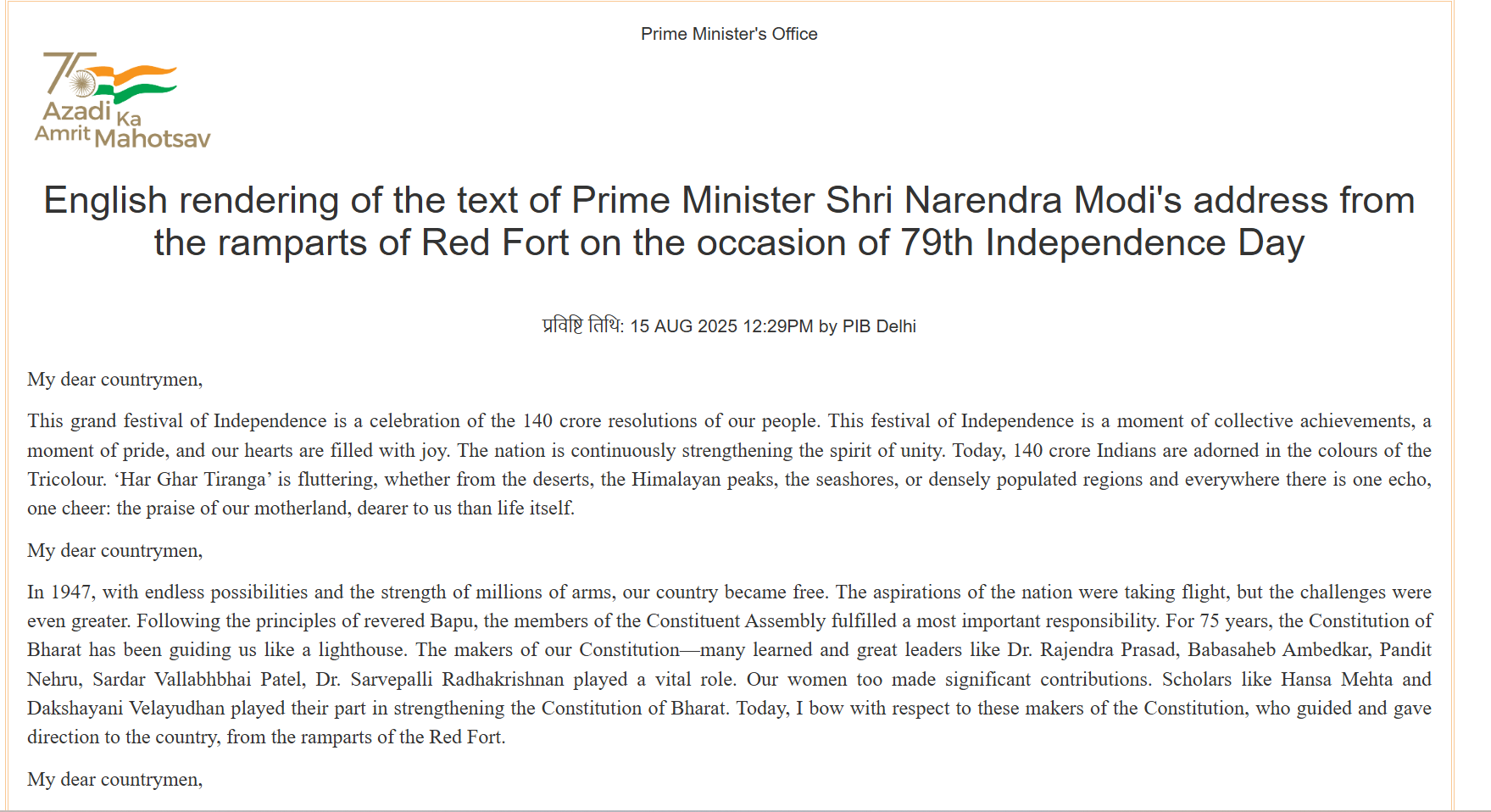
The Desk then cross-checked the Prime Minister’s speech with its official written transcript available on the Press Information Bureau (PIB) website. A review of the transcript found no mention of a proposed or existing alliance involving Pakistan, Saudi Arabia and Türkiye. It also contained no reference to Israeli Prime Minister Benjamin Netanyahu in the context described in the viral video.
https://www.pib.gov.in/PressReleasePage.aspx?PRID=2156749®=48&lang=2
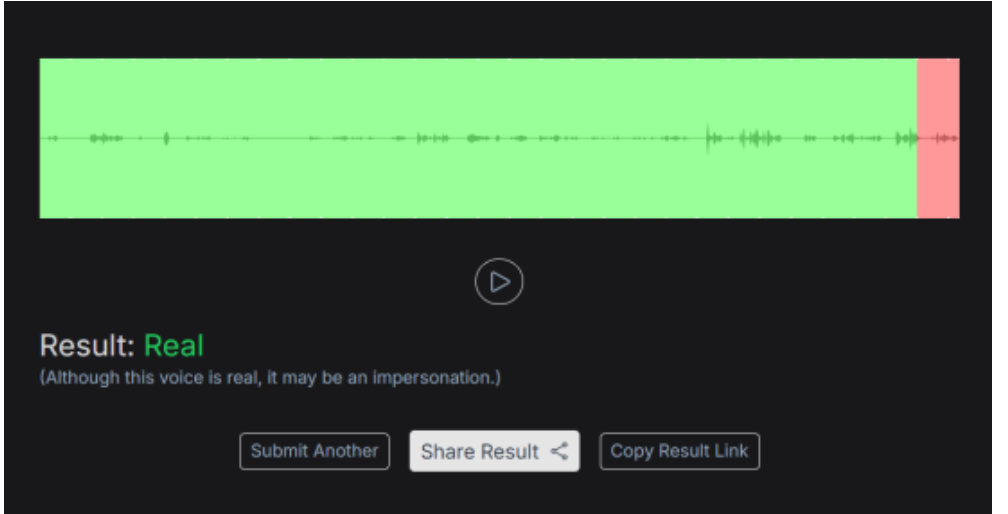
Since the video appeared to contain altered audio, the Desk next separated the soundtrack from the footage for further examination. The extracted audio was analysed using Resemble AI, an AI-based audio detection tool. The tool did not conclusively establish that the recording had been digitally manipulated. However, its assessment indicated that the voice could be an impersonation, adding further doubt to the authenticity of the audio attributed to Modi. The Desk also compared the audio findings with the original speech and its official transcript. Neither source contained the statements being circulated in the viral clip.
Conclusion
The video does not show Prime Minister Narendra Modi making the remarks attributed to him about Pakistan, Saudi Arabia, Türkiye and Israel. The footage is from his Independence Day address, but the audio carrying the alleged comments has been digitally manipulated and superimposed. Analysis by Resemble AI further indicated that the voice may be an impersonation. Therefore, the claim that Modi made the alleged remarks about the Pakistan-Saudi Arabia-Türkiye alliance and Benjamin Netanyahu is false

Related Blogs
Executive Summary
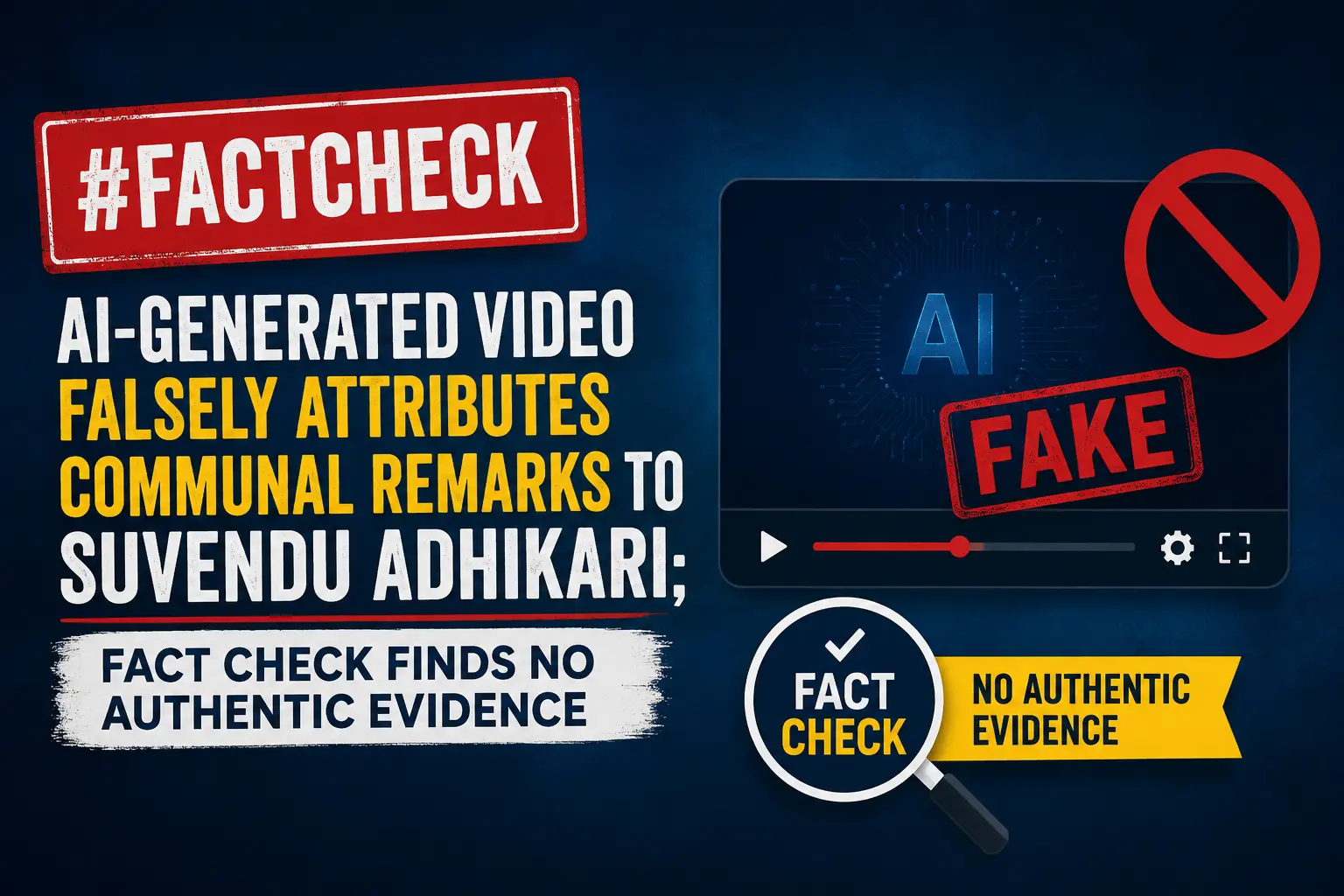
A video circulating on social media falsely claims to show West Bengal leader Suvendu Adhikari making inflammatory and communal remarks. In the viral clip, he is allegedly heard saying that if elected, his party would “work only for Hindus” and “eliminate the 27% Muslim population in West Bengal,” while also claiming that the BJP would remain in power for over 100 years. CyberPeace Research Wing research found that the viral video, which allegedly shows West Bengal leader Suvendu Adhikari making a statement about eliminating the Muslim population in West Bengal to ensure long-term BJP rule, is AI-generated and not real.
Claim
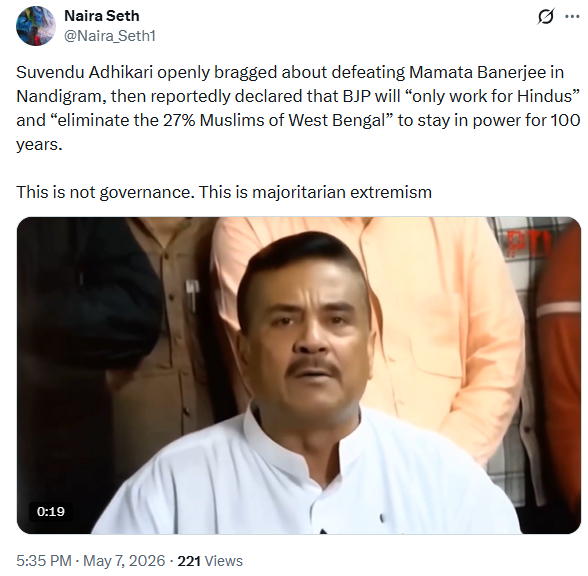
An X user (@Naira_Seth1) shared the clip alleging it reflects “majoritarian extremism disguised as politics,” suggesting that Suvendu Adhikari made communally charged and unconstitutional statements.
Fact Check
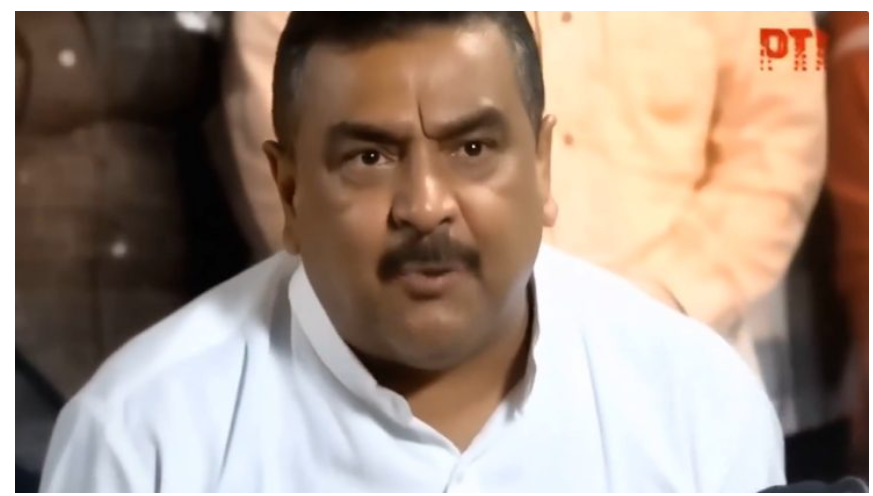
A detailed analysis of the video shows clear signs of manipulation. The person appearing in the latter part of the clip does not match Suvendu Adhikari.
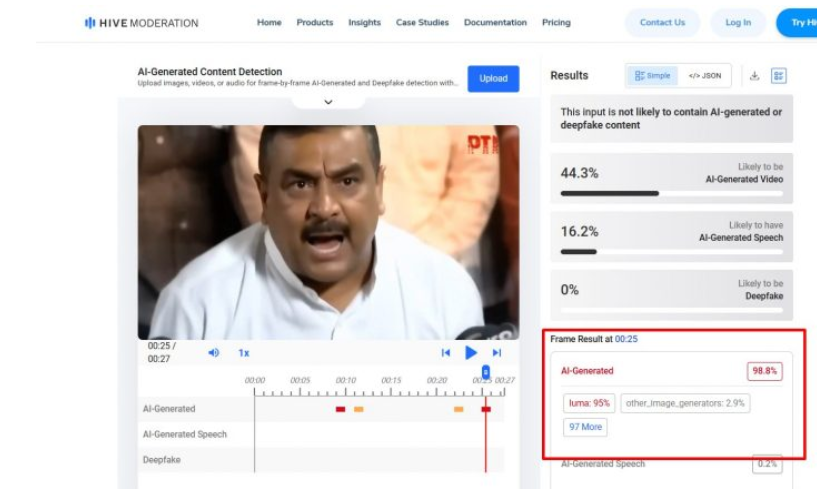
Additionally, the video was tested using an AI detection tool (Hive Moderation), which indicated a 98.8% probability of AI-generated content, particularly around the 0:25 timestamp.
Further verification through reverse image search of key frames led to an original press byte of Suvendu Adhikari posted by PTI News on May 6. In that authentic video, he is seen speaking about taking strict legal action against criminals, with no mention of any religious community or communal statements.
https://x.com/PTI_News/status/2052020784152068114?s=20

Conclusion
The viral video allegedly showing Suvendu Adhikari making communal remarks is AI-generated and misleading. The original footage confirms that no such statements were made, and the clip has been digitally manipulated to spread misinformation.

Executive Summary:
A viral video circulating on social media that appears to be deliberately misleading and manipulative is shown to have been done by comedian Samay Raina casually making a lighthearted joke about actress Rekha in the presence of host Amitabh Bachchan which left him visibly unsettled while shooting for an episode of Kaun Banega Crorepati (KBC) Influencer Special. The joke pointed to the gossip and rumors of unspoken tensions between the two Bollywood Legends. Our research has ruled out that the video is artificially manipulated and reflects a non genuine content. However, the specific joke in the video does not appear in the original KBC episode. This incident highlights the growing misuse of AI technology in creating and spreading misinformation, emphasizing the need for increased public vigilance and awareness in verifying online information.

Claim:
The claim in the video suggests that during a recent "Influencer Special" episode of KBC, Samay Raina humorously asked Amitabh Bachchan, "What do you and a circle have in common?" and then delivered the punchline, "Neither of you and circle have Rekha (line)," playing on the Hindi word "rekha," which means 'line'.ervicing routes between Amritsar, Chandigarh, Delhi, and Jaipur. This assertion is accompanied by images of a futuristic aircraft, implying that such technology is currently being used to transport commercial passengers.

Fact Check:
To check the genuineness of the claim, the whole Influencer Special episode of Kaun Banega Crorepati (KBC) which can also be found on the Sony Set India YouTube channel was carefully reviewed. Our analysis proved that no part of the episode had comedian Samay Raina cracking a joke on actress Rekha. The technical analysis using Hive moderator further found that the viral clip is AI-made.

Conclusion:
A viral video on the Internet that shows Samay Raina making a joke about Rekha during KBC was released and completely AI-generated and false. This poses a serious threat to manipulation online and that makes it all the more important to place a fact-check for any news from credible sources before putting it out. Promoting media literacy is going to be key to combating misinformation at this time, with the danger of misuse of AI-generated content.
- Claim: Fake AI Video: Samay Raina’s Rekha Joke Goes Viral
- Claimed On: X (Formally known as Twitter)
- Fact Check: False and Misleading

Introduction
Indian Cybercrime Coordination Centre (I4C) was established by the Ministry of Home Affairs (MHA) to provide a framework and eco-system for law enforcement agencies (LEAs) to deal with cybercrime in a coordinated and comprehensive manner. The Indian Ministry of Home Affairs approved a scheme for the establishment of the Indian Cyber Crime Coordination Centre (I4C) in October2018, which was inaugurated by Home Minister Amit Shah in January 2020. I4C is envisaged to act as the nodal point to curb Cybercrime in the country. Recently, on 13th March2024, the Centre designated the Indian Cyber Crime Coordination Centre (I4C) as an agency of the Ministry of Home Affairs (MHA) to perform the functions under the Information Technology Act, 2000, to inform about unlawful cyber activities.
The gazetted notification dated 13th March 2024 read as follows:
“In exercise of the powers conferred by clause (b) of sub-section (3) of section 79 of the Information Technology Act 2000, Central Government being the appropriate government hereby designate the Indian Cybercrime Coordination Centre (I4C), to be the agency of the Ministry of Home Affairs to perform the functions under clause (b) of sub-section (3) of section79 of Information Technology Act, 2000 and to notify the instances of information, data or communication link residing in or connected to a computer resource controlled by the intermediary being used to commit the unlawful act.”
Impact
Now, the Indian Cyber Crime Coordination Centre (I4C) is empowered to issue direct takedown orders under 79(b)(3) of the IT Act, 2000. Any information, data or communication link residing in or connected to a computer resource controlled by any intermediary being used to commit unlawful acts can be notified by the I4C to the intermediary. If an intermediary fails to expeditiously remove or disable access to a material after being notified, it will no longer be eligible for protection under Section 79 of the IT Act, 2000.
Safe Harbour Provision
Section79 of the IT Act also serves as a safe harbour provision for the Intermediaries. The safe harbour provision under Section 79 of the IT Act states that "an intermediary shall not be liable for any third-party information, data, or communication link made available or hosted by him". However, it is notable that this legal immunity cannot be granted if the intermediary "fails to expeditiously" take down a post or remove a particular content after the government or its agencies flag that the information is being used to commit something unlawful. Furthermore, Intermediaries are also obliged to perform due diligence on their platforms and comply with the rules & regulations and maintain and promote a safe digital environment on the respective platforms.
Under the Information Technology (Intermediary Guidelines and Digital Media Ethics Code) Rules, 2021, The government has also mandated that a ‘significant social media intermediary’ must appoint a Chief Compliance Officer (CCO), Resident Grievance Officer (RGO), and Nodal Contact Person and publish periodic compliance report every month mentioning the details of complaints received and action taken thereon.
I4C's Role in Safeguarding Cyberspace
The Indian Cyber Crime Coordination Centre (I4C) is actively working towards initiatives to combat the emerging threats in cyberspace. I4C is one of the crucial extensions of the Ministry of Home Affairs, Government of India, working extensively to combat cyber crimes and ensure the overall safety of netizens. The ‘National Cyber Crime Reporting Portal’ equipped with a 24x7 helpline number 1930, is one of the key component of the I4C.
Components Of The I4C
- National Cyber Crime Threat Analytics Unit
- National Cyber Crime Reporting Portal
- National Cyber Crime Training Centre
- Cyber Crime Ecosystem Management Unit
- National Cyber Crime Research and Innovation Centre
- National Cyber Crime Forensic Laboratory Ecosystem
- Platform for Joint Cyber Crime Investigation Team.
Conclusion
I4C, through its initiatives and collaborative efforts, plays a pivotal role in safeguarding cyberspace and ensuring the safety of netizens. I4C reinforces India's commitment to combatting cybercrime and promoting a secure digital environment. The recent development by designating the I4C as an agency to notify the instances of unlawful activities in cyberspace serves as a significant step to counter cybercrime and promote an ethical and safe digital environment for netizens.
References
- https://www.deccanherald.com/india/centre-designates-i4c-as-agency-of-mha-to-notify-unlawful-activities-in-cyber-world-2936976
- https://www.business-standard.com/india-news/home-ministry-authorises-i4c-to-issue-takedown-notices-under-it-act-124031500844_1.html
- https://www.hindustantimes.com/india-news/it-ministry-empowers-i4c-to-notify-instances-of-cybercrime-101710443217873.html
- https://i4c.mha.gov.in/about.aspx#:~:text=Objectives%20of%20I4C,identifying%20Cybercrime%20trends%20and%20patterns
