
#FactCheck - AI-Generated Image Falsely Shared as Bees Attacking Shankaracharya Swami Avimukteshwaranand Saraswati
Executive Summary
During the Gau Raksha Yatra of Shankaracharya Swami Avimukteshwaranand Saraswati, bees reportedly attacked a discourse event in Rohania area of Varanasi, Uttar Pradesh. Following the incident, a picture has gone viral on social media showing bees attacking Swami Avimukteshwaranand Saraswati. Several users are sharing the image as genuine while targeting the Shankaracharya online. CyberPeace Research Wing investigated the viral image and found it to be fake. Our research revealed that the picture was created using Artificial Intelligence (AI). While it is true that a bee attack occurred during Swami Avimukteshwaranand Saraswati’s discourse program, the viral image itself is fabricated.
Claim
A Facebook user named “Sanjay Chaudhary” shared the viral image on May 15, 2026, with the caption: “Prakritik kop ka bhajan bana Shukracharya Umashankar alias Avimukteshwaranand… This Kaalnemi was delivering false sermons in Rohania, Varanasi in the name of religion… The bees from a nearby hive did not like it and collectively attacked, creating chaos. Even insects and nature no longer like the opposition’s politics disguised as Sanatan Dharma. Calling Yogi Ji Aurangzeb, Akbar and butcher is not acceptable even to nature and insects.”
Post link and archive link are given below:
- https://www.facebook.com/sanjaychaudhary073/posts/pfbid02kgts8igKDwgctz3MamECMGoGfQR5aWPTdsDgLeux3pD9jwP7ADfgNpoPfHvMb9Zul
- https://perma.cc/E6SE-BAXZ

Fact-Check
To verify the viral claim, we used Google Open Search tools and found reports related to the incident on the YouTube channel of News18 UP Uttarakhand. A report published on May 13, 2026 stated that bees attacked the discourse event during Swami Avimukteshwaranand’s Gau Raksha Yatra in Rohania, Varanasi. The incident created panic at the venue, forcing the Swami to end his discourse midway. The channel also uploaded a YouTube Shorts video related to the incident.

As part of the research, we further analyzed the viral image using AI detection tools. First, we used the tool “Sight Engine,” which indicated an 88 percent probability that the image was AI-generated.
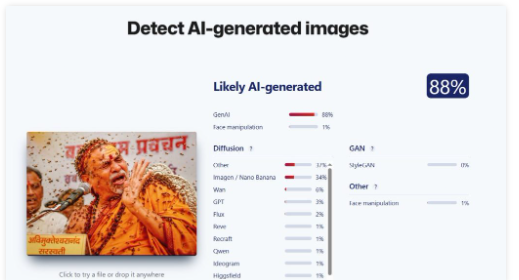
We then examined the image using another AI detection tool called “Undetectable,” which also suggested that the photo was likely created using AI.

Conclusion
Our research found that the viral image is AI-generated. The picture was created using artificial intelligence tools. While bees did attack during Swami Avimukteshwaranand Saraswati’s Gau Raksha Yatra on May 13, 2026, the viral image circulating on social media is fictional and not real.

Related Blogs

Executive Summary
Prime Minister Narendra Modi recently appealed to citizens to reduce the consumption of gold and edible oil for a year. He also urged people to conserve petrol, diesel, and cooking gas amid the crisis arising from the ongoing tensions in West Asia involving the United States, Israel, and Iran. Amid this backdrop, a purported image of Union Home Minister Amit Shah and his son Jay Shah, who currently serves as Chairman of the International Cricket Council, has gone viral on social media. The image shows them seated inside a chartered aircraft along with two other individuals. Several social media users shared the picture as genuine while targeting the central government and Amit Shah.
However, CyberPeace Research Wing reseach found that the viral image is fake and was generated using Artificial Intelligence (AI).
Claim
An Instagram user named “Om Prakash Shukla” shared the viral image on May 24, 2026, with the caption:“People are sacrificing their desires for the nation, while they are enjoying luxury.”
https://www.instagram.com/p/DYuFqnmCh7T

Fact Check
To verify the authenticity of the viral image, we conducted a Google Lens search. However, the image was not found on any credible news platform, which raised suspicion about its authenticity. We also performed keyword-based searches related to the image using Google Search, but found no authentic reports or media coverage associated with the picture.
Further reseach involved analysing the image using AI detection tools. We first examined the picture using the “Sight Engine” AI detection tool, which indicated a 99 percent probability that the image was AI-generated.
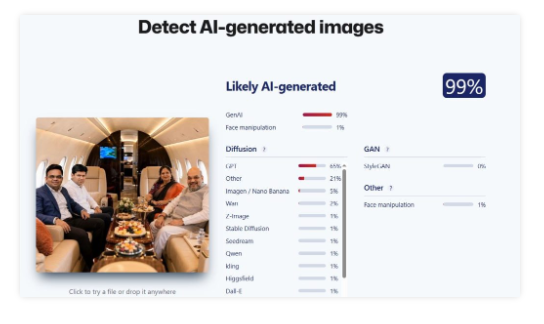
We also tested the image using another AI detection platform called “TruthScan.” This tool likewise suggested, with around 97 percent probability, that the image had been created using artificial intelligence

Conclusion
The reseach found that the viral image featuring Union Home Minister Amit Shah and ICC Chairman Jay Shah inside a chartered aircraft is AI-generated. The image was digitally created using AI tools, and the viral claim associated with it is false.
.webp)
Introduction
As per the National Crime Records Bureau (NCRB) ‘Cyber Crime In India Report 2022’, A total of 65,893 cases were registered under Cyber Crimes, showing an increase of 24.4% in registration in comparison to 52,974 cases registered in 2021. The crime rate increased from 3.9 in 2021 to 4.8 in 2022. During 2022, 64.8% of cyber-crime cases registered were for the motive of fraud (42,710 out of 65,893 cases), followed by Extortion with 5.5% (3,648 cases) and Sexual Exploitation with 5.2% (3,434 cases). The statistics released by NCRB show the increased rate of cyber crimes in the country, which poses a significant question of safety in the online world. The rise in cybercrime indicates a rise in emerging criminal groups with malicious intentions, creating new cybercrime hotspots in the country where these groups target and commit cyber crimes despite limited resources.
Cyber Crime Hotspots
Police have recently arrested several cyber criminals in a specific region, indicating that certain areas have become hotspots for cybercrime. Mewat region is one such hotspot indicating a growing trend of cybercrime operating from this area. The Mewat gang's modus operandi is quite different; Cybercriminals in Mewat scam mobile owners just using smartphones and SIM cards without kingpins and targeting mobile owners. The scammers also lure people through online marketplaces such as OLX, in which they pretend to sell possessions and then either physically lure victims to pick-up locations or scam them virtually.
A study conducted by Future Crime Research Foundation and IIT Kanpur in 2023 has revealed that Jamatara city, once considered the cyber crime capital of India, is no longer the epicentre. The study found that 35 hotspots in India are actively involved in cybercrime activities. The top 10 cybercrime hotspots in India collectively account for 80% of cybercrime-related cases in India. These districts are strategically located near India's capital or closer to the National Capital Region (NCR). These districts are strategically placed with multiple borders, making them easy targets for criminals.
Online financial fraud and social media-related crimes are the most common in India. Cybercriminals exploit data as a gold mine, using it to commit crimes. For instance, they can obtain banking and insurance data, use simple AI tools to cheat victims, and they can easily impersonate identities to lure innocent people. In cybercrime hotspots, sextortion is a modern way for cybercriminals to record and demand money. Loan app fraud, OLX fraud, and job fraud also originate from these specific regions.
Recommendations
To counter the challenges posed by emerging cybercrime hubs, the following recommendations are to be considered:
- Advanced threat Intelligence: The digital landscape is evolving, and the threat landscape is becoming more complex. AI's role in cybersecurity is becoming increasingly critical, both positively and negatively, as it helps in understanding and addressing advanced threats. AI is capable of proactive threat hunting, real-time anomaly detection, and swift incident response.
- Enhancing capabilities of Law Enforcement Agencies: Law enforcement agencies must be sensitised to advanced tools or techniques to investigate cyber crime cases effectively. The development and implementation of advanced forensic tools and technologies need to be utilised or implemented to keep up with the evolving tactics of cybercrime perpetrators.
- Continuous Monitoring: Continuous cybersecurity monitoring is crucial for detecting anomalies and preventing cyber-attacks. It involves analysing systems and data to establish baseline security, identify deviations, and investigate potential threats. Cybersecurity experts use data observability tools, artificial intelligence, and machine learning to detect unexpected dataset changes.
- Cyber Security Awareness: Public awareness needs to be higher. Cybercrime prevention and cybersecurity is a shared responsibility of all of us by being aware of the threats and following the best practices. The frequent interaction between law enforcement and the public is necessary to raise awareness about safeguarding personal and financial information. Effective campaigns on cyber security are necessary to educate netizens.
Safety Tips for Netizens
Install up-to-date security software and firewalls on devices, use strong passwords for accounts, and regularly update software and applications. Be cautious when clicking on links or downloading files from unknown sources, and be cautious of your personal information.
Conclusion
The rise of Cyber Crime Hotspots in specific regions or districts has significantly exacerbated the issue of increasing cybercrime rates. In order to combat cybercrime more effectively, it is necessary for law enforcement agencies to strengthen their coordination between different states and to adapt advanced technology methods to counter cybercrime threats effectively. Moreover, educating netizens about cyber crime threats and providing best practices is an effective method to counter these threats, considered the first line of defense against cybercrime.
References
- https://ncrb.gov.in/uploads/nationalcrimerecordsbureau/custom/1701607577CrimeinIndia2022Book1.pdf
- https://economictimes.indiatimes.com/tech/technology/no-kingpins-just-a-smartphone-and-sim-card-how-cybercriminals-in-mewat-scam-mobile-owners/articleshow/98062889.cms?from=mdr
- https://www.futurecrime.org/fcrf-cyber-crime-survey-2023
- https://timesofindia.indiatimes.com/city/mumbai/jamtara-loses-crown-as-new-remote-districts-rewrite-indias-cybercrime-map/articleshow/104475868.cms?from=mdr
- https://government.economictimes.indiatimes.com/news/secure-india/80-of-cyber-crimes-from-10-new-districts-iit-report/103921338
- https://www.dw.com/en/how-mewat-became-indias-new-hub-for-cyber-criminals/video-68674527
- https://www.indiatoday.in/from-india-today-magazine/story/into-cybercrime-hotspot-india-mewat-rajasthan-haryana-uttar-pradesh-2381545-2023-05-19
- https://frontline.thehindu.com/the-nation/spotlight-how-nuh-district-in-haryana-became-a-breeding-ground-for-cybercriminals/article67098193.ece
- https://www.opindia.com/2024/04/nuh-mewat-cyber-crime-haryana-police-crackdown/#google_vignette

Introduction
Human Trafficking has been a significant concern and threat to society for a very long time. The aspects of our physical safety also have been influenced by human traffickers and the modus operandi they have adopted and deployed over the years. We are always cautious of younger children in regard to trafficking whenever we go out to crowded or unknown places. This concern and threat have also migrated to cyberspace and now pose new and different tangents of threats. These crimes are committed using technology and are further substantiated by different cybercrimes.
What is Cyber-Enabled Human Trafficking?
Cyber-enabled human trafficking is the new evolution of human trafficking in the digital age. Bad actors lure the victims via the internet and use social engineering to exploit their vulnerabilities to get them into their traps. In today's time, crime is often substantiated in lieu of fake job offers and a better lifestyle in new and major metropolitan cities. Now this crime has gone beyond the geographical boundaries of our nation, and often the victims end up in remote locations in the Middle East or South East Asia.
Cybercrime Hubs in Myanmar
The reports have indicated that a lot of trafficked victims are taken down to various cybercrime hubs in Myanmar. The victims are often lured on the pretext of job offers overseas, which pay handsomely. The victims make their way into the foreign nation but are then cornered by the bad actors and are segregated and taken into different hubs. The victims are often school graduates and seek basic jobs for their earnings. The victims are taken into Cybercrime hubs which Chinese syndicate criminals allegedly run.The victims are kept in tough conditions, beaten up, and held captive in remote jungles. Once the victim has lost hope, the criminals train them to commit cyber frauds like phishing. The victims are given scripts and mobile numbers to commit cybercrimes. The victims are given targets to ensure their survival, and due to the dark and threatening conditions, the victims just give up on the demands just to remain alive. Some of the victims make their way back home as well, but that is after 6-7 years of such constant torture and abuse to commit cybercrimes. The majority of such survivors face trouble seeking legal assistance as the criminals are almost impossible to track, thus making redressal for crimes and rehabilitation for survivors tough.
How to stay safe?
The criminals in such acts often target the vulnerable sector of the population, these people generally hail from tier 3 towns and rural areas. These victims aspire for a better life and earning opportunities, and due to less education and minimal awareness, they fail to see the traps set by the victims. The population at large can deploy the following measures and safe practices to avoid such horrific threats-
- Avoid Stranger interaction: Avoid interacting with strangers on any online platform or portal. Social media sites are the most used platforms by bad actors to make contact with potential victims.
- Do not Share: Avoid sharing any personal information with anyone online, and avoid filling out third-party surveys/forms seeking personal information.
- Check, Check and Recheck: Always be on alert for threats and always check and cross-check any link or platform you use or access.
- Too good to be true: If something feels like Too good to be true, it probably is and hence avoid falling for attractive job offers and work-from-home opportunities on social media platforms.
- Know your helplines: One should know the helpline numbers to make sure to exercise the reporting duty and also encourage your family members to report in case of any threat or issue.
- Raise Awareness: It is the duty of all netizens to raise awareness in society to arm more people against cybercrimes and fraud.
Conclusion
The name of cybercriminals is spreading all across the ecosystems, and now the technology is being deployed by such bad actors to even substantiate physical crimes. We need to be on alert and remain aware of such crimes and the modus Operandi of cyber criminals. Awareness and education are our best weapons to combat the threats and issues of cyber-enabled human trafficking, as the criminals feed on our vulnerabilities, lets eradicate them for once and for all and work towards creating a wholesome safe cyber ecosystem for all.https://www.scmp.com/week-asia/politics/article/3228543/inside-chinese-run-crime-hubs-myanmar-are-conning-world-we-can-kill-you-here
