
#FactCheck: IIT Baba Abhay Singh Is Alive; False Death Claim Debunked by Hisar Police
Executive Summary
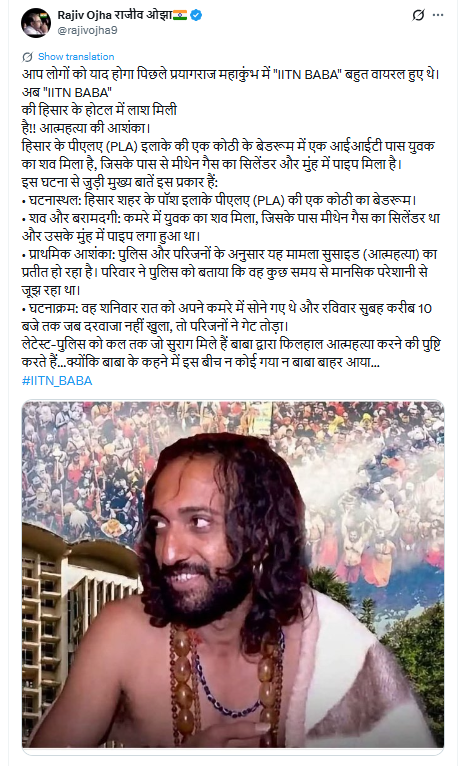
A social media post is being shared claiming that the body of IIT Baba Abhay Singh has been found in Hisar. The viral post also features a photograph of Abhay Singh, popularly known as IIT Baba. The caption accompanying the post reads, “The body of #IITian Baba was found in a bedroom in Hisar, along with a methane gas cylinder and a pipe in his mouth; suicide is suspected… Further details will emerge as the investigation progresses.”
CyberPeace Research found that the claim about IIT Baba Abhay Singh’s death is false.
Claim:
Social media users are claiming that ‘IITian Baba’, who came into the limelight during the Prayagraj Maha Kumbh, died by suicide in Hisar. The post alleges that his body was found in a room at a house in the PLA area of Hisar, with preliminary information suggesting that the police suspect suicide.
https://x.com/rajivojha9/status/2110238805177585752
https://archive.ph/submit/?url
Fact Check
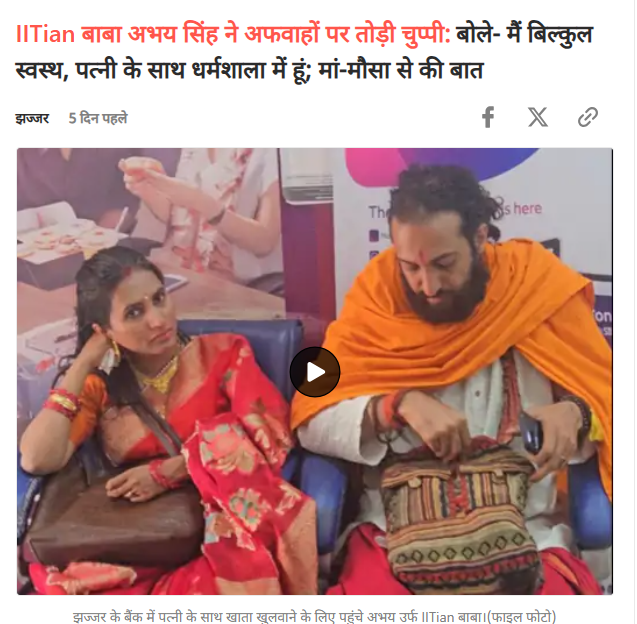
To verify the claim that IIT Baba Abhay Singh’s body was found in Hisar, we first conducted a Google search using relevant keywords. However, we did not find any credible media reports confirming his death. During the search, we came across a report published on the Dainik Bhaskar website on October 15, 2026, which stated that Abhay Singh, popularly known as IIT Baba, is alive and currently in Dharamshala, Himachal Pradesh, with his wife.
According to the Dainik Bhaskar report, IIT Baba Abhay Singh denied the rumours of his death during a conversation. The report also stated that he had spoken to his family members amid the circulation of these rumours.
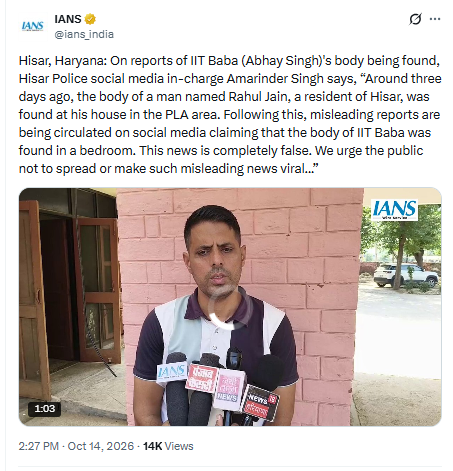
During our research, we found a video posted on the official X account of news agency IANS on October 14, 2026. In the video, Hisar Police social media in-charge Amarinder Singh clarified while speaking to the media that the claim circulating on social media about IIT Baba Abhay Singh’s death was
false.He explained that three days earlier, the body of a local resident named Rahul Jain had been found at his residence in the PLA area of Hisar, following which rumours about IIT Baba Abhay Singh’s death began circulating on social media. Amarinder Singh also appealed to people not to share misleading information.
https://x.com/ians_india/status/2110293986904768641?s=20
Conclusion
The evidence gathered during our research confirms that the claim that IIT Baba Abhay Singh’s body was found in Hisar is false. Hisar Police also refuted the claim after reports of his death went viral on social media.

Related Blogs

Introduction
Deepfake have become a source of worry in an age of advanced technology, particularly when they include the manipulation of public personalities for deceitful reasons. A deepfake video of cricket star Sachin Tendulkar advertising a gaming app recently went popular on social media, causing the sports figure to deliver a warning against the widespread misuse of technology.
Scenario of Deepfake
Sachin Tendulkar appeared in the deepfake video supporting a game app called Skyward Aviator Quest. The app's startling quality has caused some viewers to assume that the cricket legend is truly supporting it. Tendulkar, on the other hand, has resorted to social media to emphasise that these videos are phony, highlighting the troubling trend of technology being abused for deceitful ends.
Tendulkar's Reaction
Sachin Tendulkar expressed his worry about the exploitation of technology and advised people to report such videos, advertising, and applications that spread disinformation. This event emphasises the importance of raising knowledge and vigilance about the legitimacy of material circulated on social media platforms.
The Warning Signs
The deepfake video raises questions not just for its lifelike representation of Tendulkar, but also for the material it advocates. Endorsing gaming software that purports to help individuals make money is a significant red flag, especially when such endorsements come from well-known figures. This underscores the possibility of deepfakes being utilised for financial benefit, as well as the significance of examining information that appears to be too good to be true.
How to Protect Yourself Against Deepfakes
As deepfake technology advances, it is critical to be aware of potential signals of manipulation. Here are some pointers to help you spot deepfake videos:
- Look for artificial facial movements and expressions, as well as lip sync difficulties.
- Body motions and Posture: Take note of any uncomfortable body motions or discrepancies in the individual's posture.
- Lip Sync and Audio Quality: Look for mismatches between the audio and lip motions.
- background and Content: Consider the video's background, especially if it has a popular figure supporting something in an unexpected way.
- Verify the legitimacy of the video by verifying the official channels or accounts of the prominent person.
Conclusion
The popularity of deepfake videos endangers the legitimacy of social media material. Sachin Tendulkar's response to the deepfake in which he appears serves as a warning to consumers to remain careful and report questionable material. As technology advances, it is critical that individuals and authorities collaborate to counteract the exploitation of AI-generated material and safeguard the integrity of online information.
Reference
- https://www.news18.com/tech/sachin-tendulkar-disturbed-by-his-new-deepfake-video-wants-swift-action-8740846.html
- https://www.livemint.com/news/india/sachin-tendulkar-becomes-latest-victim-of-deepfake-video-disturbing-to-see-11705308366864.html
Executive Summary
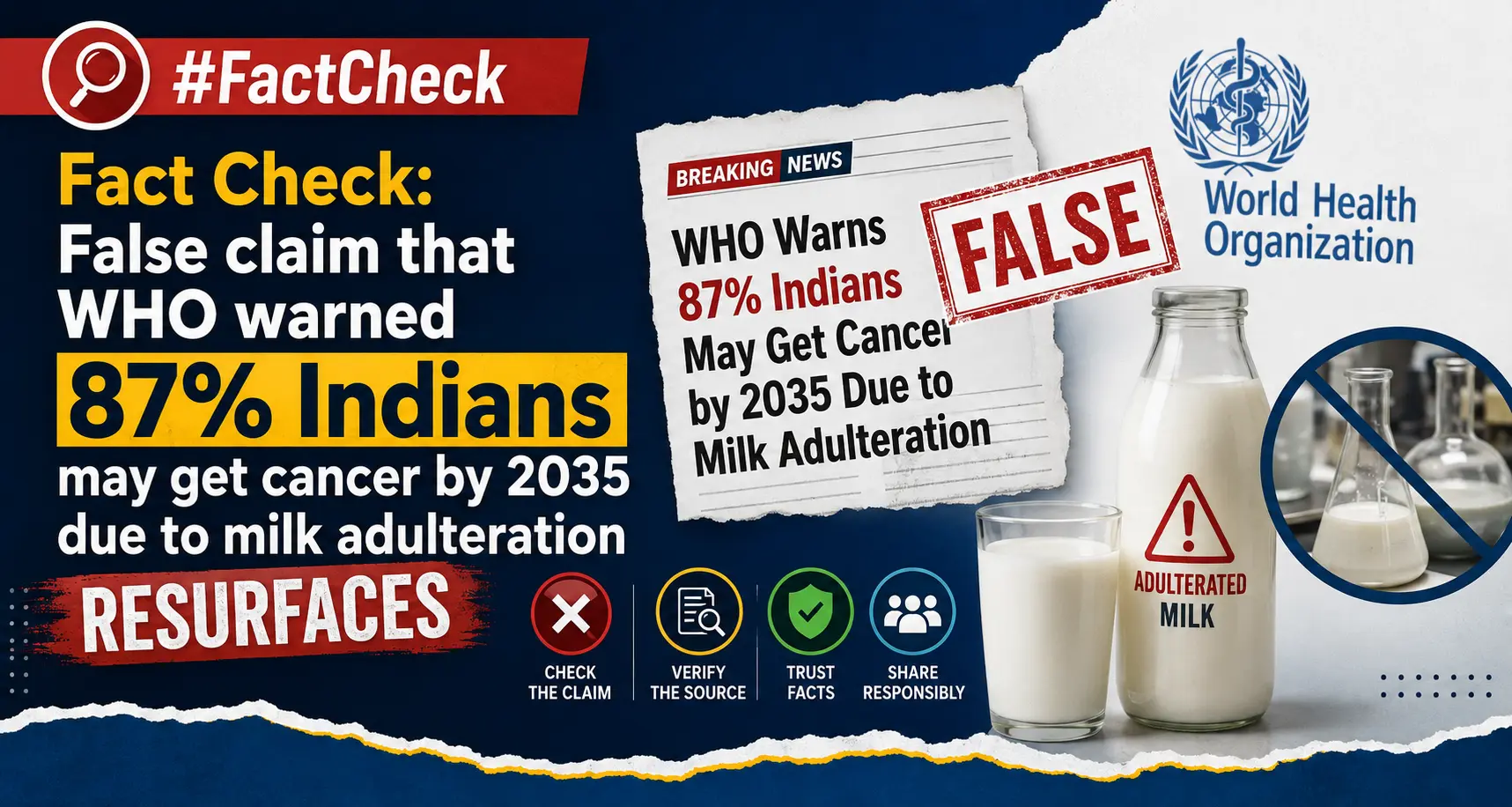
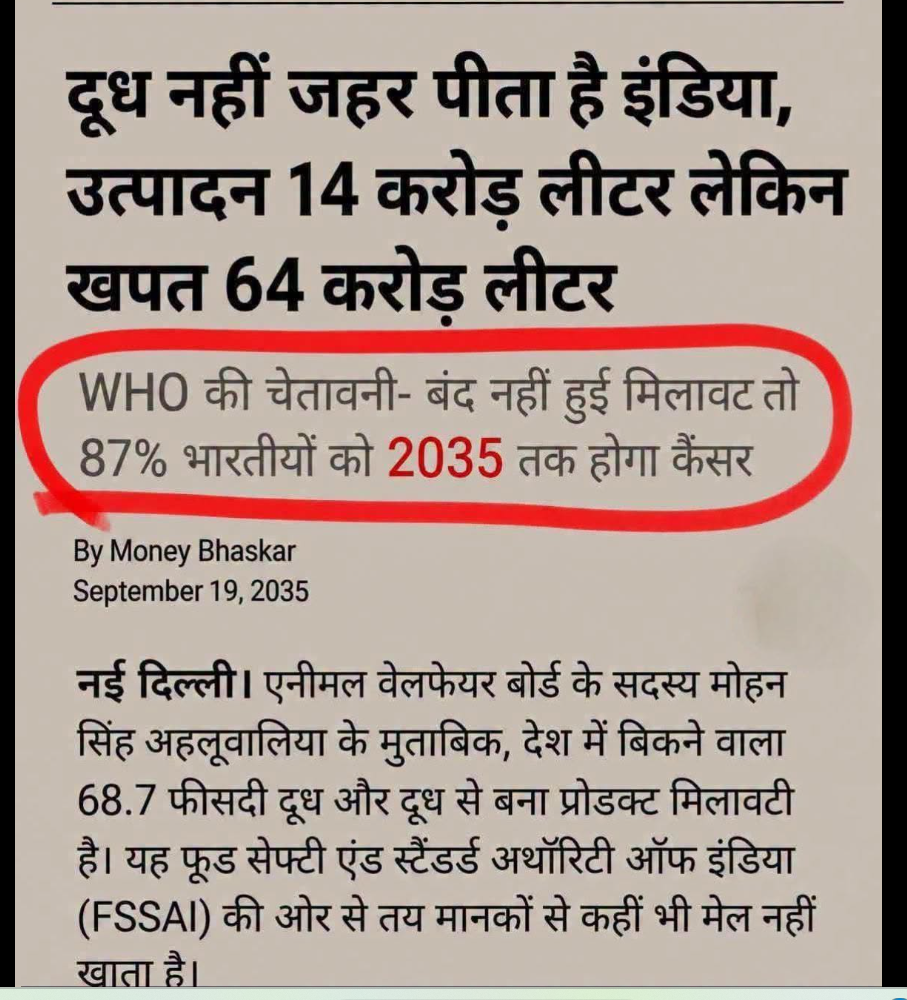
A post is going viral across various social media platforms claiming that the World Health Organization (WHO) has issued a warning over the issue of adulteration in food products. According to the claim, WHO has warned that milk adulteration is continuously increasing in India and if it continues, 87 percent of Indians will suffer from cancer by 2035. CyberPeace Research Wing’s research found that the viral claim has been circulating on social media for several years. Earlier, the same claim was shared with the year changed to 2025, stating that 87 percent of Indians would suffer from cancer by that year. Now, the year has been changed from 2025 to 2035 and the claim is being circulated again. WHO has repeatedly denied this claim and termed it fake news.
Claim:
A Facebook user named ‘Vikalp Kuchamancity’ shared the viral post on August 3, 2026, with a caption claiming, “India produces 14 crore litres of milk, but consumption is 64 crore litres. Where does this extra milk come from? WHO has warned that if adulteration is not stopped, 87 percent of Indians may suffer from cancer by 2035.”
https://www.facebook.com/photo/?fbid=968660469565357&set=a.109816988783047
Fact Check:
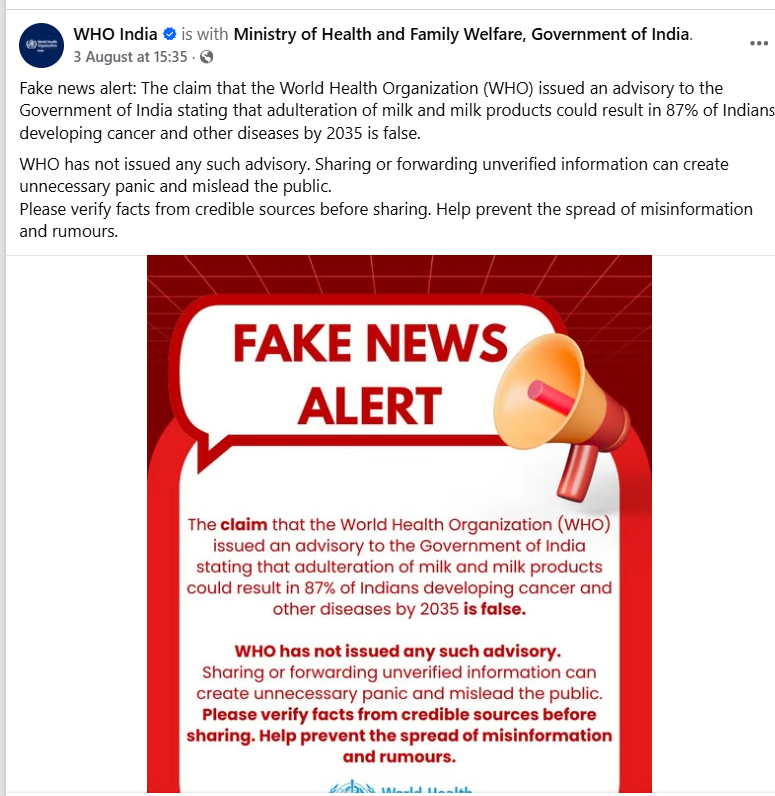
While examining the viral post, we noticed that the report displayed in the image carries the date September 19, 2035, even though the current year is 2026. This raised initial doubts about the authenticity of the claim.To investigate further, we conducted a Google search using relevant keywords. During the search, we found a post from the official Facebook page of WHO India, shared on August 3, 2026. The post denied the viral claim and stated that it is false that WHO issued any advisory to the Indian government warning that adulteration in milk and dairy products could lead to cancer and other diseases among 87 percent of Indians by 2035. WHO clarified that no such advisory has been issued.
WHO India Facebook link:
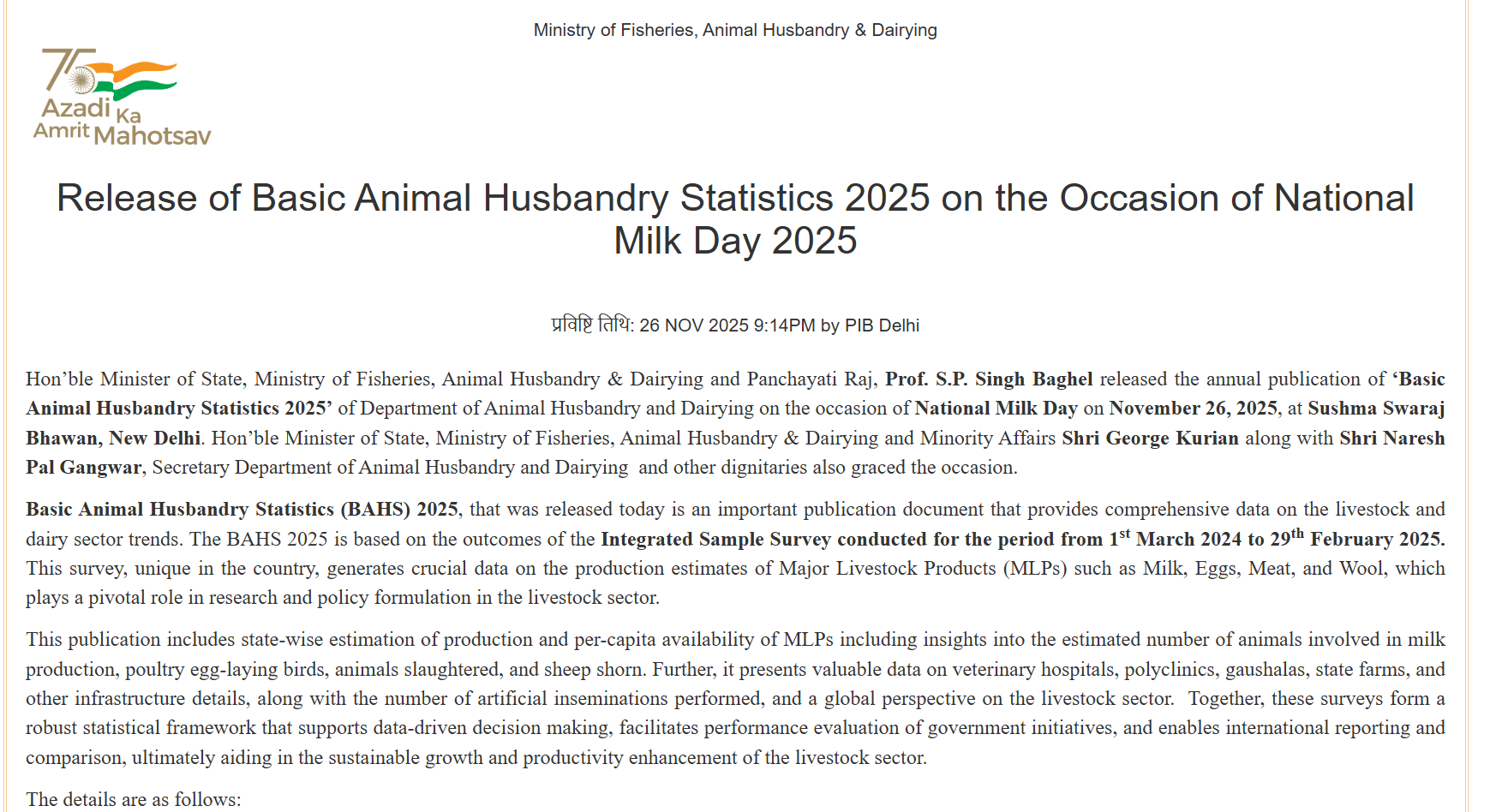
According to data mentioned in a press release issued by the Government of India on November 26, 2025, the country’s total milk production was estimated at 247.87 million tonnes in 2024-25, compared to 239.30 million tonnes in 2023-24. The per capita availability of milk increased from 319 grams per day in 2014-15 to 485 grams per day in 2024-25. The top five milk-producing states are Uttar Pradesh (15.66%), Rajasthan (14.82%), Madhya Pradesh (9.12%), Gujarat (7.78%), and Maharashtra (6.71%). Together, these states contribute 54.09% of India’s total milk production.
https://www.pib.gov.in/PressReleasePage.aspx?PRID=2195049®=3&lang=2
Conclusion:
The research confirmed that there is no evidence of any WHO warning stating that 87 percent of Indians could develop cancer by 2035 due to milk adulteration. WHO has clarified that it has not issued any such advisory. The viral claim is a recycled false claim that has been repeatedly circulated with changed dates.

Introduction
In September 2025, social media feeds were flooded with strikingly vintage saree-type portraits. These images were not taken by professional photographers, but AI-generated images. More than a million people turned to the "Nano Banana" AI tool of Google Gemini, uploading their ordinary selfies and watching them transform into Bollywood-style, cinematic, 1990s posters. The popularity of this trend is evident, as are the concerns of law enforcement agencies and cybersecurity experts regarding risks of infringement of privacy, unauthorised data sharing, and threats related to deepfake misuse.
What is the Trend?
This trend in AI sarees is created using Google Geminis' Nano Banana image-editing tool, editing and morphing uploaded selfies into glitzy vintage portraits in traditional Indian attire. A user would upload a clear photograph of a solo subject and enter prompts to generate images of cinematic backgrounds, flowing chiffon sarees, golden-hour ambience, and grainy film texture, reminiscent of classic Bollywood imagery. Since its launch, the tool has processed over 500 million images, with the saree trend marking one of its most popular uses. Photographs are uploaded to an AI system, which uses machine learning to alter the pictures according to the description specified. The transformed AI portraits are then shared by users on their Instagram, WhatsApp, and other social media platforms, thereby contributing to the viral nature of the trend.
Law Enforcement Agency Warnings
- A few Indian police agencies have issued strong advisories against participation in such trends. IPS Officer VC Sajjanar warned the public: "The uploading of just one personal photograph can make greedy operators go from clicking their fingers to joining hands with criminals and emptying one's bank account." His advisory had further warned that sharing personal information through trending apps can lead to many scams and fraud.
- Jalandhar Rural Police issued a comprehensive warning stating that such applications put the user at risk of identity theft and online fraud when personal pictures are uploaded. A senior police officer stated: "Once sensitive facial data is uploaded, it can be stored, analysed, and even potentially misused to open the way for cyber fraud, impersonation, and digital identity crimes.
The Cyber Crime Police also put out warnings on social media platforms regarding how photo applications appear entertaining but can pose serious risks to user privacy. They specifically warned that selfies uploaded can lead to data misuse, deepfake creation, and the generation of fake profiles, which are punishable under Sections 66C and 66D of the IT Act 2000.
Consequences of Such Trends
The massification of AI photo trends has several severe effects on private users and society as a whole. Identity fraud and theft are the main issues, as uploaded biometric information can be used by hackers to generate imitated identities, evading security measures or committing financial fraud. The facial recognition information shared by means of these trends remains a digital asset that could be abused years after the trend has passed. ‘Deepfake’ production is another tremendous threat because personal images shared on AI platforms can be utilised to create non-consensual artificial media. Studies have found that more than 95,000 deepfake videos circulated online in 2023 alone, a 550% increase from 2019. The images uploaded can be leveraged to produce embarrassing or harmful content that can cause damage to personal reputation, relationships, and career prospects.
Financial exploitation is also when fake applications in the guise of genuine AI tools strip users of their personal data and financial details. Such malicious platforms tend to look like well-known services so as to trick users into divulging sensitive information. Long-term privacy infringement also comes about due to the permanent retention and possible commercial exploitation of personal biometric information by AI firms, even when users close down their accounts.
Privacy Risks
A few months ago, the Ghibli trend went viral, and now this new trend has taken over. Such trends may subject users to several layers of privacy threats that go far beyond the instant gratification of taking pleasing images. Harvesting of biometric data is the most critical issue since facial recognition information posted on these sites becomes inextricably linked with user identities. Under Google's privacy policy for Gemini tools, uploaded images might be stored temporarily for processing and may be kept for longer periods if used for feedback purposes or feature development.
Illegal data sharing happens when AI platforms provide user-uploaded content to third parties without user consent. A Mozilla Foundation study in 2023 discovered that 80% of popular AI apps had either non-transparent data policies or obscured the ability of users to opt out of data gathering. This opens up opportunities for personal photographs to be shared with anonymous entities for commercial use. Exploitation of training data includes the use of personal photos uploaded to enhance AI models without notifying or compensating users. Although Google provides users with options to turn off data sharing within privacy settings, most users are ignorant of these capabilities. Integration of cross-platform data increases privacy threats when AI applications use data from interlinked social media profiles, providing detailed user profiles that can be taken advantage of for purposeful manipulation or fraud. Inadequacy of informed consent continues to be a major problem, with users engaging in trends unaware of the entire context of sharing information. Studies show that 68% of individuals show concern regarding the misuse of AI app data, but 42% use these apps without going through the terms and conditions.
CyberPeace Expert Recommendations
While the Google Gemini image trend feature operates under its own terms and conditions, it is important to remember that many other tools and applications allow users to generate similar content. Not every platform can be trusted without scrutiny, so users who engage in such trends should do so only on trustworthy platforms and make reliable, informed choices. Above all, following cybersecurity best practices and digital security principles remains essential.
Here are some best practices:-
1.Immediate Protection Measures for User
In a nutshell, protection of personal information may begin by not uploading high-resolution personal photos into AI-based applications, especially those trained for facial recognition. Instead, a person can play with stock images or non-identifiable pictures to the degree that it satisfies the program's creative features without compromising biometric security. Strong privacy settings should exist on every social media platform and AI app by which a person can either limit access to their data, content, or anything else.
2.Organisational Safeguards
AI governance frameworks within organisations should enumerate policies regarding the usage of AI tools by employees, particularly those concerning the upload of personal data. Companies should appropriately carry out due diligence before the adoption of an AI product made commercially available for their own use in order to ensure that such a product has its privacy and security levels as suitable as intended by the company. Training should instruct employees regarding deepfake technology.
3.Technical Protection Strategies
Deepfake detection software should be used. These tools, which include Microsoft Video Authenticator, Intel FakeCatcher, and Sensity AI, allow real-time detection with an accuracy higher than 95%. Use blockchain-based concepts to verify content to create tamper-proof records of original digital assets so that the method of proposing deepfake content as original remains very difficult.
4.Policy and Awareness Initiatives
For high-risk transactions, especially in banks and identity verification systems, authentication should include voice and face liveness checks to ensure the person is real and not using fake or manipulated media. Implement digital literacy programs to empower users with knowledge about AI threats, deepfake detection techniques, and safe digital practices. Companies should also liaise with law enforcement, reporting purported AI crimes, thus offering assistance in combating malicious applications of synthetic media technology.
5.Addressing Data Transparency and Cross-Border AI Security
Regulatory systems need to be called for requiring the transparency of data policies in AI applications, along with providing the rights and choices to users regarding either Biometric data or any other data. Promotion must be given to the indigenous development of AI pertaining to India-centric privacy concerns, assuring the creation of AI models in a secure, transparent, and accountable manner. In respect of cross-border AI security concerns, there must be international cooperation for setting common standards of ethical design, production, and use of AI. With the virus-like contagiousness of AI phenomena such as saree editing trends, they portray the potential and hazards of the present-day generation of artificial intelligence. While such tools offer newer opportunities, they also pose grave privacy and security concerns, which should have been considered quite some time ago by users, organisations, and policy-makers. Through the setting up of all-around protection mechanisms and keeping an active eye on digital privacy, both individuals and institutions will reap the benefits of this AI innovation, and they shall not fall on the darker side of malicious exploitation.
References
- https://www.hindustantimes.com/trending/amid-google-gemini-nano-banana-ai-trend-ips-officer-warns-people-about-online-scams-101757980904282.html%202
- https://www.moneycontrol.com/news/india/viral-banana-ai-saree-selfies-may-risk-fraud-warn-jalandhar-rural-police-13549443.html
- https://www.parliament.nsw.gov.au/researchpapers/Documents/Sexually%20explicit%20deepfakes.pdf
- https://www.mckinsey.com/capabilities/quantumblack/our-insights/the-state-of-ai-in-2023-generative-ais-breakout-year
- https://www.mckinsey.com/capabilities/quantumblack/our-insights/the-state-of-ai-in-2023-generative-ais-breakout-year
- https://socradar.io/top-10-ai-deepfake-detection-tools-2025/
