
#FactCheck- Viral Kapil Mishra Video on 50% Attendance Not Recent
Executive Summary
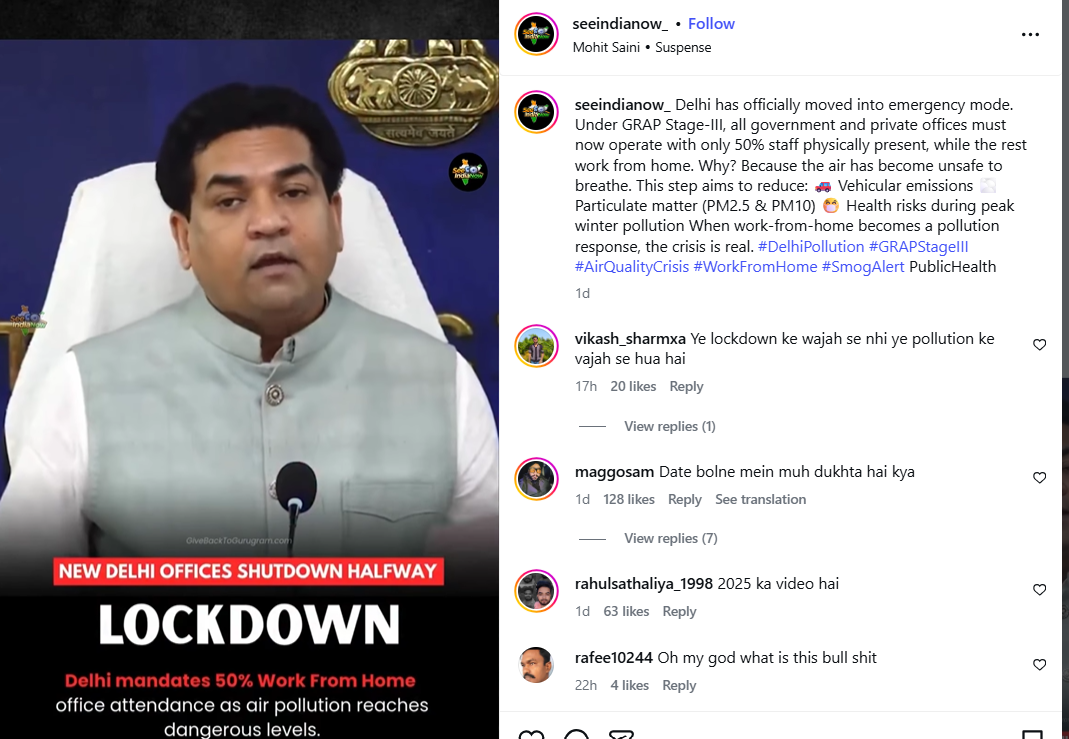
A video of Delhi government cabinet minister Kapil Mishra is being shared on social media. In the clip, he can be heard saying that from the next day, only 50 percent attendance will be allowed in offices, while the remaining 50 percent employees will work from home. He also states that all institutions must comply with this. Users are sharing the video as a recent development. However, a study by the CyberPeace found the viral claim to be misleading. Our research revealed that the video is not recent but dates back to December 2025.
Claim:
An Instagram user shared the viral video on March 24, 2026. The link to the post is given below.
Fact Check:
To verify the claim, we conducted a keyword search on Google. During this process, we found a report published on December 17, 2025, on NDTV Hindi. According to the report, the Delhi government had made 50 percent work-from-home mandatory in government offices due to severe air pollution. Additional restrictions were also imposed under GRAP Stage IV.

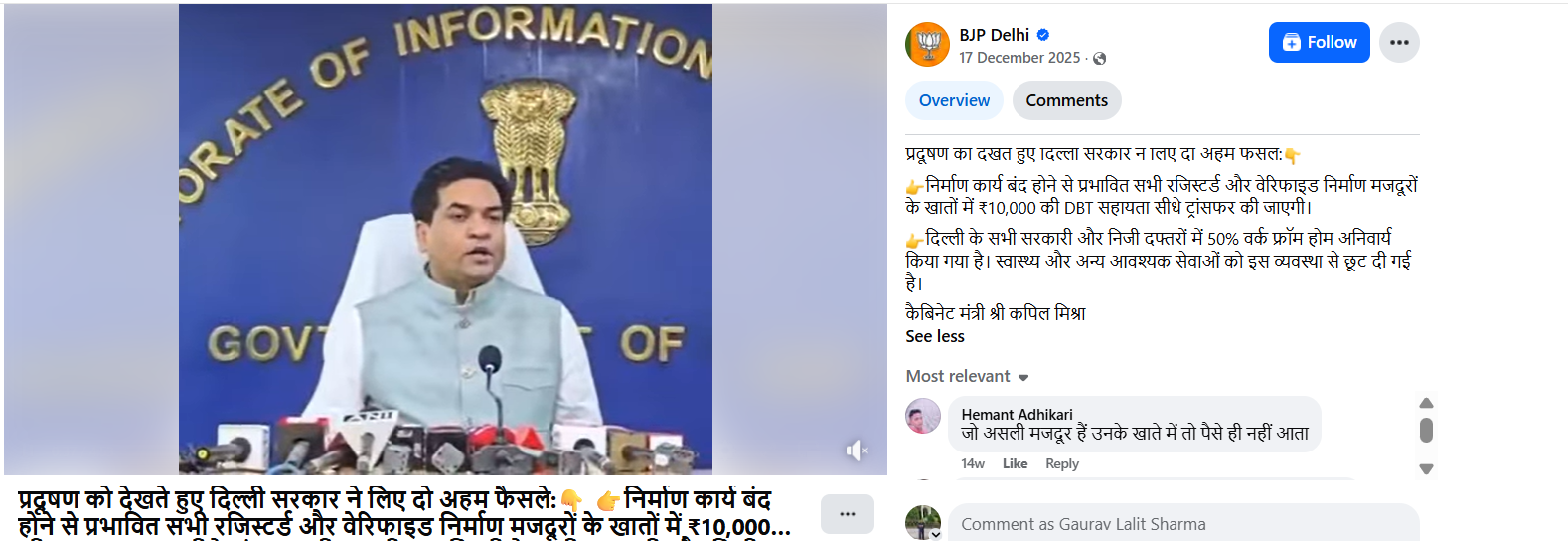
Further, we found the original video on the official social media handle of BJP Delhi. In this video, Kapil Mishra can be heard stating that 50 percent work-from-home has been made mandatory in all government and private offices in Delhi, while health and other essential services have been exempted from this arrangement.
Conclusion:
Our research found that the viral video is not recent. It is from December 2025 and is being shared with a misleading claim.

Related Blogs

Introduction
In an era when misinformation spreads like wildfire across the digital landscape, the need for effective strategies to counteract these challenges has grown exponentially in a very short period. Prebunking and Debunking are two approaches for countering the growing spread of misinformation online. Prebunking empowers individuals by teaching them to discern between true and false information and acts as a protective layer that comes into play even before people encounter malicious content. Debunking is the correction of false or misleading claims after exposure, aiming to undo or reverse the effects of a particular piece of misinformation. Debunking includes methods such as fact-checking, algorithmic correction on a platform, social correction by an individual or group of online peers, or fact-checking reports by expert organisations or journalists. An integrated approach which involves both strategies can be effective in countering the rapid spread of misinformation online.
Brief Analysis of Prebunking
Prebunking is a proactive practice that seeks to rebut erroneous information before it spreads. The goal is to train people to critically analyse information and develop ‘cognitive immunity’ so that they are less likely to be misled when they do encounter misinformation.
The Prebunking approach, grounded in Inoculation theory, teaches people to recognise, analyse and avoid manipulation and misleading content so that they build resilience against the same. Inoculation theory, a social psychology framework, suggests that pre-emptively conferring psychological resistance against malicious persuasion attempts can reduce susceptibility to misinformation across cultures. As the term suggests, the MO is to help the mind in the present develop resistance to influence that it may encounter in the future. Just as medical vaccines or inoculations help the body build resistance to future infections by administering weakened doses of the harm agent, inoculation theory seeks to teach people fact from fiction through exposure to examples of weak, dichotomous arguments, manipulation tactics like emotionally charged language, case studies that draw parallels between truths and distortions, and so on. In showing people the difference, inoculation theory teaches them to be on the lookout for misinformation and manipulation even, or especially, when they least expect it.
The core difference between Prebunking and Debunking is that while the former is preventative and seeks to provide a broad-spectrum cover against misinformation, the latter is reactive and focuses on specific instances of misinformation. While Debunking is closely tied to fact-checking, Prebunking is tied to a wider range of specific interventions, some of which increase motivation to be vigilant against misinformation and others increase the ability to engage in vigilance with success.
There is much to be said in favour of the Prebunking approach because these interventions build the capacity to identify misinformation and recognise red flags However, their success in practice may vary. It might be difficult to scale up Prebunking efforts and ensure their reach to a larger audience. Sustainability is critical in ensuring that Prebunking measures maintain their impact over time. Continuous reinforcement and reminders may be required to ensure that individuals retain the skills and information they gained from the Prebunking training activities. Misinformation tactics and strategies are always evolving, so it is critical that Prebunking interventions are also flexible and agile and respond promptly to developing challenges. This may be easier said than done, but with new misinformation and cyber threats developing frequently, it is a challenge that has to be addressed for Prebunking to be a successful long-term solution.
Encouraging people to be actively cautious while interacting with information, acquire critical thinking abilities, and reject the effect of misinformation requires a significant behavioural change over a relatively short period of time. Overcoming ingrained habits and prejudices, and countering a natural reluctance to change is no mean feat. Developing a widespread culture of information literacy requires years of social conditioning and unlearning and may pose a significant challenge to the effectiveness of Prebunking interventions.
Brief Analysis of Debunking
Debunking is a technique for identifying and informing people that certain news items or information are incorrect or misleading. It seeks to lessen the impact of misinformation that has already spread. The most popular kind of Debunking occurs through collaboration between fact-checking organisations and social media businesses. Journalists or other fact-checkers discover inaccurate or misleading material, and social media platforms flag or label it. Debunking is an important strategy for curtailing the spread of misinformation and promoting accuracy in the digital information ecosystem.
Debunking interventions are crucial in combating misinformation. However, there are certain challenges associated with the same. Debunking misinformation entails critically verifying facts and promoting corrected information. However, this is difficult owing to the rising complexity of modern tools used to generate narratives that combine truth and untruth, views and facts. These advanced approaches, which include emotional spectrum elements, deepfakes, audiovisual material, and pervasive trolling, necessitate a sophisticated reaction at all levels: technological, organisational, and cultural.
Furthermore, It is impossible to debunk all misinformation at any given time, which effectively means that it is impossible to protect everyone at all times, which means that at least some innocent netizens will fall victim to manipulation despite our best efforts. Debunking is inherently reactive in nature, addressing misinformation after it has grown extensively. This reactionary method may be less successful than proactive strategies such as Prebunking from the perspective of total harm done. Misinformation producers operate swiftly and unexpectedly, making it difficult for fact-checkers to keep up with the rapid dissemination of erroneous or misleading information. Debunking may need continuous exposure to fact-check to prevent erroneous beliefs from forming, implying that a single Debunking may not be enough to rectify misinformation. Debunking requires time and resources, and it is not possible to disprove every piece of misinformation that circulates at any particular moment. This constraint may cause certain misinformation to go unchecked, perhaps leading to unexpected effects. The misinformation on social media can be quickly spread and may become viral faster than Debunking pieces or articles. This leads to a situation in which misinformation spreads like a virus, while the antidote to debunked facts struggles to catch up.
Prebunking vs Debunking: Comparative Analysis
Prebunking interventions seek to educate people to recognise and reject misinformation before they are exposed to actual manipulation. Prebunking offers tactics for critical examination, lessening the individuals' susceptibility to misinformation in a variety of contexts. On the other hand, Debunking interventions involve correcting specific false claims after they have been circulated. While Debunking can address individual instances of misinformation, its impact on reducing overall reliance on misinformation may be limited by the reactive nature of the approach.
.png)
CyberPeace Policy Recommendations for Tech/Social Media Platforms
With the rising threat of online misinformation, tech/social media platforms can adopt an integrated strategy that includes both Prebunking and Debunking initiatives to be deployed and supported on all platforms to empower users to recognise the manipulative messaging through Prebunking and be aware of the accuracy of misinformation through Debunking interventions.
- Gamified Inoculation: Tech/social media companies can encourage gamified inoculation campaigns, which is a competence-oriented approach to Prebunking misinformation. This can be effective in helping people immunise the receiver against subsequent exposures. It can empower people to build competencies to detect misinformation through gamified interventions.
- Promotion of Prebunking and Debunking Campaigns through Algorithm Mechanisms: Tech/social media platforms may promote and guarantee that algorithms prioritise the distribution of Prebunking materials to users, boosting educational content that strengthens resistance to misinformation. Platform operators should incorporate algorithms that prioritise the visibility of Debunking content in order to combat the spread of erroneous information and deliver proper corrections; this can eventually address and aid in Prebunking and Debunking methods to reach a bigger or targeted audience.
- User Empowerment to Counter Misinformation: Tech/social media platforms can design user-friendly interfaces that allow people to access Prebunking materials, quizzes, and instructional information to help them improve their critical thinking abilities. Furthermore, they can incorporate simple reporting tools for flagging misinformation, as well as links to fact-checking resources and corrections.
- Partnership with Fact-Checking/Expert Organizations: Tech/social media platforms can facilitate Prebunking and Debunking initiatives/campaigns by collaborating with fact-checking/expert organisations and promoting such initiatives at a larger scale and ultimately fighting misinformation with joint hands initiatives.
Conclusion
The threat of online misinformation is only growing with every passing day and so, deploying effective countermeasures is essential. Prebunking and Debunking are the two such interventions. To sum up: Prebunking interventions try to increase resilience to misinformation, proactively lowering susceptibility to erroneous or misleading information and addressing broader patterns of misinformation consumption, while Debunking is effective in correcting a particular piece of misinformation and having a targeted impact on belief in individual false claims. An integrated approach involving both the methods and joint initiatives by tech/social media platforms and expert organizations can ultimately help in fighting the rising tide of online misinformation and establishing a resilient online information landscape.
References
- https://mark-hurlstone.github.io/THKE.22.BJP.pdf
- https://futurefreespeech.org/wp-content/uploads/2024/01/Empowering-Audiences-Through-%E2%80%98Prebunking-Michael-Bang-Petersen-Background-Report_formatted.pdf
- https://newsreel.pte.hu/news/unprecedented_challenges_Debunking_disinformation
- https://misinforeview.hks.harvard.edu/article/global-vaccination-badnews/

Introduction
In a setback to the Centre, the Bombay High Court on Friday 20th September 2024, struck down the provisions under IT Amendment Rules 2023, which empowered the Central Government to establish Fact Check Units (FCUs) to identify ‘fake and misleading’ information about its business on social media platforms.
Chronological Overview
- On 6th April 2023, the Ministry of Electronics and Information Technology (MeitY) notified the Information Technology (Intermediary Guidelines and Digital Media Ethics Code) Amendment Rules, 2023 (IT Amendment Rules, 2023). These rules introduced new provisions to establish a fact-checking unit with respect to “any business of the central government”. This amendment was done In exercise of the powers conferred by section 87 of the Information Technology Act, 2000. (IT Act).
- On 20 March 2024, the Central Government notified the Press Information Bureau (PIB) as FCU under rule 3(1)(b)(v) of the Information Technology (Intermediary Guidelines and Digital Media Ethics Code) Amendment Rules 2023 (IT Amendment Rules 2023).
- The next day on 21st March 2024, the Supreme Court stayed the Centre's decision on notifying PIB -FCU, considering the pendency of the proceedings before the High Court of Judicature at Bombay. A detailed analysis covered by CyberPeace on the Supreme Court Stay decision can be accessed here.
- In the latest development, the Bombay High Court on 20th September 2024, struck down the provisions under IT Amendment Rules 2023, which empowered the Central Government to establish Fact Check Units (FCUs) to identify ‘fake and misleading’ information about its business on social media platforms.
Brief Overview of Bombay High Court decision dated 20th September 2024
Justice AS Chandurkar was appointed as the third judge after a split verdict in January 2023 by a division bench consisting of Justices Gautam Patel and Neela Gokhal. As a Tie-breaker judge' Justice AS Chandurkar delivered the decision striking down provisions for setting up a Fact Check Unit under IT amendment 2023 rules. Striking down the Centre's proposed fact check unit provision, Justice A S Chandurkar of Bombay High Court also opined that there was no rationale to undertake an exercise in determining whether information related to the business of the Central govt was fake or false or misleading when in digital form but not doing the same when such information was in print. It was also contended that there is no justification to introduce an FCU only in relation to the business of the Central Government. Rule 3(1)(b)(v) has a serious chilling effect on the exercise of the freedom of speech and expression under Article 19(1)(a) of the Constitution since the communication of the view of the FCU will result in the intermediary simply pulling down the content for fear of consequences or losing the safe harbour provision given under IT Act.
Justice Chandurkar held that the expressions ‘fake, false or misleading’ are ‘vague and overbroad’, and that the ‘test of proportionality’ is not satisfied. Rule 3(1)(b)(v), was violative of Articles 14 and 19 (1) (a) and 19 (1) (g) of the Constitution and it is “ultra vires”, or beyond the powers, of the IT Act.
Role of Expert Organisations in Curbing Mis/Disinformation and Fake News
In light of the recent developments, and the rising incidents of Mis/Disinformation and Fake News it becomes significantly important that we all stand together in the fight against these challenges. The actions against Mis/Disinformation and fake news should be strengthened by collective efforts, the expert organisations like CyberPeace Foundation plays an key role in enabling and encouraging netizens to exercise caution and rely on authenticated sources, rather than solely rely on govt FCU to block the content.
Mis/Disinformation and Fake News should be stopped, identified and countered by netizens at the very first stage of its spread. In light of the Bombay High Court's decision to stuck down the provision related to setting up the FCU by the Central Government, it entails that the government's intention to address misinformation related solely to its business/operations may not have been effectively communicated in the eyes of the judiciary.
It is high time to exercise collective efforts against Mis/Disinformation and Fake News and support expert organizations who are actively engaged in conducting proactive measures, and campaigns to target these challenges, specifically in the online information landscape. CyberPeace actively publishes fact-checking reports and insights on Prebunking and Debunking, conducts expert sessions and takes various key steps aimed at empowering netizens to build cognitive defences to recognise the susceptible information, disregard misleading claims and prevent further spreads to ensure the true online information landscape.
References:
- https://www.scconline.com/blog/post/2024/09/20/bombay-high-court-it-rules-amendment-2023-fact-check-units-article14-article19-legal-news/#:~:text=Bombay%20High%20Court%3A%20A%20case,grounds%20that%20it%20violated%20constitutional
- https://indianexpress.com/article/cities/mumbai/bombay-hc-strikes-down-it-act-amendment-fact-check-unit-9579044/
- https://www.cyberpeace.org/resources/blogs/supreme-court-stay-on-centres-notification-of-pibs-fact-check-unit-under-it-amendment-rules-2023
Introduction
The world has been surfing the wave of technological advancements and innovations for the past decade, and it all pins down to one device – our mobile phone. For all mobile users, the primary choices of operating systems are Android and iOS. Android is an OS created by google in 2008 and is supported by most brands like – One+, Mi, OPPO, VIVO, Motorola, and many more and is one of the most used operating systems. iOS is an OS that was developed by Apple and was introduced in their first phone – The iPhone, in 2007. Both OS came into existence when mobile phone penetration was slow globally, and so the scope of expansion and advancements was always in favor of such operating systems.
The Evolution
iOS
Ever since the advent of the iPhone, iOS has seen many changes since 2007. The current version of iOs is iOS 16. However, in the course of creating new iOS and updating the old ones, Apple has come out with various advancements like the App Store, Touch ID & Face ID, Apple Music, Podcasts, Augmented reality, Contact exposure, and many more, which have later become part of features of Android phone as well. Apple is one of the oldest tech and gadget developers in the world, most of the devices manufactured by Apple have received global recognition, and hence Apple enjoys providing services to a huge global user base.
Android
The OS has been famous for using the software version names on the food items like – Pie, Oreo, Nougat, KitKat, Eclairs, etc. From Android 10 onwards, the new versions were demoted by number. The most recent Android OS is Android 13; this OS is known for its practicality and flexibility. In 2012 Android became the most popular operating system for mobile devices, surpassing Apple’s iOS, and as of 2020, about 75 percent of mobile devices run Android.
Android vs. iOS
1. USER INTERFACE
One of the most noticeable differences between Android and iPhone is their user interface. Android devices have a more customizable interface, with options to change the home screen, app icons, and overall theme. The iPhone, on the other hand, has a more uniform interface with less room for customization. Android allows users to customize their home screen by adding widgets and changing the layout of their app icons. This can be useful for people who want quick access to certain functions or information on their home screen. IOS does not have this feature, but it does allow users to organize their app icons into folders for easier navigation.
2. APP SELECTION
Another factor to consider when choosing between Android and iOS is the app selection. Both platforms have a wide range of apps available, but there are some differences to consider. Android has a larger selection of apps overall, including a larger selection of free apps. However, some popular apps, such as certain music streaming apps and games, may be released first or only available on iPhone. iOS also has a more curated app store, meaning that all apps must go through a review process before being accepted for download. This can result in a higher quality of apps overall, but it can also mean that it takes longer for new apps to become available on the platform. iPhone devices tend to have less processing power and RAM. But they are generally more efficient in their use of resources. This can result in longer battery life, but it may also mean that iPhones are slower at handling multiple tasks or running resource-intensive apps.
3. PERFORMANCE
When it comes to performance, both Android and iPhone have their own strengths and weaknesses. Android devices tend to have more processing power and RAM. This can make them faster and more capable of handling multiple tasks simultaneously. However, this can also lead to Android devices having shorter battery life compared to iPhones.
4. SECURITY
Security is an important consideration for any smartphone user, and Android and iPhone have their own measures to protect user data. Android devices are generally seen as being less secure than iPhones due to their open nature. Android allows users to install apps from sources other than the Google Play Store, which can increase the risk of downloading malicious apps. However, Android has made improvements in recent years to address this issue. Including the introduction of Google Play Protect, which scans apps for malware before they are downloaded. On the other hand, iPhone devices have a more closed ecosystem, with all apps required to go through Apple‘s review process before being available for download. This helps reduce the risk of downloading malicious apps, but it can also limit the platform’s flexibility.
Conclusion
The debate about the better OS has been going on for some time now, and it looks like it will get more comprehensive in the times to come, as netizens go deeper into cyberspace, they will get more aware and critical of their uses and demands, which will allow them to opt for the best OS for their convenience. Although the Andriod OS, due to its integration, stands more vulnerable to security threats as compared to iOS, no software is secure in today’s time, what is secure is its use and application hence the netizen and the platforms need to increase their awareness and knowledge to safeguard themselves and the wholesome cyberspace.
