#FactCheck-Deepfake Video Falsely Claims Indian Army JCO Criticised Govt, Resigned
Executive Summary
A video circulating on social media allegedly shows an Indian Army Air Defence JCO, identified as “Anurag Thakur,” criticising the Central government and announcing his resignation. In the clip, the individual is purportedly heard expressing disappointment with the government’s support for soldiers and claiming heavy casualties within his unit. However, an investigation by the CyberPeace Research Wing has found the claim to be false and the video manipulated.
Claim:
The viral post alleges that an Indian Army Air Defence JCO criticised the Centre and resigned, citing lack of support for soldiers and unacknowledged casualties.

Fact Check:
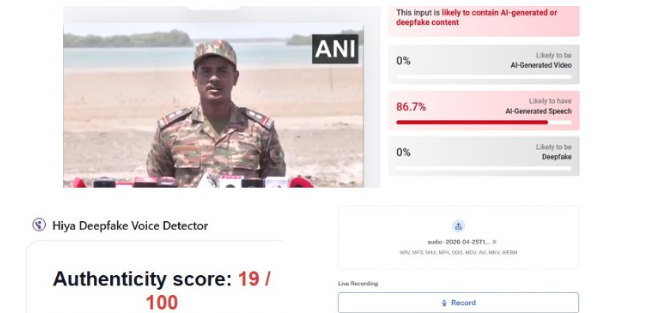
A keyword search using terms such as “Indian Army Air Defence JCO,” “Anurag Thakur,” and “resignation” did not yield any credible news reports supporting the claim. A reverse image search of the viral clip led to an original video posted by ANI on April 22, 2026. The ANI watermark is also visible in the viral footage, confirming that the clip has been sourced from this original video.

In the authentic version, the same personnel appears in the same setting, but he is speaking in Hindi about operations against adversary drones during “Operation Sindoor” in May 2025. He explains how his unit detected and neutralised multiple drones, successfully safeguarding a critical installation. Importantly, the original video does not identify the individual as Anurag Thakur, nor does it contain any reference to resignation, casualties, or criticism of the government.
Further technical analysis using the AI detection tool Hive Moderation indicated that the audio in the viral clip has an 86 percent likelihood of being artificially generated.
Conclusion:
The viral video has been altered with fabricated audio to falsely claim that an Indian Army officer criticised the government and resigned. The claim is baseless and the clip is a clear case of a deepfake created to mislead viewers.
Related Blogs

Executive Summary:
CVE 2024-3094 is a backdoor vulnerability recently found in Kali Linux installations that happened between March 26th to 29th. This vulnerability was found in XZ package version 5.6.0 to 5.6.1. It could allow the malicious actor to compromise SSHD authentication, and grant unauthorized access to the entire system remotely. The users who have installed or updated Kali Linux during the said time are advised to update their system to safeguard against this vulnerability.
The Dangerous Backdoor
The use of the malicious implant found in XZ Utils as a remote code execution tool makes it more dangerous, because of its ability to compromise the affected systems. Initially, researchers believed the vulnerability enabled an authentication bypass for the OpenSSH server (SSHD) process. However, further analysis revealed it is better characterized as a remote code execution (RCE) vulnerability.
The backdoor intercepts the RSA_public_decrypt function, verifies the host's signature using a fixed Ed448 key, and if successful, executes malicious code passed by the attacker via the system() function. This leaves no trace in SSHD logs and makes it difficult to detect the vulnerability.
Impacted Linux Distributions
The compromised versions of XZ Utils have been found in the following Linux distributions released in March 2024:
- Kali Linux (between March 26 and March 29)
- openSUSE Tumbleweed and openSUSE MicroOS (March 7 to March 28)
- Fedora 41, Fedora Rawhide, and Fedora Linux 40 beta
- Debian (testing, unstable, and experimental distributions only)
- Arch Linux container images (February 29 to March 29)
- Meanwhile, distributions such as Red Hat Enterprise Linux (RHEL), SUSE Linux Enterprise, openSUSE Leap, and Debian Stable are not believed to be affected.
How Did This Happen?
The malicious code appears to have been inserted by taking advantage of a typical control transfer vulnerability. The original maintainer of the XZ Libs project on GitHub handed over control of the repository to an account that had been contributing to various data compression-related projects for several years. It was at this point that the backdoor was implanted in the project code.
Fortunately, the Potential Disaster Was Averted
As per Igor Kuznetsov, head of Kaspersky's Global Research and Analysis Team (GReAT), the vulnerability CVE-2024-3094 is considered as the largest scale attack that has happened in the Linux ecosystem history. Because it targeted the primary remote management tool for Linux servers on the internet which is SSH servers.
As this vulnerability was detected in the testing and rolling distributions in the short period of time, where the latest software packages are used. This results to the minimum damage to the linux users and so far no case of CVE-2024-3094 being actively exploited have been detected.
Staying Safe
The U.S. Cybersecurity and Infrastructure Security Agency (CISA) advises that users who installed or updated the affected operating systems in March immediately roll back to XZ Utils 5.4.6 version and be on alert for any malicious activity. It is recommended to change the passwords in the case of a distribution where a weak version of XZ Utils has been installed.
The Yara rule has been released to detect any infected systems by CVE-2024-3094 Vulnerability.
Conclusion
The discovery of the XZ Utils backdoor provides a reminder to be vigilant in the open source software environment. This supply chain attack highlights the importance of strong security measures, elaborate code reviews, and regular distribution of security updates to provide shield against such vulnerabilities. Always staying informed and taking the necessary precautions, Linux users can mitigate the potential impact of this vulnerability to keep their systems safe.
References :
- https://thehackernews.com/2024/03/urgent-secret-backdoor-found-in-xz.html
- https://www.helpnetsecurity.com/2024/03/29/cve-2024-3094-linux-backdoor/
- https://www.kali.org/blog/about-the-xz-backdoor/
- https://www.kaspersky.com/blog/cve-2024-3094-vulnerability-backdoor/50873/
- https://www.rapid7.com/blog/post/2024/04/01/etr-backdoored-xz-utils-cve-2024-3094/

Introduction
In 2022, Oxfam’s India Inequality report revealed the worsening digital divide, highlighting that only 38% of households in the country are digitally literate. Further, only 31% of the rural population uses the internet, as compared to 67% of the urban population. Over time, with the increasing awareness about the importance of digital privacy globally, the definition of digital divide has translated into a digital privacy divide, whereby different levels of privacy are afforded to different sections of society. This further promotes social inequalities and impedes access to fundamental rights.
Digital Privacy Divide: A by-product of the digital divide
The digital divide has evolved into a multi-level issue from its earlier interpretations; level I implies the lack of physical access to technologies, level II refers to the lack of digital literacy and skills and recently, level III relates to the impacts of digital access. Digital Privacy Divide (DPD) refers to the various gaps in digital privacy protection provided to users based on their socio-demographic patterns. It forms a subset of the digital divide, which involves uneven distribution, access and usage of information and communication technology (ICTs). Typically, DPD exists when ICT users receive distinct levels of digital privacy protection. As such, it forms a part of the conversation on digital inequality.
Contrary to popular perceptions, DPD, which is based on notions of privacy, is not always based on ideas of individualism and collectivism and may constitute internal and external factors at the national level. A study on the impacts of DPD conducted in the U.S., India, Bangladesh and Germany highlighted that respondents in Germany and Bangladesh expressed more concerns about their privacy compared to respondents in the U.S. and India. This suggests that despite the U.S. having a strong tradition of individualistic rights, that is reflected in internal regulatory frameworks such as the Fourth Amendment, the topic of data privacy has not garnered enough interest from the population. Most individuals consider forgoing the right to privacy as a necessary evil to access many services, and schemes and to stay abreast with technological advances. Research shows that 62%- 63% of Americans believe that companies and the government collecting data have become an inescapable necessary evil in modern life. Additionally, 81% believe that they have very little control over what data companies collect and about 81% of Americans believe that the risk of data collection outweighs the benefits. Similarly, in Japan, data privacy is thought to be an adopted concept emerging from international pressure to regulate, rather than as an ascribed right, since collectivism and collective decision-making are more valued in Japan, positioning the concept of privacy as subjective, timeserving and an idea imported from the West.
Regardless, inequality in privacy preservation often reinforces social inequality. Practices like surveillance that are geared towards a specific group highlight that marginalised communities are more likely to have less data privacy. As an example, migrants, labourers, persons with a conviction history and marginalised racial groups are often subject to extremely invasive surveillance under suspicions of posing threats and are thus forced to flee their place of birth or residence. This also highlights the fact that focus on DPD is not limited to those who lack data privacy but also to those who have (either by design or by force) excess privacy. While on one end, excessive surveillance, carried out by both governments and private entities, forces immigrants to wait in deportation centres during the pendency of their case, the other end of the privacy extreme hosts a vast number of undocumented individuals who avoid government contact for fear of deportation, despite noting high rates of crime victimization.
DPD is also noted among groups with differential knowledge and skills in cyber security. For example, in India, data privacy laws mandate that information be provided on order of a court or any enforcement agency. However, individuals with knowledge of advanced encryption are adopting communication channels that have encryption protocols that the provider cannot control (and resultantly able to exercise their right to privacy more effectively), in contrast with individuals who have little knowledge of encryption, implying a security as well as an intellectual divide. While several options for secure communication exist, like Pretty Good Privacy, which enables encrypted emailing, they are complex and not easy to use in addition to having negative reputations, like the Tor Browser. Cost considerations also are a major factor in propelling DPD since users who cannot afford devices like those by Apple, which have privacy by default, are forced to opt for devices that have relatively poor in-built encryption.
Children remain the most vulnerable group. During the pandemic, it was noted that only 24% of Indian households had internet facilities to access e-education and several reported needing to access free internet outside of their homes. These public networks are known for their lack of security and privacy, as traffic can be monitored by the hotspot operator or others on the network if proper encryption measures are not in place. Elsewhere, students without access to devices for remote learning have limited alternatives and are often forced to rely on Chromebooks and associated Google services. In response to this issue, Google provided free Chromebooks and mobile hotspots to students in need during the pandemic, aiming to address the digital divide. However, in 2024, New Mexico was reported to be suing Google for allegedly collecting children’s data through its educational products provided to the state's schools, claiming that it tracks students' activities on their personal devices outside of the classroom. It signified the problems in ensuring the privacy of lower-income students while accessing basic education.
Policy Recommendations
Digital literacy is one of the critical components in bridging the DPD. It enables individuals to gain skills, which in turn effectively addresses privacy violations. Studies show that low-income users remain less confident in their ability to manage their privacy settings as compared to high-income individuals. Thus, emphasis should be placed not only on educating on technology usage but also on privacy practices since it aims to improve people’s Internet skills and take informed control of their digital identities.
In the U.S., scholars have noted the role of libraries and librarians in safeguarding intellectual privacy. The Library Freedom Project, for example, has sought to ensure that the skills and knowledge required to ensure internet freedoms are available to all. The Project channelled one of the core values of the library profession i.e. intellectual freedom, literacy, equity of access to recorded knowledge and information, privacy and democracy. As a result, the Project successfully conducted workshops on internet privacy for the public and also openly objected to the Department of Homeland Security’s attempts to shut down the use of encryption technologies in libraries. The International Federation of Library Association adopted a Statement of Privacy in the Library Environment in 2015 that specified “when libraries and information services provide access to resources, services or technologies that may compromise users’ privacy, libraries should encourage users to be aware of the implications and provide guidance in data protection and privacy.” The above should be used as an indicative case study for setting up similar protocols in inclusive public institutions like Anganwadis, local libraries, skill development centres and non-government/non-profit organisations in India, where free education is disseminated. The workshops conducted must inculcate two critical aspects; firstly, enhancing the know-how of using public digital infrastructure and popular technologies (thereby de-alienating technology) and secondly, shifting the viewpoint of privacy as a right an individual has and not something that they own.
However, digital literacy should not be wholly relied on, since it shifts the responsibility of privacy protection to the individual, who may not either be aware or cannot be controlled. Data literacy also does not address the larger issue of data brokers, consumer profiling, surveillance etc. Resultantly, an obligation on companies to provide simplified privacy summaries, in addition to creating accessible, easy-to-use technical products and privacy tools, should be necessitated. Most notable legislations address this problem by mandating notices and consent for collecting personal data of users, despite slow enforcement. However, the Digital Personal Data Protection Act 2023 in India aims to address DPD by not only mandating valid consent but also ensuring that privacy policies remain accessible in local languages, given the diversity of the population.
References
- https://idronline.org/article/inequality/indias-digital-divide-from-bad-to-worse/
- https://arxiv.org/pdf/2110.02669
- https://arxiv.org/pdf/2201.07936#:~:text=The%20DPD%20index%20is%20a,(33%20years%20and%20over).
- https://www.pewresearch.org/internet/2019/11/15/americans-and-privacy-concerned-confused-and-feeling-lack-of-control-over-their-personal-information/
- https://eprints.lse.ac.uk/67203/1/Internet%20freedom%20for%20all%20Public%20libraries%20have%20to%20get%20serious%20about%20tackling%20the%20digital%20privacy%20divi.pdf
- /https://openscholarship.wustl.edu/cgi/viewcontent.cgi?article=6265&context=law_lawreview
- https://eprints.lse.ac.uk/67203/1/Internet%20freedom%20for%20all%20Public%20libraries%20have%20to%20get%20serious%20about%20tackling%20the%20digital%20privacy%20divi.pdf
- https://bosniaca.nub.ba/index.php/bosniaca/article/view/488/pdf
- https://www.hindustantimes.com/education/just-24-of-indian-households-have-internet-facility-to-access-e-education-unicef/story-a1g7DqjP6lJRSh6D6yLJjL.html
- https://www.forbes.com/councils/forbestechcouncil/2021/05/05/the-pandemic-has-unmasked-the-digital-privacy-divide/
- https://www.meity.gov.in/writereaddata/files/Digital%20Personal%20Data%20Protection%20Act%202023.pdf
- https://www.isc.meiji.ac.jp/~ethicj/Privacy%20protection%20in%20Japan.pdf
- https://socialchangenyu.com/review/the-surveillance-gap-the-harms-of-extreme-privacy-and-data-marginalization/

In the pulsating heart of the digitized era, our world is rapidly morphing into a tightly knit network of interconnections. Concurrently, the vast expanse of the cyber realm continues to broaden at an unparalleled pace. As we, denizens of the Information Revolution, pioneer this challenging new frontier, a novel notion is steadily gaining traction as an essential instrument for tackling the multifaceted predicaments and hazards emanating from our escalating dependency on digital technology. This novel notion is cyber diplomacy.
Recently, a riveting discourse unraveling the continually evolving topography of cyber diplomacy unfolded on the podcast 'Patching the System.' Two distinguished personalities graced the conversation - Benedikt Wechsler, Switzerland's Ambassador for Digitization, and Kaja Ciglic, Senior Director of Digital Diplomacy at Microsoft. This thought-provoking dialogue provides a mesmerizing peek into the intricate maze of this freshly minted diplomatic domain - a landscape still in the process of carving out its rules against an ever-escalating high stakes backdrop.
Call for Robust International Norms
During their enlightening exchange, Wechsler and Ciglic shed light on the dire need of robust international norms and regulations in dynamic cyberspace. The drew comparison with well established norms governing maritime and airspace activities, suggesting a similar framework to maneuver the intricacies of the digital realm. The necessity of this mammoth task is accentuated by swift technological development and the unique nature of the internet where participation is diverse.
Their discourse also underscores the critical argument that cyberspace cannot be commoditized. It has evolved into critical infrastructure that demands collective supervision. Wechsler also advocated for collaboration and the importance of a united front composed of big tech giants and the government working in tandem for creation of a resilient and secured digital landscape.
Dual Edged Sword
Their conversation courageously plunged into the more sinister depths of the digital world and dissected the rising tide of cyberspace militarisation. Illustrative case point, recent cyber operations in Ukraine starkly underscore how malevolent elements have exploited digital tools to disastrous effect. Ciglic astutely pointed out the inherent dual nature of this scenario - while malignant entities will persistently manipulate technologies like AI, these identical tools can simultaneously serve as critical allies in reinforcing cyber defenses.
In finality, the dialogue unspools a potent call to arms. Both Wechsler and Ciglic fervently endorse the inception of a permanent body under the United Nations' purview specifically designed to tackle cyber-related quandaries. They also amplified the significance of an inclusive engagement process involving diverse stakeholders cutting across sectors - private entities, academia, civil society.
In India, this strategy is very practical. India has been making proactive investments in cybersecurity and digital resilience due to its rapidly developing digital ecosystem and strong IT industry. The government of the country, business executives, and academic institutions understand how strategically important it is to protect vital digital infrastructure and data. For example, India has seen a number of high-profile assaults on its vital infrastructure, like the Mumbai power outage in 2020, which emphasizes the necessity for extensive cybersecurity protections. The security components of the digital ecosystem have been given top priority by the Indian government's "Digital India" project, which aims to promote digital inclusion. This program has improved cybersecurity while simultaneously making great progress toward closing the nation's digital gap, especially in rural areas.
India's growing influence on global affairs and its prowess in the digital realm highlight how important it is to incorporate Indian viewpoints into the larger plan. By doing this, it guarantees a thorough and all-encompassing strategy that negotiates the intricacies of the Indian and global digital ecosystems. This strategy enhances cybersecurity at the national level and establishes India as a key global partner in the endeavor to make the internet a safer and more secure place for everyone. The whole community may benefit greatly from India's experiences and activities in combating cyber dangers and enhancing resilience in an increasingly interconnected world.
Conclusion
As we meticulously chart our trajectory across the cyber wilderness, the wisdom disseminated by Wechsler and Ciglic emerges as a priceless navigational aid. They inspire us to remember that while the gauntlet we face may be daunting, the opportunities unfurling before us are equally, if not more, monumental in their potential. By embracing a multi-faceted, synergistic approach, we set the stage for a shared journey towards a safer, resilient digital habitat.
The timeless words of Albert Einstein echo these sentiments: 'Technology advances could have made human life carefree and happy if the development of the organizing power of men [and women] had been able to keep pace with its technical advances.' As we grapple with the perplexities and burstiness of the digital age, let these words guide our collective endeavor as we strive to balance our organizing prowess with our rapid technological advancements.