
#FactCheck -Viral Claim About Air India Cancelling All International Flights Until July Is False
Executive Summary
A video circulating on social media falsely claims that Air India has cancelled all of its international flights until July due to a fuel shortage. However, research conducted by CyberPeace Research Wing found the claim to be misleading and false. Our research revealed that Air India has made no announcement regarding the cancellation of all international flights. In reality, the airline has only made temporary reductions and adjustments on select international routes due to increasing operational pressure and the impact on profitability.
Claim
An X (formerly Twitter) user shared the viral video on May 3, 2026, claiming: “Due to a fuel shortage, Air India has cancelled all its international flights until July.”he post quickly gained attention and was widely shared on social media platforms.

Fact Check
To verify the claim, we examined the official social media accounts of Air India. During the research, we found a post on X in which the airline itself described the viral claim as fake and misleading.
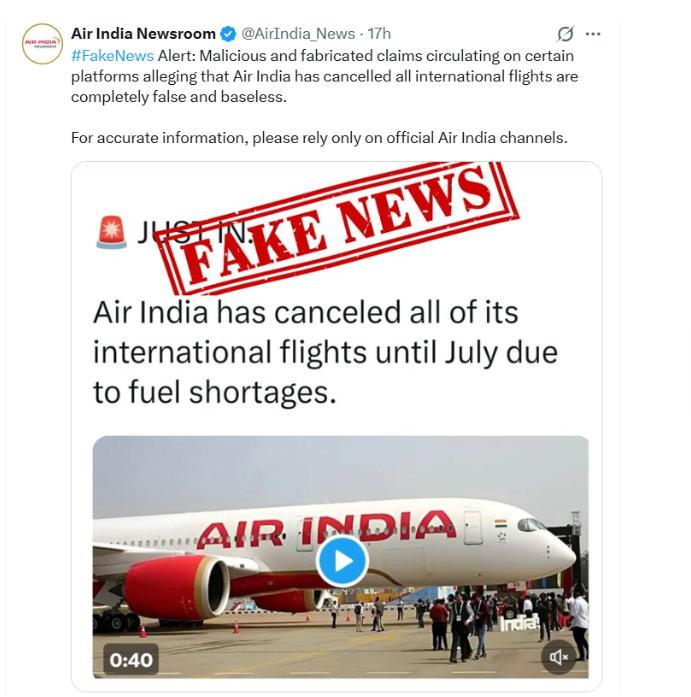
Taking the research further, we searched using relevant keywords and found a report published by ETNOW Swadesh on May 13, 2026. According to the report, Air India has not cancelled all international flights. Instead, due to mounting operational costs and pressure on profitability, the airline has temporarily reduced or modified services on a few select international routes.

Conclusion
Our research found that Air India has not announced the cancellation of all international flights until July. The viral claim circulating on social media is false and misleading. The airline has only implemented temporary adjustments and reductions on certain international routes, not a complete suspension of global operations.

Related Blogs

Introduction
Your iPhone isn’t just a device: it’s a central hub for almost everything in your life. From personal photos and videos to sensitive data, it holds it all. You rely on it for essential services, from personal to official communications, sharing of information, banking and financial transactions, and more. With so much critical information stored on your device, protecting it from cyber threats becomes essential. This is where the iOS Lockdown Mode feature comes in as a digital bouncer to keep cyber crooks at bay.
Apple introduced the ‘lockdown’ mode in 2022. It is a new optional security feature and is available on iPhones, iPads, and Mac devices. It works as an extreme and optional protection mechanism for a certain segment of users who might be at a higher risk of being targeted by serious cyber threats and intrusions into their digital security. So people like journalists, activists, government officials, celebrities, cyber security professionals, law enforcement professionals, and lawyers etc are some of the intended beneficiaries of the feature. Sometimes the data on their devices can be highly confidential and it can cause a lot of disruption if leaked or compromised by cyber threats. Given how prevalent cyber attacks are in this day and age, the need for such a feature cannot be overstated. This feature aims at providing an additional firewall by limiting certain functions of the device and hence reducing the chances of the user being targeted in any digital attack.
How to Enable Lockdown Mode in Your iPhone
On your iPhone running on iOS 16 Developer Beta 3, you just need to go to Settings - Privacy and Security - Lockdown Mode. Tap on Turn on Lockdown Mode, and read all the information regarding the features that will be unavailable on your device if you go forward, and if you’re satisfied with the same all you have to do is scroll down and tap on Turn on Lockdown Mode. Your iPhone will get restarted with Lockdown Mode enabled.
Easy steps to enable lockdown mode are as follows:
- Open the Settings app.
- Tap Privacy & Security.
- Scroll down, tap Lockdown Mode, then tap Turn On Lockdown Mode.
How Lockdown Mode Protects You
Lockdown Mode is a security feature that prevents certain apps and features from functioning properly when enabled. For example, your device will not automatically connect to Wi-Fi networks without security and will disconnect from a non-secure network when Lockdown Mode is activated. Many other features may be affected because the system will prioritise security standards above the typical operational functions. Since lockdown mode restricts certain features and activities, one can exclude a particular app or website in Safari from being impacted and limited by restrictions. Only exclude trusted apps or websites if necessary.
References:
- https://support.apple.com/en-in/105120#:~:text=Tap%20Privacy%20%26%20Security.,then%20enter%20your%20device%20passcode
- https://www.business-standard.com/technology/tech-news/apple-lockdown-mode-what-is-it-and-how-it-prevents-spyware-attacks-124041200667_1.html

The World Wide Web was created as a portal for communication, to connect people from far away, and while it started with electronic mail, mail moved to instant messaging, which let people have conversations and interact with each other from afar in real-time. But now, the new paradigm is the Internet of Things and how machines can communicate with one another. Now one can use a wearable gadget that can unlock the front door upon arrival at home and can message the air conditioner so that it switches on. This is IoT.
WHAT EXACTLY IS IoT?
The term ‘Internet of Things’ was coined in 1999 by Kevin Ashton, a computer scientist who put Radio Frequency Identification (RFID) chips on products in order to track them in the supply chain, while he worked at Proctor & Gamble (P&G). And after the launch of the iPhone in 2007, there were already more connected devices than people on the planet.
Fast forward to today and we live in a more connected world than ever. So much so that even our handheld devices and household appliances can now connect and communicate through a vast network that has been built so that data can be transferred and received between devices. There are currently more IoT devices than users in the world and according to the WEF’s report on State of the Connected World, by 2025 there will be more than 40 billion such devices that will record data so it can be analyzed.
IoT finds use in many parts of our lives. It has helped businesses streamline their operations, reduce costs, and improve productivity. IoT also helped during the Covid-19 pandemic, with devices that could help with contact tracing and wearables that could be used for health monitoring. All of these devices are able to gather, store and share data so that it can be analyzed. The information is gathered according to rules set by the people who build these systems.
APPLICATION OF IoT
IoT is used by both consumers and the industry.
Some of the widely used examples of CIoT (Consumer IoT) are wearables like health and fitness trackers, smart rings with near-field communication (NFC), and smartwatches. Smartwatches gather a lot of personal data. Smart clothing, with sensors on it, can monitor the wearer’s vital signs. There are even smart jewelry, which can monitor sleeping patterns and also stress levels.
With the advent of virtual and augmented reality, the gaming industry can now make the experience even more immersive and engrossing. Smart glasses and headsets are used, along with armbands fitted with sensors that can detect the movement of arms and replicate the movement in the game.
At home, there are smart TVs, security cameras, smart bulbs, home control devices, and other IoT-enabled ‘smart’ appliances like coffee makers, that can be turned on through an app, or at a particular time in the morning so that it acts as an alarm. There are also voice-command assistants like Alexa and Siri, and these work with software written by manufacturers that can understand simple instructions.
Industrial IoT (IIoT) mainly uses connected machines for the purposes of synchronization, efficiency, and cost-cutting. For example, smart factories gather and analyze data as the work is being done. Sensors are also used in agriculture to check soil moisture levels, and these then automatically run the irrigation system without the need for human intervention.
Statistics
- The IoT device market is poised to reach $1.4 trillion by 2027, according to Fortune Business Insight.
- The number of cellular IoT connections is expected to reach 3.5 billion by 2023. (Forbes)
- The amount of data generated by IoT devices is expected to reach 73.1 ZB (zettabytes) by 2025.
- 94% of retailers agree that the benefits of implementing IoT outweigh the risk.
- 55% of companies believe that 3rd party IoT providers should have to comply with IoT security and privacy regulations.
- 53% of all users acknowledge that wearable devices will be vulnerable to data breaches, viruses,
- Companies could invest up to 15 trillion dollars in IoT by 2025 (Gigabit)
CONCERNS AND SOLUTIONS
- Two of the biggest concerns with IoT devices are the privacy of users and the devices being secure in order to prevent attacks by bad actors. This makes knowledge of how these things work absolutely imperative.
- It is worth noting that these devices all work with a central hub, like a smartphone. This means that it pairs with the smartphone through an app and acts as a gateway, which could compromise the smartphone as well if a hacker were to target that IoT device.
- With technology like smart television sets that have cameras and microphones, the major concern is that hackers could hack and take over the functioning of the television as these are not adequately secured by the manufacturer.
- A hacker could control the camera and cyberstalk the victim, and therefore it is very important to become familiar with the features of a device and ensure that it is well protected from any unauthorized usage. Even simple things, like keeping the camera covered when it is not being used.
- There is also the concern that since IoT devices gather and share data without human intervention, they could be transmitting data that the user does not want to share. This is true of health trackers. Users who wear heart and blood pressure monitors have their data sent to the insurance company, who may then decide to raise the premium on their life insurance based on the data they get.
- IoT devices often keep functioning as normal even if they have been compromised. Most devices do not log an attack or alert the user, and changes like higher power or bandwidth usage go unnoticed after the attack. It is therefore very important to make sure the device is properly protected.
- It is also important to keep the software of the device updated as vulnerabilities are found in the code and fixes are provided by the manufacturer. Some IoT devices, however, lack the capability to be patched and are therefore permanently ‘at risk’.
CONCLUSION
Humanity inhabits this world that is made up of all these nodes that talk to each other and get things done. Users can harmonize their devices so that everything runs like a tandem bike – completely in sync with all other parts. But while we make use of all the benefits, it is also very important that one understands what they are using, how it is functioning, and how one can tackle issues should they come up. This is also important to understand because once people get used to IoT, it will be that much more difficult to give up the comfort and ease that these systems provide, and therefore it would make more sense to be prepared for any eventuality. A lot of times, good and sensible usage alone can keep devices safe and services intact. But users should be aware of any issues because forewarned is forearmed.

Executive Summary:
An alleged video is making the rounds on the internet featuring Ranveer Singh criticizing the Prime Minister Narendra Modi and his Government. But after examining the video closely it revealed that it has been tampered with to change the audio. In fact, the original videos posted by different media outlets actually show Ranveer Singh praising Varanasi, professing his love for Lord Shiva, and acknowledging Modiji’s role in enhancing the cultural charms and infrastructural development of the city. Differences in lip synchronization and the fact that the original video has no sign of criticizing PM Modi show that the video has been potentially manipulated in order to spread misinformation.

Claims:
The Viral Video of Bollywood actor Ranveer Singh criticizing Prime Minister Narendra Modi.

Fact Check:
Upon receiving the Video we divided the video into keyframes and reverse-searched one of the images, we landed on another video of Ranveer Singh with lookalike appearance, posted by an Instagram account named, “The Indian Opinion News''. In the video Ranveer Singh talks about his experience of visiting Kashi Vishwanath Temple with Bollywood actress Kriti Sanon. When we watched the Full video we found no indication of criticizing PM Modi.

Taking a cue from this we did some keyword search to find the full video of the interview. We found many videos uploaded by media outlets but none of the videos indicates criticizing PM Modi as claimed in the viral video.

Ranveer Singh shared his thoughts about how he feels about Lord Shiva, his opinions on the city and the efforts undertaken by the Prime Minister Modi to keep history and heritage of Varanasi alive as well as the city's ongoing development projects. The discrepancy in the viral video clip is clearly seen when we look at it closely. The lips are not in synchronization with the words which we can hear. It is clearly seen in the original video that the lips are in perfect synchronization with the words of audio. Upon lack of evidence to the claim made and discrepancies in the video prove that the video was edited to misrepresent the original interview of Bollywood Actor Ranveer Singh. Hence, the claim made is misleading and false.
Conclusion:
The video that claims Ranveer Singh criticizing PM Narendra Modi is not genuine. Further investigation shows that it has been edited by changing the audio. The original footage actually shows Singh speaking positively about Varanasi and Modi's work. Differences in lip-syncing and upon lack of evidence highlight the danger of misinformation created by simple editing. Ultimately, the claim made is false and misleading.
- Claim: A viral featuring Ranveer Singh criticizing the Prime Minister Narendra Modi and his Government.
- Claimed on: X (formerly known as Twitter)
- Fact Check: Fake & Misleading
