
#FactCheck: AI-Generated Video Falsely Shows Tiger Approaching Neem Karoli Baba
Executive Summary
A video is being shared on social media, purportedly showing a tiger approaching Neem Karoli Baba. In the video, Baba appears to place his hand on the tiger before walking away. Users are sharing the video on social media, believing it to depict a real incident. However, CyberPeace Research found the viral claim to be false. Our research found that the viral video is not authentic but AI-generated.
Claim:
A user on the social media platform X (formerly Twitter) shared the viral video on October 5, purportedly showing a tiger approaching Neem Karoli Baba. In the video, Baba appears to place his hand on the tiger before walking away. The post link, archive link, and screenshot are provided below.
https://x.com/kajutakla/status/2106961156674031795?s=20

Fact Check
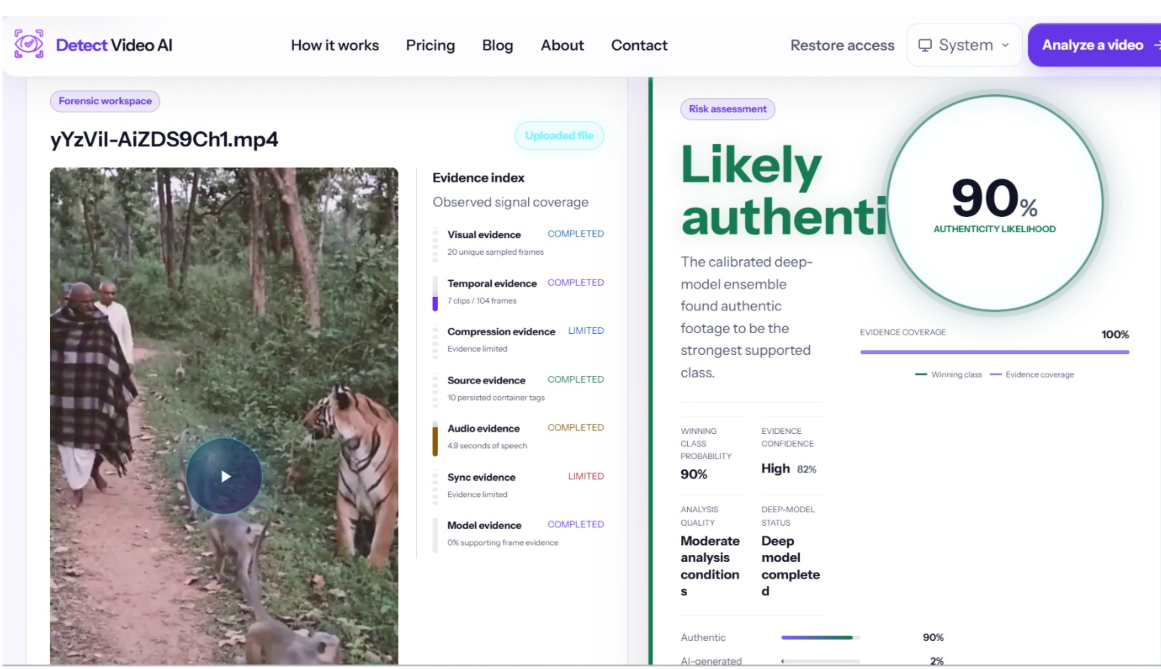
To verify the authenticity of the viral claim, we conducted a Google search using relevant keywords. During the search, we did not find any credible media reports confirming the claim. We then analysed the video using the AI detection tool DetectVideo AI. According to the tool’s results, the video has a 90 per cent probability of being AI-generated.
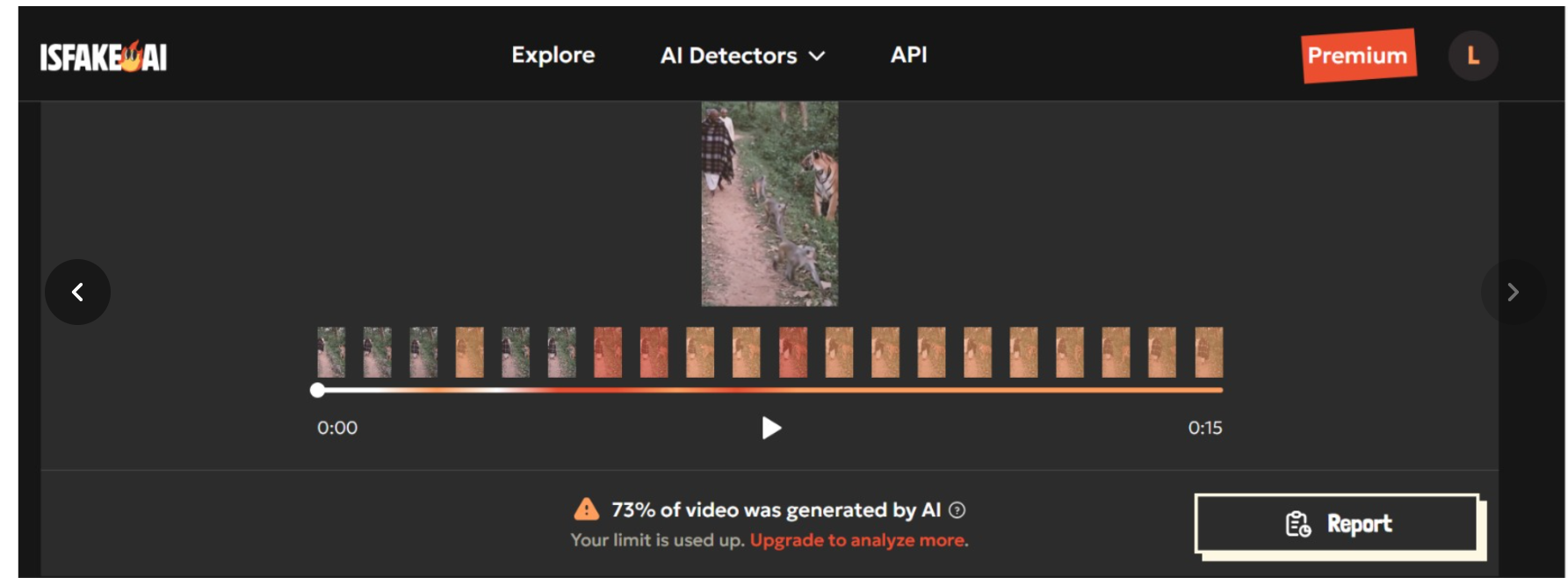
To further verify the authenticity of the viral video, we scanned it using another AI detection tool, ISFAKE AI. According to the results, the viral video is AI-generated.
Conclusion
Our research found that the viral video is not authentic but AI-generated. We did not find any credible media reports or other reliable sources confirming that the video shows a real incident involving Neem Karoli Baba and a tiger. The findings of AI detection tools further indicate that the visuals have been artificially generated. Therefore, the viral video is being circulated on social media with a misleading claim, presenting AI-generated visuals as a real incident.

Related Blogs

Introduction
A Reuters investigation has uncovered an elephant in the room regarding Meta Platforms' internal measures to address online fraud and illicit advertising. The confidential documents that Reuters reviewed disclosed that Meta was planning to generate approximately 10% of its 2024 revenue, i.e., USD 16 billion, from ads related to scams and prohibited goods. The findings point out a disturbing paradox: on the one hand, Meta is a vocal advocate for digital safety and platform integrity, while on the other hand, the internal logs of the company indicate the existence of a very large area allowing the shunning of fraudulent advertisement activities that exploit users throughout the world.
The Scale of the Problem
Internal Meta projections show that its platforms, Facebook, Instagram, and WhatsApp, are displaying a staggering 15 billion scam ads per day combined. The advertisements include deceitful e-commerce promotions, fake investment schemes, counterfeit medical products, and unlicensed gambling platforms.
Meta has developed sophisticated detection tools, but even then, the system does not catch the advertisers until they are 95% certain to be fraudsters. By having at least that threshold for removing an ad, the company is unlikely to lose much money. As a result, instead of turning the fraud adjacent advertisers down, it charges them higher ad rates, which is the strategy they call “penalty bids” internally.
Internal Acknowledgements & Business Dependence
Internal documents that date between 2021 and 2025 reveal that the financial, safety, and lobbying divisions of Meta were cognizant of the enormity of revenues generated from scams. One of the 2025 strategic papers even describes this revenue source as "violating revenue," which implies that it includes ads that are against Meta's policies regarding scams, gambling, sexual services, and misleading healthcare products.
The company's top executives consider the cost-benefit scenario of stricter enforcement. According to a 2024 internal projection, Meta's half-yearly earnings from high-risk scam ads were estimated at USD 3.5 billion, whereas regulatory fines for such violations would not exceed USD 1 billion, thus making it a tolerable trade-off from a commercial viewpoint. At the same time, the company intends to scale down scam ad revenue gradually, thus from 10.1% in 2024 to 7.3% by 2025, and 6% by 2026; however, the documents also reveal a planned slowdown in enforcement to avoid "abrupt reductions" that could affect business forecasts.
Algorithmic Amplification of Scams
One of the most alarming situations is the fact that Meta's own advertising algorithms amplify scam content. It has been reported that users who click on fraudulent ads are more likely to see other similar ads, as the platform's personalisation engine assumes user "interest."
This scenario creates a self-reinforcing feedback loop where the user engagement with scam content dictates the amount of such content being displayed. Thus, a digital environment is created which encourages deceptive engagement and consequently, user trust is eroded and systemic risk is amplified.
An internal presentation in May 2025 was said to put a number on how deeply the platform's ad ecosystem was intertwined with the global fraud economy, estimating that one-third of the scams that succeeded in the U.S. were due to advertising on Meta's platforms.
Regulatory & Legal Implications
The disclosures arrived at the same time as the US and UK governments started to closely check the company's activities more than ever before.
- The U.S. Securities and Exchange Commission (SEC) is said to be looking into whether Meta has had any part in the promotion of fraudulent financial ads.
- The UK’s Financial Conduct Authority (FCA) found that Meta’s platforms were the main sources of scams related to online payments and claimed that the amount of money lost was more than all the other social platforms combined in 2023.
Meta’s spokesperson, Andy Stone, at first denied the accusations, stating that the figures mentioned in the leak were “rough and overly-inclusive”; nevertheless, he conceded that the company’s consistent efforts toward enforcement had negatively impacted revenue and would continue to do so.
Operational Challenges & Policy Gaps
The internal documents also reveal the weaknesses in Meta's day-to-day operations when it comes to the implementation of its own policies.
- Because of the large number of employees laid off in 2023, the whole department that dealt with advertiser-brand impersonation was said to have been dissolved.
- Scam ads were categorised as a "low severity" issue, which was more of a "bad user experience" than a critical security risk.
- At the end of 2023, users were submitting around 100,000 legitimate scam reports per week, of which Meta dismissed or rejected 96%.
Human Impact: When Fraud Becomes Personal
The financial and ethical issues have tangible human consequences. The Reuters investigation documented multiple cases of individuals defrauded through hijacked Meta accounts.
One striking example involves a Canadian Air Force recruiter, whose hacked Facebook account was used to promote fake cryptocurrency schemes. Despite over a hundred user reports, Meta failed to act for weeks, during which several victims, including military colleagues, lost tens of thousands of dollars.
The case underscores not just platform negligence, but also the difficulty of law enforcement collaboration. Canadian authorities confirmed that funds traced to Nigerian accounts could not be recovered due to jurisdictional barriers, a recurring issue in transnational cyber fraud.
Ethical and Cybersecurity Implications
The research has questioned extremely important things at least from the perspective of cyber policy:
- Platform Accountability: Meta, by its practice, is giving more importance to the monetary aspect rather than the truth, and in this way, it is going against the principles of responsible digital governance.
- Transparency in Ad Ecosystems: The lack of transparency in digital advertising systems makes it very easy for dishonest actors to use automated processes with very little supervision.
- Algorithmic Responsibility: The use of algorithms that impact the visibility of misleading content and targeting can be considered the direct involvement of the algorithms in the fraud.
- Regulatory Harmonisation: The presence of different and disconnected enforcement frameworks across jurisdictions is a drawback to the efforts in dealing with cross-border cybercrime.
- Public Trust: Users’ trust in the digital world is mainly dependent on the safety level they see and the accountability of the companies.
Conclusion
Meta’s records show a very unpleasant mix of profit, laxity, and failure in the policy area concerning scam-related ads. The platform’s readiness to accept and even profit from fraudulent players, though admitting the damage they cause, calls for an immediate global rethinking of advertising ethics, regulatory enforcement, and algorithmic transparency.
With the expansion of its AI-driven operations and advertising networks, protecting the users of Meta must evolve from being just a public relations goal to being a core business necessity, thus requiring verifiable accountability measures, independent audits, and regulatory oversight. It is an undeniable fact that there are billions of users who count on Meta’s platforms for their right to digital safety, which is why this right must be respected and enforced rather than becoming optional.
References
- https://www.reuters.com/investigations/meta-is-earning-fortune-deluge-fraudulent-ads-documents-show-2025-11-06/?utm_source=chatgpt.com
- https://www.indiatoday.in/technology/news/story/leaked-docs-claim-meta-made-16-billion-from-scam-ads-even-after-deleting-134-million-of-them-2815183-2025-11-07

Introduction
The ongoing debate on whether AI scaling has hit a wall has been rehashed by the underwhelming response to OpenAI’s ChatGPT v5. AI scaling laws, which describe that machine learning models perform better with increased training data, model parameters and computational resources, have guided the rapid progress of Large Language Models (LLMs) so far. But many AI researchers suggest that further improvements in LLMs will have to be effected through large computational costs by orders of magnitude, which does not justify the returns. The question, then, is whether scaling remains a viable path or whether the field must explore new approaches. This is not just a tech issue but a profound innovation challenge for countries like India, charting their own AI course.
The Scaling Wall: Gaps and Innovation Opportunities
Escalating costs, data scarcity, and diminishing gains mean that simply building larger AI models may no longer guarantee breakthroughs. In such a scenario, LLM developers will have to refine new approaches to training these models, for example, by diversifying data types and redefining training techniques.
This global challenge has a bearing on India’s AI ambitions. For India, where compute and data resources are relatively scarce, this scaling slowdown poses both a challenge and an opportunity. While the India AI Mission embodies smart priorities such as democratising compute resources and developing local datasets, looming scaling challenges could prove a roadblock. Realising these ambitions requires strong input from research and academia, and improved coordination between policymakers and startups. The scaling wall highlights systemic innovation gaps where sustained support is needed, not only in hardware but also in talent development, safety research, and efficient model design.
Way Forward
To truly harness AI’s transformative power, India must prioritise policy actions and ecosystem shifts that support smarter, safer, and context-rich research through the following measures:
- Driving Efficiency and Compute Innovation: Instead of relying on brute-force scaling, India should invest in research and startups working on efficient architectures, energy-conscious training methods, and compute optimisation.
- Investing in Multimodal and Diverse Data: While indigenous datasets are being developed under the India AI Mission through AI Kosha, they must be ethically sourced from speech, images, video, sensor data, and regional content, apart from text, to enable context-rich AI models truly tailored to Indian needs.
- Addressing Core Problems for Trustworthy AI: LLMs offered by all major companies, like OpenAI, Grok, and Deepseek, have the problem of unreliability, hallucinations, and biases, since they are primarily built on scaling large datasets and parameters, which have inherent limitations. India should invest in capabilities to solve these issues and design more trustworthy LLMs.
- Supporting Talent Development and Training: Despite its substantial AI talent pool, India faces an impending demand-supply gap. It will need to launch national programs and incentives to upskill engineers, researchers, and students in advanced AI skills such as model efficiency, safety, interpretability, and new training paradigms
Conclusion
The AI scaling wall debate is a reminder that the future of LLMs will depend not on ever-larger models but on smarter, safer, and more sustainable innovation. A new generation of AI is approaching us, and India can help shape its future. The country’s AI Mission and startup ecosystem are well-positioned to lead this shift by focusing on localised needs, efficient technologies, and inclusive growth, if implemented effectively. How India approaches this new set of challenges and translates its ambitions into action, however, remains to be seen.
References
- https://blogs.nvidia.com/blog/ai-scaling-laws/
- https://www.marketingaiinstitute.com/blog/scaling-laws-ai-wall
- https://fortune.com/2025/02/19/generative-ai-scaling-agi-deep-learning/
- https://indiaai.gov.in/
- https://www.deloitte.com/in/en/about/press-room/bridging-the-ai-talent-gap-to-boost-indias-tech-and-economic-impact-deloitte-nasscom-report.html
Executive Summary
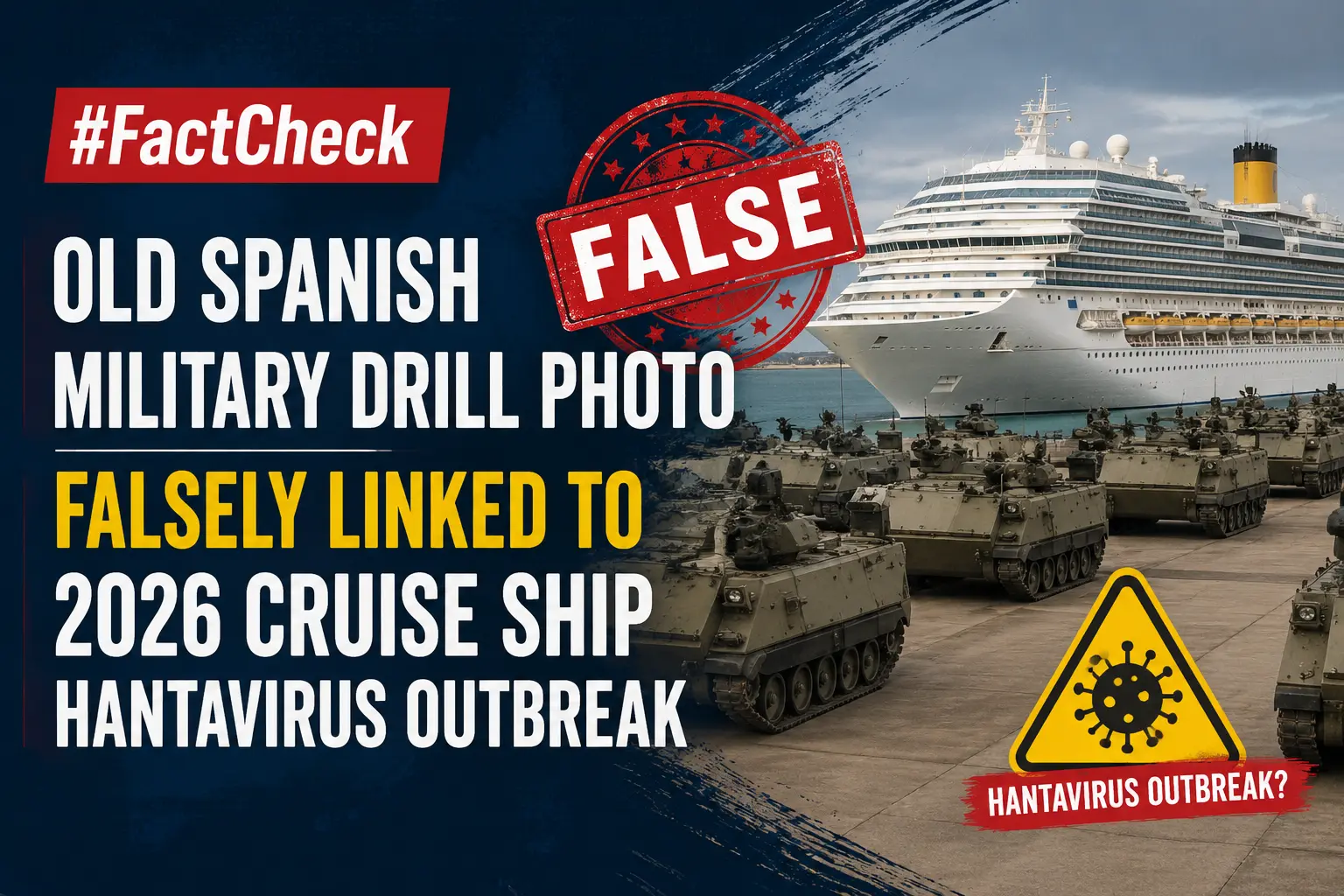
A photograph circulating widely on social media has been falsely linked to the reported hantavirus outbreak on a cruise ship in May 2026. The image is being shared with claims that it shows a cameraman filming evacuation operations without wearing personal protective equipment (PPE), suggesting that the global health scare was staged. However, the claim is misleading. The viral image has no connection to the hantavirus outbreak or any real evacuation related to the incident. research found that the photograph actually originates from a Spanish military exercise conducted a year earlier.
Claim
A post on X dated May 13, 2026, shared the image with the caption, “Don’t be fooled! The #Hantavirus HOAX,” alleging that the evacuations were staged events filmed from a movie set. The image shows several individuals in full personal protective equipment (PPE) carrying a patient on a biocontainment stretcher across a dock in front of a large vessel. A cameraman, dressed in plain clothes, is seen descending a ramp connected to the ship while apparently recording the scene.

Fact Check
The image went viral across X, Threads and Instagram in multiple languages, with users claiming the hantavirus outbreak was a “hoax” or that evacuation operations were staged. These posts emerged as authorities were monitoring passengers aboard the Dutch-flagged MV Hondius and others potentially exposed to the virus following reports of an outbreak during its Atlantic voyage.

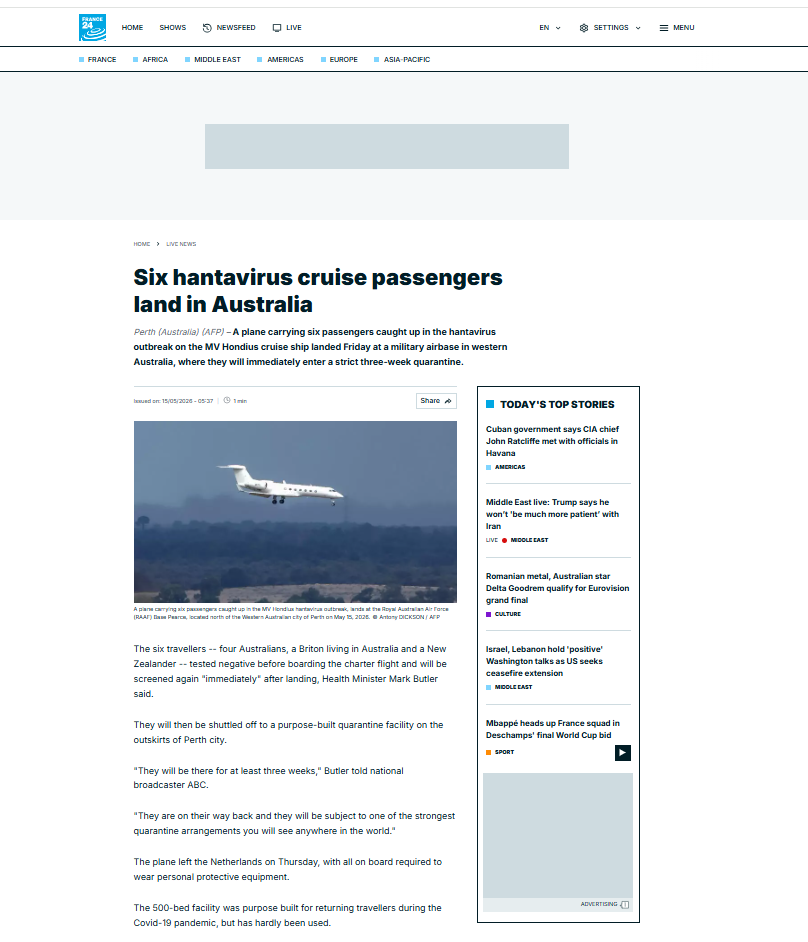
Health officials have repeatedly stressed that the overall public health risk from the Andes strain of hantavirus remains low. It is a rare rodent-borne virus and the only variant known to transmit between humans.
Reverse image search traced the photograph to the official website of the Port of Almería in Spain, where it was published in a May 7, 2025 article documenting an international maritime exercise involving the Spanish Navy and the health ministry.
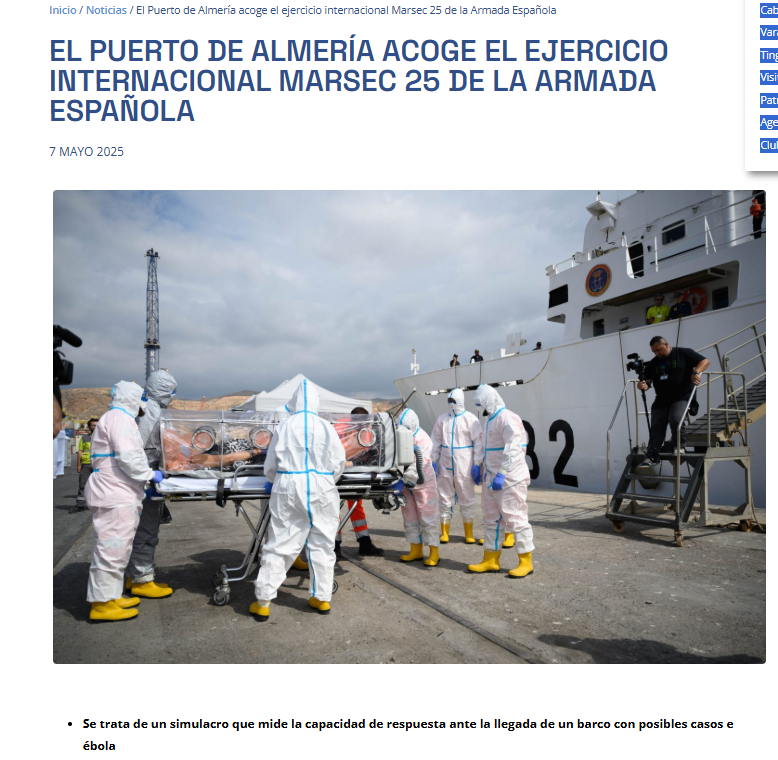
The exercise simulated the arrival of a vessel carrying suspected Ebola cases. Ebola is a rare but highly lethal disease that can cause fever, bleeding and organ failure.
Conclusion
The viral claim is false. The photograph has no connection to the reported hantavirus outbreak. It is from a Spanish military exercise conducted in 2025 and is being falsely shared out of context.
