
#FactCheck-AI-Generated Video Falsely Shows Neymar and Messi Facing Off in FIFA World Cup 2026
Executive Summary
A video linked to the FIFA World Cup 2026 is being widely shared on social media. The clip appears to show a match between Brazil and Argentina, with Neymar and Lionel Messi facing each other on the field. In the video, Messi is seen trying to stop Neymar from scoring, but Neymar dribbles past him and scores a goal. The footage is being circulated as a real moment from the ongoing FIFA World Cup. CyberPeace Research Wing research found the claim to be false. The video does not depict any real football match and was created using artificial intelligence (AI).
Claim
A Facebook user named “India Guru” shared the viral video on June 25, 2026, with the caption: "Neymar’s storm in the FIFA World Cup. Lionel Messi could only watch. Wow! What a moment… Brilliant." https://www.facebook.com/reel/993162133465919 , https://perma.cc/V8SA-Y3SE

Fact Check
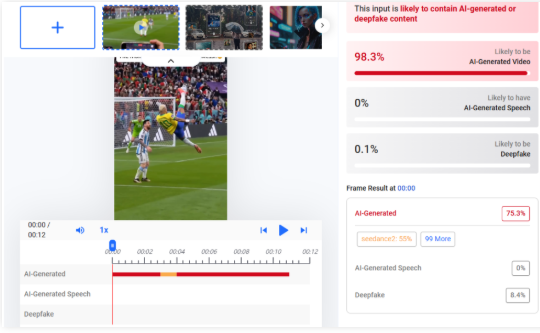
To verify the claim, we searched relevant keywords on Google. However, we found no credible news reports related to the viral video or the claims being made alongside it. We also found no evidence that Brazil and Argentina had played a match against each other during the FIFA World Cup 2026. A closer examination of the footage revealed unusual movements in the legs and body positions of both players, which appeared unnatural and inconsistent with real match footage. These visual anomalies raised suspicions that the video had been generated using artificial intelligence. The video was then analyzed using the AI detection tool Hive Moderation, which indicated a nearly 99 percent probability that the content was AI-generated.
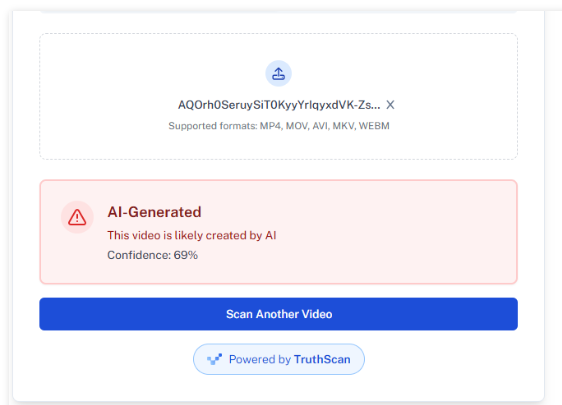
For additional verification, we also examined the clip using Undetectable AI, which similarly indicated a high likelihood that the video had been created using artificial intelligence.
Conclusion
Our research found that the viral claim linking the video to a FIFA World Cup 2026 match between Neymar and Lionel Messi is false. The footage is AI-generated and does not show a real football match.

Related Blogs

Introduction
The Government of India has initiated a cybercrime crackdown that has resulted in the blocking of 781,000 SIM cards and 208,469 IMEI (International Mobile Equipment Identity) numbers that are associated with digital fraud as of February 2025. This data was released as a written response by the Union Minister of State for Home Affairs, Bandi Sanjay Kumar, with respect to a query presented in the Lok Sabha. A significant jump from the 669,000 SIM cards blocked in the past year, efforts aimed at combating digital fraud are in full swing, considering the increasing cases. The Indian Cyber Crime Coordination Centre (I4C) is proactively blocking other platform accounts found suspicious, such as WhatsApp Accounts (83,668) and Skype IDs (3,962) on its part, aiding in eliminating identified threat actors.
Increasing Digital Fraud And The Current Combative Measures
According to the data tabled by the Ministry of Finance in the Rajya Sabha, the first 10 months of the Financial year 2024-2025 have recorded around 2.4 million incidents covering an amount of Rs. 4,245 crore involving cases of digital Financial Fraud cases. Apart from the evident financial loss, such incidents also take an emotional toll as people are targeted regardless of their background and age, leaving everyone equally vulnerable. To address this growing problem, various government departments have dedicated measures to combat and reduce such incidents. Some of the notable initiatives/steps are as follows:
- The Citizen Financial Cyber Fraud Reporting and Management System- This includes reporting Cybercrimes through the nationwide toll-free (1930) number and registration on the National Cyber Crime Reporting Portal. On being a victim of digital fraud, one can call the toll-free number, describing details of the incident, which would further help in the investigation. After reporting the incident, the complainant receives a generated login ID/acknowledgement number that they can use for further reference.
- International Incoming Spoofed Calls Prevention System- This is a mechanism developed to counter fraudulent calls that appear to originate from within India but are actually made from international locations. This system prevents the misuse of the Calling Line Identity (CLI), which is manipulated to deceive recipients in order to carry out financial crimes like digital arrests, among other things. Coordinating with the Department of Telecommunication (DoT), private telecommunication service providers (TSPs) are being encouraged to check with their ILD (International Long-Distance) network as a measure. Airtel has recently started categorising such numbers as International numbers on their part.
- Chakshu Facility at Sanchar Saathi platform- A citizen-centric initiative, created by the Department of Telecommunications, to empower mobile subscribers. It focuses on reporting unsolicited commercial communication (spam messages) and reporting suspected fraudulent communication. (https://sancharsaathi.gov.in/).
- Aadhaar-based verification of SIM cards- A directive issued by the Prime Minister's Office to the Department of Telecommunications mandates an Aadhaar-based biometric verification for the issuance of new SIM cards. This has been done so in an effort to prevent fraud and cybercrime through mobile connections obtained using fake documents. Legal action against non-compliant retailers in the form of FIRs is also being taken.
On the part of the public, awareness of the following steps could encourage them on how to deal with such situations:
- Awareness regarding types of crimes and the tell-tale signs of the modus operandi of a criminal: A general awareness and a cautionary approach to how such crimes take place could help better prepare and respond to such malicious scams. Some important signs on the part of the offender include pressuring the victim into immediate action, insistence on video calls, and the threat of arrest in case of non-compliance. It is also important to note that no official authority, in any legal capacity, allows for enabling a digital/online arrest.
- Knowing the support channels: Awareness regarding reporting mechanisms and cyber safety hygiene tips can help in building cyber resilience amongst netizens.
Conclusion
As cybercrooks continue to find new ways of duping people of their hard-earned money, both government and netizens must make efforts to combat such crimes and increase awareness on both ends (systematic and public). Increasing developments in AI, deepfakes, and other technology often render the public inept at assessing the veracity of the source, making them susceptible to such crime. A cautionary yet proactive approach is need of the hour.
References
- https://mobileidworld.com/india-blocks-781000-sim-cards-in-major-cybercrime-crackdown/
- https://www.storyboard18.com/how-it-works/over-83k-whatsapp-accounts-used-for-digital-arrest-blocked-home-ministry-60292.htm
- https://www.business-standard.com/finance/news/digital-financial-frauds-touch-rs-4-245-crore-in-the-apr-jan-period-of-fy25-125032001214_1.html
- https://www.business-standard.com/india-news/govt-blocked-781k-sims-3k-skype-ids-83k-whatsapp-accounts-till-feb-125032500965_1.html
- https://pib.gov.in/PressReleasePage.aspx?PRID=2042130
- https://mobileidworld.com/india-mandates-aadhaar-biometric-verification-for-new-sim-cards-to-combat-fraud/
- https://pib.gov.in/PressReleaseIframePage.aspx?PRID=2067113
Introduction
By the morning of May 19, 2026, many Indians woke up to see a worrying message being circulated on WhatsApp and X (formerly Twitter) stating that the government proposed to appropriate all gold stored in the temples, convert it to cash by some new scheme, and further, regard temple towers, doors, etc., gilded with gold as the "Strategic Gold Reserves of India." The panic spread immediately; religious communities were enraged, and online arguments broke out. By afternoon, the rumour was out of control. The catch was that this whole thing was false.
The Rise of Misinformation: An Old Problem with a New Engine
Misinformation is an ancient phenomenon. Folk scholars have observed for centuries that fabrications, rumours, and hoaxes move through the same channels and follow the same patterns as reliable news, deriving their credibility from repetition rather than proof and relying on social networks for believability.
A seminal 2017 study published in the Journal of Economic Perspectives by Allcott and Gentzkow discovered that fake news articles were far more widely shared than the most popular legitimate news articles in the run-up to the 2016 United States presidential election. The study additionally discovered that nearly 62% of all American adults get at least a fraction of their news through social media, a reality the researchers posited would allow fake news to spread wide and far through unvetted channels.
India is an even more extreme case; on a platform such as WhatsApp, where researcher Kiran Garimella, working for MIT, estimates that 50 billion messages are transmitted every single day in India alone, misinformation is less something that spreads and more something that simply exists.
The Science of Viral Misinformation
The temple gold rumour took a course typical of conspiracy theories. A dramatic, provocative rumour that simultaneously appealed to religious, state, and financial safety was received by an audience already conditioned to mistrust its leaders. In Science, 2018, MIT researchers Vosoughi, Roy, and Aral mapped the very mechanism at scale: it revealed false information to propagate about six times more than true information, reaching about three times as many people. The study further concluded that falsehoods were 70% more likely to be shared than true stories and that the 'engine' of false information spread was not bots and algorithms but humans. The simple reason was that humans prefer something that is novel, surprising, and alarming.
Pariser further elaborated this process within his book Filter Bubble; as algorithms mainly show users what conforms with their existing beliefs, people are put in individual echo chambers, and their tendency to share emotional or falsified content results in corrections often failing to keep up.
The Importance of Fact-Checking and Official Sources
The government reacted to this with a swift and concise response, and an official statement released by the Ministry of Finance on 19 May 2026 cautioned citizens that all legal government policies are declared only through official press releases, government websites, and appropriate agencies and not via social media forwards.
India has a dedicated institutional resource for exactly this purpose. The PIB Fact Check Unit (FCU), established in November 2019 under the Press Information Bureau, has now published over 2,900 fact-checks covering false claims about government policies, schemes, deepfakes, AI-generated content, fabricated notifications, and fraudulent websites. Citizens can submit suspicious content directly to the FCU via WhatsApp (+91 8799711259) or through factcheck.pib.gov.in: The service is free, confidential, and designed to be accessible.
The Risks of Sharing Unverified Information
Beyond confusion and unnecessary anxiety, the spread of unverified information carries concrete risks. Allcott and Gentzkow's research found that individuals who consumed more ideologically homogeneous information were substantially more likely to believe false headlines, a pattern that holds regardless of education or political affiliation.
In India, where WhatsApp research has documented that approximately 13% of images shared in politically active groups constitute known misinformation, the consequences have at times extended well beyond digital confusion.
Advisory for Citizens: Verify, Inoculate, and Share Responsibly
Becoming responsible digital citizens is more than just exercising passive vigilance. An important concept every digital citizen ought to know was formulated by John Cook, Stephan Lewandowsky, and Ullrich Ecker in a 2017 PLOS ONE paper: it is called "prebunking."
Debunking seeks to counter a falsehood once it is believed, while prebunking builds resilience in advance of the exposure, similar to how a vaccine inoculates the body to protect against a disease. Prebunking is implemented through an inoculation technique wherein individuals are warned about the presence of likely future misinformation, about the subject and the typical manipulative tactics that the misinformation may use. Exposure, even in an attenuated form, arms individuals with the wherewithal to recognise and disregard the actual misinformation once it appears. What this means in practice is that informed, aware citizens, capable of analysing how misinformation is crafted, are unlikely to fall for a new rumour of this nature.
What should be kept in mind?
- Wait before sharing: A prompt sense of fear, anger, or desire to share a post is not a call to immediate dissemination but an exercise in caution.
- Prebunk yourself and others: Be mindful of subjects that persistently generate falsehoods like government schemes, religious matters, economic policy, and national security.
- Refer to official sources only: The authenticity of claims related to any government scheme can be cross-checked on PIB.gov.in, relevant ministries, or the PIB Fact Check WhatsApp number, 8799711259.
- Identify filter bubbles: Repeated confirmation of your own beliefs and concerns indicates an algorithmic bubble.
- Do not amplify ambiguity: Circulating information merely as a matter of cautious verification has damaging repercussions.
- Rectify what has been shared: Issue the correction to the same recipients as the false information.
Conclusion
The swift clarifications issued by the government in May 2026 and fact-check systems by PIB have helped contain the panic, but the role of the government cannot be seen as the sole bulwark against misinformation. An informed citizenry, digitally and information literate to such an extent that they know how misinformation is created and circulated, is our strongest defence against fake news. It is not only the ability to fact-check but also to detect manipulative attempts before misinformation goes viral. Check before you share. Stop before you panic. When in doubt, check the PIB Fact Check.
References
[3] https://www.pib.gov.in/PressReleasePage.aspx?PRID=2247720
[4] Allcott, Hunt and Matthew Gentzkow. (2017). "Social Media and Fake News in the 2016 Election." Journal of Economic Perspectives 31(2): 211–23
[5] Vosoughi, Soroush, Deb Roy, and Sinan Aral. (2018). "The Spread of True and False News Online." Science 359(6380): 1146–1151
[6] Cook, John, Stephan Lewandowsky, and Ullrich K. H. Ecker. (2017). "Neutralizing misinformation through inoculation: Exposing misleading argumentation techniques reduces their influence." PLOS ONE 12(5): e0175799.
[7] Garimella, Kiran and Dean Eckles. (2020/2023). "Images and Misinformation in Political Groups: Evidence from WhatsApp in India.
[8] Christakis, Nicholas A. and James H. Fowler. (2011). Connected: The Surprising Power of Our Social Networks and How They Shape Our Lives.
[9] Pariser, Eli. (2011/2012). The Filter Bubble: What the Internet Is Hiding from You.

Introduction
When a tragedy strikes, moments are fragile, people are vulnerable, emotions run high, and every second is important. In such critical situations, information becomes as crucial as food, water, shelter, and medication. As soon as any information is received, it often leads to stampedes and chaos. Alongside the tragedy, whether natural or man-made, emerges another threat: misinformation. People, desperate for answers, cling to whatever they can find.
Tragedies can take many forms. These may include natural disasters, mass accidents, terrorist activities, or other emergencies. During the 2023 earthquakes in Turkey, misinformation spread on social media claiming that the Yarseli Dam had cracked and was about to burst. People believed it and began migrating from the area. Panic followed, and search and rescue teams stopped operations in that zone. Precious hours were lost. Later, it was confirmed to be a rumour. By then, the damage was already done.
Similarly, after the recent plane crash in Ahmedabad, India, numerous rumours and WhatsApp messages spread rapidly. One message claimed to contain the investigation report on the crash of Air India flight AI-171. It was later called out by PIB and declared fake.
These examples show how misinformation can take control of already painful moments. During emergencies, when emotions are intense and fear is widespread, false information spreads faster and hits harder. Some people share it unknowingly, while others do so to gain attention or push a certain agenda. But for those already in distress, the effect is often the same. It brings ore confusion, heightens anxiety, and adds to their suffering.
Understanding Disasters and the Role of Media in Crisis
Disaster can be defined as a natural or human-caused situation that causes a transformation from a usual life of society into a crisis that is far beyond its existing response capacity. It can have minimal or maximum effects, from mere disruption in daily life practices to as adverse as inability to meet basic requirements of life like food, water and shelter. Hence, the disaster is not just a sudden event. It becomes a disaster when it overwhelms a community’s ability to cope with it.
To cope with such situations, there is an organised approach called Disaster Management. It includes preventive measures, minimising damages and helping communities recover. Earlier, public institutions like governments used to be the main actors in disaster management, but today, with every small entity having a role, academic institutions, media outlets and even ordinary people are involved.
Communication is an important element in disaster management. It saves lives when done correctly. People who are vulnerable need to know what’s happening, what they should do and where to seek help. It involves risk in today’s instantaneous communication.
Research shows that the media often fails to focus on disaster preparedness. For example, studies found that during the 2019 Istanbul earthquake, the media focused more on dramatic scenes than on educating people. Similar trends were seen during the 2023 Turkey earthquakes. Rather than helping people prepare or stay calm, much of the media coverage amplified fear and sensationalised suffering. This shows a shift from preventive, helpful reporting to reactive, emotional storytelling. In doing so, the media sometimes fails in its duty to support resilience and worse, can become a channel for spreading misinformation during already traumatic events. However, fighting misinformation is not just someone’s liability. It is penalised in the official disaster management strategy. Section 54 of the Disaster Management Act, 2005 mentions that "Whoever makes or circulates a false alarm or warning as to disaster or its severity or magnitude, leading to panic, shall, on conviction, be punishable with imprisonment which may extend to one year or with a fine."
AI as a Tool in Countering Misinformation
AI has emerged as a powerful mechanism to fight against misinformation. AI technologies like Natural Language Processing (NLP) and Machine Learning (ML) are effective in spotting and classifying misinformation with up to 97% accuracy. AI flags unverified content, leading to a 24% decrease in shares and 7% drop in likes on platforms like TikTok. Up to 95% fewer people view content on Facebook when fact-checking labels are used. Facebook AI also eliminates 86% of graphic violence, 96% of adult nudity, 98.5% of fake accounts and 99.5% of content related to terrorism. These tools help rebuild public trust in addition to limiting the dissemination of harmful content. In 2023, support for tech companies acting to combat misinformation rose to 65%, indicating a positive change in public expectations and awareness.
How to Counter Misinformation
Experts should step up in such situations. Social media has allowed many so-called experts to spread fake information without any real knowledge, research, or qualification. In such conditions, real experts such as authorities, doctors, scientists, public health officials, researchers, etc., need to take charge. They can directly address the myths and false claims and stop misinformation before it spreads further and reduce confusion.
Responsible journalism is crucial during crises. In times of panic, people look at the media for guidance. Hence, it is important to fact-check every detail before publishing. Reporting that is based on unclear tips, social media posts, or rumours can cause major harm by inciting mistrust, fear, or even dangerous behaviour. Cross-checking information, depending on reliable sources and promptly fixing errors are all components of responsible journalism. Protecting the public is more important than merely disseminating the news.
Focus on accuracy rather than speed. News spreads in a blink in today's world. Media outlets and influencers often come under pressure to publish it first. But in tragic situations like natural disasters and disease outbreaks, rushing to come first is not as important as accuracy is, as a single piece of misinformation can spark mass-scale panic and can slow down emergency efforts and lead people to make rash decisions. Taking a little more time to check the facts ensures that the information being shared is helpful, not harmful. Accuracy may save numerous lives during tragedies.
Misinformation spreads quickly it can only be prevented if people learn to critically evaluate what they hear and see. This entails being able to spot biased or deceptive headlines, cross-check claims and identify reliable sources. Digital literacy is of utmost importance; it makes people less susceptible to fear-based rumours, conspiracy theories and hoaxes.
Disaster preparedness programs should include awareness about the risks of spreading unverified information. Communities, schools and media platforms must educate people on how to respond responsibly during emergencies by staying calm, checking facts and sharing only credible updates. Spreading fake alerts or panic-inducing messages during a crisis is not only dangerous, but it can also have legal consequences. Public communication must focus on promoting trust, calm and clarity. When people understand the weight their words can carry during a crisis, they become part of the solution, not the problem.
References:
- https://dergipark.org.tr/en/download/article-file/3556152
- https://www.dhs.gov/sites/default/files/publications/SMWG_Countering-False-Info-Social-Media-Disasters-Emergencies_Mar2018-508.pdf
- https://english.mathrubhumi.com/news/india/fake-whatsapp-message-air-india-crash-pib-fact-check-fcwmvuyc
- https://www.dhs.gov/sites/default/files/publications/SMWG_Countering-False-Info-Social-Media-Disasters-Emergencies_Mar2018-508.pdf
