
#FactCheck: AI-Generated Video Falsely Shared as Footage of Vehicles Swept Away in Floods on Tibet-Nepal Border
Executive Summary
A video showing vehicles being swept away by floodwaters is going viral on social media. It is being claimed that the video shows flooding along the Nepal-Tibet border.However, CyberPeace Research found that the video is AI-generated.
Claim
The video shows debris suddenly falling from a mountain while vehicles are moving along a road. During the incident, vehicles seen on the road near a fast-flowing river are swept away into the water one after another. The archive of the post can be viewed here.
https://www.facebook.com/reel/1796949138009288

Fact Check
To verify the viral video claiming to show vehicles being swept away by floods along the Tibet-Nepal border, we conducted a reverse image search of its keyframes. However, during our research, we did not find the video in any credible media report or authentic source that identified it as genuine footage of flooding along the Nepal-Tibet border. During our research, we closely examined the video and noticed several inconsistencies that raised questions about its authenticity. In cases where heavy vehicles are caught in or swept away by fast-flowing water, the force of the current, the vehicles losing balance and being submerged are generally visible. In contrast, the vehicles in the viral video appear to float almost in a straight direction through the water without any visible resistance, raising doubts about the authenticity of the footage.
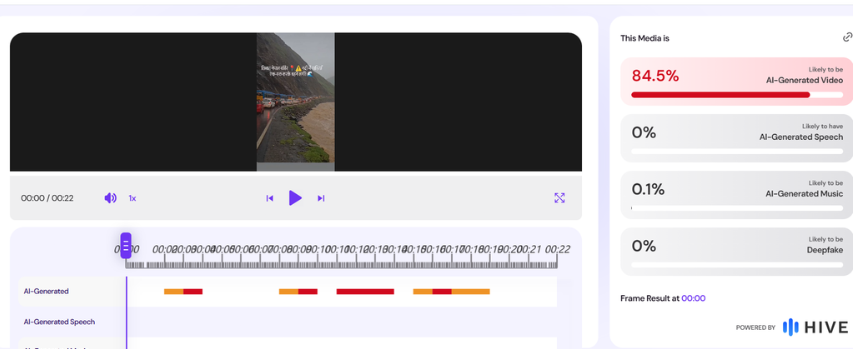
The video also shows several blue buses travelling on the road. On closer examination, the design and appearance of these buses appear to be almost identical. In addition, the letters and numbers visible on some vehicle number plates appear unusual, blurred and distorted. Such visual inconsistencies are commonly observed in AI-generated content. To further verify these findings, we scanned the viral video using the AI detection tool Hive Detect. The tool’s analysis identified the video as potentially AI-generated, with a score of 84.5 per cent.
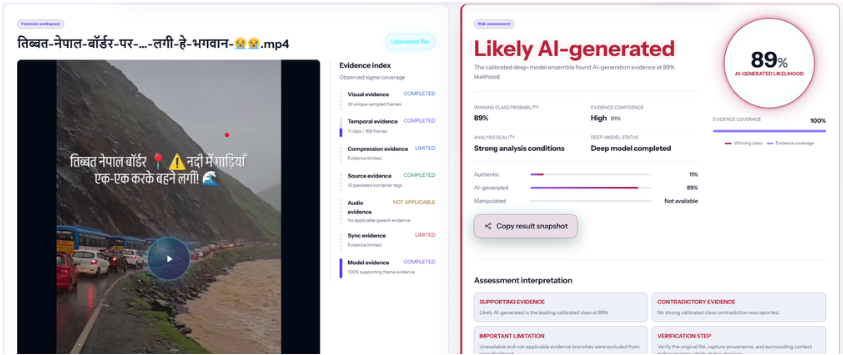
We also analysed the video using another AI detection platform, DetectVideo AI. The tool likewise identified the video as potentially AI-generated, with a score of 89 per cent.
Conclusion
The evidence gathered during our research makes it clear that the video being circulated with the claim that vehicles were swept away by floodwaters along the Tibet-Nepal border is AI-generated.

Related Blogs

Executive Summary
A video showing a house collapsing after a massive explosion is being widely shared on social media with the claim that it shows the Indian Armed Forces bombing the house of a minority community in Manipur. CyberPeace Research Wing ’s research found that the claim is false. The viral video dates back to 2023 and shows a house being demolished in Churachandpur during the ethnic violence between the Kuki and Meitei communities in Manipur.
Claim:
An X (formerly Twitter) user shared the video with the caption: “This is Manipur, not Palestine. The Indian Army is destroying minority houses in Manipur.”
The post claimed that the visuals showed the Indian Army carrying out an attack on minority community houses in Manipur.
https://www.facebook.com/reel/1042491035382024

Fact Check:
To verify the claim, CyberPeace Research Wing conducted a reverse image search using keyframes extracted from the viral video. During the search, we found the same video shared by NDTV’s official Instagram account on July 21, 2024.
According to the caption of the post, the video was from 2023, when ethnic clashes broke out between the Kuki and Meitei communities in Manipur. The post stated that the incident took place in Churachandpur, where the house of Naorem Ibomcha Meitei was destroyed by the Kuki community during the violence.
https://www.instagram.com/reels/C9sQWeTSCFx/

Further research revealed that India Today had also shared the same video with similar details
https://www.instagram.com/reels/C9sRq1nSy51/

Conclusion:
The research found that the viral video is being circulated with a misleading claim. The footage does not show the Indian Armed Forces bombing a minority community’s house in Manipur. It is from 2023 and shows the demolition of a house in Churachandpur during the ethnic violence between the Kuki and Meitei communities.

Introduction
Artificial Intelligence (AI) is fast transforming our future in the digital world, transforming healthcare, finance, education, and cybersecurity. But alongside this technology, bad actors are also weaponising it. More and more, state-sponsored cyber actors are misusing AI tools such as ChatGPT and other generative models to automate disinformation, enable cyberattacks, and speed up social engineering operations. This write-up explores why and how AI, in the form of large language models (LLMs), is being exploited in cyber operations associated with adversarial states, and the necessity for international vigilance, regulation, and AI safety guidelines.
The Shift: AI as a Cyber Weapon
State-sponsored threat actors are misusing tools such as ChatGPT to turbocharge their cyber arsenal.
- Phishing Campaigns using AI- Generative AI allows for highly convincing and grammatically correct phishing emails. Unlike the shoddily written scams of yesteryears, these AI-based messages are tailored according to the victim's location, language, and professional background, increasing the attack success rate considerably. Example: It has recently been reported by OpenAI and Microsoft that Russian and North Korean APTs have employed LLMs to create customised phishing baits and malware obfuscation notes.
- Malware Obfuscation and Script Generation- Big Language Models (LLMs) such as ChatGPT may be used by cyber attackers to help write, debug, and camouflage malicious scripts. While the majority of AI instruments contain safety mechanisms to guard against abuse, threat actors often exploit "jailbreaking" to evade these protections. Once such constraints are lifted, the model can be utilised to develop polymorphic malware that alters its code composition to avoid detection. It can also be used to obfuscate PowerShell or Python scripts to render them difficult for conventional antivirus software to identify. Also, LLMs have been employed to propose techniques for backdoor installation, additional facilitating stealthy access to hijacked systems.
- Disinformation and Narrative Manipulation
State-sponsored cyber actors are increasingly employing AI to scale up and automate disinformation operations, especially on election, protest, and geopolitical dispute days. With LLMs' assistance, these actors can create massive amounts of ersatz news stories, deepfake interview transcripts, imitation social media posts, and bogus public remarks on online forums and petitions. The localisation of content makes this strategy especially perilous, as messages are written with cultural and linguistic specificity, making them credible and more difficult to detect. The ultimate aim is to seed societal unrest, manipulate public sentiments, and erode faith in democratic institutions.
Disrupting Malicious Uses of AI – OpenAI Report (June 2025)
OpenAI released a comprehensive threat intelligence report called "Disrupting Malicious Uses of AI" and the “Staying ahead of threat actors in the age of AI”, which outlined how state-affiliated actors had been testing and misusing its language models for malicious intent. The report named few advanced persistent threat (APT) groups, each attributed to particular nation-states. OpenAI highlighted that the threat actors used the models mostly for enhancing linguistic quality, generating social engineering content, and expanding operations. Significantly, the report mentioned that the tools were not utilized to produce malware, but rather to support preparatory and communicative phases of larger cyber operations.
AI Jailbreaking: Dodging Safety Measures
One of the largest worries is how malicious users can "jailbreak" AI models, misleading them into generating banned content using adversarial input. Some methods employed are:
- Roleplay: Simulating the AI being a professional criminal advisor
- Obfuscation: Concealing requests with code or jargon
- Language Switching: Proposing sensitive inquiries in less frequently moderated languages
- Prompt Injection: Lacing dangerous requests within innocent-appearing questions
These methods have enabled attackers to bypass moderation tools, transforming otherwise moral tools into cybercrime instruments.
Conclusion
As AI generations evolve and become more accessible, its application by state-sponsored cyber actors is unprecedentedly threatening global cybersecurity. The distinction between nation-state intelligence collection and cybercrime is eroding, with AI serving as a multiplier of adversarial campaigns. AI tools such as ChatGPT, which were created for benevolent purposes, can be targeted to multiply phishing, propaganda, and social engineering attacks. The cross-border governance, ethical development practices, and cyber hygiene practices need to be encouraged. AI needs to be shaped not only by innovation but by responsibility.
References
- https://www.microsoft.com/en-us/security/blog/2024/02/14/staying-ahead-of-threat-actors-in-the-age-of-ai/
- https://www.bankinfosecurity.com/openais-chatgpt-hit-nation-state-hackers-a-28640
- https://oecd.ai/en/incidents/2025-06-13-b5e9
- https://www.microsoft.com/en-us/security/security-insider/meet-the-experts/emerging-AI-tactics-in-use-by-threat-actors
- https://www.wired.com/story/youre-not-ready-for-ai-hacker-agents/
- https://www.cert-in.org.in/PDF/Digital_Threat_Report_2024.pdf
- https://cdn.openai.com/threat-intelligence-reports/5f73af09-a3a3-4a55-992e-069237681620/disrupting-malicious-uses-of-ai-june-2025.pdf

Introduction
The Kerala High Court banned the use of mobile phones during office hours on the 2nd of December 2024, and issued an Official Memorandum titled, ‘Indulgence In Online Gaming And Watching Social Media Content During Office Hours’. This memorandum, issued by the Registrar General, prohibits mobile phone usage for personal activities such as gaming and social media during working hours. This memorandum aims to curb the productivity woes and reinforce professional discipline and further ensure the smooth functioning of the office operations.
The memorandum reiterated its earlier notices from 2009 and 2013, where the High Court had emphasised that violations would be taken seriously. This reflects the High Court’s commitment to maintaining efficiency and professionalism in the workplace. According to the memorandum, controlling officers will monitor the staff for violations and strict actions will be taken if the rules are flouted.
Background
The circumstances that led to the Kerala HC’s decision are as follows: staff engaged in playing online games, browsing social media, watching videos or movies and even engaging in online shopping or trading during work hours, excluding the allocated lunch recess (as per the memorandum).
As mentioned earlier, this memorandum is not the first of its kind. There were similar directives that were issued in 2009 and 2013 to target the poor productivity standards, rooted in the staff members' behaviours. The present memorandum is unlike the previously mentioned ones as, it specifically addresses the rise in mobile-based distractions, like online gaming and trading. The present directive does not outline any exceptions to senior officials with designated responsibilities, and emphasises universal adherence for all levels of the workforce.
According to Cell Phones at Workplace Statistics, around 97% of workers use their smartphones during work hours, mixing personal and job-related activities. And more than 55% of managers say that cell phones are a major reason for lower productivity among employees.
Therefore, it can be safely concluded that even though smartphones have become indispensable tools for communication, their misuse has wider implications for overall organisational productivity.
CyberPeace Outlook
The Kerala High Court's decision to restrict personal mobile phone usage during work hours underscores the importance of fostering a disciplined and focused workplace environment. While smartphones are vital for communication, their misuse poses significant productivity challenges. Some proactive steps that employers can take are implementing clear policies, conducting regular training sessions and promoting a culture of accountability. Balancing digital freedom and professional responsibility is the key to ensuring that technological tools serve as enablers of efficiency rather than distractions in the workplace.
References
- https://www.thehindu.com/sci-tech/technology/kerala-high-court-issues-memo-banning-staff-from-gaming-and-social-media-during-work-hours/article68963949.ece
- https://timesofindia.indiatimes.com/technology/tech-news/kerala-high-court-bans-mobile-gaming-and-social-media-for-staff-during-work-hours/articleshow/116101149.cms
- https://images.assettype.com/barandbench/2024-12-05/1hiq8ffv/Kerala_High_Court_OM.pdf
- https://www.coolest-gadgets.com/cell-phones-at-workplace-statistics/
