
#FactCheck:AI-Generated Image Falsely Shared as Houses Built Inside Mexico City Volcano Crater
Executive Summary
A picture is going viral on social media in the name of Mexico City, with the claim that the city’s population has grown so much that, due to a shortage of space, people have built houses inside the crater of a dormant volcano. The viral picture shows houses and other structures inside the crater, which several users are sharing as a real photograph. The research by the CyberPeace Research Wing found that AI technology was used to create the image. A fact-check by Vishvas News found that there are no houses inside the crater in Mexico, although farming is carried out there and residential areas are located around its outer sections.
Claim:
Facebook page ‘The Great India’ shared a picture on August 12, 2026, claiming, “Mexico City, with a huge population of around 2.5 crore, is facing a severe shortage of land. Due to the city’s unprecedented expansion, people have found an unusual way to create homes — settlements, houses and even playgrounds have reportedly been built inside the crater of a dormant volcano. The city, located in a high plateau surrounded by volcanic hills, has seen people turn volcanic slopes and depressions into habitable areas due to the declining availability of land and rapidly growing population.”
Several users on X also shared the picture believing the claim to be true.
https://x.com/Kapil_Jyani_/status/2087380670909931602?s=20
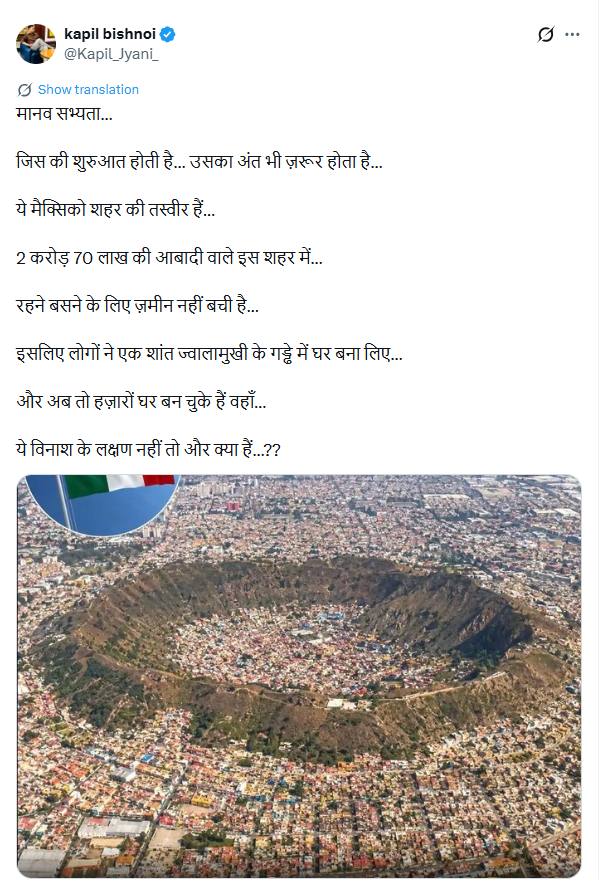
FactCheck
To verify the viral picture, we first scanned it using Google Lens. We found similar pictures on several websites and social media accounts, where they were identified as the crater of Xico Volcano in Mexico.
During the search, we also found a picture on Shutterstock, which identified the location as the crater of Xico Volcano in Chalco, Mexico.

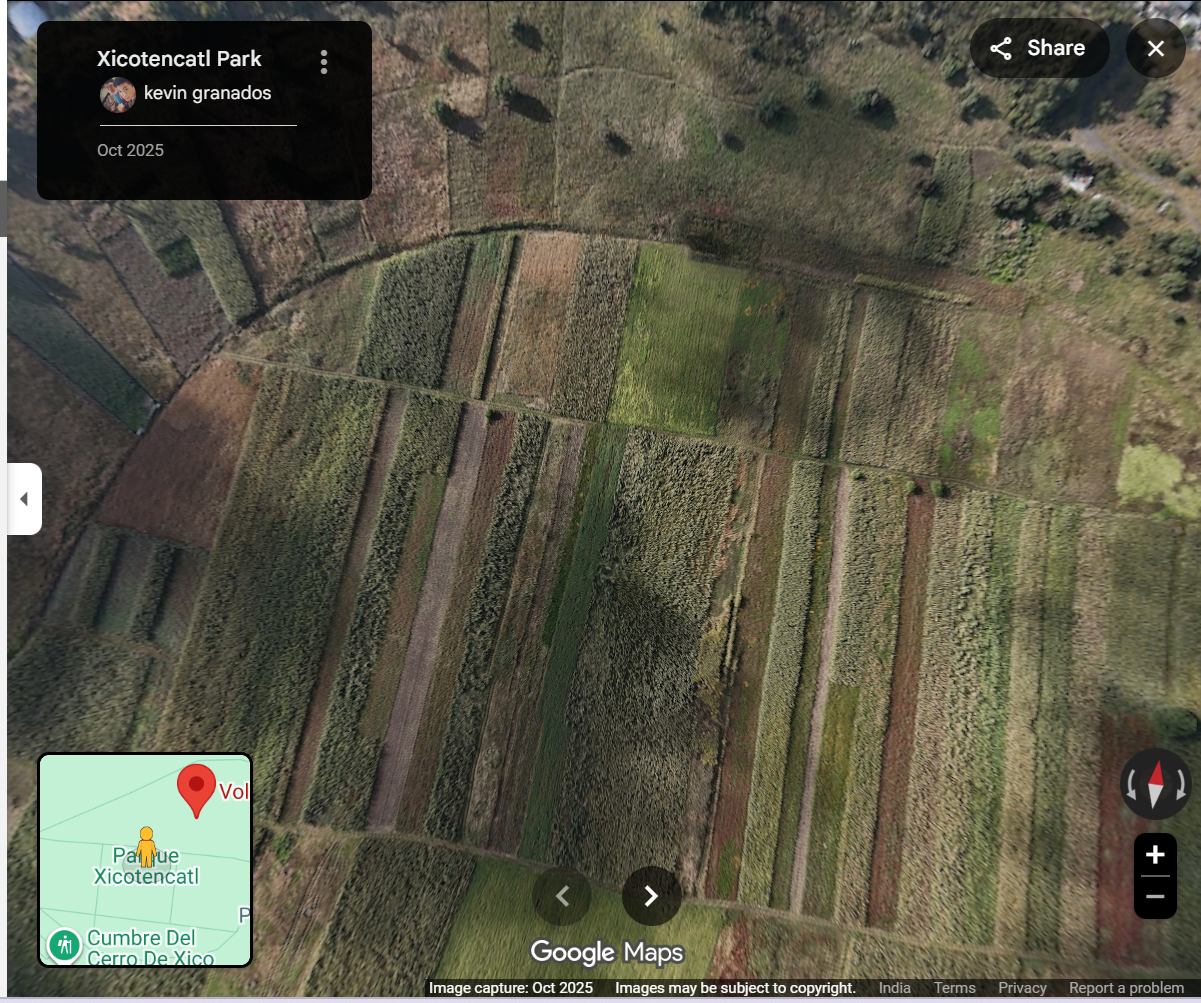
We then used Google Maps to check the location. The search showed that the Xico crater is located on the southern outskirts of Mexico City. Upon checking the area, we found agricultural activity inside the crater, while some houses could be seen in the surrounding areas.
https://maps.app.goo.gl/hszKcR1a8srtYe91A
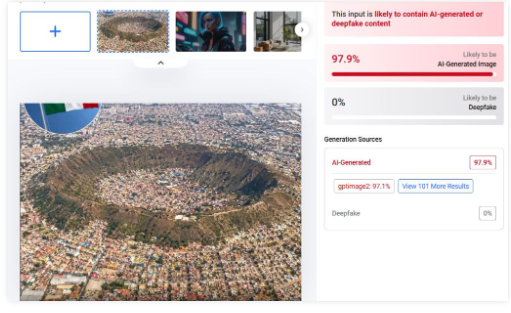
During the next stage of the research, we analysed the viral picture using AI detection tools. We first scanned the image using Hive Moderation. The tool indicated more than a 98 per cent probability that the viral picture was AI-generated.
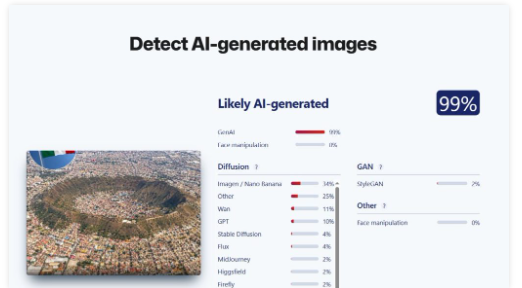
We then checked the picture using another AI detection tool, Sightengine. Its analysis also indicated a 99 per cent probability that the image was AI-generated.
Conclusion
Our research found that the claim that people have built houses inside a volcano crater in Mexico City due to a shortage of land is false. Although farming takes place inside the Xico crater, residential areas are located outside it. The viral picture was created using AI and is being shared with a misleading claim.

Related Blogs

Risk Management
The ‘Information Security Profile’ prioritises and informs cybersecurity operations based on the company's risk administration procedures. It assists in choosing areas of focus for security operations that represent the desired results for producers by supporting periodic risk evaluations and validating company motivations. A thorough grasp of the business motivations and safety requirements unique to the Production system and its surroundings is necessary in order to manage cybersecurity threats. Because every organisation has different risks and uses ICS and IT in different ways, there will be variations in how the profile is implemented.
Companies are currently adopting industry principles and cybersecurity requirements, which the Manufacturing Information is intended to supplement, not replace. Manufacturers have the ability to identify crucial operations for key supply chains and can order expenditures in a way that will optimise their impact on each dollar. The Profile's primary objective is to lessen and manage dangers associated with cybersecurity more effectively. The Cybersecurity Framework and the Profile are not universally applicable methods for controlling security risks for essential infrastructure.
Producers will always face distinct risks due to their distinct dangers, weaknesses, and tolerances for danger. Consequently, the ways in which companies adopt security protocols will also change.
Key Cybersecurity Functions: Identify, Protect, Detect, Respond, and Recover
- Determine
Create the organisational knowledge necessary to control the potential hazards of cybersecurity to information, systems, resources, and competencies. The Identify Function's tasks are essential for using the Framework effectively. An organisation can concentrate its efforts in a way that aligns with its approach to risk mitigation and company needs by having a clear understanding of the business environment, the financial resources that assist with vital operations, and the associated cybersecurity threats. Among the outcome characteristics that fall under this function are risk evaluation, mitigation strategy, the administration of assets, leadership, and the business environment.
- Protect
Create and put into place the necessary measures to guarantee the provision of crucial infrastructure amenities. The Protect Function's operations enable the limitation or containment of the possible impact of a cybersecurity incident. Instances of results Access Management, Knowledge and Instruction, Data Safety and Security, Data Protection Processes and Instructions, Repair, and Defensive Systems are some of the classifications that fall under this role.
- Detect
Create and carry out the necessary actions to determine whether a cybersecurity event has occurred. The Detect Function's operations make it possible to find vulnerability occurrences in an efficient way. This function's result subcategories include things like abnormalities and incidents, constant security monitoring, and identification processes.
- React
Create and carry out the necessary plans to address a cybersecurity event that has been discovered. The Response Function's operations facilitate the capacity to mitigate the effects of a possible cybersecurity incident. Within this Scope, emergency planning, interactions, analysis, prevention, and enhancements are a few examples of result categories.
- Recover
Create and carry out the necessary actions to uphold resilience tactics and restore any services or competencies that were hampered by a cybersecurity incident. In order to lessen the effects of a vulnerability incident, the Recovery Function's efforts facilitate a prompt return to regular operations. The following are a few instances of outcome subcategories under this role: communications, enhancements, and recovery planning.
Conclusion
The Information Security Profile, when seen in the framework of risk mitigation, offers producers a tactical method to deal with the ever-changing cybersecurity danger scenario. The assessment directs safeguarding operations prioritisation by recognising specific business reasons and connecting with corporate goals. The Profile enhances the cybersecurity standards and established industry guidelines by taking into account the differences in vulnerabilities and organisational subtleties among producers. It highlights the significance of a customised strategy, acknowledging that every business has unique risks and weaknesses.
The fundamental tasks of the Framework, to Identify, Protect, Detect, Respond, and Recover, serve as a thorough roadmap, guaranteeing a proactive and flexible approach to cybersecurity. The Profile's ultimate goal is to increase the efficacy of risk mitigation techniques, understanding that cybersecurity is a constantly shifting and evolving subject for the manufacturing sector.
References
- https://csrc.nist.gov/news/2020/cybersecurity-framework-v1-1-manufacturing-profile
- https://nvlpubs.nist.gov/nistpubs/ir/2020/NIST.IR.8183r1.pdf
- https://mysecuritymarketplace.com/reports/cybersecurity-framework-version-1-1-manufacturing-profile/

A video has been going viral on social media in recent days in which Republic TV’s Editor-in-Chief and anchor Arnab Goswami can allegedly be heard using objectionable language against Prime Minister Narendra Modi. While sharing the video, users are claiming that Arnab Goswami publicly made controversial remarks about the Prime Minister.
An investigation by CyberPeace Foundation found this claim to be completely false. Our probe revealed that the viral video is edited and is being circulated on social media with a misleading narrative. In the original video, Arnab Goswami was not making any personal statement; rather, he was referring to an old statement made by Congress leader Rahul Gandhi.
Viral Claim
An Instagram user posted this video on 5 January 2026. In the video, a voice resembling Arnab Goswami is heard saying, “Ye jo Narendra Modi hain, ye chhe mahine baad ghar se nahi nikal paayenge aur Hindustan ke log inhein danda maarenge.”
(Translation: “This Narendra Modi will not be able to step out of his house after six months, and the people of India will beat him with sticks.”)
The post link, its archive link, and screenshots can be seen below:
- Instagram link: https://www.instagram.com/reel/DTHrO7bk7Rf/?igsh=MThzbzBlcm82eWN0ZA%3D%3D
- Archive link: https://archive.ph/oaYsf

Fact Check
To verify the viral claim, we first examined the video using Google Lens search. During this process, we found a video published on 18 July 2024 on the official YouTube channel of Republic Bharat. The investigation revealed that this video is the longer (extended) version of the viral clip.
After carefully watching the full video, it became clear that Arnab Goswami was not making the statement himself. Instead, he was referring to a remark made by Congress leader Rahul Gandhi during the 2020 Delhi Assembly elections against Prime Minister Narendra Modi. This confirms that the viral video was clipped and presented out of context.
The related video link can be seen below: https://www.youtube.com/shorts/KlQV25-3l8s
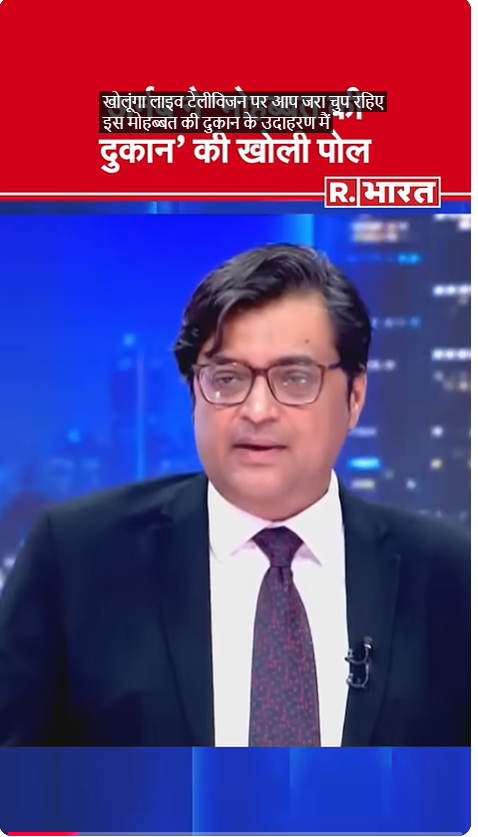
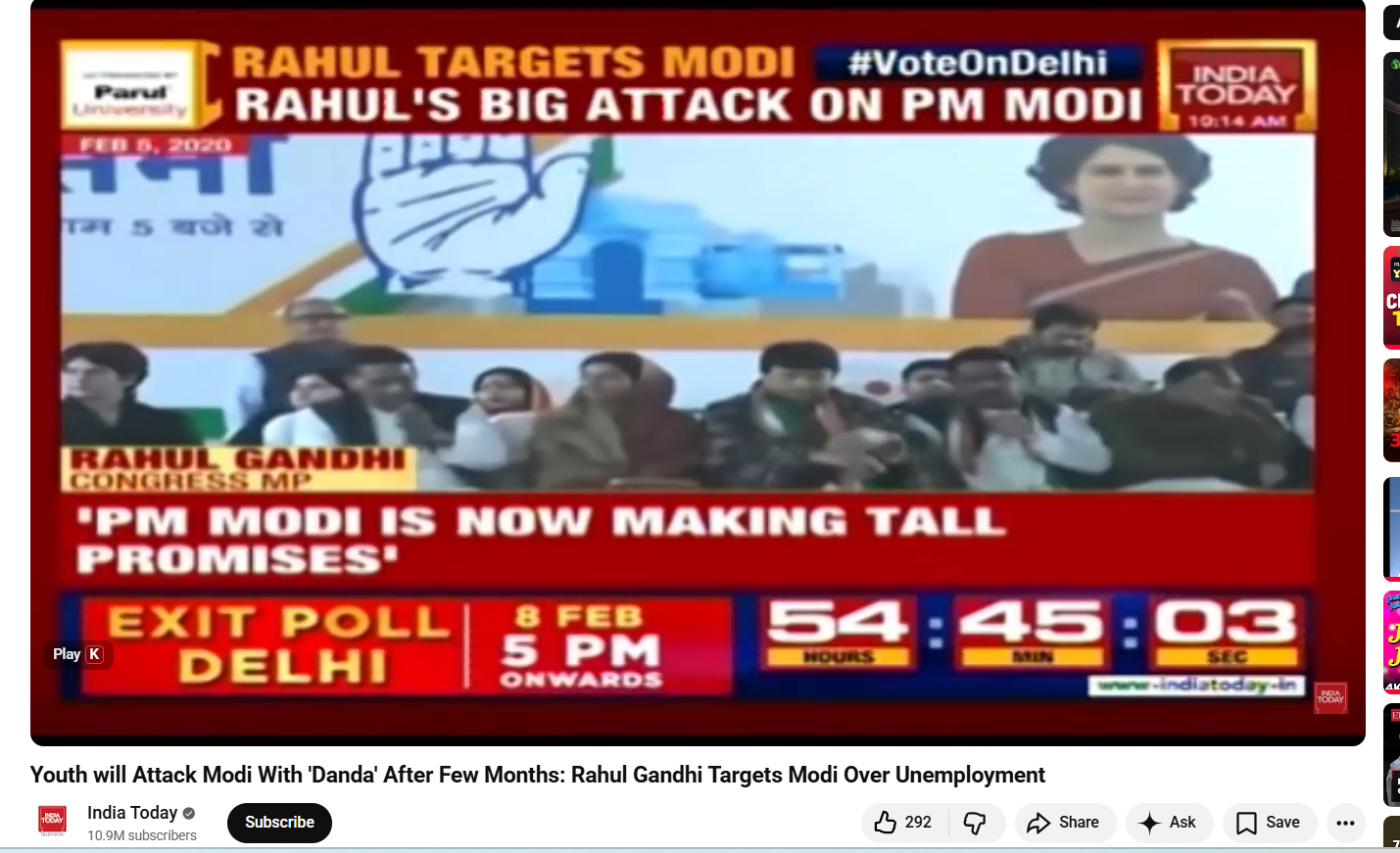
In the next step of the investigation, to verify whether Rahul Gandhi had indeed made such a statement, we conducted a customized keyword search on Google. During this, we found a video published on 6 February 2020 on the official YouTube channel of India Today.
In this video, recorded during a public event ahead of the 2020 Delhi Assembly elections, Rahul Gandhi is seen sharply attacking Prime Minister Narendra Modi, stating that if the Prime Minister fails to resolve the issue of unemployment in the country, the youth would beat him with sticks.
The video link is given below: https://www.youtube.com/watch?v=t5qCSA5nG9Y
Conclusion
The CyberPeace Foundation’s investigation found this claim to be completely fake. The viral video is edited and is being shared in a misleading context. In the original video, Arnab Goswami was referring to an old statement made by Rahul Gandhi, which was selectively clipped and presented in a way that falsely suggests Arnab Goswami himself made objectionable remarks against Prime Minister Narendra Modi.

Executive Summary:
A video showing poor runway visibility from inside an aircraft cockpit is being widely shared on social media, linking it to an alleged aircraft accident involving Maharashtra Deputy Chief Minister Ajit Pawar in Baramati on January 28, 2025. Users claim that the footage captured the final moments before the crash, suggesting that the runway visibility disappeared just seconds before landing. However, research conducted by the CyberPeace found the viral claim to be misleading. The research revealed that the video has no connection to any aircraft accident involving Deputy Chief Minister Ajit Pawar. In reality, the video dates back to 2013 and shows a pilot attempting to land an aircraft amid heavy rain. During the approach, the runway briefly disappears from the pilot’s view, prompting the pilot to abort the landing and execute a go-around. The aircraft later lands safely after weather conditions improve.
Claim
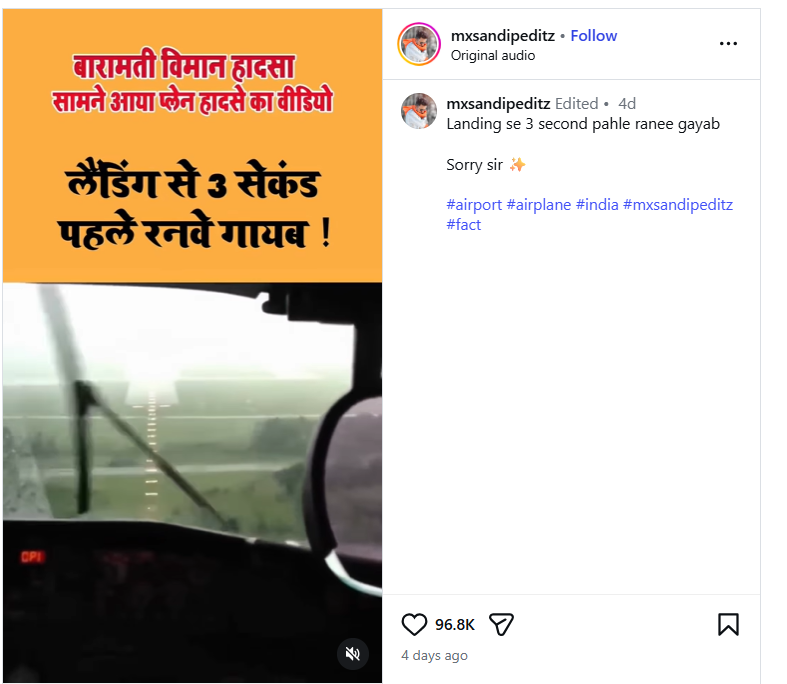
An Instagram user shared the viral video on January 29, 2026, claiming:“Baramati plane crash: video of the aircraft accident surfaces. Runway disappears just three seconds before landing.” (The link to the post, its archived version, and screenshots are provided below.)
Fact Check
To verify the claim, we extracted keyframes from the viral video and conducted a reverse image search using Google Lens. The search led us to the same video uploaded on a YouTube channel named douglesso, which was published on June 12, 2013. (Footage link and screenshot available below.)
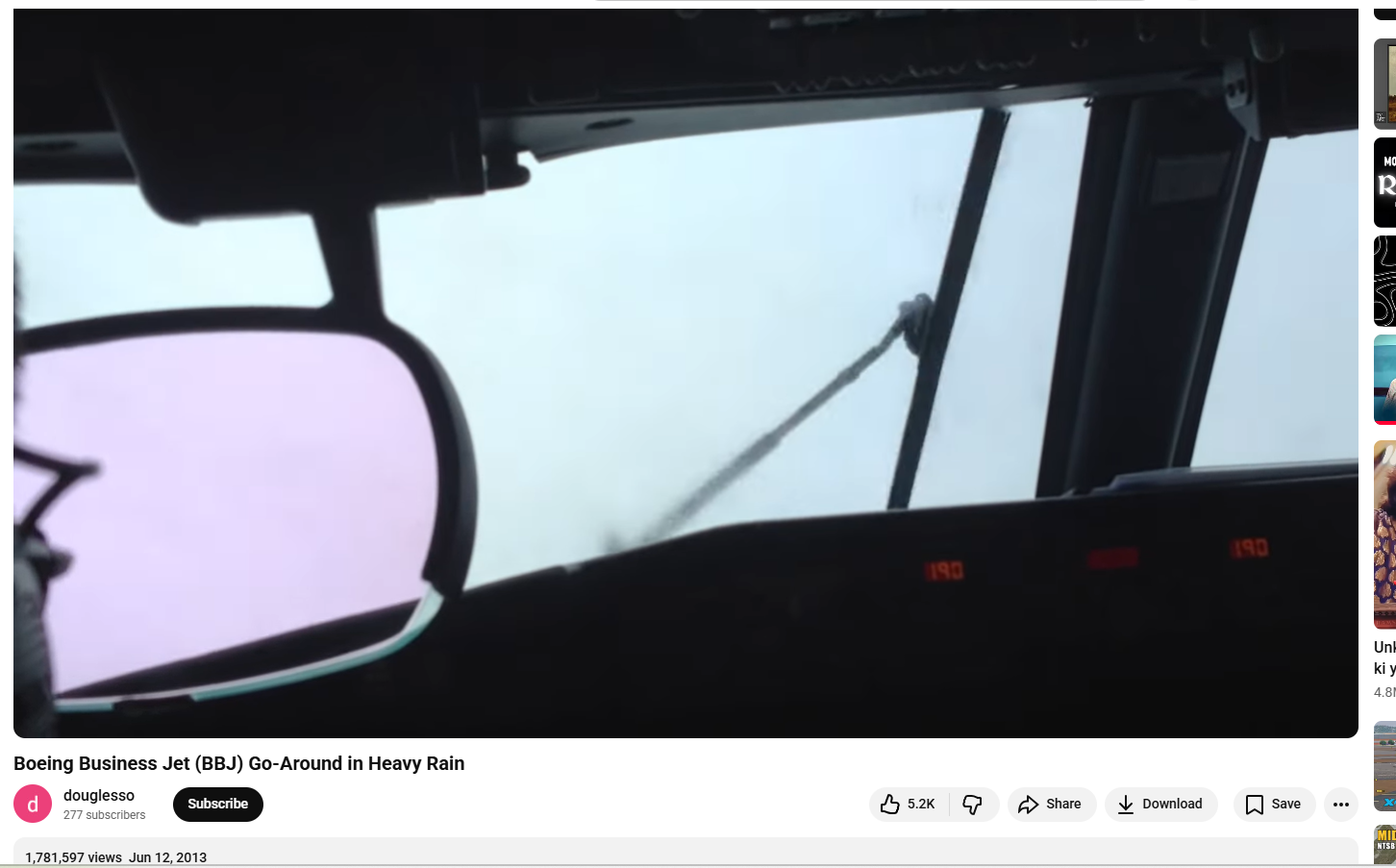
Further research led us to a report published by the American media website CNET, which featured the same visual. According to the report, the video shows a Boeing Business Jet attempting to land during heavy rainfall. The aircraft was conducting a CAT I Instrument Landing System (ILS) approach when a sudden downpour drastically reduced visibility at decision height. As the runway briefly disappeared from view, the pilots aborted the landing and carried out a go-around. The aircraft later landed safely once weather conditions improved. (The link to the CNET report and its screenshot are provided below.)
- https://www.cnet.com/culture/this-is-what-happens-when-a-plane-is-landing-and-the-runway-disappears/

Conclusion
Our research confirms that the video circulating on social media is unrelated to any recent aircraft accident involving Maharashtra Deputy Chief Minister Ajit Pawar. The clip is an old video from 2013, which is now being shared with a false and misleading claim.
