
#FactCheck: AI-generated image falsely linked to Japan mall blast after 7.1-magnitude earthquake
Executive Summary
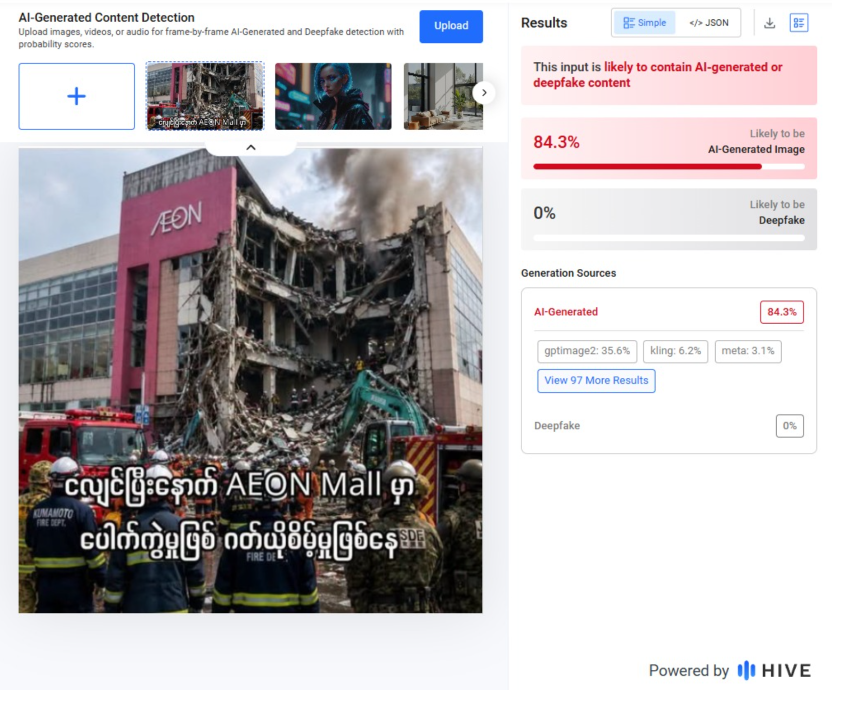
An image is being widely circulated on social media with the claim that it shows the destruction caused by an explosion at a mall in Japan following a 7.1-magnitude earthquake in July 2026. The viral image shows a shopping complex in a severely damaged condition, allegedly after the incident. CyberPeace Research Wing’s research found that the viral image does not show damage caused by an explosion or earthquake at any mall in Japan. The visuals in the image do not match authentic photographs of the affected shopping complex. The research further revealed that the viral image was created using Artificial Intelligence (AI).
Claim
A social media post claims that the AEON Mall in Japan exploded after the Kumamoto earthquake and a gas leak was suspected. The post, published in Burmese language on Facebook on July 29, 2026, shared an image claiming to show the aftermath of the incident at the mall.

FactCheck
To verify the authenticity of the viral claim, we conducted a Google search using relevant keywords. During the search, we found a report published by France24, which stated that the Kumamoto disaster management office released updated figures following the earthquake. According to the report, seven bodies were recovered from the debris, steel and wires of the Aeon shopping mall after a suspected gas blast. The report further stated that eight people were confirmed dead at the Nippon Paper Industries factory in Yatsushiro city, where part of a red-and-white smokestack collapsed. Following the 7.1-magnitude earthquake, five others were reported to be in critical condition, while around 9,500 residents were staying in evacuation centres in Kyushu, southwestern Japan.
http://france24.com/en/live-news/20260730-up-to-23-feared-dead-in-japan-quake

However, the viral image showed several visual inconsistencies and was flagged as AI-generated.
To further examine the authenticity of the image, we scanned it using the AI detection tool Hive Moderation. The results indicated that the image had an 84 percent probability of being AI-generated.
We also analysed the image using Human Meter, where the results showed a 75 percent probability that the image was AI-generated.

In the final stage of the research, we scanned the image using another AI detection tool, AI Image Detector. The tool indicated that the image had a 95 percent probability of being AI-generated.

Conclusion:
The research established that the viral image is not an authentic photograph of the damage caused by the Kumamoto earthquake or any explosion at an Aeon Mall in Japan. The image contains multiple inconsistencies and was found to be AI-generated. Therefore, the claim linking the image to the Japan earthquake incident is false.

Related Blogs

Executive Summary:
A viral post on social media shared with misleading captions about a National Highway being built with large bridges over a mountainside in Jammu and Kashmir. However, the investigation of the claim shows that the bridge is from China. Thus the video is false and misleading.

Claim:
A video circulating of National Highway 14 construction being built on the mountain side in Jammu and Kashmir.

Fact Check:
Upon receiving the image, Reverse Image Search was carried out, an image of an under-construction road, falsely linked to Jammu and Kashmir has been proven inaccurate. After investigating we confirmed the road is from a different location that is G6911 Ankang-Laifeng Expressway in China, highlighting the need to verify information before sharing.


Conclusion:
The viral claim mentioning under-construction Highway from Jammu and Kashmir is false. The post is actually from China and not J&K. Misinformation like this can mislead the public. Before sharing viral posts, take a brief moment to verify the facts. This highlights the importance of verifying information and relying on credible sources to combat the spread of false claims.
- Claim: Under-Construction Road Falsely Linked to Jammu and Kashmir
- Claimed On: Instagram and X (Formerly Known As Twitter)
- Fact Check: False and Misleading
.webp)
Data has become a critical asset for the advancement of a nation’s economic, social, and technological development. India’s emergence as a global digital economy hub makes it necessary to create a robust framework that addresses the challenges and opportunities of digital transformation. The Indian government introduced the Draft National Data Governance Framework Policy in 2022, aiming to create a comprehensive data handling and governance framework. This policy draft addresses key challenges in data management, privacy, and digital economy growth. As per the recent media reports, the Draft National Data Governance Policy so prepared is under the finalisation stage, the government specified in its implementation document for the Budget 2023-24 announcement. The policy also aims to address the country's AI adoption and the issue of lack of datasets by providing widespread access to anonymized data.
Background and Need for the Policy
India has a robust digital economy with its adoption of the Digital India Initiative, Aadhaar digital identification, UPI for seamless payments and many more. In India, 751.5 million people connect to the internet, and is home to 462.0 million social media users in January 2024, equivalent to 32.2% of its total population (Data Reportal 2024). This has brought challenges including data privacy concerns, cybersecurity threats, digital exclusion, and a need for better regulation frameworks. To overcome them, the Draft National Data Governance Policy has been designed to provide institutional frameworks for data rules, standards, guidelines, and protocols for the sharing of non-personal data sets in a manner that ensures privacy, security, and trust so that they remain secure, transparent, and accountable.
Objectives omphasizesf the Framework
The objective of the Framework Policy is to accelerate Digital Governance in India. The framework will standardize data management and security standards across the Government. It will promote transparency, accountability, and ownership in Non-Personal data and dataset access and build a platform to receive and process data requests. It will also set quality standards and promote the expansion of the datasets program and overall non-personal ecosystem. Further, it aims to build India’s digital government goals and capacity, knowledge, and competency in Government departments and entities. All this would be done while ensuring greater citizen awareness, participation, and engagement.
Key Provisions of the Draft Policy
The Draft Framework Policy aims to establish a cohesive digital governance ecosystem in India that balances the need for data utilization with protecting citizens' privacy rights. It sets up an institutional framework of the "India Data Management Office (IDMO) set up under the Digital India Corporation (DIC) which will be responsible for developing rules, standards, and guidelines under this Policy.
The key provisions of the framework policy include:
- Promoting interoperability among government digital platforms, ensuring data privacy through data anonymization and security, and enhancing citizen access to government services through digital means.
- The policy e the creation of unified digital IDs, a standardisation in digital processes, and data-sharing guidelines across ministries to improve efficiency.
- It also focuses on building digital infrastructure, such as cloud services and data centres in order to support e-governance initiatives.
- Furthermore, it encourages public-private partnerships and sets guidelines for accountability and transparency in digital governance.
Implications and Concerns of the Framework
- The policy potentially impacts data sharing in India as it mentions data anonymization. The scale of data that would need to be anonymised in India is at a very large scale and it could become a potential challenge to engage in.
- Data localization and cross-border transfers have raised concerns among global tech companies and trade partners. They argue that such requirements could increase operational costs and hinder cross-border data flows. Striking a balance between protecting national interests and facilitating business operations remains a critical challenge.
- Another challenge associated with the policy is over-data centralization under the IDMO and the potential risks of government overreach in data access.
Key Takeaways and Recommendations
The GDPR in the European Union and the Digital Personal Data Protection Act passed in 2023 in India and many others are the data privacy laws in force in different countries. The policy needs to be aligned with the DPDP Act, 2023 and be updated as per the recent developments. It further needs to maintain transparency over the sharing of data and a user’s control. The policy needs engagement with industry experts, privacy advocates, and civil society to ensure a balance of innovation with privacy and security.
Conclusion
The Draft National Data Governance Framework Policy of 2022 represents a significant stage in shaping India's digital future. It ensures the evolution of data governance evolves alongside technological advancements. The framework policy seeks to foster a robust digital ecosystem that benefits citizens, businesses, and the government alike by focusing on the essentials of data privacy, transparency, and security. However, achieving this vision requires addressing concerns like data centralisation, cross-border data flows, and maintaining alignment with global privacy standards. Continued engagement with stakeholders and necessary updates to the draft policy will be crucial to its success in balancing innovation with user rights and data integrity. The final version of the policy is expected to be released soon.
References
- https://meity.gov.in/writereaddata/files/National-Data-Governance-Framework-Policy.pdf
- https://datareportal.com/?utm_source=DataReportal&utm_medium=Country_Article_Hyperlink&utm_campaign=Digital_2024&utm_term=India&utm_content=Home_Page_Link
- https://www.imf.org/en/Publications/fandd/issues/2023/03/data-by-people-for-people-tiwari-packer-matthan
- https://inc42.com/buzz/draft-national-data-governance-policy-under-finalisation-centre/
- https://legal.economictimes.indiatimes.com/news/industry/government-unveiled-national-data-governance-policy-in-budget-2023/97680515
Introduction
AI is transforming the way work is done and redefining the nature of jobs over the next decade. In the case of India, it is not just what duties will be taken over by machines, but how millions of employees will move to other sectors, which skills will become more sought-after, and how policy will have to change in response. This article relies on recent labour data of India's Periodic Labour Force Survey (PLFS, 2023-24) and discusses the vulnerabilities to disruption by location and social groups. It recommends viable actions that can be taken to ensure that risks are minimised and economic benefits maximised.
India’s Labour Market and Its Automation Readiness
According to India’s Periodic Labour Force Survey (PLFS), the labour market is changing and growing. Participation in the labour force improved to 60.1 per percent in 2023-24 versus 57.9 per cent the year before, and the ratio of the worker population also improved, signifying the increased employment uptake both in the rural and urban geographies (PLFS, 2023-24). There has also been an upsurge of female involvement. However, a big portion of the job market has been low-wage and informal, with most of the jobs being routine and thus most vulnerable to automation. The statistics indicate a two-tiered reality of the Indian labour market: an increased number of working individuals and a structural weakness.
AI-Driven Automation’s Impact on Tasks and Emerging Opportunities
AI-driven automation, for the most part, affects the task components of jobs rather than wiping out whole jobs. The most automatable tasks are routine and manual, and more recent developments in AI have extended to non-routine cognitive tasks like document review, customer query handling, basic coding and first-level decision-making. There are two concurrent findings of global studies. To start with, part of the ongoing tasks will be automated or expedited. Second, there will be completely new tasks and work positions around data annotation, the operation of AI systems, prompt engineering, algorithmic supervision and AI adherence (World Bank, 2025; McKinsey, 2017).
In the case of India, this change will be skewed by sector. The manufacturing, back-office IT services, retail and parts of financial services will see the highest rate of disruption due to the concentration of routine processes with the ease of technology adoption. In comparison, healthcare, education, high-tech manufacturing and AI safety auditing are placed to create new skilled jobs. NITI Aayog estimates huge returns in GDP with the adoption of AI but emphasises that India has to invest simultaneously in job creation and reskilling to achieve the returns (NITI Aayog, 2025).
Groups with Highest Vulnerability in the Transition to Automation
The PLFS emphasises that a large portion of the Indian population does not have any formal employment and that the social protection is minimal and formal training is not available to them. The risk of displacement is likely to be the greatest for informal employees, making up almost 90% of India’s labour force, who carry out low-skilled, repetitive jobs in the manufacturing and retail industry (PLFS, 2023-24). Women and young people in low-level service jobs also face a greater challenge of transition pressure unless the reskilling and placement efforts can be tailored to them. Meanwhile, major cities and urban centres are likely to have openings for most of the new skilled opportunities at the expense of an increasing geographic and social divide.
The Skills and Supply Challenge
While India’s education and research ecosystem is expanding, there remain significant gaps in preparing the workforce for AI-driven change. Given the vulnerabilities highlighted earlier, AI-focused reskilling must be a priority to equip workers with practical skills that meet industry needs. Short modular programs in areas such as cloud technologies, AI operations, data annotation, human-AI interaction, and cybersecurity can provide workers with employable skills. Particular attention should be given to routine-intensive sectors like manufacturing, retail, and back-office services, as well as to regions with high informal employment or lower access to formal training. Public-private partnerships and localised training initiatives can help ensure that reskilling translates into concrete job opportunities rather than purely theoretical knowledge (NITI Aayog, 2025)
The Way Forward
To facilitate the change process, the policy should focus on three interconnected goals: safeguarding the vulnerable, developing competencies on a large-scale level, and directing innovation towards the widespread ability to benefit.
- Protect the vulnerable through social buffers. Provide informal workers with social protection in the form of portable benefits, temporary income insurance based on reskilling, and earned training leave. While the new labour codes provide essential protections such as unemployment allowances and minimum wage standards, they could be strengthened by incorporating explicit provisions for reskilling. This would better support informal workers during job transitions and enhance workforce adaptability.
- Short modular courses on cloud computing, cybersecurity, data annotation, AI operations, and human-AI interaction should be planned through collaboration between public and private training providers. Special preference should be given to industry-certified certifications and apprenticeship-based placements. These apprenticeships should be made accessible in multiple languages to ensure inclusivity. Existing government initiatives, such as NASSCOM’s Future Skills Prime, need better outreach and marketing to reach the workforce effectively.
- Enhance local labour market mediators. Close the disparity between local demand and the supply of labour in the industry by enhancing placement services and government-subsidised internship programmes for displaced employees and encouraging firms to hire and train locally.
- Invest in AI literacy, AI ethics, and basic education. Democratise access to research and learning by introducing AI literacy in schools, increasing STEM seats in universities, and creating AI labs in the region (NITI Aayog, 2025).
- Encourage AI adoption that creates jobs rather than replaces them. Fiscal and regulatory incentives should prioritise AI tools that augment worker productivity in routine roles instead of eliminating positions. Public procurement can support firms that demonstrate responsible and inclusive deployment of AI, ensuring technology benefits both business and workforce.
- Supervise and oversee the transition. Use PLFS and real-time administrative data to monitor shrinking and expanding occupations. High-frequency labour market dashboards will allow making specific interventions in those regions in which the acceleration of displacement occurs.
Conclusion
The integration of AI will significantly impact the future of the Indian workforce, but policy will determine its effect on the labour market. The PLFS indicates increased employment but a structural weakness of informal and routine employment. Evidence from the Indian market and international research points to the fact that the appropriate combination of social protection, skills building and responsible technology implementation can change disruption into a path of upward mobility. There is a very limited window of action. The extent to which India will realise the productivity and GDP benefits predicted by national research, alongside the investments made in labour market infrastructure, remains uncertain. It is crucial that these efforts lead to the capture of gains and facilitate a fair and inclusive transition for workers.
References
- Annual Report Periodic Labour Force Survey (PLFS) JULY 2022 - JUNE 2023.
- Future Jobs: Robots, Artificial Intelligence, and Digital Platforms in East Asia and Pacific, World Bank.
- Jobs Lost, Jobs Gained: What the Future of Work Will Mean for Jobs, Skills, and Wages, McKinsey Global Institute
- Roadmap for Job Creation in the AI Economy, NITI Aayog
- India central bank chief warns of financial stability risks from growing use of AI, Reuters
- AI Cyber Attacks Statistics 2025, SQ Magazine.
