
#FactCheck:AI-Generated Footage Misleadingly Shared as Rawalakot Protest Video
Executive Summary
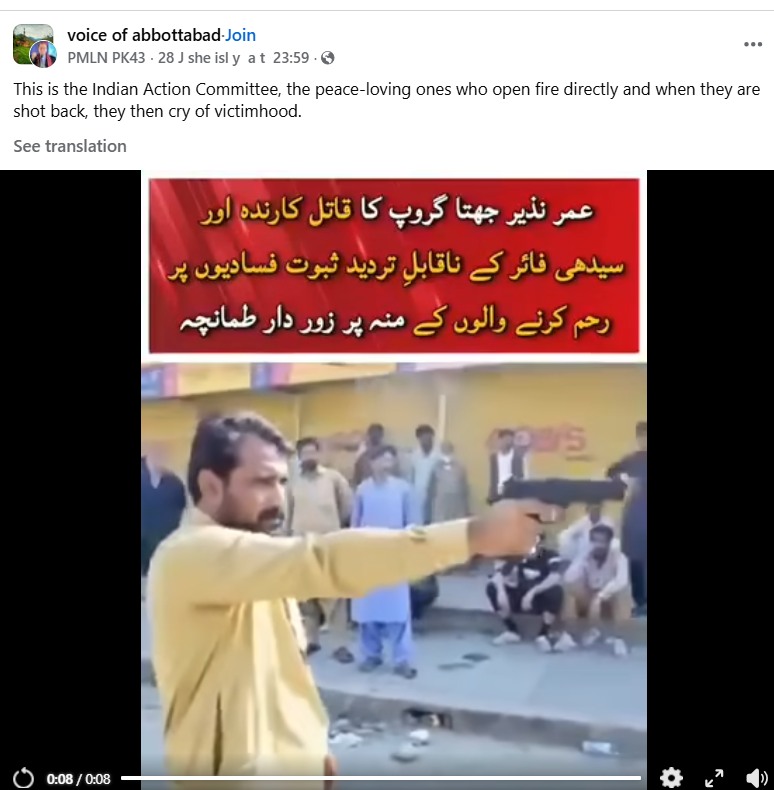
A video is being widely shared on social media, showing a man firing a pistol. The video is being shared with the claim that it is from the recent protests in Rawalakot, Pakistan-administered Kashmir. It is further claimed that the person seen in the video is associated with the Indian Action Committee, who is firing at security forces and later portraying themselves as victims after facing retaliation. The CyberPeace Research Wing analysed the viral video and found several visual inconsistencies. Further analysis using AI detection tools revealed that the viral video was generated using artificial intelligence (AI).
Claim:
A video shared on social media claims to show protesters associated with the Indian Action Committee directly firing at security forces. The post further claims that these individuals later present themselves as victims after facing a response from authorities.
https://www.facebook.com/groups/1052887838090429/permalink/27742200445399139/?rdid=EMCXtwaN9n4OwqFc#
Fact Check:
During the research, the viral video was analysed and multiple visual inconsistencies were observed. At the beginning of the clip, two men riding a motorcycle can be seen behind the person firing the gun. However, instead of moving away from the firing spot, they appear to move towards the direction where the shooting is taking place. Additionally, the hand and head movements of one of the passengers on the motorcycle appear unnatural and distorted, which are common signs of AI-generated content.
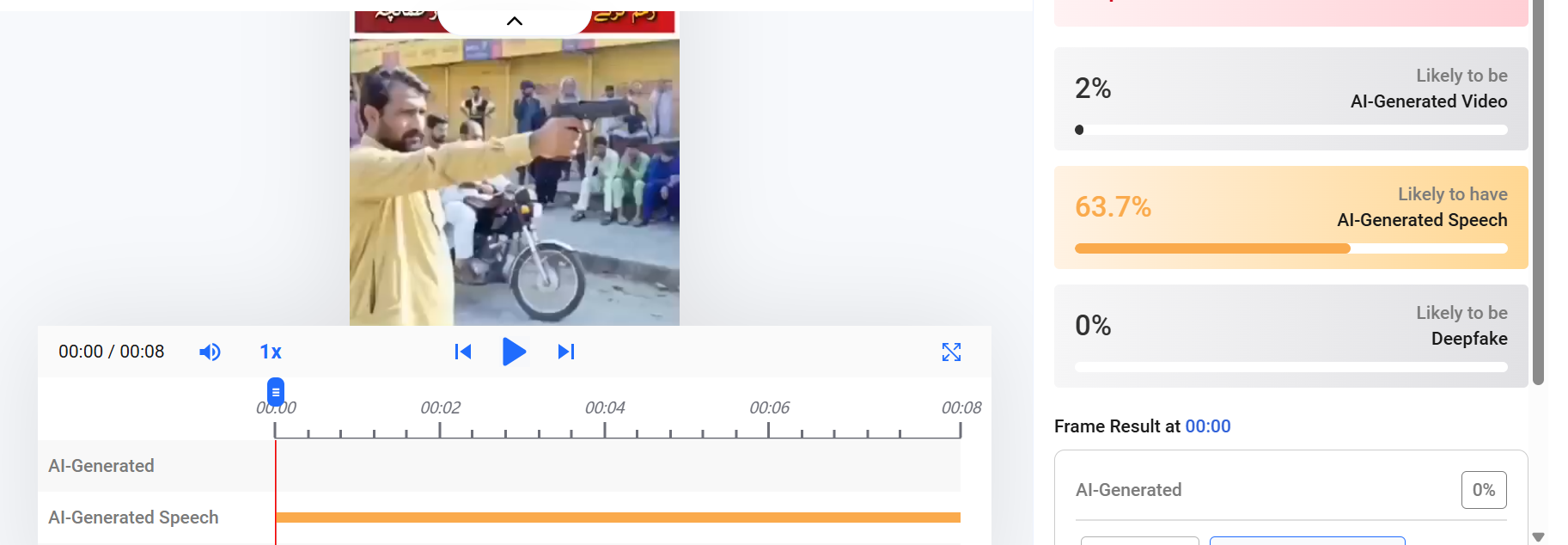
In the next step of the research, the viral video was scanned using Hive Moderation. The results indicated that the video had a 63 per cent probability of being AI-generated.
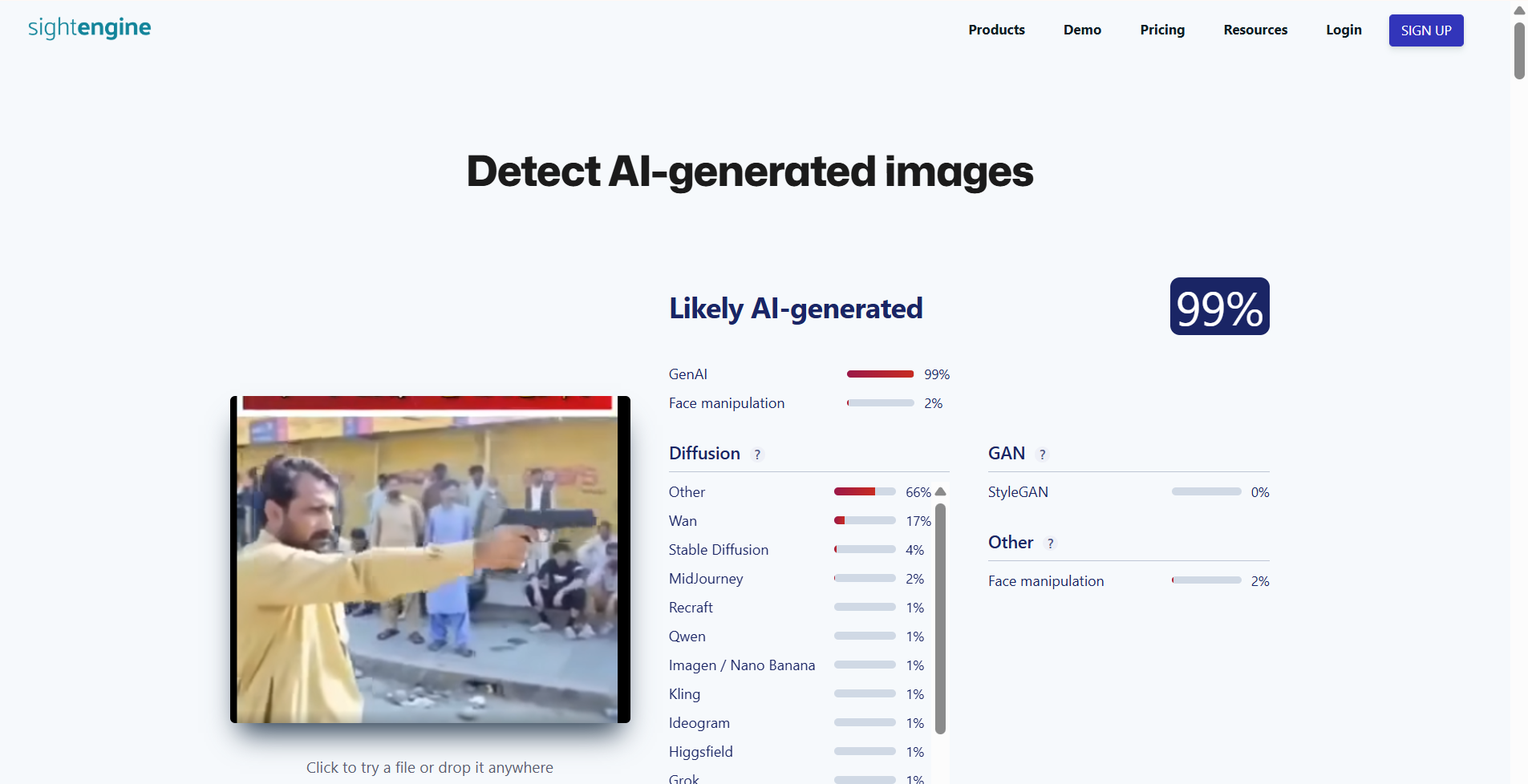
The video was also analysed using Sightengine, which flagged it as 99 per cent AI-generated.
Conclusion:
The research found that the viral video does not show a real incident from the recent protests in Rawalakot, Pakistan-administered Kashmir. The video contains multiple visual inconsistencies, and analysis through AI detection tools also confirmed that it was generated using artificial intelligence. Therefore, the claim that the video shows an Indian Action Committee member firing at security forces during the protests is false.

Related Blogs

Executive Summary:
A photo allegedly shows an Israeli Army dog attacking an elderly Palestinian woman has been circulating online on social media. However, the image is misleading as it was created using Artificial Intelligence (AI), as indicated by its graphical elements, watermark ("IN.VISUALART"), and basic anomalies. Although there are certain reports regarding the real incident in several news channels, the viral image was not taken during the actual event. This emphasizes the need to verify photos and information shared on social media carefully.

Claims:
A photo circulating in the media depicts an Israeli Army dog attacking an elderly Palestinian woman.


Fact Check:
Upon receiving the posts, we closely analyzed the image and found certain discrepancies that are commonly seen in AI-generated images. We can clearly see the watermark “IN.VISUALART” and also the hand of the old lady looks odd.

We then checked in AI-Image detection tools named, True Media and contentatscale AI detector. Both found potential AI Manipulation in the image.


Both tools found it to be AI Manipulated. We then keyword searched for relevant news regarding the viral photo. Though we found relevant news, we didn’t get any credible source for the image.

The photograph that was shared around the internet has no credible source. Hence the viral image is AI-generated and fake.
Conclusion:
The circulating photo of an Israeli Army dog attacking an elderly Palestinian woman is misleading. The incident did occur as per the several news channels, but the photo depicting the incident is AI-generated and not real.
- Claim: A photo being shared online shows an elderly Palestinian woman being attacked by an Israeli Army dog.
- Claimed on: X, Facebook, LinkedIn
- Fact Check: Fake & Misleading

Executive Summary:
A recent claim going around on social media that a child created sand sculptures of cricket legend Mahendra Singh Dhoni, has been proven false by the CyberPeace Research Team. The team discovered that the images were actually produced using an AI tool. Evident from the unusual details like extra fingers and unnatural characteristics in the sculptures, the Research Team discerned the likelihood of artificial creation. This suspicion was further substantiated by AI detection tools. This incident underscores the need to fact-check information before posting, as misinformation can quickly go viral on social media. It is advised everyone to carefully assess content to stop the spread of false information.

Claims:
The claim is that the photographs published on social media show sand sculptures of cricketer Mahendra Singh Dhoni made by a child.


Fact Check:
Upon receiving the posts, we carefully examined the images. The collage of 4 pictures has many anomalies which are the clear sign of AI generated images.

In the first image the left hand of the sand sculpture has 6 fingers and in the word INDIA, ‘A’ is not properly aligned i.e not in the same line as other letters. In the second image, the finger of the boy is missing and the sand sculpture has 4 fingers in its front foot and has 3 legs. In the third image the slipper of the boy is not visible whereas some part of the slipper is visible, and in the fourth image the hand of the boy is not looking like a hand. These are some of the major discrepancies clearly visible in the images.
We then checked using an AI Image detection tool named ‘Hive’ image detection, Hive detected the image as 100.0% AI generated.

We then checked it in another AI image detection named ContentAtScale AI image detection, and it found to be 98% AI generated.

From this we concluded that the Image is AI generated and has no connection with the claim made in the viral social media posts. We have also previously debunked AI Generated artwork of sand sculpture of Indian Cricketer Virat Kohli which had the same types of anomalies as those seen in this case.
Conclusion:
Taking into consideration the distortions spotted in the images and the result of AI detection tools, it can be concluded that the claim of the pictures representing the child's sand sculptures of cricketer Mahendra Singh Dhoni is false. The pictures are created with Artificial Intelligence. It is important to check and authenticate the content before posting it to social media websites.
- Claim: The frame of pictures shared on social media contains child's sand sculptures of cricket player Mahendra Singh Dhoni.
- Claimed on: X (formerly known as Twitter), Instagram, Facebook, YouTube
- Fact Check: Fake & Misleading
.webp)
Executive Summary
This report analyses a recently launched social engineering attack that took advantage of Microsoft Teams and AnyDesk to deliver DarkGate malware, a MaaS tool. This way, through Microsoft Teams and by tricking users into installing AnyDesk, attackers received unauthorized remote access to deploy DarkGate that offers such features as credential theft, keylogging, and fileless persistence. The attack was executed using obfuscated AutoIt scripts for the delivery of malware which shows how threat actors are changing their modus operandi. The case brings into focus the need to put into practice preventive security measures for instance endpoint protection, staff awareness, limited utilization of off-ice-connection tools, and compartmentalization to safely work with the new and increased risks that contemporary cyber threats present.
Introduction
Hackers find new technologies and application that are reputable for spreading campaigns. The latest use of Microsoft Teams and AnyDesk platforms for launching the DarkGate malware is a perfect example of how hackers continue to use social engineering and technical vulnerabilities to penetrate the defenses of organizations. This paper focuses on the details of the technical aspect of the attack, the consequences of the attack together with preventive measures to counter the threat.
Technical Findings
1. Attack Initiation: Exploiting Microsoft Teams
The attackers leveraged Microsoft Teams as a trusted communication platform to deceive victims, exploiting its legitimacy and widespread adoption. Key technical details include:
- Spoofed Caller Identity: The attackers used impersonation techniques to masquerade as representatives of trusted external suppliers.
- Session Hijacking Risks: Exploiting Microsoft Teams session vulnerabilities, attackers aimed to escalate their privileges and deploy malicious payloads.
- Bypassing Email Filters: The initial email bombardment was designed to overwhelm spam filters and ensure that malicious communication reached the victim’s inbox.
2. Remote Access Exploitation: AnyDesk
After convincing victims to install AnyDesk, the attackers exploited the software’s functionality to achieve unauthorized remote access. Technical observations include:
- Command and Control (C2) Integration: Once installed, AnyDesk was configured to establish persistent communication with the attacker’s C2 servers, enabling remote control.
- Privilege Escalation: Attackers exploited misconfigurations in AnyDesk to gain administrative privileges, allowing them to disable antivirus software and deploy payloads.
- Data Exfiltration Potential: With full remote access, attackers could silently exfiltrate data or install additional malware without detection.
3. Malware Deployment: DarkGate Delivery via AutoIt Script
The deployment of DarkGate malware utilized AutoIt scripting, a programming language commonly used for automating Windows-based tasks. Technical details include:
- Payload Obfuscation: The AutoIt script was heavily obfuscated to evade signature-based antivirus detection.
- Process Injection: The script employed process injection techniques to embed DarkGate into legitimate processes, such as explorer.exe or svchost.exe, to avoid detection.
- Dynamic Command Loading: The malware dynamically fetched additional commands from its C2 server, allowing real-time adaptation to the victim’s environment.
4. DarkGate Malware Capabilities
DarkGate, now available as a Malware-as-a-Service (MaaS) offering, provides attackers with advanced features. Technical insights include:
- Credential Dumping: DarkGate used the Mimikatz module to extract credentials from memory and secure storage locations.
- Keylogging Mechanism: Keystrokes were logged and transmitted in real-time to the attacker’s server, enabling credential theft and activity monitoring.
- Fileless Persistence: Utilizing Windows Management Instrumentation (WMI) and registry modifications, the malware ensured persistence without leaving traditional file traces.
- Network Surveillance: The malware monitored network activity to identify high-value targets for lateral movement within the compromised environment.
5. Attack Indicators
Trend Micro researchers identified several indicators of compromise (IoCs) associated with the DarkGate campaign:
- Suspicious Domains: example-remotesupport[.]com and similar domains used for C2 communication.
- Malicious File Hashes:some text
- AutoIt Script: 5a3f8d0bd6c91234a9cd8321a1b4892d
- DarkGate Payload: 6f72cde4b7f3e9c1ac81e56c3f9f1d7a
- Behavioral Anomalies:some text
- Unusual outbound traffic to non-standard ports.
- Unauthorized registry modifications under HKCU\Software\Microsoft\Windows\CurrentVersion\Run.
Broader Cyber Threat Landscape
In parallel with this campaign, other phishing and malware delivery tactics have been observed, including:
- Cloud Exploitation: Abuse of platforms like Cloudflare Pages to host phishing sites mimicking Microsoft 365 login pages.
- Quishing Campaigns: Phishing emails with QR codes that redirect users to fake login pages.
- File Attachment Exploits: Malicious HTML attachments embedding JavaScript to steal credentials.
- Mobile Malware: Distribution of malicious Android apps capable of financial data theft.
Implications of the DarkGate Campaign
This attack highlights the sophistication of threat actors in leveraging legitimate tools for malicious purposes. Key risks include:
- Advanced Threat Evasion: The use of obfuscation and process injection complicates detection by traditional antivirus solutions.
- Cross-Platform Risk: DarkGate’s modular design enables its functionality across diverse environments, posing risks to Windows, macOS, and Linux systems.
- Organizational Exposure: The compromise of a single endpoint can serve as a gateway for further network exploitation, endangering sensitive organizational data.
Recommendations for Mitigation
- Enable Advanced Threat Detection: Deploy endpoint detection and response (EDR) solutions to identify anomalous behavior like process injection and dynamic command loading.
- Restrict Remote Access Tools: Limit the use of tools like AnyDesk to approved use cases and enforce strict monitoring.
- Use Email Filtering and Monitoring: Implement AI-driven email filtering systems to detect and block email bombardment campaigns.
- Enhance Endpoint Security: Regularly update and patch operating systems and applications to mitigate vulnerabilities.
- Educate Employees: Conduct training sessions to help employees recognize and avoid phishing and social engineering tactics.
- Implement Network Segmentation: Limit the spread of malware within an organization by segmenting high-value assets.
Conclusion
Using Microsoft Teams and AnyDesk to spread DarkGate malware shows the continuous growth of the hackers’ level. The campaign highlights how organizations have to start implementing adequate levels of security preparedness to threats, including, Threat Identification, Training employees, and Rights to Access.
The DarkGate malware is a perfect example of how these attacks have developed into MaaS offerings, meaning that the barrier to launch highly complex attacks is only decreasing, which proves once again why a layered defense approach is crucial. Both awareness and flexibility are still the key issues in addressing the constantly evolving threat in cyberspace.

