
#FactCheck- Hong Kong Fire Video Falsely Shared as Footage of Recent Israeli Attack on Iran
Executive Summary
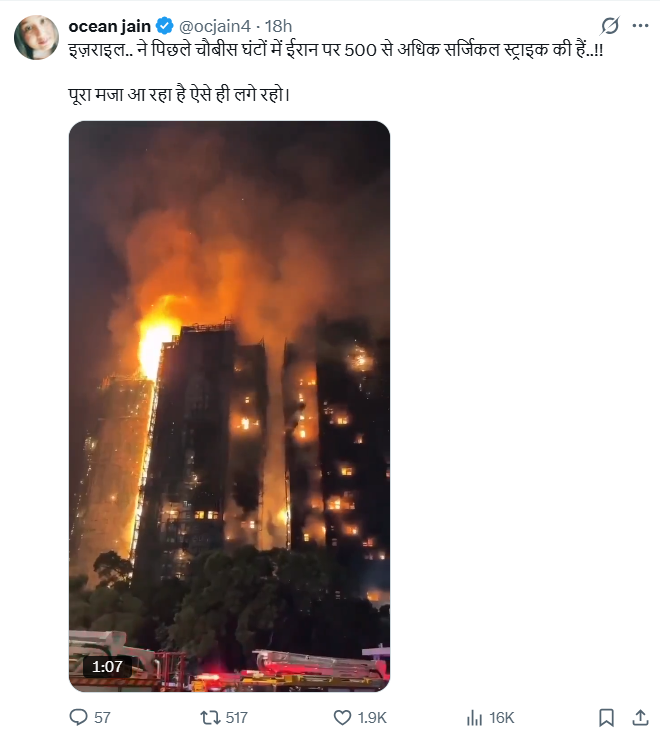
A video is being widely shared on social media with the claim that it shows the aftermath of a recent Israeli attack on Iran. The footage shows multiple residential high-rise buildings engulfed in flames, with thick plumes of smoke rising into the sky. Users sharing the video claim that Israel carried out more than 500 airstrikes on Iran. CyberPeace Research Wingresearch found the claim to be misleading. The viral video is not related to any Israeli attack on Iran. It actually shows a massive fire that broke out in a residential complex in Hong Kong in November 2025.
Claim:
An X user shared the viral video and wrote, “Israel has carried out more than 500 surgical strikes on Iran in the last 24 hours. Enjoying it thoroughly. Keep it up.”
Post link, archive link and screenshot can be seen below:
https://x.com/ocjain4/status/2064715707997413618?s=20
Fact Check:
To verify the authenticity of the viral video, we extracted keyframes and conducted a Google Lens search. During the research, we found the same footage on Reuters’ website, where it had been published on November 26, 2025.
Report link and screenshot can be seen below:
https://www.reuters.com/video/watch/idRW511126112025RP1/
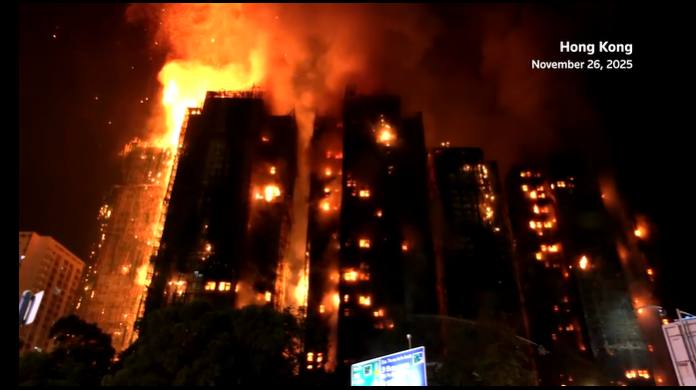
According to Reuters, the video shows a massive fire that engulfed multiple high-rise residential buildings in Hong Kong’s northern Tai Po district. The blaze claimed the lives of at least four people. Thick smoke could be seen billowing from the buildings as firefighters and emergency response teams worked to bring the fire under control.
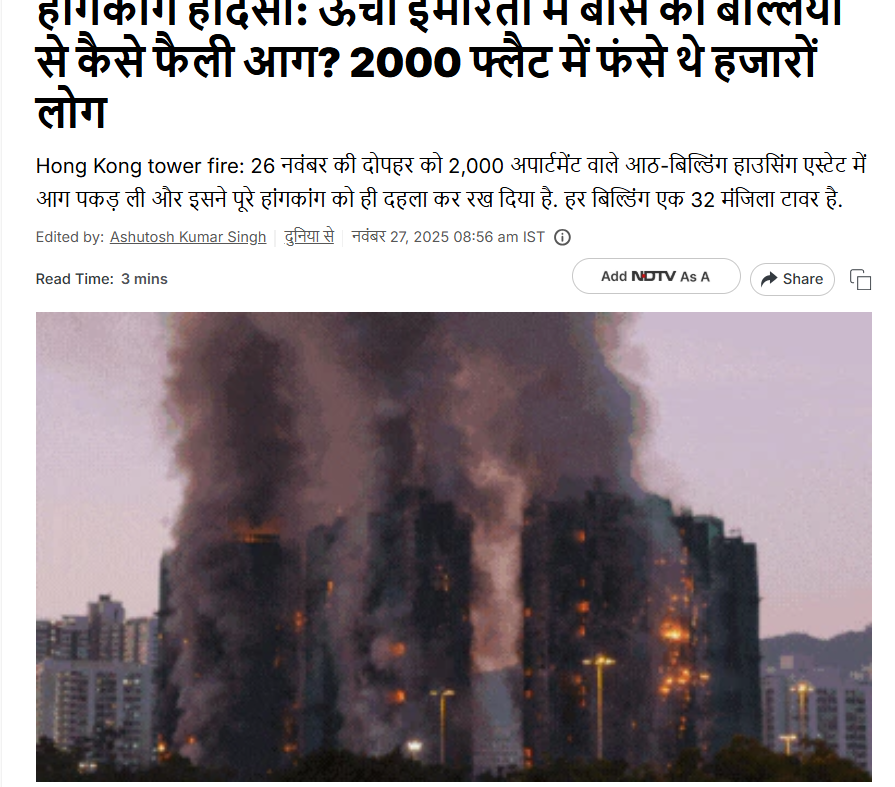
After establishing the source of the video, we conducted a keyword search on Google and found a report published by NDTV on November 27, 2025, which also covered the incident.
Report link and screenshot can be seen below:
Conclusion:
Our research found that the viral video is not related to any Israeli attack on Iran. The footage actually shows a massive fire that broke out in residential buildings in Hong Kong in November 2025. Chinese President Xi Jinping had expressed condolences to the victims, including a firefighter who lost his life while on duty.

Related Blogs

Executive Summary:
A video clip being circulated on social media allegedly shows the Hon’ble President of India, Smt. Droupadi Murmu, the TV anchor Anjana Om Kashyap and the Hon’ble Chief Minister of Uttar Pradesh, Shri Yogi Adityanath promoting a medicine for diabetes. While The CyberPeace Research Team did a thorough investigation, the claim was found to be not true. The video was digitally edited, with original footage of the heavy weight persons being altered to falsely suggest their endorsement of the medication. Specific discrepancies were found in the lip movements and context of the clips which indicated AI Manipulation. Additionally, the distinguished persons featured in the video were actually discussing unrelated topics in their original footage. Therefore, the claim that the video shows endorsements of a diabetes drug by such heavy weights is debunked. The conclusion drawn from the analysis is that the video is an AI creation and does not reflect any genuine promotion. Furthermore, it's also detected by AI voice detection tools.

Claims:
A video making the rounds on social media purporting to show the Hon'ble President of India, Smt. Draupadi Murmu, TV anchor Anjana Om Kashyap, and Hon'ble Chief Minister of Uttar Pradesh Shri Yogi Adityanath giving their endorsement to a diabetes medicine.

Fact Check:
Upon receiving the post we carefully watched the video and certainly found some discrepancies between lip synchronization and the word that we can hear. Also the voice of Chief Minister of Uttar Pradesh Shri Yogi Adityanath seems to be suspicious which clearly indicates some sign of fabrication. In the video, we can hear Hon'ble President of India Smt. Droupadi Murmu endorses a medicine that cured her diabetes. We then divided the video into keyframes, and reverse-searched one of the frames of the video. We landed on a video uploaded by Aaj Tak on their official YouTube Channel.

We found something similar to the same viral video, we can see the courtesy written as Sansad TV. Taking a cue from this we did some keyword searches and found another video uploaded by the YouTube Channel Sansad TV. In this video, we found no mention of any diabetes medicine. It was actually the Swearing in Ceremony of the Hon’ble President of India, Smt. Droupadi Murmu.

In the second part, there was a man addressed as Dr. Abhinash Mishra who allegedly invented the medicine that cures diabetes. We reverse-searched the image of that person and landed at a CNBC news website where the same face was identified as Dr Atul Gawande who is a professor at Harvard School of Public Health. We watched the video and found no sign of endorsing or talking about any diabetes medicine he invented.

We also extracted the audio from the viral video and analyzed it using the AI audio detection tool named Eleven Labs, which found the audio very likely to be created using the AI Voice generation tool with the probability of 98%.

Hence, the Claim made in the viral video is false and misleading. The Video is digitally edited using different clips and the audio is generated using the AI Voice creation tool to mislead netizens. It is worth noting that we have previously debunked such voice-altered news with bogus claims.
Conclusion:
In conclusion, the viral video claiming that Hon'ble President of India, Smt. Droupadi Murmu and Chief Minister of Uttar Pradesh Shri Yogi Adityanath promoted a diabetes medicine that cured their diabetes, is found to be false. Upon thorough investigation it was found that the video is digitally edited from different clips, the clip of Hon'ble President of India, Smt. Droupadi Murmu is taken from the clip of Oath Taking Ceremony of 15th President of India and the claimed doctor Abhinash Mishra whose video was found in CNBC News Outlet. The real name of the person is Dr. Atul Gawande who is a professor at Harvard School of Public Health. Online users must be careful while receiving such posts and should verify before sharing them with others.
Claim: A video is being circulated on social media claiming to show distinguished individuals promoting a particular medicine for diabetes treatment.
Claimed on: Facebook
Fact Check: Fake & Misleading

Introduction:
The G7 Summit is an international forum that includes member states from France, the United States, the United Kingdom, Germany, Japan, Italy, Canada and the European Union (EU). The annual G7 meeting that is held every year was hosted by Japan this year in May 2023. It took place in Hiroshima. Artificial Intelligence (AI) was the major theme of this G7 summit. Key takeaways from this G7 summit highlight that leaders together focused on escalating the adoption of AI for beneficial use cases across the economy and the government and improving the governing structure to mitigate the potential risks of AI.
Need for fair and responsible use of AI:
The G7 recognises that they really need to work together to ensure the responsible and fair use of AI to help establish technical standards for the same. Members of the G7 countries agreed to adopt an open and enabling environment for the development of AI technologies. They also emphasized that AI regulations should be based on democratic values. G7 summit calls for the responsible use of AI. The ministers discussed the risks involved in AI technology programs like ChatGPT. They came up with an action plan for promoting responsible use of AI with human beings leading the efforts.
Further Ministers from the Group of Seven (G7) countries (Canada, France, Germany, Italy, Japan, the UK, the US, and the EU) met virtually on 7 September 2023 and committed to creating ‘international guiding principles applicable for all AI actors’, and a code of conduct for organisations developing ‘advanced’ AI systems.
What is HAP (Hiroshima AI Process)
Hiroshima AI Process (HAP) aims to establish trustworthy AI technical standards at the international level. The G7 agreed on creating a ministerial forum to prompt the fair use of AI. Hiroshima AI Process (HAP) is an effort by G7 to determine a way forward to regulate AI. The HAP establishes a forum for international discussions on inclusive AI governance and interoperability to achieve a common vision and goal of trustworthy AI at the global level.
The HAP will be operating in close connection with organisations including the Organisation for Economic Co-operation and Development (OECD) and the Global Partnership on AI (GPAI).
This Hiroshima AI Process (HAP) initiated at the Annual G7 Summit held in Hiroshima, Japan is a significant step towards regulating AI and the Hiroshima AI Process (HAP) is likely to conclude by December 2023.
G7 leaders emphasized fostering an environment where trustworthy AI systems are designed, developed and deployed for the common good worldwide. They advocated for international standards and interoperable tools for trustworthy AI that enable Innovation by creating a comprehensive policy framework, including overall guiding principles for all AI actors in the AI ecosystem.
Stressing upon fair use of advanced technologies:
The impact and misuse of generative AI was also discussed by the G7 leaders. The G7 members also stressed misinformation and disinformation in the realm of generative AI models. As they are capable of creating synthetic content such as deepfakes. In particular, they noted that the next generation of interactive generative media will leverage targeted influence content that is highly personalized, localized, and conversational.
In the digital landscape, there is a rapid advancement of technologies such as generative
Artificial Intelligence (AI), deepfake, machine learning, etc. Such technologies offer convenience to users in performing several tasks and are capable of assisting individuals and business entities. Since these technologies are easily accessible, cyber-criminals leverage AI tools and technologies for malicious activities, hence certain regulatory mechanisms at the global level will ensure and advocate for the ethical, reasonable and fair use of such advanced technologies.
Conclusion:
The G7 summit held in May 2023 focused on advanced international discussions on inclusive AI governance and interoperability to achieve a common vision and goal of trustworthy AI, in line with shared democratic values. AI governance has become a global issue, countries around the world are coming forward and advocating for the responsible and fair use of AI and influence on global AI governance and standards. It is significant to establish a regulatory framework that defines AI capabilities and identifies areas prone to misuse. And set forth reasonable technical standards while also fostering innovations. Hence overall prioritizing data privacy, integrity, and security in the evolving nature of advanced technologies.
References:
- https://www.politico.eu/wp-content/uploads/2023/09/07/3e39b82d-464d-403a-b6cb-dc0e1bdec642-230906_Ministerial-clean-Draft-Hiroshima-Ministers-Statement68.pdf
- https://www.g7hiroshima.go.jp/en/summit/about/
- https://www.drishtiias.com/daily-updates/daily-news-analysis/the-hiroshima-ai-process-for-global-ai-governance
- https://www.businesstoday.in/technology/news/story/hiroshima-ai-process-g7-calls-for-adoption-of-international-technical-standards-for-ai-382121-2023-05-20
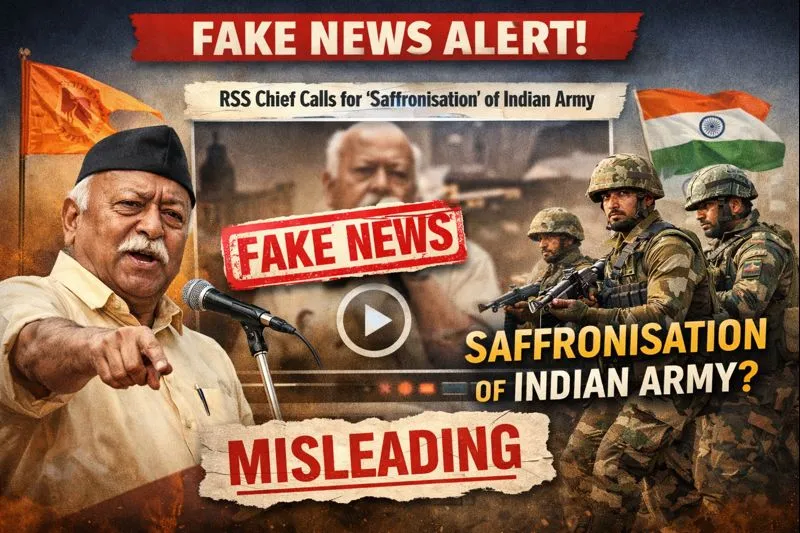
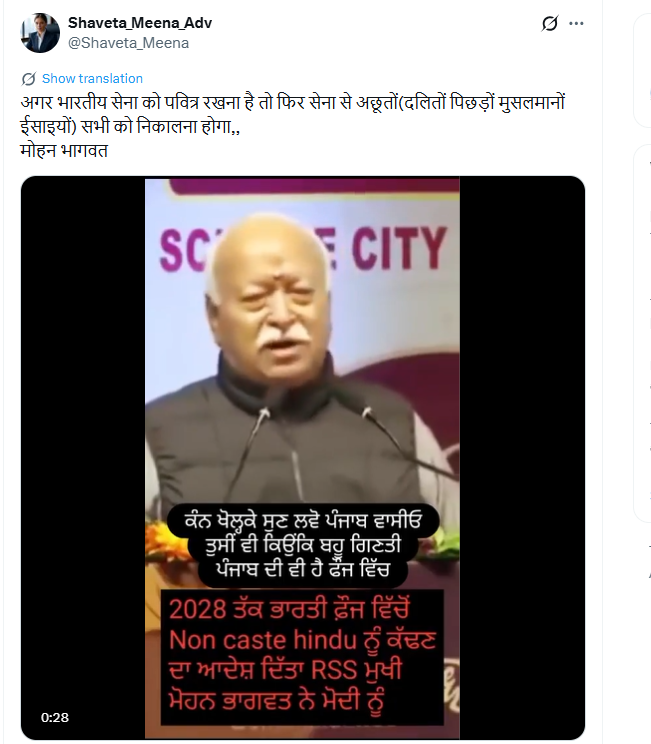
A video purportedly showing Rashtriya Swayamsevak Sangh (RSS) chief Mohan Bhagwat making remarks about the “saffronisation” of the Indian Army has been widely circulated on social media. The clip claims that Bhagwat called for the removal of non-Hindus from the armed forces and linked the issue to future political leadership changes in the country.
Claim
However, a verification by the Cyber Peace Foundation has established that the video is misleading and has been digitally manipulated.
In the video, Bhagwat is allegedly heard saying that unless more than 50 percent of non-Hindus are removed from the Indian Army by 2028, Prime Minister Narendra Modi would be replaced by Uttar Pradesh Chief Minister Yogi Adityanath. The clip further attributes another statement to him, suggesting that he would resign if the Prime Minister were to demand Nitish Kumar’s resignation.
By the time of publication, the video had been viewed over 7,000 times.( lINK, ARCHIVE Link, Screenshot
Fact Check:
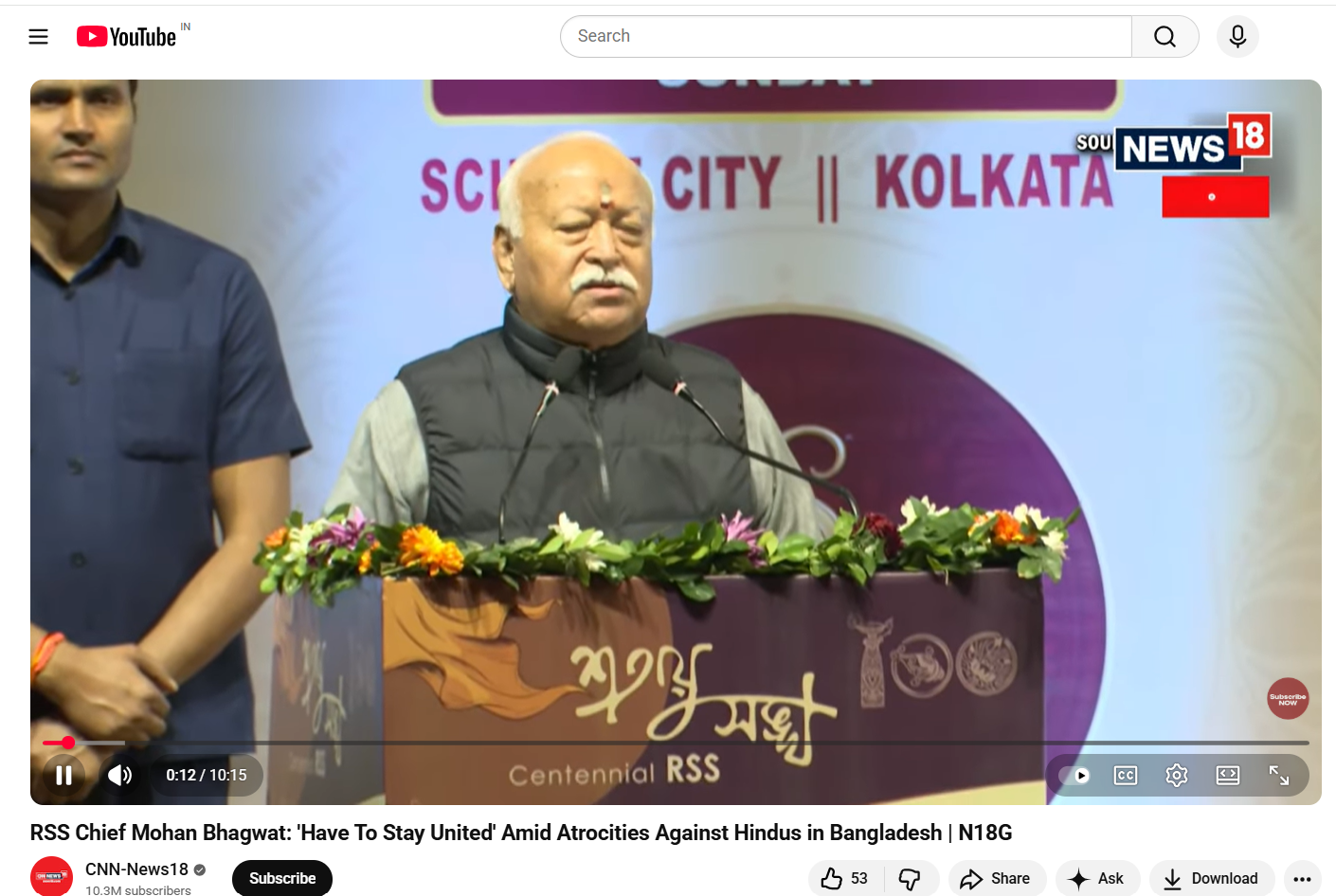
The reverse image search also directed the Desk to a video uploaded on CNN-News18’s official YouTube channel on December 21, 2025. The footage was found to be a longer version of the viral clip and was recorded at the RSS centenary event held in Kolkata on the same date. A comparison of both videos confirmed that the background visuals, stage setup and camera angles were identical.
However, a careful review of the original CNN-News18 video revealed that Mohan Bhagwat did not make any of the statements attributed to him in the viral clip.
In his original address, Bhagwat spoke about unity and referred to concerns over increasing atrocities against Hindus in Bangladesh. He made no reference to the Indian Army, nor did he comment on its composition or alleged saffronisation. Here is the link to the original video, along with a screenshot: https://www.youtube.com/watch?v=KnsAUGfBQBk&t=1s
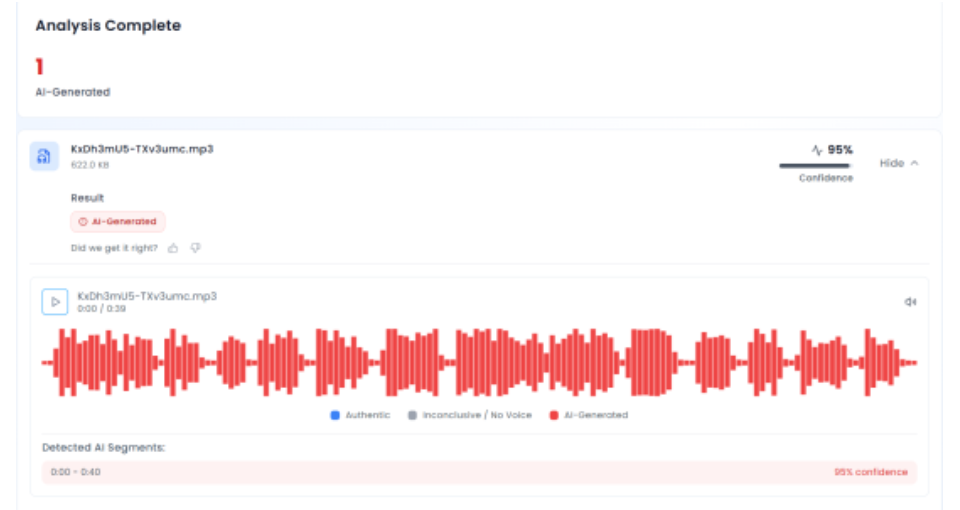
In the next phase of the investigation, the audio track from the viral video was extracted and analysed using the AI audio detection tool Aurigin. The tool’s assessment indicated that the voice heard in the clip was artificially generated, confirming that the audio did not originate from the original speech.
Conclusion
The claim that RSS chief Mohan Bhagwat called for the saffronisation of the Indian Army is false. PTI Fact Check found that the viral video was digitally manipulated, using genuine footage from an RSS centenary event but pairing it with an AI-generated audio track. The altered video was shared online to mislead viewers by falsely attributing statements Bhagwat never made.
