
Protection of your social media accounts
Introduction
In the interconnected world of social networking and the digital landscape, social media users have faced some issues like hacking. Hence there is a necessity to protect your personal information and data from scammers or hackers. In case your email or social media account gets hacked, there are mechanisms or steps you can utilise to recover your email or social media account. It is important to protect your email or social media accounts in order to protect your personal information and data on your account. It is always advisable to keep strong passwords to protect your account and enable two-factor authentication as an extra layer of protection. Hackers or bad actors can take control of your account, they can even change the linked mail ID or Mobile numbers to take full access to your account.
Recent Incident
Recently, a US man's Facebook account was deleted or disabled by Facebook. He has sued Facebook and initiated a legal battle. He has contended that there was no violation of any terms and policy of the platform, and his account was disabled. In the first instance, he approached the platform. However, the platform neglected his issue then he filed a suit, where the court ordered Facebook's parent company, Meta, to pay $50,000 compensation, citing ignorance of the tech company.
Social media account recovery using the ‘Help’ Section
If your Facebook account has been disabled, when you log in to your account, you will see a text saying that your account is disabled. If you think that your account is disabled by mistake, in such a scenario, you can make a request to Facebook to ‘review’ its decision using the help centre section of the platform. To recover your social media account, you can go to the “Help” section of the platform where you can fix a login problem and also report any suspicious activity you have faced in your account.
Best practices to stay protected
- Strong password: Use strong and unique passwords for your email and all social media accounts.
- Privacy settings: You can utilise the privacy settings of the social media platform, where you can set privacy as to who can see your posts and who can see your contact information, and you can also keep your social media account private. You might have noticed a few accounts on which the user's name is unusual and isn’t one which you recognise. The account has few or no friends, posts, or visible account activity.
- Avoid adding unknown users or strangers to your social networking accounts: Unknown users might be scammers who can steal your personal information from your social media profiles, and such bad actors can misuse that information to hack into your social media account.
- Report spam accounts or posts: If you encounter any spam post, spam account or inappropriate content, you can report such profile or post to the platform using the reporting centre. The platform will review the report and if it goes against the community guidelines or policy of the platform. Hence, recognise and report spam, inappropriate, and abusive content.
- Be cautious of phishing scams: As a user, we encounter phishing emails or links, and phishing attacks can take place on social media as well. Hence, it is important that do not open any suspicious emails or links. On social media, ‘Quiz posts’ or ‘advertisement links’ may also contain phishing links, hence, do not open or click on such unauthenticated or suspicious links.
Conclusion
We all use social media for connecting with people, sharing thoughts, and lots of other activities. For marketing or business, we use social media pages. Social media offers a convenient way to connect with a larger community. We also share our personal information on the platform. It becomes important to protect your personal information, your email and all your social media accounts from hackers or bad actors. Follow the best practices to stay safe, such as using strong passwords, two-factor authentication, etc. Hence contributing to keeping your social media accounts safe and secure.
References:
- https://www.gpb.org/news/2023/07/11/facebook-wrongfully-deleted-his-account-he-sued-the-company-and-won
- https://consumer.ftc.gov/articles/how-recover-your-hacked-email-or-social-media-account

Related Blogs

Executive Summary:
A video of Pakistani Olympic gold medalist and Javelin player Arshad Nadeem wishing Independence Day to the People of Pakistan, with claims of snoring audio in the background is getting viral. CyberPeace Research Team found that the viral video is digitally edited by adding the snoring sound in the background. The original video published on Arshad's Instagram account has no snoring sound where we are certain that the viral claim is false and misleading.

Claims:
A video of Pakistani Olympic gold medalist Arshad Nadeem wishing Independence Day with snoring audio in the background.

Fact Check:
Upon receiving the posts, we thoroughly checked the video, we then analyzed the video in TrueMedia, an AI Video detection tool, and found little evidence of manipulation in the voice and also in face.


We then checked the social media accounts of Arshad Nadeem, we found the video uploaded on his Instagram Account on 14th August 2024. In that video, we couldn’t hear any snoring sound.

Hence, we are certain that the claims in the viral video are fake and misleading.
Conclusion:
The viral video of Arshad Nadeem with a snoring sound in the background is false. CyberPeace Research Team confirms the sound was digitally added, as the original video on his Instagram account has no snoring sound, making the viral claim misleading.
- Claim: A snoring sound can be heard in the background of Arshad Nadeem's video wishing Independence Day to the people of Pakistan.
- Claimed on: X,
- Fact Check: Fake & Misleading
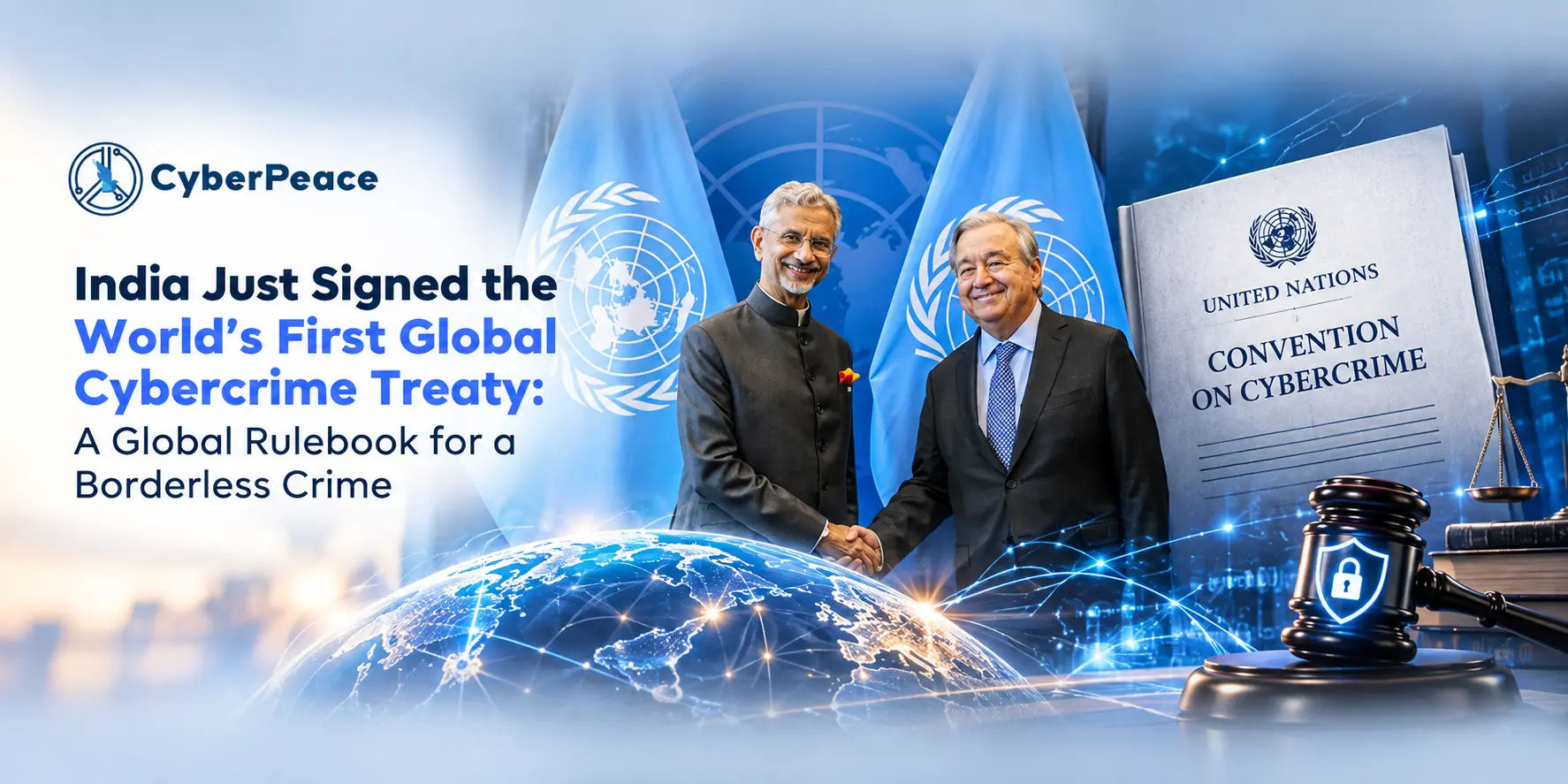
On 25 September 2026, at UN Headquarters in New York, External Affairs Minister S. Jaishankar signed the United Nations Convention against Cybercrime on the sidelines of the 81st session of the UN General Assembly, calling it a step that "strengthens international cooperation for a safer digital future."
The signature places India among the growing list of nations joining what is officially the first comprehensive global treaty dedicated to cybercrime. What Jaishankar's brief statement did not mention is that this same treaty has spent the better part of three years drawing sustained, detailed criticism from human rights organisations, technology companies, and digital rights groups, who argue it risks becoming a tool for surveillance rather than a tool against crime.
A Conversation CyberPeace Has Been Having for Years
For CyberPeace, India’s signature is not an isolated development but the latest chapter in a conversation the organisation has been following since the Convention was still being negotiated.
In December 2024, CyberPeace published its analysis of the emerging UN Convention against Cybercrime, examining its objectives, proposed offences, mechanisms for international cooperation, electronic evidence and its relationship with the Budapest Convention. The analysis also highlighted an important principle embedded in the emerging framework: that stronger cybercrime enforcement must operate alongside due process, privacy and human-rights safeguards.
That conversation continued in October 2025, when CyberPeace published The Digital Leviathan: The UN Cybercrime Treaty and the Future of Global Governance. The piece examined the Convention not merely as a cybercrime instrument, but as part of a larger evolution in global digital governance, particularly around cross-border evidence, international cooperation and the changing architecture of cyber sovereignty.
And in August 2026, CyberPeace returned to the question from the operational side in The World Is Rewriting the Rules Against Cyber-Enabled Transnational Crime. The analysis placed the Convention alongside the wider international response to transnational cyber-enabled crime, including scam networks, financial fraud and increasingly sophisticated criminal ecosystems that operate across multiple jurisdictions.
What the Convention actually is
The treaty's full, formal title is unusually descriptive for a UN instrument: the United Nations Convention against Cybercrime, Strengthening International Cooperation for Combating Certain Crimes Committed by Means of Information and Communications Technology Systems and for the Sharing of Evidence in Electronic Form of Serious Crimes. The UN General Assembly adopted it unanimously on 24 December 2024, following three years of negotiation, and it opened for signature at a ceremony in Hanoi, Vietnam, in October 2025. It will remain open for signature at UN Headquarters through 31 December 2026, and comes into force ninety days after the fortieth country ratifies it.
At its core, the Convention gives signatory states a shared legal framework for two things: preventing and prosecuting offences committed through digital systems, and cooperating across borders when evidence, offenders, or victims of a crime are scattered across multiple jurisdictions, a structural problem that has long frustrated cybercrime investigations. It also includes provisions specifically addressing the recovery of criminal proceeds, adding a financial dimension that lets states cooperate not just on prosecuting offenders but on tracing and reclaiming stolen money that has moved across borders, often through mule accounts and shell transactions designed to outrun any single country's jurisdiction.
Why India signed, in its own words
Jaishankar's public reasoning was concise. Cybercrime, in the government's framing, does not respect national boundaries, and India's own cybercrime caseload, spanning cross-border financial fraud, romance scams, and organised online extortion networks often operating from outside India's borders, has repeatedly run into exactly the jurisdictional walls this Convention is designed to lower. Prof. Triveni Singh, a well known cybercrime expert and former IPS officer, put the practical case plainly: "Cybercrime does not stop at national borders. Criminals can operate from one country and target victims in another. This convention can help countries share evidence and work together faster. For India, stronger international cooperation can make it easier to investigate cross-border cyber fraud and trace stolen money."
The part the announcement leaves out
Here is where the story gets considerably more complicated than a signing ceremony photo suggests. Since before the Convention's text was even finalised, a wide coalition of digital rights organisations, including the Electronic Frontier Foundation, Human Rights Watch, the Global Network Initiative, and Privacy International, has warned that the treaty's language is dangerously broad, and that its safeguards against misuse are considerably weaker than they need to be.
Cisco, one of the few major technology companies to comment publicly, stated the Convention does not do enough to "sufficiently protect basic human rights." UN Secretary-General António Guterres, notably, has himself urged countries to sign and ratify the Convention while simultaneously calling for its implementation to be "rooted in human rights," a somewhat unusual dual message from the very institution that produced the text, and one that implicitly acknowledges the concerns raised against it.
Where this leaves India
None of this means India's signature was unwarranted. The jurisdictional friction Prof. Triveni Singh described is real and well documented, and a shared international framework for evidence sharing genuinely could accelerate investigations that currently stall for months while agencies wait on slow, bilateral mutual legal assistance requests. India's existing domestic cybercrime coordination architecture is already substantial, spanning I4C, the National Cybercrime Reporting Portal, and newer mechanisms like the Citizen Financial Cyber Fraud Reporting and Management System and the Sahyog platform, and a global treaty that maps onto this existing infrastructure could genuinely close gaps that purely domestic tools cannot reach, particularly in cases where the perpetrator, the server, and the victim all sit in different countries, a pattern that has become close to the default in organised online financial fraud rather than the exception.
But the criticisms levelled at the Convention are not fringe objections; they come from some of the most established digital rights organisations in the world, and they focus specifically on the treaty's most powerful surveillance and cross-border cooperation provisions, the very mechanisms India will now need to operationalise domestically. Signing the Convention is also only the first procedural step; India's obligations under it will not take practical effect until the instrument is ratified domestically, a process that typically allows room for a signatory state to clarify how broadly or narrowly it intends to apply the treaty's more expansive provisions. How India chooses to implement those provisions, whether through the kind of judicial oversight and narrow, offence-specific application human rights groups have called for, or through the broader interpretation the treaty's text technically permits, will likely determine whether this Convention becomes a genuine tool against fraud and organised cybercrime, or a broader instrument whose reach eventually extends well past the digital offences it was signed to address.
References
- The420.in, "India Signs UN Cybercrime Convention to Strengthen Global Fight Against Digital Crime." ANI, "EAM Jaishankar signs UN Convention against Cybercrime on UNGA sidelines." https://aninews.in/news/world/us/eam-jaishankar-signs-un-convention-against-cybercrime-on-unga-sidelines20260926063207/
- Ministry of Cyber Affairs, "India signs UN Convention against Cybercrime at UNGA 81." https://ministryofcyberaffairs.com/news/india-signs-un-convention-against-cybercrime-at-unga-81-95b7e43b-7e29-4722-a4a7-304bca55b71c
- Electronic Frontier Foundation, "UN Cybercrime Convention Negotiations Enter Final Phase With Troubling Surveillance Powers Still on the Table." https://www.eff.org/deeplinks/2023/08/un-cybercrime-convention-negotiations-enter-final-phase-troubling-surveillance
- Electronic Frontier Foundation, "First Draft of UN Cybercrime Convention Drops Troubling Provisions, But Dangerous And Open-Ended Cross Border Surveillance Powers Are Still on the Table."
- https://www.eff.org/deeplinks/2023/07/first-draft-un-cybercrime-treaty-drops-troubling-provisions-dangerous-and-open
- Global Network Initiative, "GNI Calls on Member States Not to Support the UN Cybercrime Convention." https://globalnetworkinitiative.org/gni-statement-on-uncc/
- Just Security, "The UN Cybercrime Convention: Analyzing the Risks to Human Rights and Global Privacy." https://www.justsecurity.org/98738/cybercrime-convention-human-rights/
- TechRadar Pro, "UN cybercrime convention inadequate, says Human Rights Watch." https://techradar.com/pro/un-cybercrime-convention-inadequate-says-human-rights-watch
- Digital Watch Observatory, "Comparative analysis: the Budapest Convention vs the UN Convention Against Cybercrime." https://dig.watch/updates/comparative-analysis-the-budapest-convention-vs-the-un-convention-against-cybercrime
- epicenter.works, "Cybercrime Convention: Cross-Border Human Rights Violations." https://epicenter.works/en/content/cybercrime-convention-cross-border-human-rights-violations
- UN Press, "Secretary-General Urges All Countries to Sign, Ratify New UN Convention against Cybercrime, Calls for Solutions Rooted in Human Rights." https://press.un.org/en/2025/sgsm22961.doc.htm
- https://cyberpeace.org/resources/blogs/the-digital-leviathan-the-un-cybercrime-treaty-and-the-future-of-global-governance
- https://cyberpeace.org/resources/blogs/the-world-is-rewriting-the-rules-against-cyber-enabled-transnational-crime
Executive Summary
A video is being widely circulated on social media by Pakistani propaganda-linked users, showing a group of people protesting on a road. It is being claimed that protesters in Jammu & Kashmir stopped Indian Army personnel from entering Nagrota, indicating growing public opposition against the forces. Research by CyberPeace Research Wing found that the claim is misleading. The viral video is unrelated to any protest against the Indian Army.
Claim
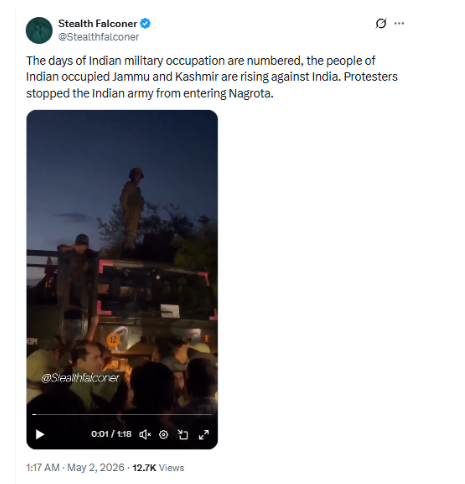
A user posted the video on X, claiming: “The days of Indian military occupation are numbered; people of Jammu & Kashmir have risen against India. Protesters stopped the Indian Army from entering Nagrota.”
- https://x.com/Stealthfalconer/status/2050301106623045758?s=20
Fact Check
During the research, the CyberPeace Research Wing team found no evidence of any such incident where civilians blocked or opposed the Indian Army in Nagrota. Further probe led to a post by an X user “Defence News Of INDIA,” which contained the full version of the viral video. The accompanying information clarified that the protest took place in Dansal’s Badsu Panchayat area of Nagrota and was led by BJP MLA Devayani Rana.
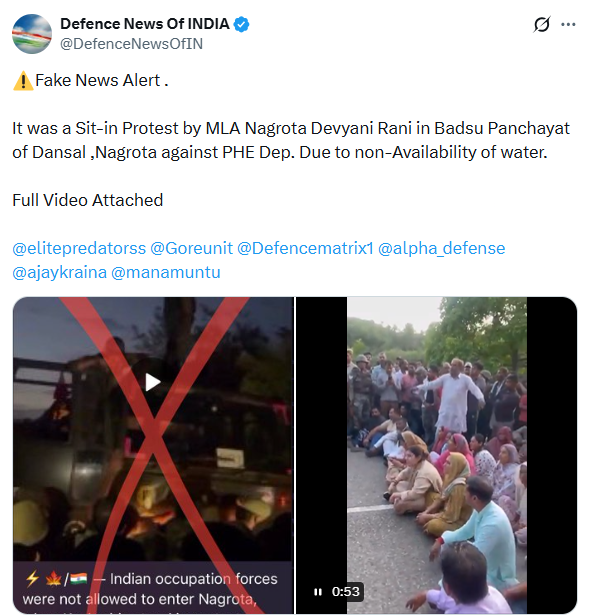
The protest was organized against the Public Health Engineering (PHE) Department over severe water shortage issues in the region. Locals, along with the MLA, staged a sit-in to highlight the lack of water supply.
We also found multiple media reports, including from KBC News – Kashmir and Jammu Links News, confirming that Devayani Rana led a road blockade protest in her constituency over water scarcity and accused the Jal Shakti Department of negligence and administrative failure. Additionally, videos of the same protest were available on social media platforms, including live streams shared from Devayani Rana’s official pages.

Conclusion
Our research confirms that the viral claim is false and misleading. The video does not show any protest against the Indian Army. It is actually from a demonstration led by Devayani Rana and local residents over water shortage issues in Nagrota.
