#FactCheck - AI-Generated Video Falsely Shared as Iran’s Attack on Israeli Nuclear Site
Executive Summary:
A video is going viral on social media linking it to the ongoing conflict between the US-Israel and Iran. The clip shows explosions on buildings and is being shared with the claim that it depicts an attack on Israel. It is further claimed that Iran targeted a nuclear site located near the sea in Israel, and this video shows that attack. However, an research by the CyberPeace found the claim to be false. The video is not from a real incident but has been created using AI.
Claim:
On social media platform X, a user shared the viral video on March 8, 2026, with the caption: “Iran attacked an Israeli nuclear site located near the sea.”

Fact Check:
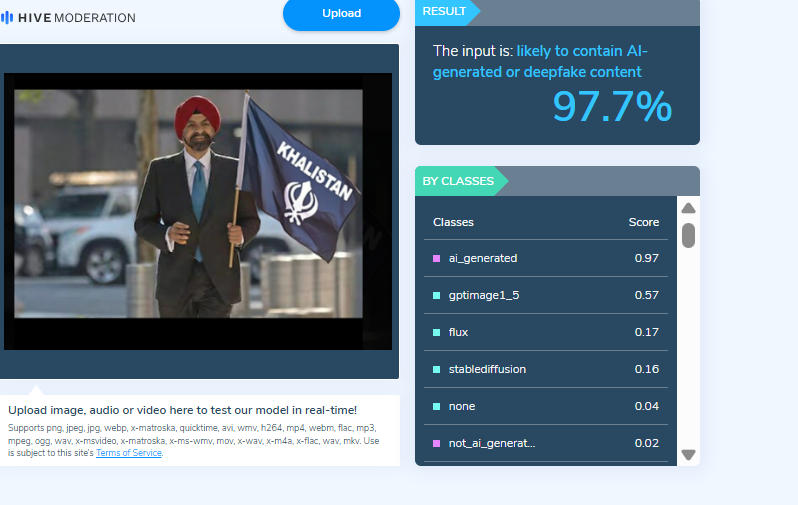
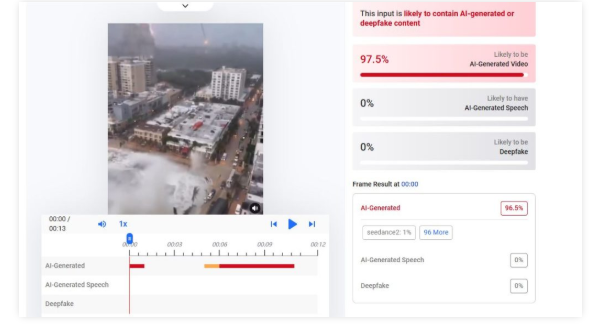
To verify the viral claim, we searched relevant keywords on Google but found no credible news reports supporting it.On closely examining the video, we observed several technical inconsistencies. The person seen in the video appears robotic, raising suspicion that the content may be AI-generated. To confirm this, we analyzed the video using AI detection tools. The tool Hive Moderation indicated that the video is approximately 97.5 percent likely to be generated using artificial intelligence.
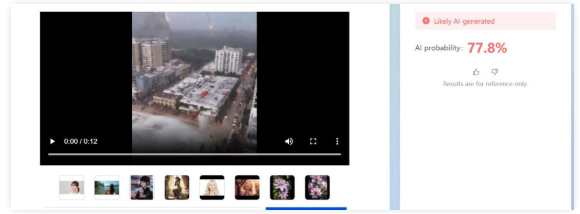
We also used the AI detection tool Matrix.Tencent. The results suggested that the video is likely AI-generated, with around a 77 percent probability.
Conclusion:
Our research found that the viral video claiming to show an Iranian attack on Israel is AI-generated and not related to any real incident.
Related Blogs

.webp)
Introduction
Raksha Bandhan is a cherished festival which is celebrated every year on the full moon day of the Hindu month of Shravan. It is a festival that represents the love, care, and protection that siblings share. This year, Raksha Bandhan falls on 09th August 2025. On this day, sisters tie a sacred thread known as Rakhi on their brothers' wrists as a symbol of love and protection, and in return, brothers promise to safeguard them in all walks of life. The origin of this festival traces back to the Mahabharata, when lord Krishna injured his finger. To bandage the wound, Draupadi, also known as Panchali, tore a piece of her saree and tied it on Krishna's finger. Krishna was touched by her selfless gesture and promised to always protect her, a promise he fulfilled during Drapadi’s time of greatest need.
Today, in the evolving world driven by technology in all aspects of life, the nature of threats has evolved. In this digital age, physical safety alone is no longer enough. Alongside the traditional vow, there is now a growing need for another promise, the promise of Cyber Raksha (Cyber Safety). As we celebrate the spirit of Raksha Bandhan, this year also take the pledge of offering and taking care of the Cyber Suraksha of your sibling.
Ek Vaada Cyber Raksha ka
All the brothers and sisters share the bond of mutual care and responsibility. In the evolving threats of cybercrimes, they must understand the vulnerabilities they might face and the cyber safety tips they should be aware of to protect themselves. You must promise to guide, protect each other from online dangers, and help understand the importance of digital safety. Hence, this Raksha Bandhan, let’s also tie a knot of cyber awareness, responsibility, and digital protection, because true raksha in today’s age is not only about protection in the offline world, it is about protection in both the offline and online world.
CyberPeace has curated the following best practices for you to consider in your life and also to share with your sisters and brothers.
Password Security
It is most important to realise that cybercrooks mostly have their eyes on your passwords to target and gain access to your accounts or information. Scammers try multiple ways to get access to your passwords by way of various methods such as OTP frauds, Fake login pages (spoofing), Social engineering, Credential stuffing, Brute-force attacks, phishing, etc.
Quick Tips
- Use strong passwords.
- Regularly update passwords.
- Use separate passwords for different accounts.
- Use secure & trusted password managers.
- Use two-factor authentication for an extra layer of security.
- Make sure not to save passwords on random devices.
Social Media Security
There are endless cyber scams that take place through social media, such as identity theft, cyberbullying, cyber stalking, online harassment, data leaks, suspicious links leading to phishing and malware, exposure to inappropriate content, etc. It becomes important for netizens to protect their accounts, data, and online presence on social media platforms from the growing cyber threats.
Quick Tips
- Review app permissions and do not give any unnecessary app permissions.
- Keep your account private or customise your privacy settings as per your needs.
- Be cautious while interacting with strangers.
- Do not click on any suspicious or unknown links.
- Make sure to log out in case you have to log in to your social media on an unfamiliar device, and update your password to prevent unauthorised access.
- Always use Two-Factor authentication for your social media accounts.
- Avoid sharing too much of your personal information on the public story or public posts. This can be used by cybercriminals for social engineering.
- Use the report & block function to protect yourself from spam accounts and unwanted interactions.
- If you encounter any issue, report it to the ‘Platform’s reporting mechanism at the ‘Help Centre’.
- One can also reach out to the platform’s grievance officer.
Device Security
In today’s world, the interconnectedness is unavoidable, your devices, be it smartphones, tablets, laptops are not just tools, they are digital extensions of yourself. They contain your discussions, recollections, private information, and frequently your financial and professional information. Safeguarding your devices in the digital world can be equated with safeguarding your physical possessions against undesirable encroachments. Just like a sibling would never let anyone invade your privacy, you too must promise to keep your devices secured against malicious threats like malware, spyware, ransomware, and unauthorized access.
Quick Tips
- Update your apps, browsers, and operating systems frequently; these updates frequently contain security vulnerabilities.
- Install reliable anti-virus and anti-malware software, then perform routine device scans.
- Do not download files or apps from unidentified sources.
- Avoid using open or unprotected public Wi-Fi for private activities like email or banking.
- Employ screen locks (passwords, biometrics, or PINs) to stop unwanted physical access.
- Enable remote wipe or ‘find my Device’ functions in case your device is lost or stolen.
Digital Payments Security
Rakshabandhan is all about giving, but let’s not make it easy for cyber fraudsters to take! Convenience can come at a great cost. It often comes with a danger of fraud, phishing, and money-stealing schemes, as evidenced by the rise in digital payments and UPI transactions. But by being cautious, one can avoid being defrauded. Whether you’re gifting a sibling online or shopping for festive deals, promise yourself and your loved ones that you’ll transact wisely and safely.
Quick Tips
- Never give out your bank credentials, CVV, OTP, or UPI PIN to anyone, even if they seem trustworthy before extensively verifying their credentials.
- Before completing a transaction, confirm the account information or UPI ID.
- Refund or payment links sent by WhatsApp accounts or unknown numbers should not be clicked.
- Use only trusted apps (like BHIM, PhonePe, Google Pay, etc.) downloaded from official app stores.
Email Security
Your email serves as a key to your digital kingdom and serves as more than just a tool for communication. Your email frequently connects everything, from banking to social networking. Scammers use phishing assaults, malware attachments, and impersonation frauds to target it first. Just like a sibling watches your back, watch your inbox. Make a vow not to fall for the digital bait.
Quick tips
- Never open attachments or links in emails that seem strange or suspicious.
- Subject lines that evoke fear, such as “Account Suspended,” “Urgent Action Required” should be avoided.
- Verify the sender’s email address at all times because scammers frequently use little misspellings to deceive you.
- Set up two-factor authentication and create a secure, one of a kind password for your email accounts.
- Avoid using unprotected Wi-Fi networks or public computers to check your email.
- Avoid responding to spam emails or unsubscribing through dubious links as this could give the attacker your address.
Common scams to watch out for
Festive deals scams
As the festive season sales surge in India, so does the risk of cyber scams. Cyber crooks exploit the victims and urge them to share OTPs under the guise of preventing fraudulent activity, sharing malicious links to get sensitive information.
Mis-disinformation
The spread of mis-disinformation has surged on social media platforms. It spreads like wildfire across the digital landscape, and the need for effective strategies to counteract these challenges has grown exponentially in a very short period. ‘Prebunking’ and ‘Debunking’ are two approaches for countering the growing spread of misinformation online.
Deepfake and Voice cloning scams
By using the Deepfake technology, cybercriminals manipulate audio and video content which looks very realistic but, in actuality, is fake. Voice cloning is also a part of deepfake. To create a voice clone of anyone's, audio can be deepfaked too, which closely resembles a real one but, in actuality, is a fake voice created through deepfake technology.
Juice Jacking
Cybercriminals can hack your phone using or exploiting some public charging stations, such as at airports, Malls, hotel rooms, etc. When you plug your cell phone into a USB power charger, you may be plugging into a hacker. Juice jacking poses a security threat commonly at places that provide free charging stations for mobile devices.
Suspicious links & downloads
Suspicious links & downloads can lead you to a phishing site or install malware into your system, which can even lead to compromise your device, expose sensitive data, and cause financial losses.
Conclusion
This Rakhi, ensure your and your sibling’s online safety and security by being cybersafe and smart. You can seek assistance from the CyberPeace Helpline at helpline@cyberpeace.net

Executive Summary
A shocking video showing a car hanging from a highway signboard is going viral on social media. The clip allegedly shows a black Mahindra Thar stuck on an overhead direction signboard on the Delhi–Jaipur Highway (NH-48). Social media users are widely sharing the video, claiming it shows a real road accident. However, a research by CyberPeace found the viral claim to be false. Our findings reveal that the circulating video is not real but AI-generated.
Claim
Social media users are sharing the clip as footage of an actual road accident. A viral post on X (formerly Twitter) claims that the incident took place on the Delhi–Jaipur Highway, showing a black Mahindra & Mahindra Thar lodged in a highway signboard.
- https://x.com/SenBaijnath/status/2024098520006029504
- https://archive.ph/cmr5e

Fact Check
On closely examining the viral video, several inconsistencies were observed that are commonly associated with AI-generated content. For instance, it appears highly improbable for a heavy vehicle to get stuck precisely at the center of a signboard at such a height. Despite the scale of the alleged incident, traffic on the highway below continues moving normally without any disruption. Additionally, the text visible on the right side of the signboard appears distorted and unusually written. To further verify the authenticity of the video, we analysed it using the AI detection tool Hive Moderation, which indicated a 99.9% probability that the video was AI-generated.

Another AI image detection tool, WasitAI, also found that the visuals in the viral clip were largely AI-generated.

Conclusion
Based on our research and available evidence, it is clear that the viral video showing a Mahindra Thar hanging from a highway signboard is not real but AI-generated.

The race for global leadership in AI is in full force. As China and the US emerge as the ‘AI Superpowers’ in the world, the world grapples with the questions around AI governance, ethics, regulation, and safety. Some are calling this an ‘AI Arms Race.’ Most of the applications of these AI systems are in large language models for commercial use or military applications. Countries like Germany, Japan, France, Singapore, and India are now participating in this race and are not mere spectators.
The Government of India’s Ministry of Electronics and Information Technology (MeitY) has launched the IndiaAI Mission, an umbrella program for the use and development of AI technology. This MeitY initiative lays the groundwork for supporting an array of AI goals for the country. The government has allocated INR 10,300 crore for this endeavour. This mission includes pivotal initiatives like the IndiaAI Compute Capacity, IndiaAI Innovation Centre (IAIC), IndiaAI Datasets Platform, IndiaAI Application Development Initiative, IndiaAI FutureSkills, IndiaAI Startup Financing, and Safe & Trusted AI.
There are several challenges and opportunities that India will have to navigate and capitalize on to become a significant player in the global AI race. The various components of India’s ‘AI Stack’ will have to work well in tandem to create a robust ecosystem that yields globally competitive results. The IndiaAI mission focuses on building large language models in vernacular languages and developing compute infrastructure. There must be more focus on developing good datasets and research as well.
Resource Allocation and Infrastructure Development
The government is focusing on building the elementary foundation for AI competitiveness. This includes the procurement of AI chips and compute capacity, about 10,000 graphics processing units (GPUs), to support India’s start-ups, researchers, and academics. These GPUs have been strategically distributed, with 70% being high-end newer models and the remaining 30% comprising lower-end older-generation models. This approach ensures that a robust ecosystem is built, which includes everything from cutting-edge research to more routine applications. A major player in this initiative is Yotta Data Services, which holds the largest share of 9,216 GPUs, including 8,192 Nvidia H100s. Other significant contributors include Amazon AWS's managed service providers, Jio Platforms, and CtrlS Datacenters.
Policy Implications: Charting a Course for Tech Sovereignty and Self-reliance
With this government initiative, there is a concerted effort to develop indigenous AI models and reduce tech dependence on foreign players. There is a push to develop local Large Language Models and domain-specific foundational models, creating AI solutions that are truly Indian in nature and application. Many advanced chip manufacturing takes place in Taiwan, which has a looming China threat. India’s focus on chip procurement and GPUs speaks to a larger agenda of self-reliance and sovereignty, keeping in mind the geopolitical calculus. This is an important thing to focus on, however, it must not come at the cost of developing the technological ‘know-how’ and research.
Developing AI capabilities at home also has national security implications. When it comes to defence systems, control over AI infrastructure and data becomes extremely important. The IndiaAI Mission will focus on safe and trusted AI, including developing frameworks that fit the Indian context. It has to be ensured that AI applications align with India's security interests and can be confidently deployed in sensitive defence applications.
The big problem here to solve here is the ‘data problem.’ There must be a focus on developing strategies to mitigate the data problem that disadvantages the Indian AI ecosystem. Some data problems are unique to India, such as generating data in local languages. While other problems are the ones that appear in every AI ecosystem development lifecycle namely generating publicly available data and licensed data. India must strengthen its ‘Digital Public Infrastructure’ and data commons across sectors and domains.
India has proposed setting up the India Data Management Office to serve as India’s data regulator as part of its draft National Data Governance Framework Policy. The MeitY IndiaAI expert working group report also talked about operationalizing the India Datasets Platform and suggested the establishment of data management units within each ministry.
Economic Impact: Growth and Innovation
The government’s focus on technology and industry has far-reaching economic implications. There is a push to develop the AI startup ecosystem in the country. The IndiaAI mission heavily focuses on inviting ideas and projects under its ambit. The investments will strengthen the IndiaAI startup financing system, making it easier for nascent AI businesses to obtain capital and accelerate their development from product to market. Funding provisions for industry-led AI initiatives that promote social impact and stimulate innovation and entrepreneurship are also included in the plan. The government press release states, "The overarching aim of this financial outlay is to ensure a structured implementation of the IndiaAI Mission through a public-private partnership model aimed at nurturing India’s AI innovation ecosystem.”
The government also wants to establish India as a hub for sustainable AI innovation and attract top AI talent from across the globe. One crucial aspect that needs to be worked on here is fostering talent and skill development. India has a unique advantage, that is, top-tier talent in STEM fields. Yet we suffer from a severe talent gap that needs to be addressed on a priority basis. Even though India is making strides in nurturing AI talents, out-migration of tech talent is still a reality. Once the hardware manufacturing “goods-side” of economics transitions to service delivery in the field of AI globally, India will need to be ready to deploy its talent. Several structural and policy interfaces, like the New Education Policy and industry-academic partnership frameworks, allow India to capitalize on this opportunity.
India’s talent strategy must be robust and long-term, focusing heavily on multi-stakeholder engagement. The government has a pivotal role here by creating industry-academia interfaces and enabling tech hubs and innovation parks.
India's Position in the Global AI Race
India’s foreign policy and geopolitical standpoint have been one of global cooperation. This must not change when it comes to AI. Even though this has been dubbed as the “AI Arms Race,” India should encourage worldwide collaboration on AI R&D through collaboration with other countries in order to strengthen its own capabilities. India must prioritise more significant open-source AI development, work with the US, Europe, Australia, Japan, and other friendly countries to prevent the unethical use of AI and contribute to the formation of a global consensus on the boundaries for AI development.
The IndiaAI Mission will have far-reaching implications for India’s diplomatic and economic relations. The unique proposition that India comes with is its ethos of inclusivity, ethics, regulation, and safety from the get-go. We should keep up the efforts to create a powerful voice for the Global South in AI. The IndiaAI Mission marks a pivotal moment in India's technological journey. Its success could not only elevate India's status as a tech leader but also serve as a model for other nations looking to harness the power of AI for national development and global competitiveness. In conclusion, the IndiaAI Mission seeks to strengthen India's position as a global leader in AI, promote technological independence, guarantee the ethical and responsible application of AI, and democratise the advantages of AI at all societal levels.
References
- Ashwini Vaishnaw to launch IndiaAI portal, 10 firms to provide 14,000 GPUs. (2025, February 17). https://www.business-standard.com/. Retrieved February 25, 2025, from https://www.business-standard.com/industry/news/indiaai-compute-portal-ashwini-vaishnaw-gpu-artificial-intelligence-jio-125021700245_1.html
- Global IndiaAI Summit 2024 being organized with a commitment to advance responsible development, deployment and adoption of AI in the country. (n.d.). https://pib.gov.in/PressReleaseIframePage.aspx?PRID=2029841
- India to Launch AI Compute Portal, 10 Firms to Supply 14,000 GPUs. (2025, February 17). apacnewsnetwork.com. https://apacnewsnetwork.com/2025/02/india-to-launch-ai-compute-portal-10-firms-to-supply-14000-gpus/
- INDIAai | Pillars. (n.d.). IndiaAI. https://indiaai.gov.in/
- IndiaAI Innovation Challenge 2024 | Software Technology Park of India | Ministry of Electronics & Information Technology Government of India. (n.d.). http://stpi.in/en/events/indiaai-innovation-challenge-2024
- IndiaAI Mission To Deploy 14,000 GPUs For Compute Capacity, Starts Subsidy Plan. (2025, February 17). www.businessworld.in. Retrieved February 25, 2025, from https://www.businessworld.in/article/indiaai-mission-to-deploy-14000-gpus-for-compute-capacity-starts-subsidy-plan-548253
- India’s interesting AI initiatives in 2024: AI landscape in India. (n.d.). IndiaAI. https://indiaai.gov.in/article/india-s-interesting-ai-initiatives-in-2024-ai-landscape-in-india
- Mehra, P. (2025, February 17). Yotta joins India AI Mission to provide advanced GPU, AI cloud services. Techcircle. https://www.techcircle.in/2025/02/17/yotta-joins-india-ai-mission-to-provide-advanced-gpu-ai-cloud-services/
- IndiaAI 2023: Expert Group Report – First Edition. (n.d.). IndiaAI. https://indiaai.gov.in/news/indiaai-2023-expert-group-report-first-edition
- Satish, R., Mahindru, T., World Economic Forum, Microsoft, Butterfield, K. F., Sarkar, A., Roy, A., Kumar, R., Sethi, A., Ravindran, B., Marchant, G., Google, Havens, J., Srichandra (IEEE), Vatsa, M., Goenka, S., Anandan, P., Panicker, R., Srivatsa, R., . . . Kumar, R. (2021). Approach Document for India. In World Economic Forum Centre for the Fourth Industrial Revolution, Approach Document for India [Report]. https://www.niti.gov.in/sites/default/files/2021-02/Responsible-AI-22022021.pdf
- Stratton, J. (2023, August 10). Those who solve the data dilemma will win the A.I. revolution. Fortune. https://fortune.com/2023/08/10/workday-data-ai-revolution/
- Suri, A. (n.d.). The missing pieces in India’s AI puzzle: talent, data, and R&D. Carnegie Endowment for International Peace. https://carnegieendowment.org/research/2025/02/the-missing-pieces-in-indias-ai-puzzle-talent-data-and-randd?lang=en
- The AI arms race. (2024, February 13). Financial Times. https://www.ft.com/content/21eb5996-89a3-11e8-bf9e-8771d5404543