
#FactCheck- Viral Video Falsely Claims Iranian Strike Destroyed Israeli Army Headquarters
Executive Summary
A video is going viral on social media showing a massive building engulfed in flames and collapsing into debris. It is being widely claimed that Iran launched a powerful attack that destroyed Israel’s army headquarters. However, research by CyberPeace reveals that this claim is misleading. The viral video is AI-generated and has no connection to any real-world event.
Claim
An X (formerly Twitter) user shared the viral video with the caption: “Iran has targeted Israel’s army headquarters. It seems Israel’s dream of becoming ‘Greater Israel’ will remain unfulfilled.”
Post link:
- https://x.com/KAMESHKUMAR96/status/2039009484069368083
Archived version:
- https://archive.ph/HKXkK
- https://x.com/KAMESHKUMAR96/status/2039009484069368083
- https://archive.ph/HKXkK
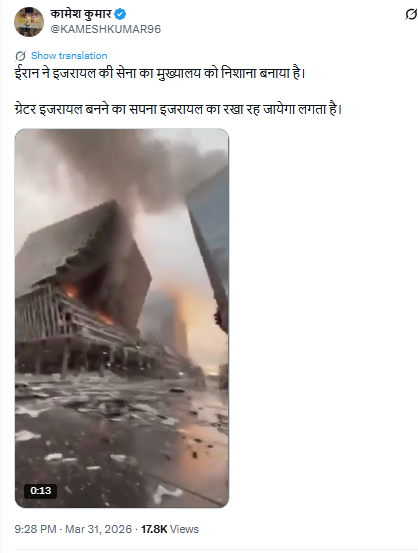
Similar videos have also been shared by other users on social media:
Fact Check
To verify the claim, we extracted keyframes from the viral video and conducted a reverse image search. During this process, we found several credible media reports confirming that Iran has carried out drone and missile attacks on Israel and the Gulf regions in recent times. However, none of these reports featured the viral video, indicating that it is not authentic footage.

- https://www.youtube.com/watch?v=fxDBX90bYng

A closer examination of the video revealed multiple visual inconsistencies commonly associated with AI-generated content. For instance, a building on the left side appears to bend and collapse in a rubber-like manner—something that is physically unrealistic for structures made of concrete and steel. Additionally, the smoke and flames appear unnatural and lack realistic dynamics.
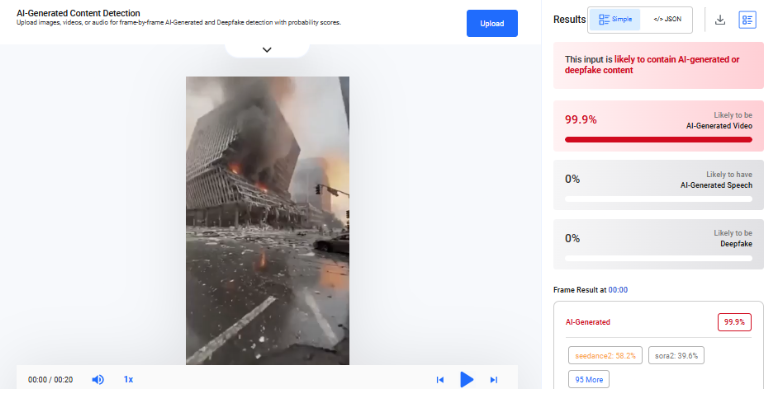
To further verify, we analyzed the video using the AI detection tool Hive Moderation, which classified it as 99.9% AI-generated.
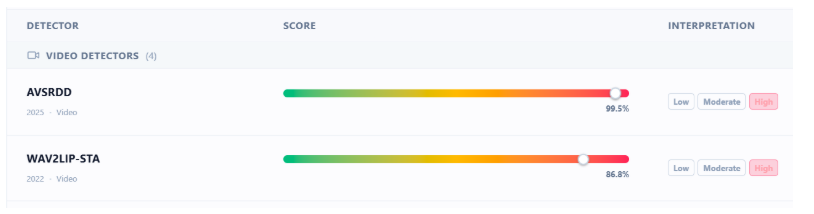
We also tested the video using the Deepfake-o-Meter platform.The AVSRDD (2025) model detected it as 99.5% AI-generated
Conclusion
Our research clearly establishes that the viral video claiming Iran destroyed Israel’s army headquarters is false and misleading. The footage does not appear in any credible news coverage of recent attacks, which strongly indicates that it is not real. Moreover, multiple AI detection tools consistently classify the video as artificially generated, with extremely high probability scores. Visual anomalies in the clip further support this finding.

Related Blogs

Executive Summary:
An old video dated 2023 showing the arrest of a Bangladeshi migrant for murdering a Polish woman has been going viral massively on social media claiming that he is an Indian national. This viral video was fact checked and debunked.
Claim:
The video circulating on social media alleges that an Indian migrant was arrested in Greece for assaulting a young Christian girl. It has been shared with narratives maligning Indian migrants. The post was first shared on Facebook by an account known as “Voices of hope” and has been shared in the report as well.

Facts:
The CyberPeace Research team has utilized Google Image Search to find the original source of the claim. Upon searching we find the original news report published by Greek City Times in June 2023.


The person arrested in the video clip is a Bangladeshi migrant and not of Indian origin. CyberPeace Research Team assessed the available police reports and other verifiable sources to confirm that the arrested person is Bangladeshi.
The video has been dated 2023, relating to a case that occurred in Poland and relates to absolutely nothing about India migrants.
Neither the Polish government nor authorized news agency outlets reported Indian citizens for the controversy in question.

Conclusion:
The viral video falsely implicating an Indian migrant in a Polish woman’s murder is misleading. The accused is a Bangladeshi migrant, and the incident has been misrepresented to spread misinformation. This highlights the importance of verifying such claims to prevent the spread of xenophobia and false narratives.
- Claim: Video shows an Indian immigrant being arrested in Greece for allegedly assaulting a young Christian girl.
- Claimed On: X (Formerly Known As Twitter) and Facebook.
- Fact Check: Misleading.

Executive Summary
A video showing a building collapse is going viral on social media. It is being shared as footage of a tragic incident that took place in Satya Niketan, Delhi. The video is accompanied by claims that it shows the building collapse in Satya Niketan. However, a research by CyberPeace’s Research Wing found that the viral video is not from the incident in Satya Niketan, Delhi. The research revealed that the video is actually from Moradabad, Uttar Pradesh, where a building collapsed on September 5, 2026. Clear similarities were found between the viral video and visuals from the incident in Moradabad. This confirms that an old video is being shared on social media with a false context, linking it to the incident in Satya Niketan, Delhi.
Claim:
A user shared the viral video on YouTube with the caption: “Major accident in Delhi! A five-storey building collapsed.”
https://www.youtube.com/shorts/1qeW-pFoMd4

Fact Check
While investigating the viral video, we conducted a reverse image search using its keyframes. This led us to the same video, which was uploaded on an Instagram account on September 5, 2026. The text visible in the video identified the location as Moradabad, Uttar Pradesh.
https://www.instagram.com/p/Dc54OW2SOh3/

In the next stage of our research, we found the video on Republic Bharat’s Instagram channel, where it was also identified as being from Moradabad.
https://www.instagram.com/reels/Dc8XTlpgaRL/

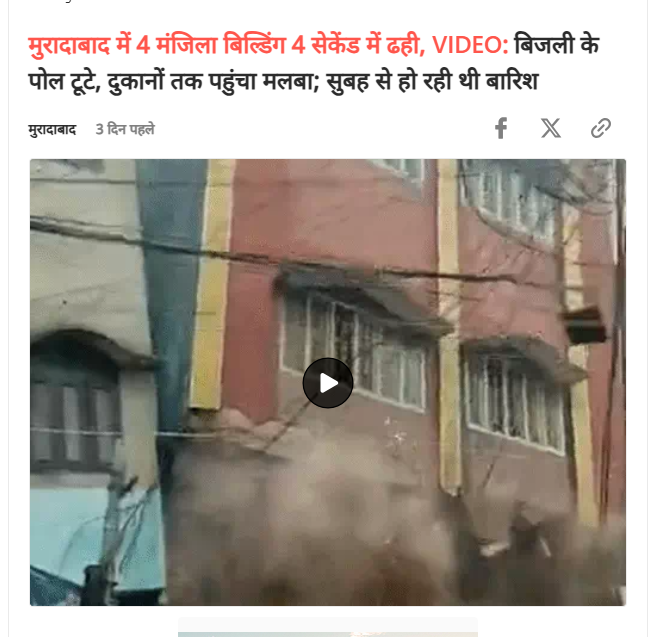
Based on the information gathered above, a keyword search led us to a report published by Dainik Bhaskar on September 5, 2026. The report also contained visuals matching those seen in the viral video. According to the Dainik Bhaskar report, on September 5, 2026, a four-storey dilapidated building collapsed in the Mughalpura area of Moradabad amid heavy rain, triggering panic in the area. However, the administration had sealed the building a day earlier after assessing its condition. The incident took place at around 3 p.m. The building was owned by a man named Sarfaraz Ali.
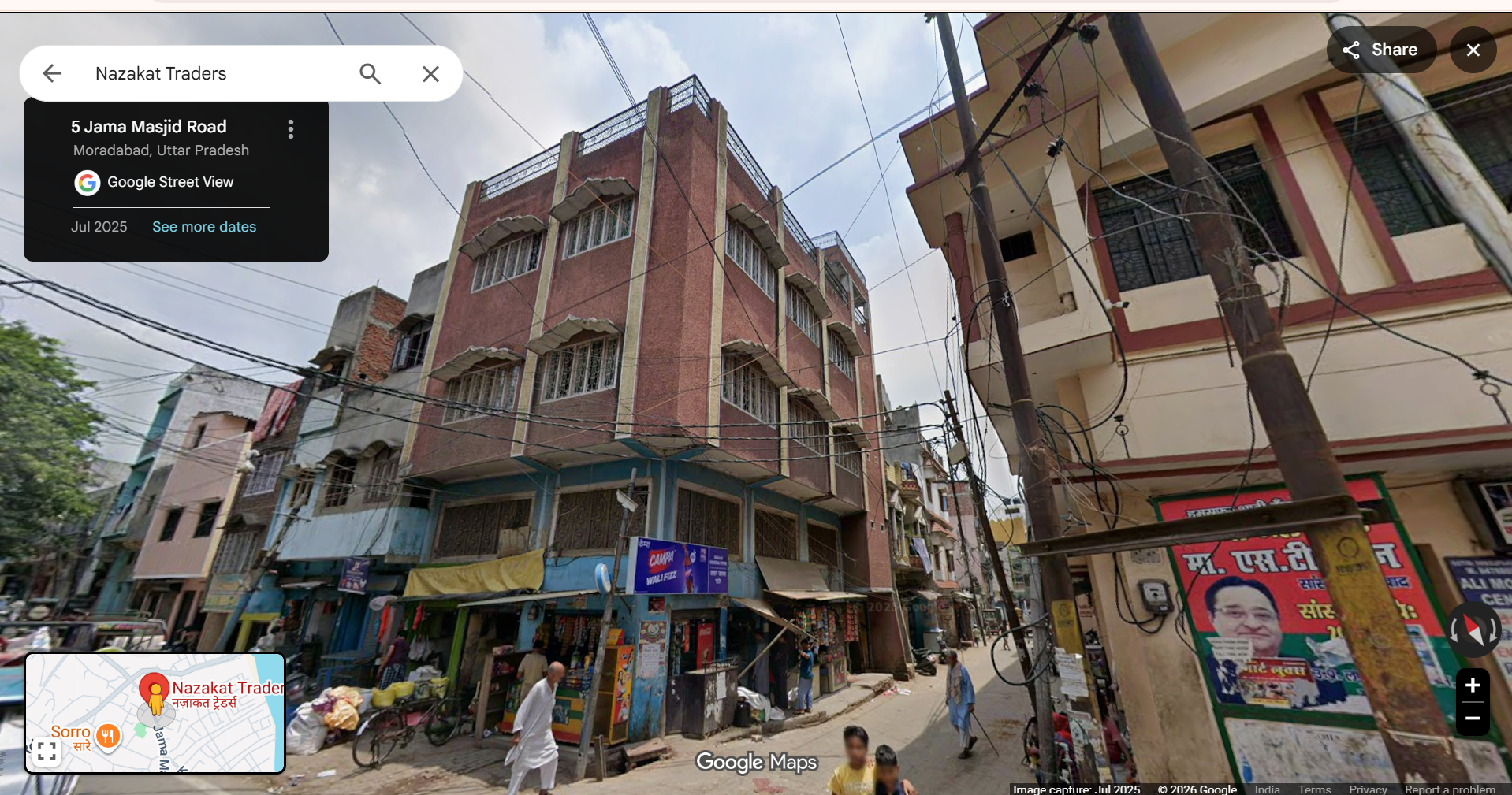
In our research, we also tried to geolocate the building seen collapsing in the viral video. We found that the building was located near Guiyan Bagh on Jama Masjid Road in Moradabad. The location can be seen in the image below.
Conclusion
The evidence gathered during our research clearly establishes that the video being circulated as footage of the tragic building collapse in Satya Niketan, Delhi, is not from Delhi. Our findings show that the viral video actually captures the collapse of a dilapidated four-storey building in the Mughalpura area of Moradabad, Uttar Pradesh, on September 5, 2026, amid heavy rainfall. The video was traced to multiple sources that identified the location as Moradabad, and further verification through media reports and geolocation confirmed that the visuals correspond to the same incident. Therefore, the viral video is being shared with a false context by incorrectly linking an incident in Moradabad to the building collapse in Satya Niketan, Delhi.

Recognizing As the Ministry of Electronic and Information Technology (MeitY) continues to invite proposals from academicians, institutions, and industry experts to develop frameworks and tools for AI-related issues through the IndiaAI Mission, it has also funded two AI projects that will deal with matters related to deepfakes as per a status report submitted on 21st November 2024. The Delhi court also ordered the nomination of the members of a nine-member Committee constituted by the MeitY on 20th November 2024 (to address deepfake issues) and asked for a report within three months.
Funded AI projects :
The two projects funded by MeitY are:
- Fake Speech Detection Using Deep Learning Framework- The project was initiated in December 2021 and focuses on detecting fake speech by creating a web interface for detection software this also includes investing in creating a speech verification software platform that is specifically designed for testing fake speech detection systems. It is set to end in December 2024.
- Design and Development of Software for Detecting Deepfake Videos and Images- This project was funded by MeitY from January 2022 to March 2024. It also involved the Centre for Development of Advanced Computing (C-DAC), Kolkata and Hyderabad as they have developed a prototype tool capable of detecting deepfakes. Named FakeCheck, it is designed as a desktop application and a web portal aiming to detect deepfakes without the use of the internet. Reports suggest that it is currently undergoing the testing phase and awaiting feedback.
Apart from these projects, MeitY has released their expression of interest for proposals in four other areas which include:
- Tools that detect AI-generated content along with traceable markers,
- Tools that develop an ethical AI framework for AI systems to be transparent and respect human values,
- An AI risk management and assessment tool that analyses threats and precarious situations of AI-specific risks in public AI use cases and;
- Tools that can assess the resilience of AI in stressful situations such as cyberattacks, national disasters, operational failures, etc.
CyberPeace Outlook
Deepfakes pose significant challenges to critical sectors in India, such as healthcare and education, where manipulated content can lead to crimes like digital impersonation, misinformation, and fraud. The rapid advancement of AI, with developments (regarding regulation) that can’t keep pace, continues to fuel such threats. Recognising these risks, MeitY’s IndiaAI mission, promoting investments and encouraging educational institutions to undertake AI projects that strengthen the country's digital infrastructure comes in as a guiding light. A part of the mission focuses on developing indigenous solutions, including tools for assessment and regulation, to address AI-related threats effectively. While India is making strides in this direction, the global AI landscape is evolving rapidly, with many nations advancing regulations to mitigate AI-driven challenges. Consistent steps, including inviting proposals and funding projects provide the much-needed impetus for the mission to be realized.
References
- https://economictimes.indiatimes.com/tech/technology/meity-dot-at-work-on-projects-for-fair-ai-development/articleshow/115777713.cms?from=mdr
- https://www.hindustantimes.com/india-news/meity-seeks-tools-to-detect-deepfakes-label-ai-generated-content-101734410291642.html
- https://www.msn.com/en-in/news/India/meity-funds-two-ai-projects-to-detect-fake-media-forms-committee-on-deepfakes/ar-AA1vMAlJ
- https://indiaai.gov.in/
