
#FactCheck -Old 2016 Madame Tussauds Wax Statue Video Misrepresented as PM Modi Being “Made Up” by Team
Executive Summary
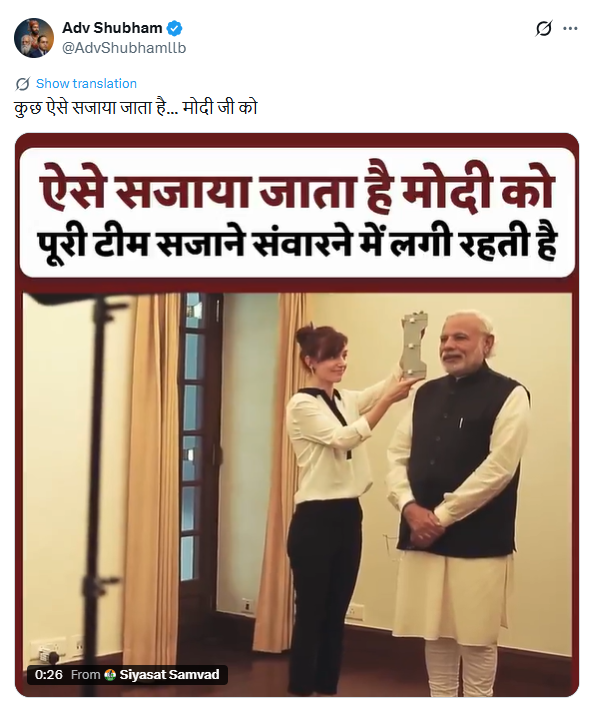
A video of Prime Minister Narendra Modi is being widely shared on social media with the claim that he is being “made up” or styled by a team, with users attempting to mock him using the footage. The clip is being circulated with misleading captions suggesting it shows the Prime Minister undergoing makeup and grooming by a dedicated team. CyberPeace Foundation Research Wing, in its research, found that the viral claim is false. In fact, the viral video is not recent, but from 2016. At that time, a statue of PM Modi was to be installed at Madame Tussauds Museum. A team of artists and experts visited the Prime Minister's residence to take measurements for the statue. This misleading claim has been circulating on social media for several years. We have previously fact-checked this claim and exposed the truth.
Claim
An X user named “Adv Shubham” shared the viral video on May 27, 2026, with the caption:“This is how Modi Ji is styled…”The post also claims that the Prime Minister is regularly “made up” by a team.
- https://x.com/AdvShubhamllb/status/2059682034289946746
- https://perma.cc/FVM9-PQBP
Fact Check
The viral video is not recent. It dates back to 2016 and is related to a completely different context. During the investigation, we found the same footage on the official YouTube channel of Madame Tussauds London, uploaded on March 16, 2016.

According to the video details, it shows the process of taking measurements for a wax statue of Prime Minister Narendra Modi for installation at Madame Tussauds. A team of artists and experts had visited the Prime Minister’s residence in Delhi for this purpose.
Conclusion
The viral claim that Prime Minister Narendra Modi is being “made up” by a team is false. The footage is from 2016 and shows a measurement session conducted for his wax statue at Madame Tussauds Museum.

Related Blogs

Introduction
युद्धे सूर्यास्ते युध्यन्तः समाप्तयन्ति, In ancient times, after the day’s battle had ended and the sun had set, warriors would lay down their arms and rest, allowing their minds and bodies to recover before facing the next challenge, and giving warriors time to rest and prepare mentally and physically for the next day. Today, as we remain endlessly connected to work through screens and notifications, the Right to Disconnect bill seeks to restore that same rhythm of rest and renewal in the digital age. By giving individuals the space to disconnect, it aims to restores balance, protects psychological health, and acknowledges that human resilience is not limitless, even in a world dominated by technology.
The Right to Disconnect Bill, 2025, was recently introduced in the lower house of Parliament during the winter session, which began on 1st December 2025, as a private member’s bill by Ms. Supriya Sule, Lok Sabha MP.
Understanding the Psychology Behind the Proposed Right to disconnect Bill
The purpose of this law is based on neuroscience for humans. When workers are always in a state of being "always on", the situation of their bodies gets to the chronic stress response state where they are getting overwhelmed with cortisol, which is the main human stress hormone. The constant vigilance that the body and mind are under forces the nervous system into always being in a state of sympathetic activation, while depriving it of the restorative (parasympathetic) states that are necessary for genuine recovery. Neuroscience studies show that 96% of heavy users of technology suffer from anxiety and lack of sleep due to technology. This phenomenon is known medically as "bytemares." The brain tries to attend to several things at once, and this way its cognitive capacity becomes thinner, so there is a reduction in focus, productivity is decreased, and the stress level is increased considerably.
Increasingly, the mental suffering that people get through is not only the physical and psychological aspects of it. The digital fatigue generated by the "always-on culture" getting chronic takes its toll on the emotional capacity of the staff, interrupts their sleep cycles (particularly depriving them of REM sleep), and leads to lower melatonin secretion.
Employees in such environments have a 23% increased chance of suffering from burnout, which the World Health Organisation defines as an occupational syndrome consisting of emotional exhaustion, depersonalization, and downgrading of performance. Mental health is the silent destruction that goes on without anyone noticing; the individuals who are affected show productive performance while their neuroendocrine systems are dying little by little.
Hence, the intent of the Indian legislature is clear, which is to prioritize the human dimension, allowing employees, the warriors of the digital age, to pause and recover, fostering work‑life balance without compromising commitment or productivity, and reflecting a thoughtful, humane approach in the modern technology driven world.
The proposed Right to Disconnect Bill takes position as a law that can greatly help with the mental health of employees and therefore keep them healthy. The bill allows employees to legally disconnect from electronic communication related to their jobs outside of the working hours set by the employer; this way, it recognises more or less that the human brain was never meant to be always connected.
The Need for Digital Detox from a Scientific Perspective
Digital detoxification is the process through which the brain resets its dopamine receptors, hence stopping the process of instant gratification that is constantly reinforced through notifications. The employees who cut off their connection can focus better, remain emotionally stable, and lead healthier lives, the effect of which is measurable. Not only on single persons, but also the World Health Organisation, through its studies, has declared that mental health interventions in workplaces can yield a return of 4:1 on investment through increased productivity and decline in absenteeism.
Digital Detox: Structured Disconnection, Not Digital Rejection
One of the most important aspects of the proposed bill is the acknowledgment of digital detox as a supportive tool. However, it is very important to note that digital detox does not mean completely cutting off technology. It is the rule-based disengagement that brings back cognitive balance. Measures like limiting notifications after work hours, protecting weekends and holidays from routine communication and creating offline time zones facilitate the brain's resetting process. Psychological studies associate such practices with better concentration, emotional control, sleep quality and finally productivity in the long run. The initiative of having digital detox centres and offering counselling services is an indication that the issue of overexposure is not just a matter of personal lack of discipline, but rather a problem of modern working designs.
Positioning Mental Well-Being as Core
The fundamental aspect of the bill is based on the constitutional assurance provided by Article 21 (Constitution of India), the Right to Life and personal Liberty, which has been interpreted by the courts to cover health of mind and body as well as time for leisure. This law reform grants a right to not be available at work, which means that employers will not be able to require constant availability at work without suffering legal consequences. The Right to Disconnect Bill finally illustrates society's unanimity that, amidst our digital age, mental well-being protection is no more a nice-to-have it is a must-have. The bill permits the guarding of the recovery periods, and at the same time, it recognises that the productivity that is sustainable comes from employees who are rested and mentally healthy, not from the constantly depleted workforce in the digital chains.
The psychological Rationale
Psychological analysis indicates that this always-on condition impacts productivity in measurable ways. The human brain may get overloaded to distinguish between important and unimportant information due to the uninterrupted flow of alerts and communications. The whole process leads to a situation, continuous exposure to alerts diminishes the ability to notice the really important events thus allowing the critical ones to go unnoticed. Burnout results as a natural consequence. Research shows that the psychological state resulting from digital overstimulation is anxiety, sleep problems, tiredness, and inability to focus.
Work Culture in the Cybersecurity Realm and Analysis of the Right to Disconnect
Although every sector today demands high productivity and significant commitment from its workforce, the Cybersecurity professionals, IT engineers, SOC analysts, incident responders, cyberseucrity researchers, cyber lawyers and digital operations teams are often engage in 24x7 loop because they deal with uniquely critical responsibilities, if ignored or delayed, can compromise sensitive systems, data integrity, and national security.
It is notable that the flow of activities has been silently but significantly changing the paradigm. Availability has replaced accountability, and often responsiveness is regarded as performance. The “on duty” and “off duty” line blurs when a client escalation or a suspected breach alert calls the phone at midnight. This way, an unspoken rule develops that the worker has to be reachable irrespective of the time as being reachable has become part of the job.
In India, the 48-hour work week that is already among the world's most demanding has been made even more intense by digital connectivity. The work intensity of remote and hybrid models has further crossed spatial and temporal boundaries producing a psychologically endless workday. Hence, the cyber workforce lives in a constant state of low-grade alertness, i.e., never fully sleeping, never fully offline. For professionals working in cyber security, this issue of wellbeing is not just a personal issue but also a business issue. Mental fatigue may lead to poor decision making, slower response time in case of incidents, and more errors being made unintentionally by people.
Hence comes the relevance of the proposed Right to Disconnect bill, Implementing it in the cybersecurity realm may require employers to plan for additional task forces so that productivity remains unaffected, while ensuring that employees receive the rest and balance they need. This approach not only protects mental well‑being but also creates opportunities for new roles, distributes workloads fairly, and strengthens the overall resilience and efficiency of the organization.
Legislature Intent - The Right to Disconnect as a preventive control
In this scenario, the Right to Disconnect Bill, 2025, which was presented in the Lok Sabha as a private member's bill, can be seen as a precautionary measure in the digital risk ecosystem instead of merely as a employee welfare initiative. It intends to create legally enforceable lines of demarcation between the demands of a job and one's personal life. The bill provisions, like the right not to answer work calls and texts after office hours, protection from being fired, pay for overtime, and agreed-upon emergency protocols, are all tools to set new norms rather than to impose restrictions on the output.
This can be seen as security logic that has been established in the cyber governance sphere. Even the best systems require planned downtimes for patching, upgrading, and recovery. Humans cannot be treated differently. Loss of operation without recovery will only increase the likelihood of failure. The Right to Disconnect works as a human-layer security, which reduces the risk of incidents caused by fatigue and burnout among employees.
The Legislative Recognition of Human Needs
The Right to Disconnect Bill is a landmark change of thinking, moving from the perception of disconnection as unprofessional to the acknowledgement of it as a basic requirement for human dignity and health. The Indian legislation, which was passed through a private member's bill, clearly defines the limits of professional and personal time. By providing the employees with the legal right to disconnect, the bill affirms what psychological science has been telling us for a long time: people need real breaks to be at their best.
Conclusion
The Proposed Right to Disconnect Bill, 2025, is a progressive move in law, which, among others confirms that a digital world, constant connectivity may undermines both individual health and company/orgnisation’s buisness continuity. A balanced approach is essential, with clearly agreed-upon emergency norms to guide situations where employees may need to work extra hours in a reasonable and lawful manner. It recognises that people are the backbone of the digital ecosystem and need time off to work effectively and securely. In a connected economy, protecting mental bandwidth is as crucial as protecting technical networks, making the Right to Disconnect a key element of sustainable resilience.
From a cybersecurity perspective, no secure digital future can emerge from exhausted minds. A strong digital and cyber‑India will have laws like the Right to Disconnect Bill, signaling a shift in policy thinking. This law moves the burden from individuals having to adapt to always-on technologies onto systems, organisations, and governance structures to respect human limits. By recognising mental well-being as an essential factor of employee’s wellbeing, the bill reinforces that resilient work ecosystems depend not only on robust infrastructure and controls but also on well-rested, focused, and secure individuals.
References
- https://www.shankariasparliament.com/blogs/pdf/right-to-disconnect-bill-2025
- https://ijlr.iledu.in/wp-content/uploads/2025/04/V5I653.pdf
- https://timesofindia.indiatimes.com/education/news/no-calls-and-emails-after-office-hours-right-to-disconnect-bill-introduced-in-lok-sabha-to-set-workplace-boundaries/articleshow/125806984.cms
- https://www.hindustantimes.com/india-news/what-is-right-to-disconnect-bill-introduced-in-lok-sabha-and-can-it-clear-parliament-101765025582585.html

Executive Summary
A video is being widely shared on social media with the claim that the Chinese Army has entered 60 kilometres inside Arunachal Pradesh and occupied Indian territory. In the video, a man appears to be recording the situation using his selfie camera, while soldiers can be seen standing face-to-face and arguing with each other in the background. The CyberPeace Research Wing found that the claim is false. The viral video is not from Arunachal Pradesh. It shows a confrontation between India’s Border Security Force (BSF) and Bangladesh’s Border Guard Bangladesh (BGB) along the India-Bangladesh border.
Claim
A Facebook user shared the video with the caption:
"China is entering 60 km inside India and occupying Arunachal Pradesh. China is turning Arunachal Pradesh into its territory. Where are Prime Minister Modi, Defence Minister Rajnath Singh and Home Minister Amit Shah?"
Post link:
https://www.facebook.com/reel/1736825064305394
https://www.facebook.com/reel/1736825064305394

FactCheck
Our research found no credible news report confirming that Chinese troops had entered 60 kilometres inside Arunachal Pradesh or occupied Indian territory.
The people in the viral video can be heard speaking in Bengali, suggesting that the footage could be from the India-Bangladesh border rather than Arunachal Pradesh.
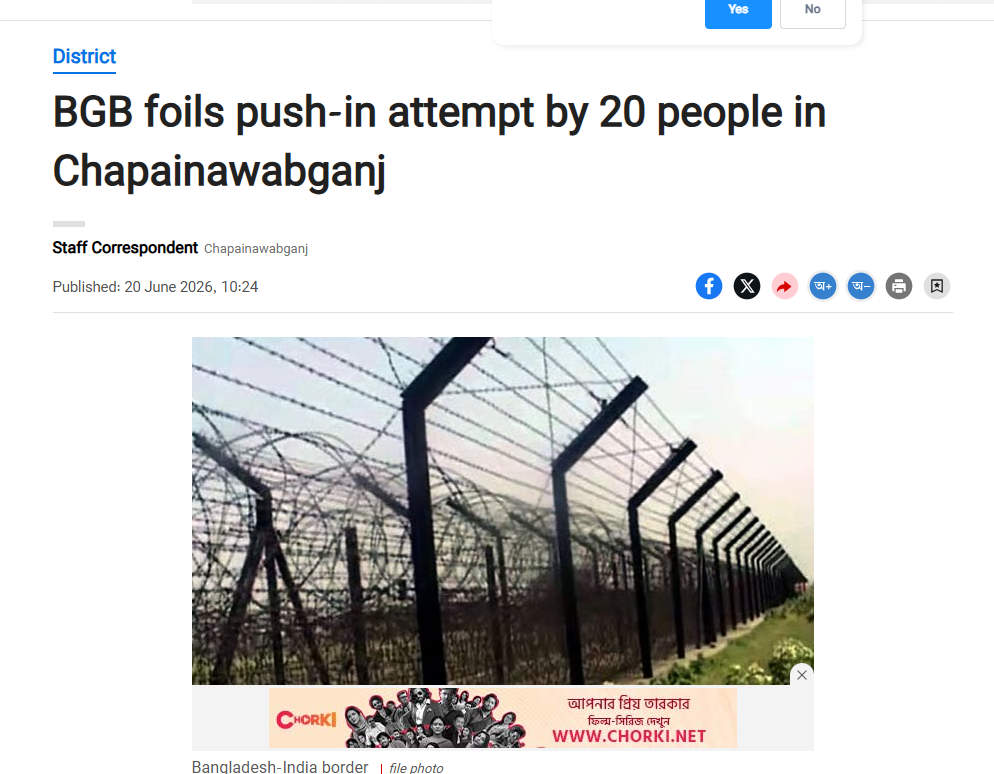
A reverse image search of keyframes from the viral video led us to an identical video posted on the Facebook page of Bangladeshi news channel Jamuna TV on June 20. According to the caption, the incident took place along the Chapainawabganj border in Bangladesh, where personnel of India’s BSF and Bangladesh’s BGB had confronted each other.
https://www.facebook.com/reel/1049262804595610

We also found reports from Bangladeshi media outlet Prothom Alo about the incident. According to the reports, Bangladeshi security personnel had stopped around 20 people who were attempting to return to Bangladesh from India, following which a verbal altercation took place between BSF and BGB personnel.
https://www.prothomalo.com/bangladesh/district/syzkfootaq
Conclusion
The viral claim is false. The video does not show Chinese troops entering or occupying 60 kilometres of territory inside Arunachal Pradesh. It actually shows a confrontation between BSF and BGB personnel along the India-Bangladesh border in the Chapainawabganj area of Bangladesh. The footage is being circulated with a false Arunachal Pradesh-related narrative.
.webp)
Introduction
Cyber slavery has emerged as a serious menace. Offenders target innocent individuals, luring them with false promises of employment, only to capture them and subject them to horrific torture and forced labour. According to reports, hundreds of Indians have been imprisoned in 'Cyber Slavery' in certain Southeast Asian countries. Indians who have travelled to South Asian nations such as Cambodia in the hopes of finding work and establishing themselves have fallen victim to the illusion of internet slavery. According to reports, 30,000 Indians who travelled to this region on tourist visas between 2022 and 2024 did not return. India Today’s coverage demonstrated how survivors of cyber slavery who have somehow escaped and returned to India have talked about the terrifying experiences they had while being coerced into engaging in cyber slavery.
Tricked by a Job Offer, Trapped in Cyber Slavery
India Today aired testimonials of cyber slavery victims who described how they were trapped. One individual shared that he had applied for a well-paying job as an electrician in Cambodia through an agent in Delhi. However, upon arriving in Cambodia, he was offered a job with a Chinese company where he was forced to participate in cyber scam operations and online fraudulent activities.
He revealed that a personal system and mobile phone were provided, and they were compelled to cheat Indian individuals using these devices and commit cyber fraud. They were forced to work 12-hour shifts. After working there for several months, he repeatedly requested his agent to help him escape. In response, the Chinese group violently loaded him into a truck, assaulted him, and left him for dead on the side of the road. Despite this, he managed to survive. He contacted locals and eventually got in touch with his brother in India, and somehow, he managed to return home.
This case highlights how cyber-criminal groups deceive innocent individuals with the false promise of employment and then coerce them into committing cyber fraud against their own country. According to the Ministry of Home Affairs' Indian Cyber Crime Coordination Center (I4C), there has been a significant rise in cybercrimes targeting Indians, with approximately 45% of these cases originating from Southeast Asia.
CyberPeace Recommendations
Cyber slavery has developed as a serious problem, beginning with digital deception and progressing to physical torture and violent actions to commit fraudulent online acts. It is a serious issue that also violates human rights. The government has already taken note of the situation, and the Indian Cyber Crime Coordination Centre (I4C) is taking proactive steps to address it. It is important for netizens to exercise due care and caution, as awareness is the first line of defence. By remaining vigilant, they can oppose and detect the digital deceit of phony job opportunities in foreign nations and the manipulative techniques of scammers. Netizens can protect themselves from significant threats that could harm their lives by staying watchful and double-checking information from reliable sources.
References
- CyberPeace Highlights Cyber Slavery: A Serious Concern https://www.cyberpeace.org/resources/blogs/cyber-slavery-a-serious-concern
- https://www.indiatoday.in/india/story/india-today-operation-cyber-slaves-stories-of-golden-triangle-network-of-fake-job-offers-2642498-2024-11-29
- https://www.indiatoday.in/india/video/cyber-slavery-survivors-narrate-harrowing-accounts-of-torture-2642540-2024-11-29?utm_source=washare
