
#FactCheck- Brigadier Assault in Delhi Not Linked to Dance Club or Military Operation
Executive Summary
Misleading claims related to an incident in Delhi are being widely circulated on social media. Several posts allege that an Indian Army brigadier and his son were assaulted while returning from a “dance club party.” The posts further claim that the attack was triggered by remarks related to “Operation Sindoor.” However, research by the CyberPeace found that these claims are completely false and fabricated.
Claim
On social media platform X, some users (including @ManipurPost5) shared posts claiming that an Indian Army brigadier and his son were attacked after returning from a dance club. The posts also alleged that the altercation escalated after someone mocked “Operation Sindoor.”
Fact check
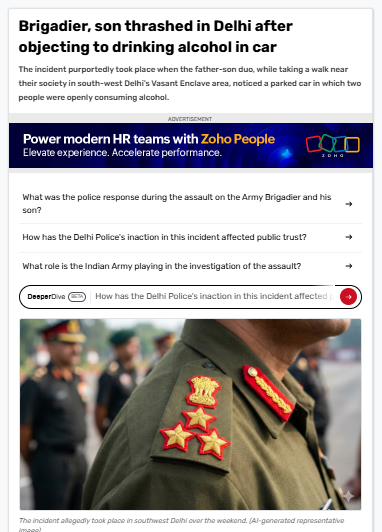
To verify the claim, we conducted keyword searches on Google and found a report published by Republic World on April 14, 2026, which included visuals similar to those being circulated.

According to the report, the victims were identified as Brigadier Parminder Singh Arora, a serving Indian Army officer, and his son Tejas Arora. At the time of the incident, they were taking a walk near their residence after dinner. Reports state that they noticed a group of individuals consuming alcohol inside a parked car in a public place and objected to it. This led to an argument, which later escalated into a violent assault. Around 7–8 individuals allegedly attacked the brigadier and his son, with the son sustaining more serious injuries. Questions have also been raised about the role of police personnel present at the scene. Following the complaint, a case was registered, one police constable was suspended, and two accused individuals have been arrested so far. The vehicle involved has also been seized. Further verification led us to another report published by India Today on April 14, 2026, which corroborated the same details of the incident.
Conclusion
The viral claim is misleading and entirely false.The incident has no connection to any “dance club party” or to “Operation Sindoor.” In reality, the altercation began after the brigadier objected to public drinking near his residence.

Related Blogs

Executive Summary
A video is being shared on social media with the claim that a thief in Indore, Madhya Pradesh, performed dangerous stunts to evade the police. In the viral video, several police personnel can be seen chasing a man. The man appears to dodge vehicles on the road to escape the police and then climbs onto the roof of a moving bus. He later jumps from the bus and climbs onto a roadside hoarding. The video is being shared with the claim that a clever thief gave the police a tough time in Indore. Research by CyberPeace Research Wing found that the video is AI-generated and is being shared with a misleading claim.
Claim:
A high-voltage, filmy-style chase between police and a clever thief took place in a busy market in Indore. The police later surrounded the accused and detained him. Archive of the post can be seen here. Similar posts can be seen here and here.
https://www.facebook.com/reel/1356598853312128

Fact Check:
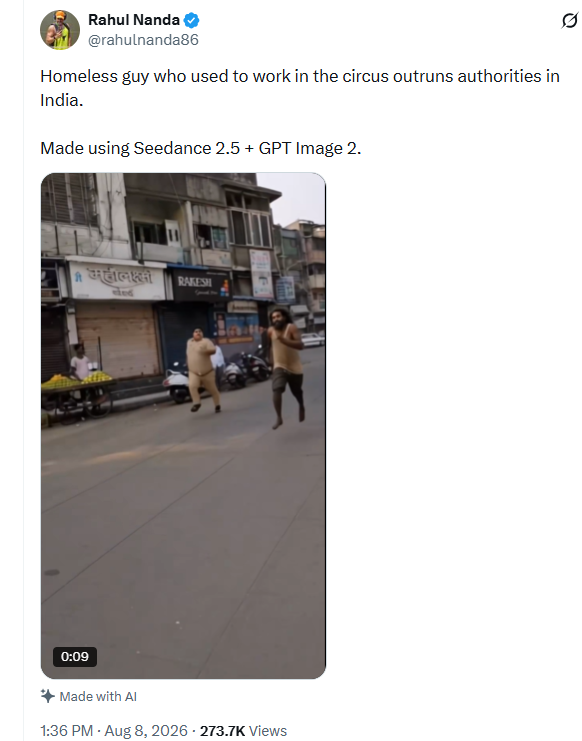
To verify the claim, we conducted a reverse image search of keyframes from the viral video using Google Lens. During the search, we found the same video posted on August 8 on the X account of a user named Rahul Nanda. The post stated that the video had been created using AI.
https://x.com/rahulnanda86/status/2086001127762657614
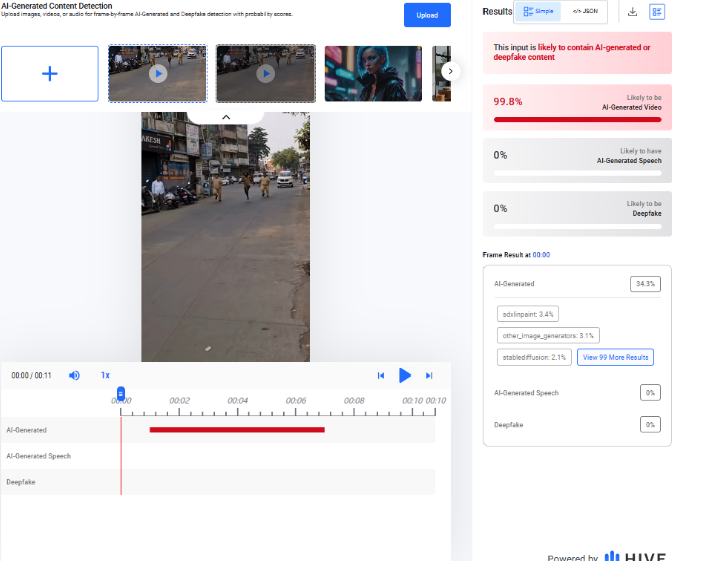
We then analysed the viral video using the AI detection tool Hive Moderation. The tool gave the video a 99.8 per cent score for being potentially AI-generated.
As part of the research, we also checked the video using another AI detection tool, Deepfake-O-Meter. Six different detectors on the tool indicated a high probability that the video was AI-generated.

Conclusion
The evidence gathered during our research establishes that the viral video claiming to show a thief evading police in Indore is AI-generated. Therefore, the claim is misleading.
.webp)
The Digital Covenant: Aligning Communication with SDG Goals
“Rethinking Communication, Cyber Responsibility, and Sustainability in a Connected World”
Introduction
It is rightly said by Antonio Guterres, United Nations Secretary General, “Everyone should be able to express themselves freely without fear of attack. Everyone should be able to access a range of views and information sources.” In 2024, when the Global Alliance for PR and Communication Management asserted that it aligns with the era of digital transformation, where technology is moving at terminal velocity and bringing various risks and threats, it called on the global leaders and stakeholders to proclaim ‘Responsible Communication’ as the 18th Sustainable Development Goal (SDG). On May 17th, as we celebrate World Telecommunication and Information Society Day (WTISD) 2025, we must align our personal, professional, and virtual spaces with a safe and sustainable information age.
In terms of digital growth, it is indubitable that India is growing at a brisk pace consistently in alignment with its South Asian and Western counterparts and has incorporated international covenants on digital personal data and cyber crimes within its domestic regime.
UN Global Principles for Information Integrity
The United Nations has displayed its constant commitment to the achievement of the seventeen SDGs that were adopted at the United Nations Conference in 2012 in Rio de Janeiro. It recognises that you cannot isolate the digital transformation, technology, and digitisation from other areas that are included within the SDGs, such as health, education, and poverty. The UN released Policy Brief 8 in June 2023 by the UN Secretary-General that seeks to empirically derive data on the threats posed to information integrity and then come up with norms that help guide the member states, the digital platforms, and other stakeholders. The norms must be in conformity with the right to freedom of opinion and expression and the right to information access.
In line with its agenda, it has formulated Global Principles of Information Integrity, which include “Societal Trust and Resilience”, “Healthy Incentives”, “Public Empowerment”, “Independent, Free and Pluralistic Media” and “Transparency and Research”. The principles recognise the harm caused by hatred, misinformation, and disinformation propagated by the misuse of advances in Artificial Intelligence Technology (AI).
Breaking the Binary: Bridging the Gender Digital Divide
The reflection of how far we have come and how far we have to go can be deciphered with a single sentence, i.e., using digital technologies to promote gender equality. This can be seen both as a paradox and a pressing call to action. As we celebrate WTISD 2025, the day highlights the fundamental role of Information and Communication Technologies (ICTs) in accelerating progress and bringing those not included in this digital transformation to become a part of this change, especially the female population that remains isolated from mainstream growth. As per the data given by ITU, “Out of the world population, 70 per cent of men are using the internet, compared with 65 per cent of women.”
This exclusion is not merely a technical gap but a societal and economic chasm, reinforcing existing inequalities. By including such an important goal in the theme of this day, it marks a critical moment towards the formation of gender-sensitive digital policies, promoting digital literacy among women and girls, and ensuring safe, affordable, and meaningful connectivity. We can explore the future potential where technology is the true instrument for gender parity, not a mirror of old hierarchies.
India and its courts have time and again proven their commitment to cultivating digital transformation as an inherent strength to bridge this digital divide, and the recent judgement where the court declared the right to digital access an intrinsic part of the right to life and liberty is a single instance among many.
CyberPeace Resolution on World Telecommunication and Information Society Day
CyberPeace is actively bridging the gap between digital safety and sustainable development through its initiatives, aligning with the principles of the Sustainable Development Goals (SDGs). The ‘CyberPeace Corps’ empowers communities by fostering cyber hygiene awareness and building digital resilience. The ‘CyberPeace Initiative’, a project with Google.org, tackles digital misinformation, promoting informed online engagement. Additionally, Digital Shakti, now in its fifth phase, empowers women by enhancing their digital literacy and safety. These are just a few of the many impactful initiatives by CyberPeace, aimed at creating a safer and more inclusive digital future. Together, we are spreading awareness and strengthening the foundation for a safer and more inclusive digital future and promoting responsible tech use. Let us be resolute on this World Telecommunication and Information Society Day for “Clean Data. Safe Clicks. Stronger Future. Pledge to Cyber Hygiene Today!”
References
Executive Summary
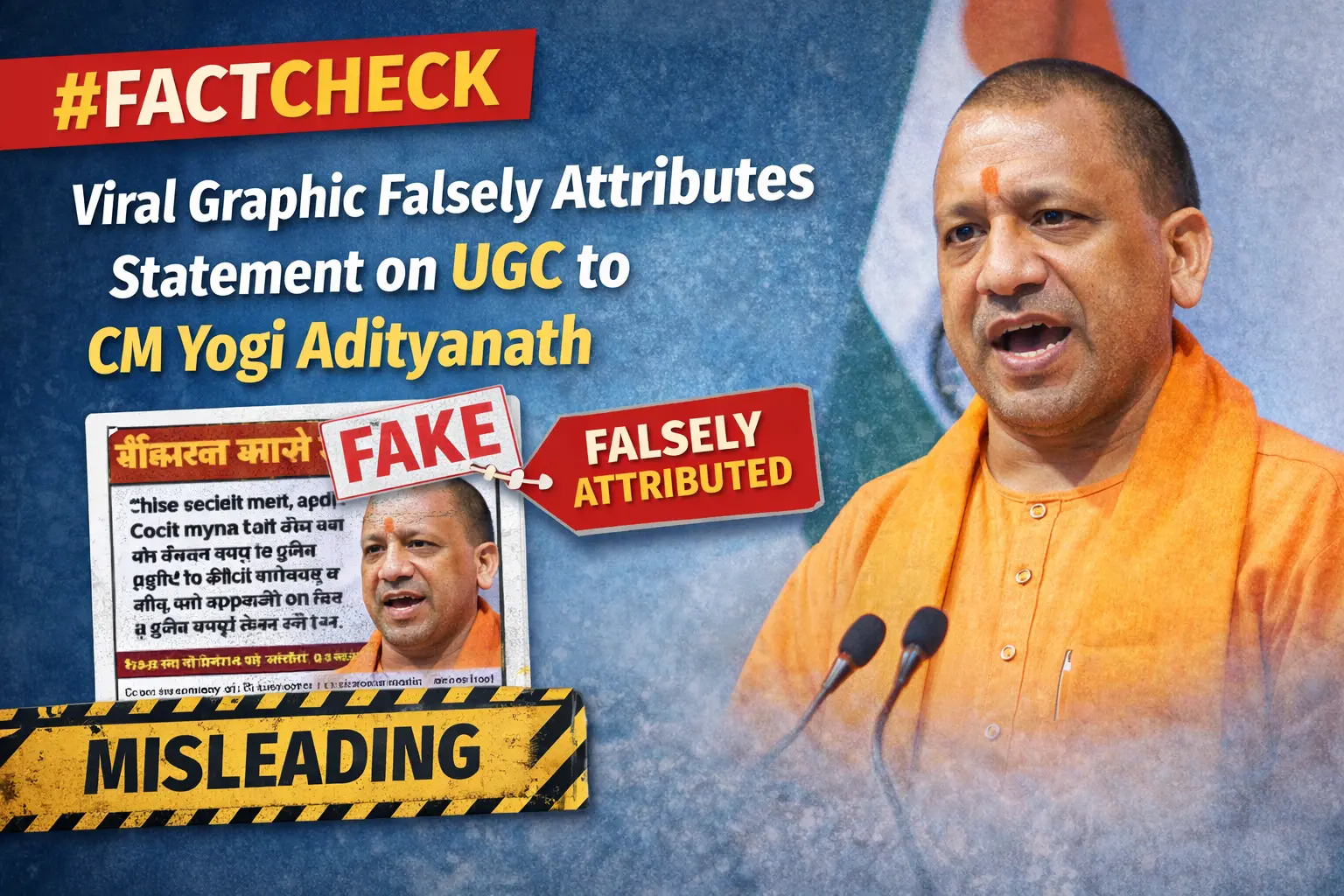
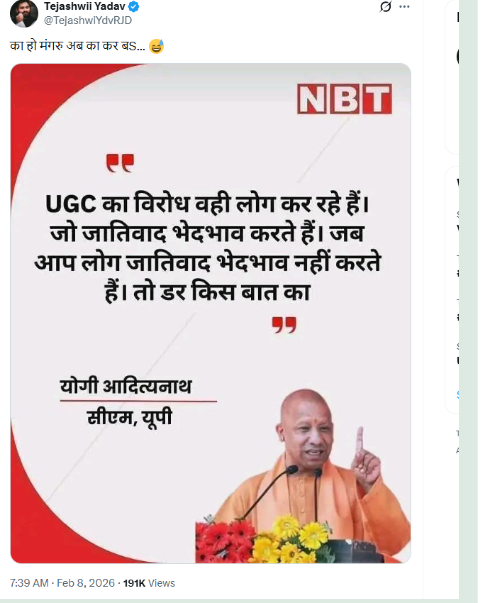
A news graphic is being shared on social media claiming that Uttar Pradesh Chief Minister Yogi Adityanath said,“Those who practice casteism and discrimination are the ones opposing UGC. If you do not indulge in caste-based discrimination, what is there to fear?” The CyberPeace’s research found the viral claim circulating on social media to be false. Our research revealed that Chief Minister Yogi Adityanath never made such a statement. It was also established that the viral news graphic has been digitally edited.
Claim
On February 8, a user on social media platform X (formerly Twitter) shared a news graphic bearing the logo of Navbharat Times, attributing the above statement to CM Yogi Adityanath. The post and its archived version can be seen below, along with screenshots. (Links and screenshots provided)
Fact Check:
To verify the authenticity of the claim, we conducted a keyword-based search on Google. However, we did not find any credible or reliable media report supporting the viral statement. We further examined the official social media accounts of Chief Minister Yogi Adityanath, including his Facebook and Instagram handles. Our review found no post, speech, or statement resembling the claim made in the viral graphic.
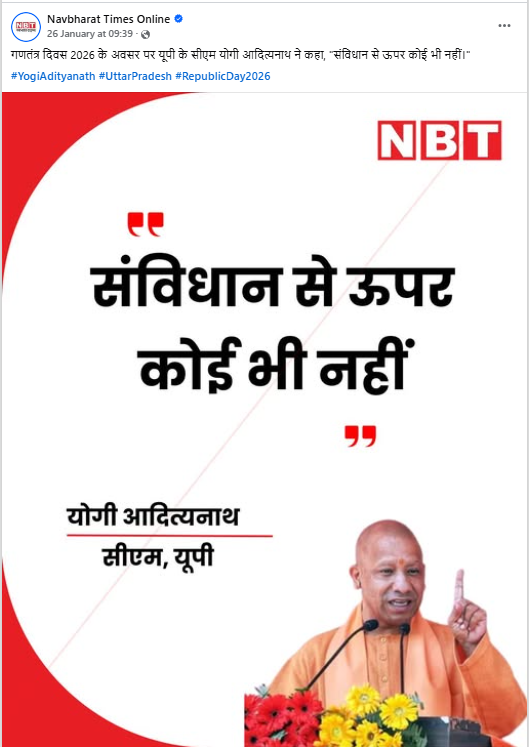
Continuing the research , we examined the official social media accounts of Navbharat Times. During this process, we found the original graphic published on the Navbharat Times Facebook page on January 26, 2026. The caption of the original graphic read: “On the occasion of Republic Day 2026, Uttar Pradesh Chief Minister Yogi Adityanath said, ‘No one is above the Constitution.’”
This clearly differs from the claim made in the viral graphic, indicating that the latter was altered.
Conclusion
Our research confirms that Uttar Pradesh Chief Minister Yogi Adityanath did not make the statement being attributed to him on social media. The viral news graphic is digitally edited and misleading. The claim, therefore, is false.
