
Enhancing Your Privacy on WhatsApp: A Comprehensive Security Guide
Overview:
In today’s digital landscape, safeguarding personal data and communications is more crucial than ever. WhatsApp, as one of the world’s leading messaging platforms, consistently enhances its security features to protect user interactions, offering a seamless and private messaging experience
App Lock: Secure Access with Biometric Authentication
To fortify security at the device level, WhatsApp offers an app lock feature, enabling users to protect their app with biometric authentication such as fingerprint or Face ID. This feature ensures that only authorized users can access the app, adding an additional layer of protection to private conversations.
How to Enable App Lock:
- Open WhatsApp and navigate to Settings.
- Select Privacy.
- Scroll down and tap App Lock.
- Activate Fingerprint Lock or Face ID and follow the on-screen instructions.

Chat Lock: Restrict Access to Private Conversations
WhatsApp allows users to lock specific chats, moving them to a secured folder that requires biometric authentication or a passcode for access. This feature is ideal for safeguarding sensitive conversations from unauthorized viewing.
How to Lock a Chat:
- Open WhatsApp and select the chat to be locked.
- Tap on the three dots (Android) or More Options (iPhone).
- Select Lock Chat
- Enable the lock using Fingerprint or Face ID.

Privacy Checkup: Strengthening Security Preferences
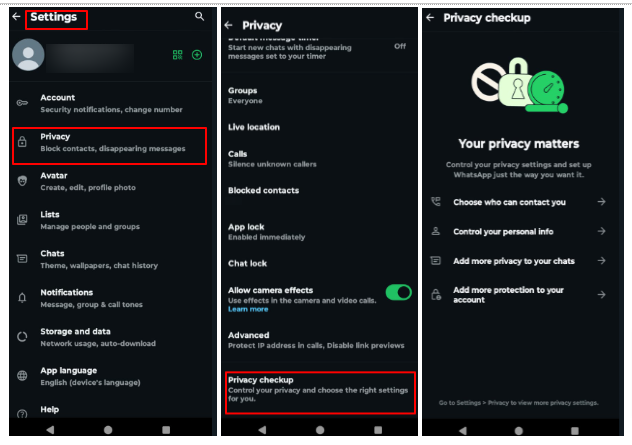
The privacy checkup tool assists users in reviewing and customizing essential security settings. It provides guidance on adjusting visibility preferences, call security, and blocked contacts, ensuring a personalized and secure communication experience.
How to Run Privacy Checkup:
- Open WhatsApp and navigate to Settings.
- Tap Privacy.
- Select Privacy Checkup and follow the prompts to adjust settings.
Automatic Blocking of Unknown Accounts and Messages
To combat spam and potential security threats, WhatsApp automatically restricts unknown accounts that send excessive messages. Users can also manually block or report suspicious contacts to further enhance security.
How to Manage Blocking of Unknown Accounts:
- Open WhatsApp and go to Settings.
- Select Privacy.
- Tap to Advanced
- Enable Block unknown account messages

IP Address Protection in Calls
To prevent tracking and enhance privacy, WhatsApp provides an option to hide IP addresses during calls. When enabled, calls are routed through WhatsApp’s servers, preventing location exposure via direct connections.
How to Enable IP Address Protection in Calls:
- Open WhatsApp and go to Settings.
- Select Privacy, then tap Advanced.
- Enable Protect IP Address in Calls.

Disappearing Messages: Auto-Deleting Conversations
Disappearing messages help maintain confidentiality by automatically deleting sent messages after a predefined period—24 hours, 7 days, or 90 days. This feature is particularly beneficial for reducing digital footprints.
How to Enable Disappearing Messages:
- Open the chat and tap the Chat Name.
- Select Disappearing Messages.
- Choose the preferred duration before messages disappear.

View Once: One-Time Access to Media Files
The ‘View Once’ feature ensures that shared photos and videos can only be viewed a single time before being automatically deleted, reducing the risk of unauthorized storage or redistribution.
How to Send View Once Media:
- Open a chat and tap the attachment icon.
- Choose Camera or Gallery to select media.
- Tap the ‘1’ icon before sending the media file.

Group Privacy Controls: Manage Who Can Add You
WhatsApp provides users with the ability to control group invitations, preventing unwanted additions by unknown individuals. Users can restrict group invitations to ‘Everyone,’ ‘My Contacts,’ or ‘My Contacts Except…’ for enhanced privacy.
How to Adjust Group Privacy Settings:
- Open WhatsApp and go to Settings.
- Select Privacy and tap Groups.
- Choose from the available options: Everyone, My Contacts, or My Contacts Except

Conclusion
WhatsApp continuously enhances its security features to protect user privacy and ensure safe communication. With tools like App Lock, Chat Lock, Privacy Checkup, IP Address Protection, and Disappearing Messages, users can safeguard their data and interactions. Features like View Once and Group Privacy Controls further enhance confidentiality. By enabling these settings, users can maintain a secure and private messaging experience, effectively reducing risks associated with unauthorized access, tracking, and digital footprints. Stay updated and leverage these features for enhanced security.

Related Blogs

Introduction
Established in the US, one of the world’s largest cab networks came into existence in 2010 and, since its inception, has expanded all over the globe with operations in 10,000 cities across 71 countries. It made a remarkable start in India in 2017 and, since then, has seen a rise in the customers and drivers for the company. India is among the largest markets for Uber, with 600,000 monthly drivers and 8.5 million monthly riders.
GeM
Government e-Marketplace (GeM) is a one-stop portal to facilitate online procurement of common-use Goods & Services required by various Government Departments / Organizations / PSUs. GeM aims to enhance transparency, efficiency and speed in public procurement. It provides the tools of e-bidding, reverses e-auction and demand aggregation to facilitate government users achieve the best value for their money. Government e-Marketplace owes its genesis to the recommendations of two Groups of Secretaries to the Prime Minister in January 2016. They recommended setting up a dedicated e-market for different goods & services procured or sold by Government/PSUs besides reforming DGS&D. Subsequently, the Finance Minister, in his Budget speech for FY 2016-17, announced setting up of a technology-driven platform to facilitate procurement of goods and services by various Ministries and agencies of the Government. The portal was launched on 9th August 2016 by the Commerce & Industry Minister.
Uber-GeM collaboration
The cab network giant has registered on the portal of the Government E-marketplace and has declared that it will offer its services to Government officials from Ministries and PSUs. The project is currently in its pilot phase and shall be executed systematically to cover all the ministries and PSUs in the nation. The officials can book cabs at a fixed price with no cancellation or surge fees on the rides. The authorised officials will be able to book a cab from the portal and select from the list of drivers available. It will be a cashless/cardless ride for the officials; additional vehicle categories for government riders have been added, namely, GeM Yatraa Hatch and GeM Yatraa Sedan, and there will be hourly rentals for multiple-stops, allowing the government officials to enjoy the flexible and easily accessible network of cabs in major cities.
Advantages
Such collaboration between Government institutions and corporates will go a long way to secure a stable equilibrium in the market. Uber, a US-based company, enjoys a vast user base in India and has created new job avenues. The advantages of the collaboration between GeM and Uber are as follows-
Easy accessibility
This will undoubtedly provide ease in accessibility in terms of being in a new place, and language barriers will no longer exist with such options for Government officials.
Increased jobs for drivers
With more cabs being engaged with ministries and PSUs, it is pertinent that the requirement for drivers will grow, thus increasing the employability rate in India and allowing the user to have an uninterrupted experience.
Ease of travel and commuting
This move will provide flexibility, thus leading to more ease in travel in cases of emergencies or places inaccessible by trains or other modes of transport.
Rise in travel and tourism
Coupled with the other factors, the opportunities for the users to visit different places will be an added advantage which will help boost the tourism industry, thus creating a balance in the market.
Sustainable Government corporate relationship

Such collaborations between the government and corporates will be substantial, signifying the ease of doing business in India. They will also act as a beacon of example for compliance with opportunities for the other companies and stakeholders.
Opportunities for collaboration with ingenious start-ups
With such major corporate joining hands with the government, the indigenous start-ups will have various opportunities to engage with companies and recreate similar businesses rooted in India, thus transforming the economy.
Conclusion
Transportation and communication play a vital role in our lives, thus, such collaboration will go a long way in creating a better and more uniform user experience in the country. This also goes a long way to showcase that the Governmental platforms also offer services of a global standard. Such portals exist in South Korea, Singapore, the US and Europe. The network of cabs can only be sustained using the locals as drivers, hence these collaborations are win-win for all as the market dynamics are improving, employability will increase, and improved user experience will be seen.

Introduction
The emergence of deepfake technology has become a significant problem in an era driven by technological growth and power. The government has reacted proactively as a result of concerns about the exploitation of this technology due to its extraordinary realism in manipulating information. The national government is in the vanguard of defending national interests, public trust, and security as the digital world changes. On the 26th of December 2023, the central government issued an advisory to businesses, highlighting how urgent it is to confront this growing threat.
The directive aims to directly address the growing concerns around Deepfakes, or misinformation driven by AI. This advice represents the result of talks that Union Minister Shri Rajeev Chandrasekhar, had with intermediaries during the course of a month-long Digital India dialogue. The main aim of the advisory is to accurately and clearly inform users about information that is forbidden, especially those listed under Rule 3(1)(b) of the IT Rules.
Advisory
The Ministry of Electronics and Information Technology (MeitY) has sent a formal recommendation to all intermediaries, requesting adherence to current IT regulations and emphasizing the need to address issues with misinformation, specifically those driven by artificial intelligence (AI), such as Deepfakes. Union Minister Rajeev Chandrasekhar released the recommendation, which highlights the necessity of communicating forbidden information in a clear and understandable manner, particularly in light of Rule 3(1)(b) of the IT Rules.
Advise on Prohibited Content Communication
According to MeitY's advice, intermediaries must transmit content that is prohibited by Rule 3(1)(b) of the IT Rules in a clear and accurate manner. This involves giving users precise details during enrollment, login, and content sharing/uploading on the website, as well as including such information in customer contracts and terms of service.
Ensuring Users Are Aware of the Rules
Digital platform suppliers are required to inform their users of the laws that are relevant to them. This covers provisions found in the IT Act of 2000 and the Indian Penal Code (IPC). Corporations should inform users of the potential consequences of breaking the restrictions outlined in Rule 3(1)(b) and should also urge users to notify any illegal activity to law enforcement.
Talks Concerning Deepfakes
For more than a month, Union Minister Rajeev Chandrasekhar had a significant talk with various platforms where they addressed the issue of "deepfakes," or computer-generated fake videos. The meeting emphasized how crucial it is that everyone abides by the laws and regulations in effect, particularly the IT Rules to prevent deepfakes from spreading.
Addressing the Danger of Disinformation
Minister Chandrasekhar underlined the grave issue of disinformation, particularly in the context of deepfakes, which are false pieces of content produced using the latest developments such as artificial intelligence. He emphasized the dangers this deceptive data posed to internet users' security and confidence. The Minister emphasized the efficiency of the IT regulations in addressing this issue and cited the Prime Minister's caution about the risks of deepfakes.
Rule Against Spreading False Information
The Minister referred particularly to Rule 3(1)(b)(v), which states unequivocally that it is forbidden to disseminate false information, even when doing so involves cutting-edge technology like deepfakes. He called on intermediaries—the businesses that offer digital platforms—to take prompt action to take such content down from their systems. Additionally, he ensured that everyone is aware that breaking such rules has legal implications.
Analysis
The Central Government's latest advisory on deepfake technology demonstrates a proactive strategy to deal with new issues. It also highlights the necessity of comprehensive legislation to directly regulate AI material, particularly with regard to user interests.
There is a wider regulatory vacuum for content produced by artificial intelligence, even though the current guideline concentrates on the precision and lucidity of information distribution. While some limitations are mentioned in the existing laws, there are no clear guidelines for controlling or differentiating AI-generated content.
Positively, it is laudable that the government has recognized the dangers posed by deepfakes and is making appropriate efforts to counter them. As AI technology develops, there is a chance to create thorough laws that not only solve problems but also create a supportive environment for the creation of ethical AI content. User protection, accountability, openness, and moral AI use would all benefit from such laws. This offers an opportunity for regulatory development to guarantee the successful and advantageous incorporation of AI into our digital environment.
Conclusion
The Central Government's preemptive advice on deepfake technology shows a great dedication to tackling new risks in the digital sphere. The advice highlights the urgent need to combat deepfakes, but it also highlights the necessity for extensive legislation on content produced by artificial intelligence. The lack of clear norms offers a chance for constructive regulatory development to protect the interests of users. The advancement of AI technology necessitates the adoption of rules that promote the creation of ethical AI content, guaranteeing user protection, accountability, and transparency. This is a turning point in the evolution of regulations, making it easier to responsibly incorporate AI into our changing digital landscape.
References
- https://economictimes.indiatimes.com/tech/technology/deepfake-menace-govt-issues-advisory-to-intermediaries-to-comply-with-existing-it-rules/articleshow/106297813.cms
- https://pib.gov.in/PressReleaseIframePage.aspx?PRID=1990542#:~:text=Ministry%20of%20Electronics%20and%20Information,misinformation%20powered%20by%20AI%20%E2%80%93%20Deepfakes.
- https://www.timesnownews.com/india/centres-deepfake-warning-to-it-firms-ensure-users-dont-violate-content-rules-article-106298282#:~:text=The%20Union%20government%20on%20Tuesday,actors%2C%20businesspersons%20and%20other%20celebrities
Artificial Intelligence (AI) continues to grow in importance in today’s world not just as technological advancement but also becoming the backbone of economic growth, national security, scientific research, and digital governance. However, AI innovations of such a sophisticated kind require significant computing power that is currently only within the reach of a few countries. Against this backdrop, India and the United Arab Emirates (UAE) have taken a significant step by partnering to build one of India's most powerful AI supercomputing infrastructures. What began as a discussion about digital infrastructure under the ambit of the new found India-UAE tech relationship, has come to a stage that is likely to usher in new AI-centric developments in the country, while bolstering the partnership between India and UAE.
From Vision to Concrete Action
This collaboration stemmed from the strengthening relationship between India and the UAE. The goal is to focus more on digital cooperation after the 2023 G20 Summit held in India. During this period, Artificial Intelligence, digital public infrastructure, and strong digital ecosystems became key topics of discussion between the two countries. This partnership received formal recognition with the India-UAE Digital Infrastructure Memorandum of Understanding (MoU) signed in 2024. This agreement identified Artificial Intelligence, high-performance computing (HPC), cloud infrastructure, and digital innovation as priority areas for cooperation.
The initiative has now moved from policy talks to actual implementation. In February 2026, the UAE announced plans to deploy an 8-exaflop AI Super Computing Cluster in partnership between CDAC and in May 2026, when our Hon’ble Prime Minister visited UAE, both governments formalized the commercial framework for establishing the system, marking one of the largest AI infrastructure collaborations between the two countries. It was one the significant agendas discussed between the two countries among others.
What Does the Agreement Include?
The agreement between the countries is for the deployment of ‘Condor Galaxy India supercomputer’, which is an AI supercomputing cluster designed specifically for complex and advanced artificial intelligence workloads. Some of the major points of agreement include:
- Deployment of an 8 Exaflop Super Computing Cluster, meaning it can perform up to eight quintillion (8 × 10¹⁸) AI-related calculations per second. This would place it among the world's most powerful AI supercomputing systems.
- This project will be implemented by G42, which is an Abu Dhabi-based AI technology company, in partnership with India's Centre for Development of Advanced Computing (C-DAC).
- The computing infrastructure will utilise 64 Cerebras CS-3 AI systems, built using wafer-scale processor technology designed for large AI models.
- G42 and C-DAC will jointly oversee installation, deployment, operation, and maintenance of the infrastructure.
- The supercomputer will support India's IndiaAI Mission, strengthening domestic AI research and innovation. It is also a step in the direction of India’ AI mission through mindful collaboration.
- Notably, the system will be physically located within India and operate under Indian governance frameworks and laws ensuring that sensitive datasets remain under India’s jurisdiction.
While beyond the infrastructure, the partnership also aims for research efforts within fields like healthcare & genomics, climate change modeling & optimization of energy, geointelligence, research studies & government usages, as well as growing startups in AI. It is hoped that the computing infrastructure will be made accessible to researchers, academic bodies, government organizations & startups from both nations to foster collaborative research.
How Are India and the UAE Collaborating?
The partnership involves more than simply sharing the hardware, the two countries are entering into a multiyear technology partnership where each brings different but complementary expertise. On one hand India offers the knowledge and experience of C-DAC, a large number of AI engineers, startups, academics and researchers, and the IndiaAI Mission, a framework to enable access to the advanced computing infrastructure needed to use these researchers.
In return, the UAE offers investment in AI infrastructure and expertise in global AI cloud infrastructure, and sovereign AI platform development, from AI cloud infrastructure company G42, a company that has deployed large AI computing clusters as part of the Condor Galaxy network. Among the biggest names involved in the new initiative is also Cerebras Systems, the artificial intelligence (AI) computing company that will supply the AI chips for the supercomputer. The leading designer of AI compute technology, Cerebras develops the world's fastest AI hardware. In particular, the flagship Wafer Scale Engine (WSE-3), a revolutionary single chip that is the largest AI processor in the world, offers significant gains in speed and computational efficiency. This partnership will spur a joint R&D effort. That allows both India and the UAE to harness their respective knowledge and resources to accelerate better results for all stakeholders in various domains.
This collaboration will enable joint research and development (R&D), allowing both countries to combine their expertise and resources to produce more effective outcomes that are mutually beneficial across multiple sectors.
Cyber and Digital Security Benefits
From a cybersecurity perspective, this partnership is particularly significant.
- Moving towards AI Sovereignty
Possessing the infrastructure within India can ensure that sensitive government, healthcare, research, and enterprise data remains within Indian jurisdiction. This will reduce dependence on foreign cloud infrastructure while improving regulatory control over sensitive and critical datasets.
- Modernising Cyber Defence
Having a high-performance computing system will improve our cyber defence through AI-based threat detection, malware flagging, vulnerability assessment and cyber testing of safeguarding critical infrastructure. These are necessary in current times considering the growing capabilities and mode of cyber attacks.
- Secure AI Development
Countries worldwide are moving toward "Sovereign AI" which is a goal of developing AI systems within nationally governed infrastructure to protect sensitive information. The India-UAE partnership directly supports this objective by combining national governance and world-class computing capability development.
- Economic Benefits for India
The project offers several long-term economic advantages. First, easing the entry barrier for startups and researchers in India as they are often reliant on expensive overseas cloud computing services. Second, enabling availability of more computing power that can accelerate innovation across sectors such as healthcare, agriculture, manufacturing, fintech, education, and logistics. Third, stronger AI computing infrastructure could foster the inflow of global capital into India’s tech ecosystem by provisioning requisite resources to run frontier AI computations. Finally, the initiative supports India's ambition of becoming a global AI innovation hub under the IndiaAI Mission by enabling domestic development of advanced AI models rather than relying solely on imported technologies that will in long-term make India a sought out destination as an AI-hub.
Why the UAE Benefits?
In the case of the UAE, the partnership further helps Abu Dhabi's vision to become a global leader in artificial intelligence by extending the reach of G42's AI capabilities internationally, while strengthening ties with one of the world’s leading digital economies as a trusted strategic technology partner. In harnessing India's extensive talent base, research communities, and growing AI capabilities, the UAE unlocks opportunities for scale and innovation, while also cementing its status as a dependable technological enabler across emerging economies. The project is a part of the UAE’s long-standing agenda to move away from hydrocarbons and towards growth in areas such as AI, digital infrastructure, and technologies of the future.
Conclusion
The India-UAE supercomputer collaboration is a step in the direction of being self-dependent in terms of having a strong computing infrastructure base in India. This also changes the outlook of international technology partnerships from traditional trade relationships to collaborations focused on AI, digital infrastructure, research, and strategic innovation. AI is becoming a defining factor in economic competitiveness and national resilience on a global scale and the access to sovereign computing infrastructure will increasingly shape our influence in world markets. By uniting UAE’s investment capacity and AI infrastructure expertise and India’s advantages. If successfully implemented, the collaboration could serve as a model of what cooperation toward sovereign and trusted AI can entail.
REFERENCES
- https://www.pib.gov.in/PressReleasePage.aspx?PRID=2006207®=48&lang=2
- https://www.pib.gov.in/PressReleaseDetail.aspx?PRID=2261385®=48&lang=1
- https://www.pib.gov.in/PressReleaseDetail.aspx?PRID=2261393®=48&lang=1
