
#FactCheck -AI-Altered Clip Falsely Attributes Taliban Comments to General Upendra Dwivedi
Executive Summary
A video clip of Indian Army Chief Upendra Dwivedi is being widely shared across social media platforms with the claim that he criticised the Indian government's policy towards Taliban-ruled Afghanistan. In the viral clip, the Army Chief is allegedly heard saying that India is doing nothing except sending money to the Taliban government due to the Centre’s failed policies.
However, CyberPeace Research Wing research found the claim to be false. The viral video is a deepfake. In the original footage, General Upendra Dwivedi was speaking about Operation Sindoor and the preparedness of the Indian Armed Forces for a possible “Operation Sindoor 2.0.” He made no remarks regarding the Taliban or the government’s Afghanistan policy.
Claim
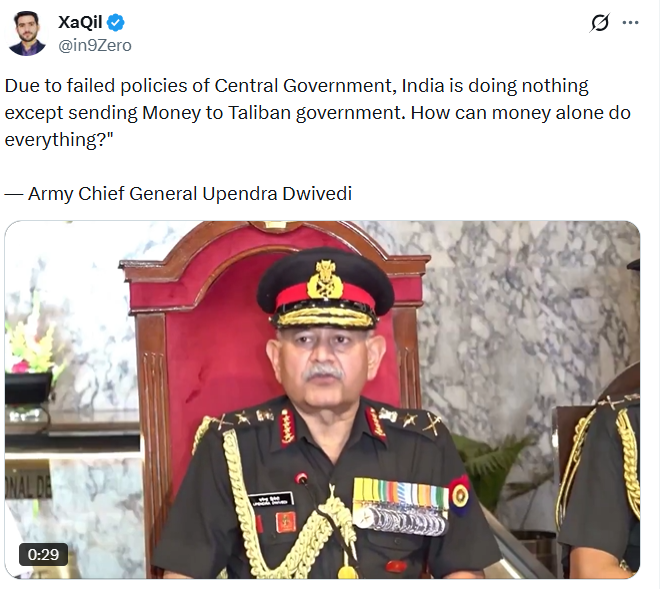
An X user named “XaQil” shared the viral video on May 31, 2026, with the caption:“Due to failed policies of the Central Government, India is doing nothing except sending Money to Taliban government. How can money alone do everything?” — Army Chief General Upendra Dwivedi.
Fact Check
In the viral video, General Dwivedi is purportedly heard making remarks about India’s Afghanistan policy, the Taliban, Pakistan, Iran, and India’s diplomatic position. To verify the claim, we searched for the original source of the video. A reverse image search of key frames led us to the authentic footage posted by news agency ANI on its official X account on May 30, 2026.
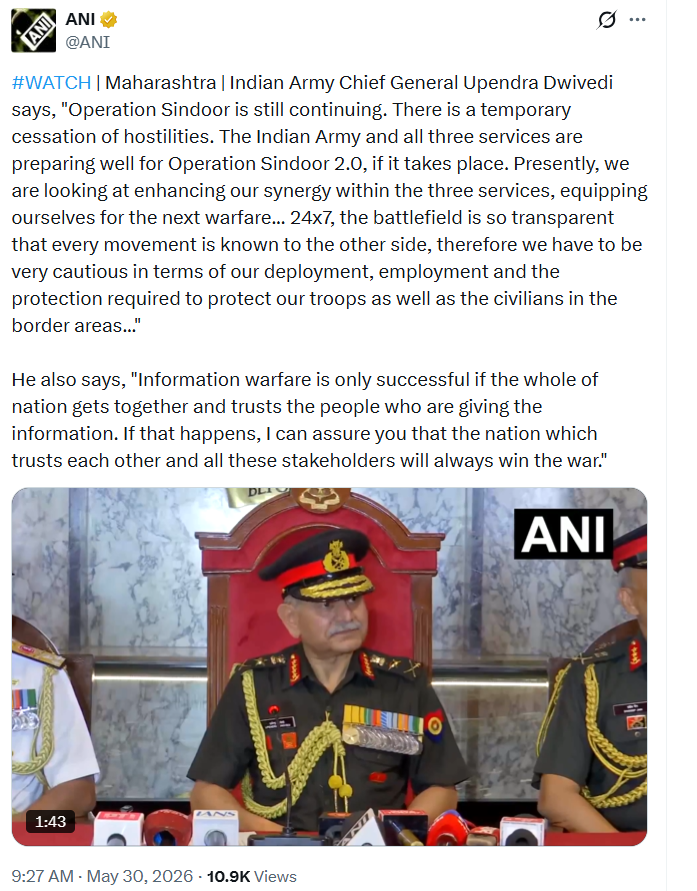
In the original video, General Dwivedi was responding to a question about Operation Sindoor. He stated that the operation was still ongoing, hostilities had only paused temporarily, and that the Indian Armed Forces were fully prepared if “Operation Sindoor 2.0” became necessary.
He also spoke about enhancing coordination among the three services and maintaining operational readiness.”
No part of his statement mentioned the Taliban, Afghanistan, Pakistan, Iran, or criticism of the Central Government.
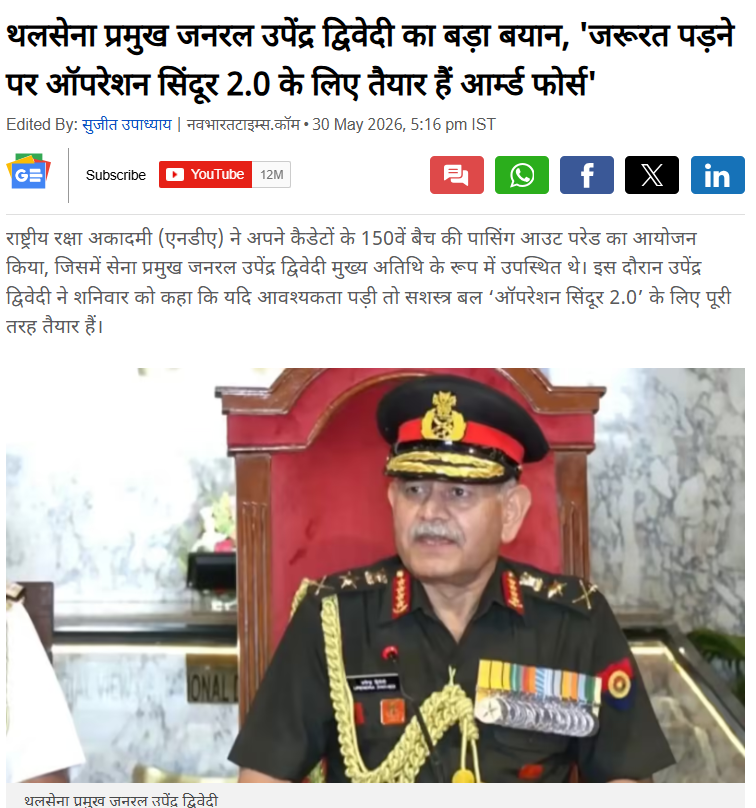
Further corroboration came from media reports covering the same event. According to a report published by Navbharat Times on May 30, 2026, General Dwivedi made the remarks during the passing-out parade of the 150th course of the National Defence Academy (NDA), where he attended as the chief guest. He reiterated that the armed forces were fully prepared for “Operation Sindoor 2.0” if required.
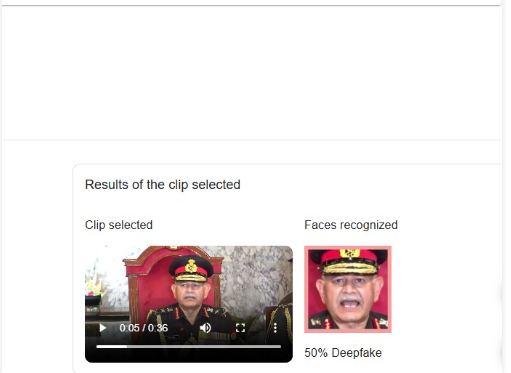
Since the content of the viral clip did not match the original statement, we examined it using InVID’s MeVer Deepfake Detector. The tool flagged signs of AI manipulation and indicated that the video had likely been altered.
Conclusion
Cyber Peace Foundation found that the viral video purportedly showing Army Chief General Upendra Dwivedi criticising the Indian government’s policy towards the Taliban is a deepfake. The Army Chief made no such remarks. The original video was recorded during an NDA event, where he spoke about Operation Sindoor and the preparedness of the Indian Armed Forces for a possible future operation. The viral clip has been manipulated using AI to spread a false narrative.

Related Blogs

Executive Summary
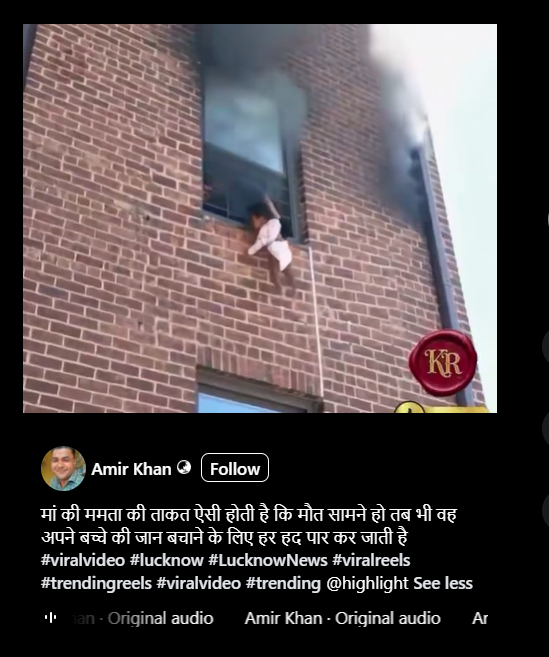
A video is being widely shared on social media after a fire incident in Aliganj, Lucknow. The approximately 15-second clip shows a building engulfed in flames, where a woman is seen hanging her small child outside a window while desperately seeking help. The video is being circulated as if it shows the recent Lucknow fire incident. CyberPeace Research Wing research found the claim to be misleading. The viral video is not related to the Lucknow fire incident. In fact, the clip is around 16 years old and originates from a completely different incident in the United States. It is being falsely shared on social media with a misleading context.
Claim:
A Facebook user shared the viral video on June 22, 2026, claiming: “A mother’s love is so powerful that even in front of death, she goes to any extent to save her child.” The post link, archived link, and screenshots are provided below.
https://www.facebook.com/reel/1168968548755052
Factcheck
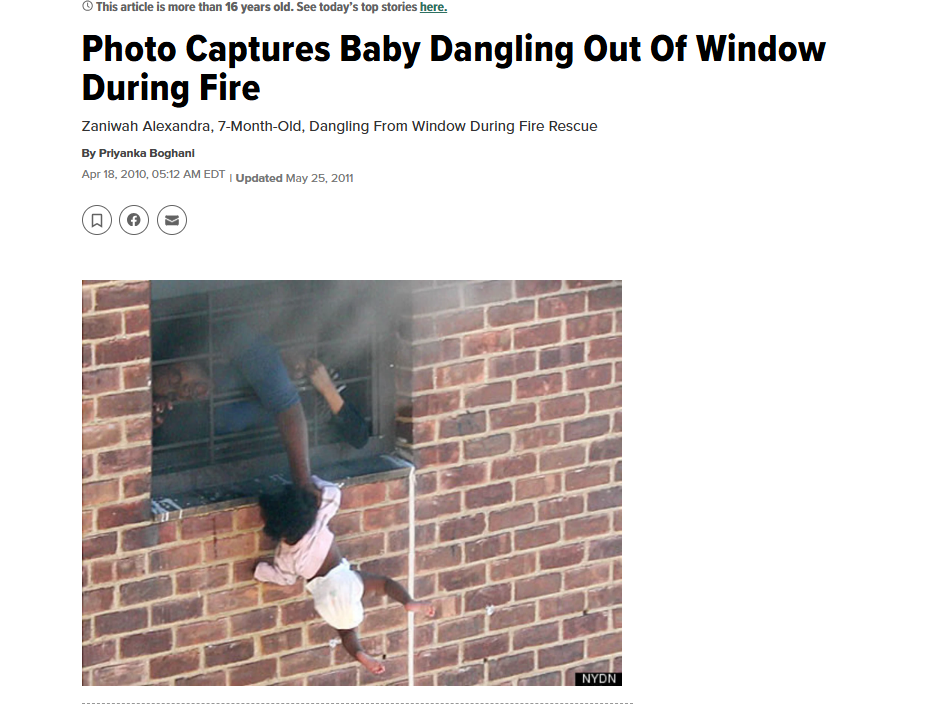
To verify the claim, we conducted a reverse image search of the video keyframes using Google Lens. During the research, we found the same visuals published in a HuffPost report dated 2010. According to the report, the incident shows a fire in an apartment in the Bronx, New York, USA. https://www.huffpost.com/entry/photo-captures-baby-dangl_n_463780
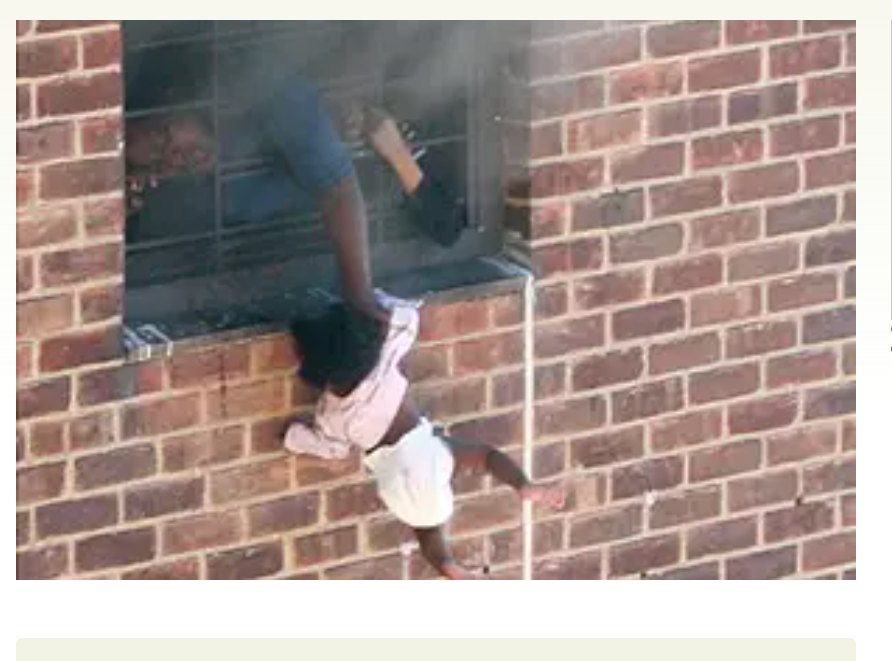
Further research led us to another report published by Gothamist in 2010, which also confirmed that the footage is related to a fire incident in the Bronx apartment building in New York. https://gothamist.com/news/baby-held-out-window-in-bronx-fire-is-healthy-adorable
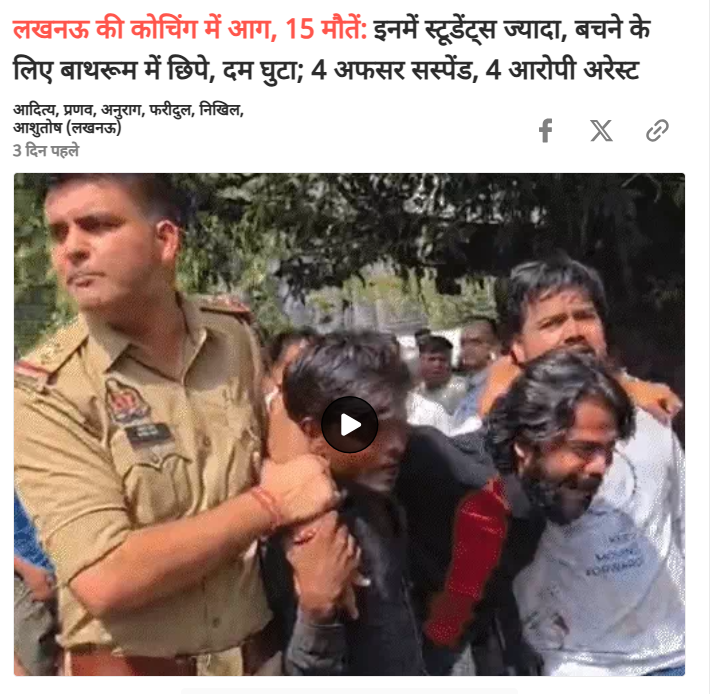
According to a report by Dainik Bhaskar, a fire incident at a coaching center in Aliganj, Lucknow resulted in the death of around 15 people. The government suspended four officials and police arrested four accused in connection with the incident. However, it was confirmed that the actual footage from the Lucknow coaching center fire is different from the viral video and has no relation to it. https://www.bhaskar.com/local/uttar-pradesh/lucknow/news/lucknow-coaching-center-fire-children-rescue-effort-138258629.html
Conclusion:
Our research confirms that the viral video is not related to the Lucknow fire incident. The footage is actually from a 16-year-old fire incident in the Bronx, New York, USA, and is being falsely shared with a misleading context on social media.

The Rise of Tech Use Amongst Children
Technology today has become an invaluable resource for children, as a means to research issues, be informed about events, gather data, and share views and experiences with others. Technology is no longer limited to certain age groups or professions: children today are using it for learning & entertainment, engaging with their friends, online games and much more. With increased digital access, children are also exposed to online mis/disinformation and other forms of cyber crimes, far more than their parents, caregivers, and educators were in their childhood or are, even in the present. Children are particularly vulnerable to mis/disinformation due to their still-evolving maturity and cognitive capacities. The innocence of the youth is a major cause for concern when it comes to digital access because children simply do not possess the discernment and caution required to be able to navigate the Internet safely. They are active users of online resources and their presence on social media is an important factor of social, political and civic engagement but young people and children often lack the cognitive and emotional capacity needed to distinguish between reliable and unreliable information. As a result, they can be targets of mis/disinformation. ‘A UNICEF survey in 10 countries’[1] reveals that up to three-quarters of children reported feeling unable to judge the veracity of the information they encounter online.
Social media has become a crucial part of children's lives, with them spending a significant time on digital platforms such as Youtube, Facebook, Instagram and more. All these platforms act as source of news, educational content, entertainment, peer communication and more. These platforms host a variety of different kinds of content across a diverse range of subject matters, and each platform’s content and privacy policies are different. Despite age restrictions under the Children's Online Privacy Protection Act (COPPA), and other applicable laws, it is easy for children to falsify their birth date or use their parent's accounts to access content which might not be age-appropriate.
The Impact of Misinformation on Children
In virtual settings, inaccurate information can come in the form of text, images, or videos shared through traditional and social media channels. In this age, online misinformation is a significant cause for concern, especially with children, because it can cause anxiety, damage self-esteem, shape beliefs, and skewing their worldview/viewpoints. It can distort children's understanding of reality, hinder their critical thinking skills, and cause confusion and cognitive dissonance. The growing infodemic can even cause an overdose of information. Misinformation can also influence children's social interactions, leading to misunderstandings, conflicts, and mistrust among peers. Children from low literacy backgrounds are more susceptible to fabricated content. Mis/disinformation can exacerbate social divisions amongst peers and lead to unwanted behavioural patterns. Sometimes even children themselves can unwittingly spread/share misinformation. Therefore, it is important to educate & empower children to build cognitive defenses against online misinformation risks, promote media literacy skills, and equip them with the necessary tools to critically evaluate online information.
CyberPeace Policy Wing Recommendations
- Role of Parents & Educators to Build Cognitive Defenses
One way parents shape their children's values, beliefs and actions is through modelling. Children observe how their parents use technology, handle challenging situations, and make decisions. For example, parents who demonstrate honesty, encourage healthy use of social media and show kindness and empathy are more likely to raise children who hold these qualities in high regard. Hence parents/educators play an important role in shaping the minds of their young charges and their behaviours, whether in offline or online settings. It is important for parents/educators to realise that they must pay close attention to how online content consumption is impacting the cognitive skills of their child. Parents/educators should educate children about authentic sources of information. This involves instructing children on the importance of using reliable, credible sources to utilise while researching on any topic of study or otherwise, and using verification mechanisms to test suspected information., This may sound like a challenging ideal to meet, but the earlier we teach children about Prebunking and Debunking strategies and the ability to differentiate between fact and misleading information, the sooner we can help them build cognitive defenses so that they may use the Internet safely. Hence it becomes paramount important for parents/educators to require children to question the validity of information, verify sources, and critically analyze content. Developing these skills is essential for navigating the digital world effectively and making informed decisions.
- The Role of Tech & Social Media Companies to Fortify their Steps in Countering Misinformation
Is worth noting that all major tech/social media companies have privacy policies in place to discourage any spread of harmful content or misinformation. Social media platforms have already initiated efforts to counter misinformation by introducing new features such as adding context to content, labelling content, AI watermarks and collaboration with civil society organisations to counter the widespread online misinformation. In light of this, social media platforms must prioritise both the designing and the practical implementation aspects of policy development and deployment to counter misinformation strictly. These strategies can be further improved upon through government support and regulatory controls. It is recommended that social media platforms must further increase their efforts to counter increasing spread of online mis/disinformation and apply advanced techniques to counter misinformation including filtering, automated removal, detection and prevention, watermarking, increasing reporting mechanisms, providing context to suspected content, and promoting authenticated/reliable sources of information.
Social media platforms should consider developing children-specific help centres that host educational content in attractive, easy-to-understand formats so that children can learn about misinformation risks and tactics, how to spot red flags and how to increase their information literacy and protect themselves and their peers. Age-appropriate, attractive and simple content can go a long way towards fortifying young minds and making them aware and alert without creating fear.
- Laws and Regulations
It is important that the government and the social media platforms work in sync to counteract misinformation. The government must consult with the concerned platforms and enact rules and regulations which strengthen the platform’s age verification mechanisms at the sign up/ account creation stage whilst also respecting user privacy. Content moderation, removal of harmful content, and strengthening reporting mechanisms all are important factors which must be prioritised at both the regulatory level and the platform operational level. Additionally, in order to promote healthy and responsible use of technology by children, the government should collaborate with other institutions to design information literacy programs at the school level. The government must make it a key priority to work with civil society organisations and expert groups that run programs to fight misinformation and co-create a safe cyberspace for everyone, including children.
- Expert Organisations and Civil Societies
Cybersecurity experts and civil society organisations possess the unique blend of large scale impact potential and technical expertise. We have the ability to educate and empower huge numbers, along with the skills and policy acumen needed to be able to not just make people aware of the problem but also teach them how to solve it for themselves. True, sustainable solutions to any social concern only come about when capacity-building and empowerment are at the heart of the initiative. Programs that prioritise resilience, teach Prebunking and Debunking and are able to understand the unique concerns, needs and abilities of children and design solutions accordingly are the best suited to implement the administration’s mission to create a safe digital society.
Final Words
Online misinformation significantly impacts child development and can hinder their cognitive abilities, color their viewpoints, and cause confusion and mistrust. It is important that children are taught not just how to use technology but how to use it responsibly and positively. This education can begin at a very young age and parents, guardians and educators can connect with CyberPeace and other similar initiatives on how to define age-appropriate learning milestones. Together, we can not only empower children to be safe today, but also help them develop into netizens who make the world even safer for others tomorrow.
References:
- [1] Digital misinformation / disinformation and children
- [2] Children's Privacy | Federal Trade Commission

Executive Summary
A video of Russian President Vladimir Putin and Chinese President Xi Jinping is being shared on social media. In the video, the two leaders can be seen cooking together and interacting with each other.The video is being linked to the BRICS Summit held at Bharat Mandapam in Delhi on September 12 and 13, 2026, with the claim that Putin and Xi Jinping were seen in this manner during the summit. The viral claim was found to be false in CyberPeace Research Wing’s research. Our research revealed that the video being shared on social media is not recent. The video dates back to 2018, when Russian President Vladimir Putin and Chinese President Xi Jinping cooked together during the Eastern Economic Forum held in Vladivostok, Russia.
Claim:
A Facebook user shared the viral video with the caption: “Russian President Vladimir Putin and Chinese President Xi Jinping enjoyed cooking and sharing a meal together in India. The special camaraderie between the two leaders was on display during the BRICS Summit.” The link to the post, along with an archive link and screenshot, is provided below.
https://www.instagram.com/reels/DdOFovfkelC/

Factcheck
To verify the authenticity of the viral claim, we conducted a reverse image search of the keyframes from the video. During the search, we found visuals matching the video on the Armenpress website, published on September 12, 2018. The link to the post and the screenshot are provided below.
https://armenpress.am/en/article/946878
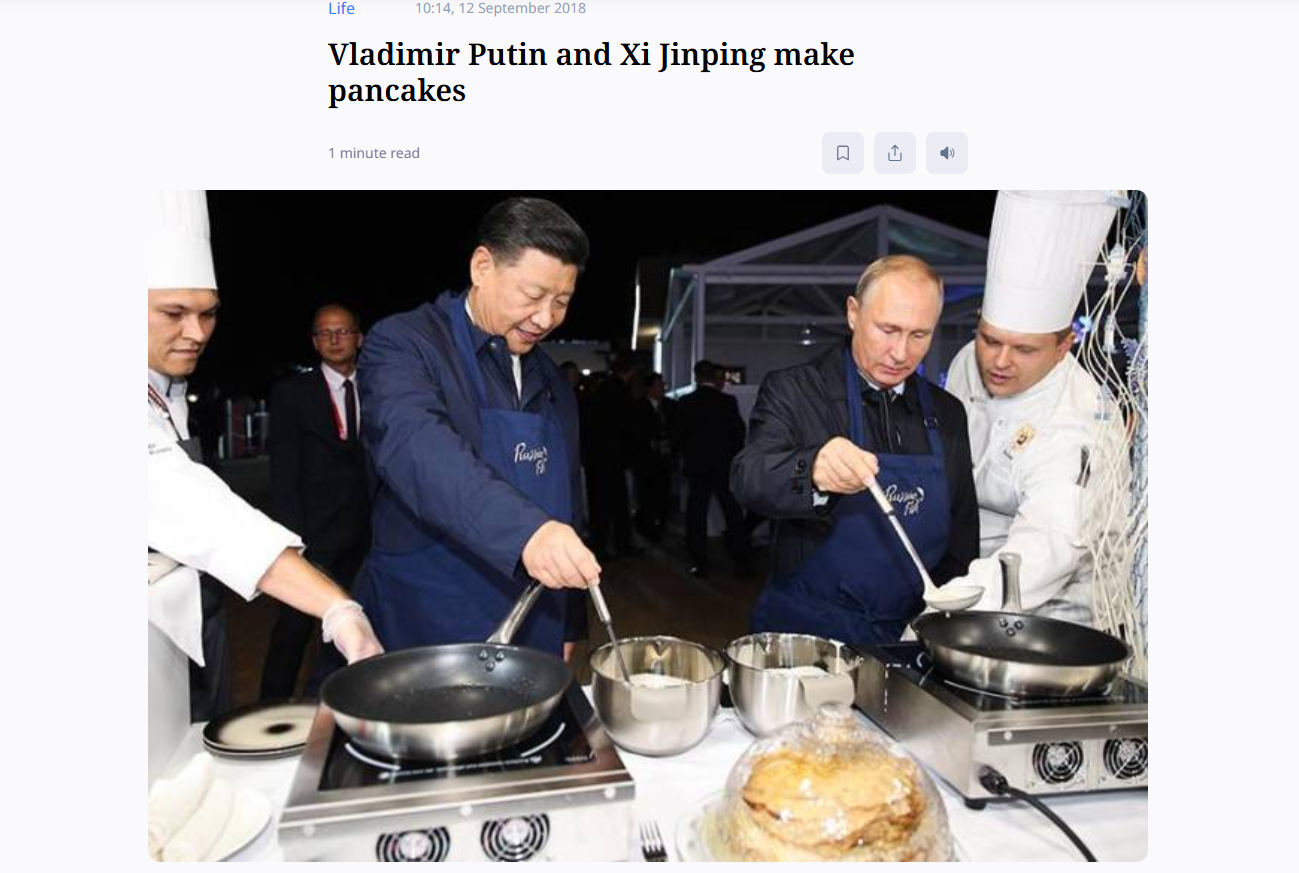
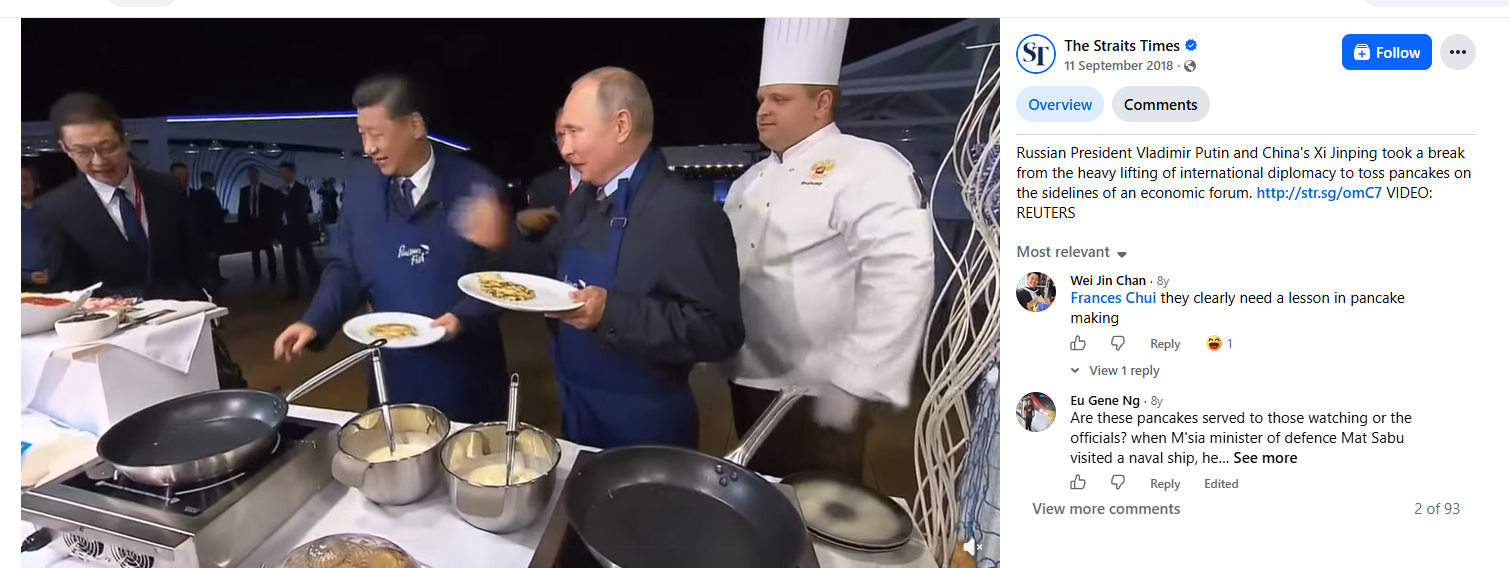
According to the report, Russian President Vladimir Putin and Chinese President Xi Jinping took a break from the hectic schedule of international diplomacy on Tuesday to make pancakes on the sidelines of an economic forum. Chinese President Xi Jinping was among the prominent leaders attending the event in Russia’s Far Eastern city of Vladivostok. The forum primarily focused on economic ties and issues related to North Korea.During the event, the two leaders made blini, a traditional Russian pancake, together at an exhibition called “Far East Street”, which showcased the region’s cultural and economic achievements. Photographs showed Putin and Xi Jinping wearing blue aprons as they poured pancake batter onto a griddle and flipped the pancakes. They later enjoyed the pancakes with caviar and vodka. As we continued our research, we found the same video on The Straits Times’ Facebook page, where it was published on September 11, 2018. According to the information provided with the video, Russian President Vladimir Putin and Chinese President Xi Jinping took a break from the hectic schedule of international diplomacy to make pancakes together on the sidelines of an economic forum. The link to the post and the screenshot are provided below.
https://www.facebook.com/watch/?v=1915270415222092
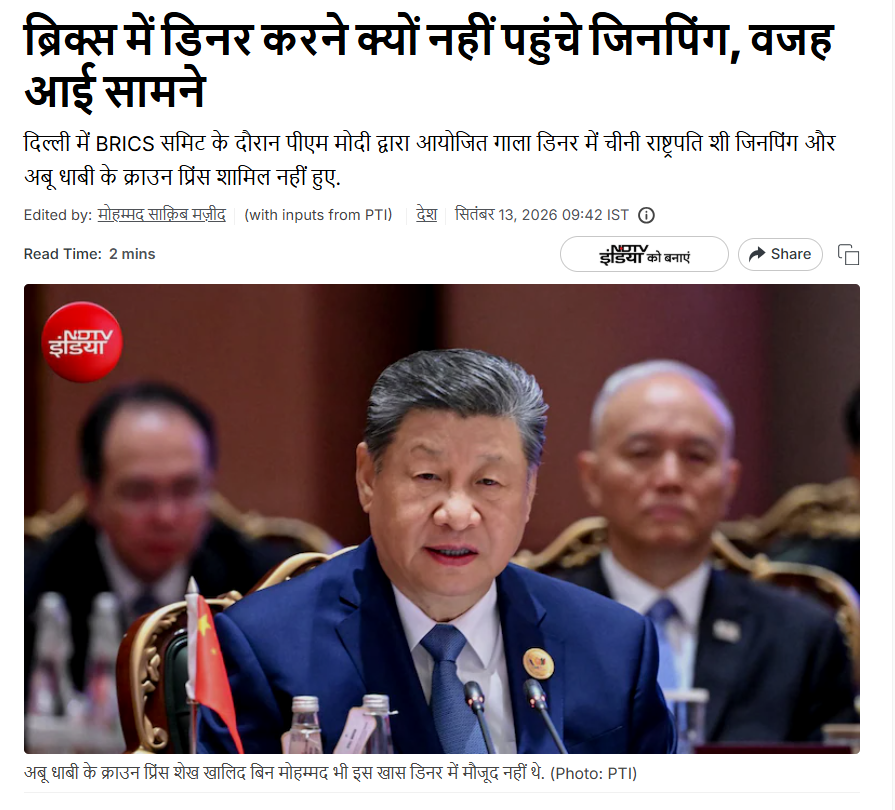
Meanwhile, for context, according to a report by a news agency, the BRICS Summit was underway in Delhi. Saturday was an important day of the summit, and Prime Minister Narendra Modi hosted a dinner for several heads of state, including Chinese President Xi Jinping. Several leaders, including Russian President Vladimir Putin, attended the special dinner. However, Chinese President Xi Jinping was not present. According to sources cited by the news agency, Xi Jinping did not attend the dinner.
https://ndtv.in/india/chinese-president-xi-jinping-skips-brics-gala-dinner-what-reason-12039666
Conclusion
Our research found that the video showing Russian President Vladimir Putin and Chinese President Xi Jinping making pancakes together is not recent and has no connection with the 2026 BRICS Summit held in Delhi. The claim circulating on social media is therefore false and misleading. Further research established that the video dates back to 2018, when Putin and Xi participated in the Eastern Economic Forum in Vladivostok, Russia. During the event, the two leaders were seen preparing traditional Russian pancakes, or blini, together at an exhibition showcasing the cultural and economic achievements of Russia’s Far East region. Therefore, the video is being shared with a false context by linking an old 2018 event to the recently held BRICS Summit.
