
#FactCheck - Viral Video of Burning Aircraft Falsely Linked to UAE, Found to Be AI-Generated
Executive Summary:
A video is being shared on social media showing an aircraft engulfed in massive flames on an airport runway. The video is being linked to the UAE. It is being claimed that a UAE airport was completely destroyed due to recent drone and missile attacks by Iran. Research by the CyberPeace found the viral claim to be false. Our research revealed that the viral video is not real, but AI-generated.
Claim:
On social media platform Facebook, a user shared the viral video on March 3, 2026, and wrote, “Amid the Iran-US-Israel conflict in the Middle East, operations at several major airports, including Dubai International Airport, have been temporarily suspended, causing thousands of flight cancellations and delays. Due to multiple missile and drone attacks from Iran, the United Arab Emirates (UAE) had shut its airspace, and limited structural damage at Dubai Airport was also confirmed, with reports of four staff members being injured. Later, considering the security situation, a limited number of flights were resumed, but full operations are still delayed due to ongoing safety concerns. This tension has significantly impacted regional aviation, travel, and global flight routes.”

Fact Check:
To verify the viral video, we searched relevant keywords on Google. However, we did not find any credible media report confirming the claim.However, we found a video report on the YouTube channel of CNN-News18 mentioning explosions near Dubai Airport after a suspected Iranian drone strike. But the visuals shown in that report are completely different from the viral video.

Upon closely examining the viral video, we noticed several inconsistencies, raising suspicion that it might be AI-generated. We then analyzed the video using the AI detection tool Sightengine. The results indicated that the video is 71 percent likely to be AI-generated.
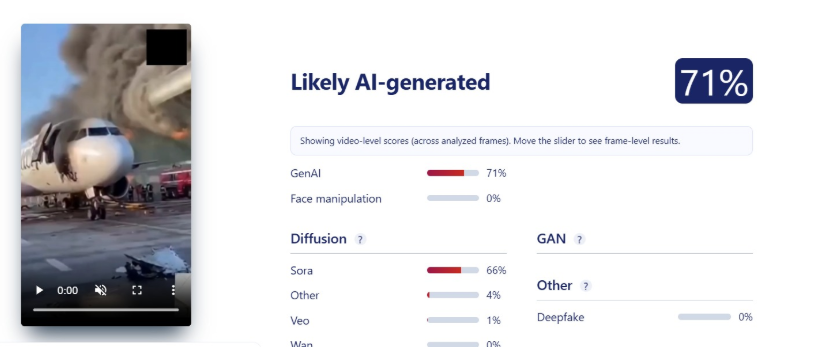
Conclusion:
Our research found that the viral video is not real, but AI-generated.

Related Blogs
.webp)
Smart Wearable devices are designed to track several activities in defined parameters and are increasingly becoming a part of everyday life. According to Markets and Markets Report, the global wearable tech market is projected to reach a staggering USD 256.4 billion by 2026. One of the main areas of use of wearable devices is health, including biomedical research, health care, personal health practices and tracking, technology development, and engineering. These wearable devices often include digital health technologies such as consumer smartwatches that monitor an individual's heart rate and step count, and other body-worn sensors like those that continuously monitor blood glucose concentration.
Wearable devices used by the general population are getting increasingly popular. Health devices like fitness trackers and smartwatches enable continuous monitoring of personal health. Privacy is an emerging concern due to the real-time collection of sensitive data. Vulnerabilities due to unauthorised access or discrimination in case of information being revealed without consent are the primary concerns with these devices. While these concerns are present a lot of related misinformation is emerging due to the same.
While wearable devices typically come with terms of use that outline how data is collected and used, and there are regulations in place such as EU Law GDPR, such regulations largely govern the regulatory compliances on the handling of personal data, however, the implementation and compliances by the manufacturer is a one another aspect which might present the question on privacy protection. In addition, beyond the challenge of regulatory compliance, the rise of myths and misinformation surrounding wearable tech presents a separate issue.
Common Misconceptions About Privacy with Wearable Tech
- With the rapid development and growth of wearable technology their use has been subject to countless rumours which fuel misinformation narratives in the minds of general public. Addressing these misconceptions and privacy concerns requires targeted strategies.
- A prevalent misconception is that they are constantly spying on users. While wearable devices collect users’ data in real time, their vulnerability to unauthorised access is similar to that of a non-wearable device. The issue is of consent when it comes to wearable technology because it gives the ability to record. If permissions are not asked when a person is being recorded then the data is accessible to external entities.
- There is a common myth that wearable tech is surveillance tool. This is entirely a conjecture. These devices collect the user data with their prior consent and have been created to provide them with real-time information, most commonly physical health information. Since users choose the information shared, the idea of wearable tech serving as a surveillance tool is unfounded.
- Another misconception about wearable tech is that it can diagnose medical conditions. These devices collect real-time health data, such as heart rate or activity levels, they are not designed for medical diagnosis. The data collected may not always be accurate or reliable for clinical use to be interpreted by a healthcare professional. This is mainly because the makers of these devices are not held to the safety and liability standards that medical providers are.
- A prevalent misconception is that wearable tech can cure health issues, which is simply untrue. Wearable tech devices are essentially tracking the health parameters that a user sets. It in no way is a cure for any health issue that one suffers from. A user can manage their health based on the parameters they set on the device such as the number of steps that they walk, check on the heart rate and other metrics for their mental satisfaction but they are not a cure to treat diseases. Wearable tech acts as alerts, notifying users of important health metrics and encouraging proactive health management.
Addressing Privacy and Health Concerns in Wearable Tech
Wearable technology raises concerns for privacy and health due to the colossal amount of personal data collected. To address these, strong data protection measures are essential, ensuring that sensitive health information is securely stored and shared only with consent. Providing users with control over their data is one of the ways to build user trust. It includes enabling them to opt in, access, or delete the data in question. Regulators should establish clear guidelines, ensuring wearables ensure the compliances with data protection regulations like HIPPA, GDPR or DPDP Act, whichever is applicable as per the jurisdiction. Furthermore, global standards for data encryption, device security, and user privacy should be implemented to mitigate risks. Transparency in data usage and consistent updates to software security are also crucial for protecting users' privacy and health while promoting the responsible use of wearable tech.
CyberPeace Insights
- Making informed decisions about wearable tech starts with thorough research. Start by reading reviews and comparing products to assess their features, compatibility, and security standards.
- Investigate the manufacturer’s reputation for data protection and device longevity. Understanding device capabilities is crucial. One should evaluate whether the wearable meets their needs, such as fitness tracking, health monitoring, or communication features. Consider software security and updates, and data accuracy when comparing options. Opt for devices that offer two-factor authentication for an additional layer of security.
- Check the permissions requested by the accompanying app; only grant access to data that is necessary for the device's functionality. Always read the terms of use to understand your rights and responsibilities regarding the use of the device. Review and customize data-sharing settings for better control to prevent unauthorised access.
- Staying updated on the tech is equally important. A user should follow the advancements in wearable technology be it regular security updates, or regulatory changes that may affect privacy and usability. This ensures getting tech that aligns with user lifestyle while meeting privacy and security expectations.
Conclusion
Privacy and Misinformation are key concerns that emerge due to the use of wearable tech designed to offer benefits such as health monitoring, fitness tracking, and personal convenience. It requires a combination of informed decision-making by users and stringent regulatory oversight to overcome the issues that emerge due to misinformation about these devices. Users must ensure they understand the capabilities and limitations of their devices, from data accuracy to privacy risks. Additionally, manufacturers and regulators need to prioritise transparency, data protection, and compliance with global standards like GDPR or DPDP to build trust. As wearable tech continues to evolve, a balanced approach to innovation and privacy will be essential in fostering its responsible and beneficial use for all.
References
- https://thehealthcaretechnologyreport.com/privacy-data-security-concerns-rise-as-healthcare-wearables-gain-popularity/
- https://journals.plos.org/digitalhealth/article?id=10.1371/journal.pdig.0000104
- https://www.marketsandmarkets.com/Market-Reports/wearable-electronics-market-983.html?gclid=Cj0KCQjwgMqSBhDCARIsAIIVN1V0sqrk6SpYSga3rcDtWcwh8npZ08L0_s4X91gh7yPAa6QmsctB-lMaAlpqEALw_wcB
- https://www.cambridge.org/core/journals/legal-information-management/article/health-data-on-the-go-navigating-privacy-concerns-with-wearable-technologies/05DAF11EFA807051362BB39260C4814C

Introduction
Considering the development of technology, Voice cloning schemes are one such issue that has recently come to light. Scammers are moving forward with AI, and their methods and plans for deceiving and scamming people have also altered. Deepfake technology creates realistic imitations of a person’s voice that can be used to conduct fraud, dupe a person into giving up crucial information, or even impersonate a person for illegal purposes. We will look at the dangers and risks associated with AI voice cloning frauds, how scammers operate and how one might protect themselves from one.
What is Deepfake?
Artificial intelligence (AI), known as “deepfake,” can produce fake or altered audio, video, and film that pass for the real thing. The words “deep learning” and “fake” are combined to get the name “deep fake”. Deepfake technology creates content with a realistic appearance or sound by analysing and synthesising diverse volumes of data using machine learning algorithms. Con artists employ technology to portray someone doing something that has never been in audio or visual form. The best example is the American President, who used deep voice impersonation technology. Deep voice impersonation technology can be used maliciously, such as in deep voice fraud or disseminating false information. As a result, there is growing concerned about the potential influence of deep fake technology on society and the need for effective tools to detect and mitigate the hazards it may provide.
What exactly are deepfake voice scams?
Artificial intelligence (AI) is sometimes utilised in deepfake speech frauds to create synthetic audio recordings that seem like real people. Con artists can impersonate someone else over the phone and pressure their victims into providing personal information or paying money by using contemporary technology. A con artist may pose as a bank employee, a government official, or a friend or relative by utilising a deep false voice. It aims to earn the victim’s trust and raise the likelihood that they will fall for the hoax by conveying a false sense of familiarity and urgency. Deep fake speech frauds are increasing in frequency as deep fake technology becomes more widely available, more sophisticated, and harder to detect. In order to avoid becoming a victim of such fraud, it is necessary to be aware of the risks and take appropriate measures.
Why do cybercriminals use AI voice deep fake?
In order to mislead users into providing private information, money, or system access, cybercriminals utilise artificial intelligence (AI) speech-deep spoofing technology to claim to be people or entities. Using AI voice-deep fake technology, cybercriminals can create audio recordings that mimic real people or entities, such as CEOs, government officials, or bank employees, and use them to trick victims into taking activities that are advantageous to the criminals. This can involve asking victims for money, disclosing login credentials, or revealing sensitive information. In phishing assaults, where fraudsters create audio recordings that impersonate genuine messages from organisations or people that victims trust, deepfake AI voice technology can also be employed. These audio recordings can trick people into downloading malware, clicking on dangerous links, or giving out personal information. Additionally, false audio evidence can be produced using AI voice-deep fake technology to support false claims or accusations. This is particularly risky regarding legal processes because falsified audio evidence may lead to wrongful convictions or acquittals. Artificial intelligence voice deep fake technology gives con artists a potent tool for tricking and controlling victims. Every organisation and the general population must be informed of this technology’s risk and adopt the appropriate safety measures.
How to spot voice deepfake and avoid them?
Deep fake technology has made it simpler for con artists to edit audio recordings and create phoney voices that exactly mimic real people. As a result, a brand-new scam called the “deep fake voice scam” has surfaced. In order to trick the victim into handing over money or private information, the con artist assumes another person’s identity and uses a fake voice. What are some ways to protect oneself from deepfake voice scams? Here are some guidelines to help you spot them and keep away from them:
- Steer clear of telemarketing calls
- One of the most common tactics used by deep fake voice con artists, who pretend to be bank personnel or government officials, is making unsolicited phone calls.
- Listen closely to the voice
- Anyone who phones you pretending to be someone else should pay special attention to their voice. Are there any peculiar pauses or inflexions in their speech? Something that doesn’t seem right can be a deep voice fraud.
- Verify the caller’s identity
- It’s crucial to verify the caller’s identity in order to avoid falling for a deep false voice scam. You might ask for their name, job title, and employer when in doubt. You can then do some research to be sure they are who they say they are.
- Never divulge confidential information
- No matter who calls, never give out personal information like your Aadhar, bank account information, or passwords over the phone. Any legitimate companies or organisations will never request personal or financial information over the phone; if they do, it’s a warning sign that they’re a scammer.
- Report any suspicious activities
- Inform the appropriate authorities if you think you’ve fallen victim to a deep voice fraud. This may include your bank, credit card company, local police station, or the nearest cyber cell. By reporting the fraud, you could prevent others from being a victim.
Conclusion
In conclusion, the field of AI voice deep fake technology is fast expanding and has huge potential for beneficial and detrimental effects. While deep fake voice technology has the potential to be used for good, such as improving speech recognition systems or making voice assistants sound more realistic, it may also be used for evil, such as deep fake voice frauds and impersonation to fabricate stories. Users must be aware of the hazard and take the necessary precautions to protect themselves as AI voice deep fake technology develops, making it harder to detect and prevent deep fake schemes. Additionally, it is necessary to conduct ongoing research and develop efficient techniques to identify and control the risks related to this technology. We must deploy AI appropriately and ethically to ensure that AI voice-deep fake technology benefits society rather than harming or deceiving it.
Reference

Introduction
The United Nations General Assembly (UNGA) has unanimously adopted the first global resolution on Artificial Intelligence (AI), encouraging countries to take into consideration human rights, keeping personal data safe, and further monitoring the threats associated with AI. This non-binding resolution proposed by the United States and co-sponsored by China and over 120 other nations advocates the strengthening of privacy policies. This step is crucial for governments across the world to shape how AI grows because of the dangers it carries that could undermine the protection, promotion, and right to human dignity and fundamental freedoms. The resolution emphasizes the importance of respecting human rights and fundamental freedoms throughout the life cycle of AI systems, highlighting the benefits of digital transformation and safe AI systems.
Key highlights
● This is indeed a landmark move by the UNGA, which adopted the first global resolution on AI. This resolution encourages member countries to safeguard human rights, protect personal data, and monitor AI for risks.
● Global leaders have shown their consensus for safe, secure, trustworthy AI systems that advance sustainable development and respect fundamental freedom.
● Resolution is the latest in a series of initiatives by governments around the world to shape AI. Therefore, AI will have to be created and deployed through the lens of humanity and dignity, Safety and Security, human rights and fundamental freedoms throughout the life cycle of AI systems.
● UN resolution encourages global cooperation, warns against improper AI use, and emphasizes the issues of human rights.
● The resolution aims to protect from potential harm and ensure that everyone can enjoy its benefits. The United States has worked with over 120 countries at the United Nations, including Russia, China, and Cuba, to negotiate the text of the resolution adopted.
Brief Analysis
AI has become increasingly prevalent in recent years, with chatbots such as the Chat GPT taking the world by storm. AI has been steadily attempting to replicate human-like thinking and solve problems. Furthermore, machine learning, a key aspect of AI, involves learning from experience and identifying patterns to solve problems autonomously. The contemporary emergence of AI has, however, raised questions about its ethical implications, potential negative impact on society, and whether it is too late to control it.
While AI is capable of solving problems quickly and performing various tasks with ease, it also has its own set of problems. As AI continues to grow, global leaders have called for regulations to prevent significant harm due to the unregulated AI landscape to the world and encourage the use of trustworthy AI. The European Union (EU) has come up with an AI act called the “European AI Act”. Recently, a Senate bill called “The AI Consent Bill” was introduced in the US. Similarly, India is also proactively working towards setting the stage for a more regulated Al landscape by fostering dialogues and taking significant measures. Recently, the Ministry of Electronics and Information Technology (MeitY) issued an advisory on AI, which requires explicit permission to deploy under-testing or unreliable AI models related to India's Internet. The following advisory also indicates measures advocating to combat deepfakes or misinformation.
AI has thus become a powerful tool that has raised concerns about its ethical implications and the potential negative influence on society. Governments worldwide are taking action to regulate AI and ensure that it remains safe and effective. Now, the groundbreaking move of the UNGA, which adopted the global resolution on AI, with the support of all 193 U.N. member nations, shows the true potential of efforts by countries to regulate AI and promote safe and responsible use globally.
New AI tools have emerged in the public sphere, which may threaten humanity in an unexpected direction. AI is able to learn by itself through machine learning to improve itself, and developers often are surprised by the emergent abilities and qualities of these tools. The ability to manipulate and generate language, whether with words, images, or sounds, is the most important aspect of the current phase of the ongoing AI Revolution. In the future, AI can have several implications. Hence, it is high time to regulate AI and promote the safe, secure and responsible use of it.
Conclusion
The UNGA has approved its global resolution on AI, marking significant progress towards creating global standards for the responsible development and employment of AI. The resolution underscores the critical need to protect human rights, safeguard personal data, and closely monitor AI technologies for potential hazards. It calls for more robust privacy regulations and recognises the dangers associated with improper AI systems. This profound resolution reflects a unified stance among UN member countries on overseeing AI to prevent possible negative effects and promote safe, secure and trustworthy AI.
References
