
#FactCheck - Out-of-Context Clip of PM Modi Misused to Claim He Insulted India
Executive Summary:
A short video clip of Prime Minister Narendra Modi is going viral on social media. In the clip, he can be heard saying, “What sins did we commit in our previous life that we were born in India?” Users are sharing this video claiming that the Prime Minister insulted India and its people during a foreign visit. However, an research by the CyberPeace found that the claim is misleading. The viral clip is taken out of context from a longer speech delivered by Modi during his visit to Shanghai, China, in 2015
Claim:
A Facebook user named “Bittu Yadav” shared the reel, portraying the statement as anti-India. The caption reads:“Look at this, and you supporters—see how your ‘leader’ is praising the country.”
Post link and archive link:

Fact Check:
To verify the claim, we searched relevant keywords on Google and found the full video uploaded on May 16, 2015, on the official YouTube channel of the Bharatiya Janata Party. The video shows Prime Minister Narendra Modi addressing the Indian community in Shanghai, China.
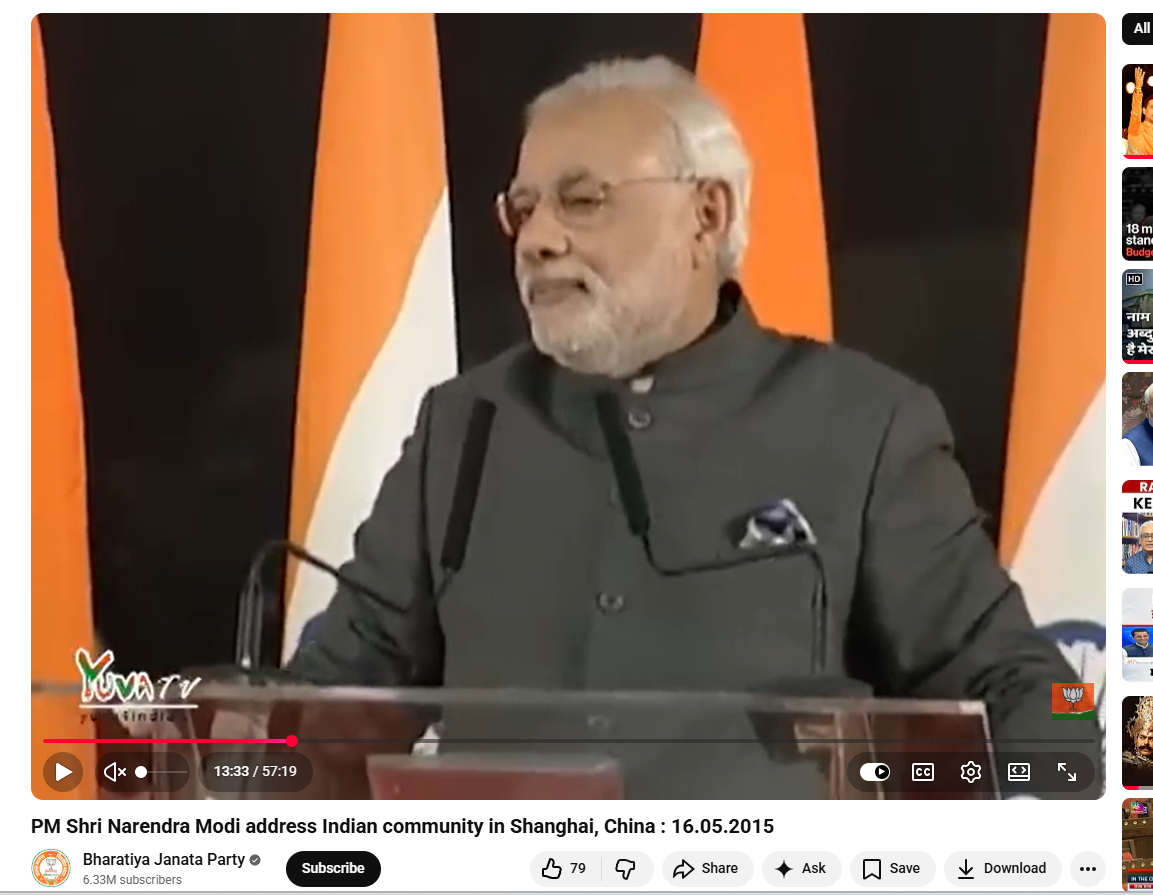
In the 57-minute speech, at around 51 minutes 25 seconds, Modi was referring to the pessimistic atmosphere in India before 2014. He said: “Within a year… people used to say, ‘Leave it, nothing will happen now. Who knows what sins we committed in our previous life that we were born in India’… From that mindset, today the world says that if there is a country growing at the fastest pace, it is India.”
This clearly shows that Modi was citing a past sentiment to highlight how perceptions about India have changed over time, not expressing his personal view. Media reports from his May 2015 China visit also noted that he addressed around 5,000 members of the Indian community in Shanghai, where he spoke about India’s economic growth and initiatives like “Make in India.”

Conclusion:
The viral claim is false. The video has been edited and shared out of context. In reality, Prime Minister Narendra Modi was referring to a past mindset before 2014 while highlighting the change in India’s global perception.

Related Blogs

Executive Summary
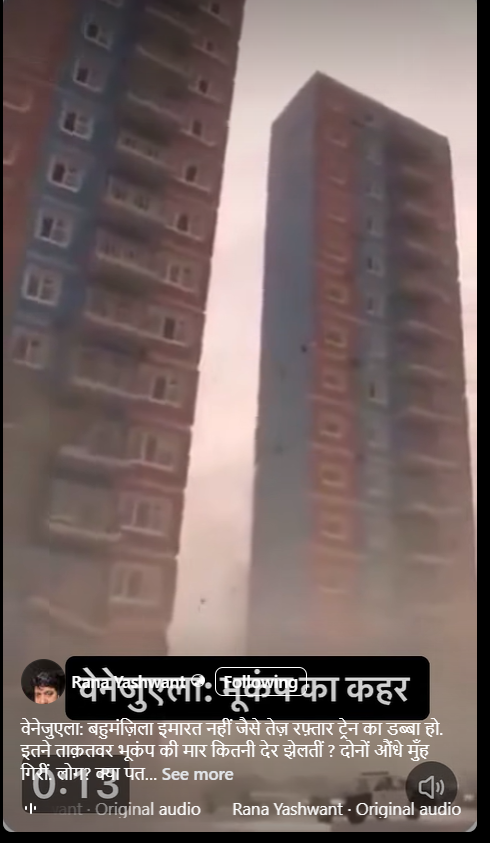
Two powerful earthquakes measuring 7.2 and 7.5 in magnitude struck Venezuela on June 24, 2026, within a span of one minute, causing widespread destruction. Hundreds of buildings were reportedly reduced to rubble. Against this backdrop, a video is being widely shared on social media showing two high-rise buildings colliding with each other before collapsing. Several users have claimed that the footage shows the aftermath of the recent earthquake in Venezuela. CyberPeace Research Wing team conducted a detailed research and found that the viral video is not authentic. The footage was generated using artificial intelligence and is being falsely shared as real visuals from the Venezuela earthquake.
Claim
A Facebook user, “Rana Yashwant,” shared the video on June 26, 2026, with the caption: "Venezuela: The high-rise buildings fell as if they were fast-moving train coaches. How long could they withstand such a powerful earthquake? Both collapsed face-first. What happened to the people? Who knows." https://www.facebook.com/reel/1036186612182534 ,https://perma.cc/98PE-DFKB
Fact Check
We first extracted several keyframes from the viral video and conducted reverse image searches using Google Lens. However, we found no credible news reports or evidence linking the footage to the recent earthquakes in Venezuela. A closer examination of the video revealed several anomalies. Despite the intense shaking and collision of the buildings, the windows and structural features remained unchanged throughout the footage. No visible deformation or damage appeared in the buildings before they collapsed, which is highly unrealistic and raised suspicions that the video had been generated using AI. To verify this, we analyzed the video using the AI detection tool detectvideo.ai. The results indicated a 73 percent probability that the footage was AI-generated.

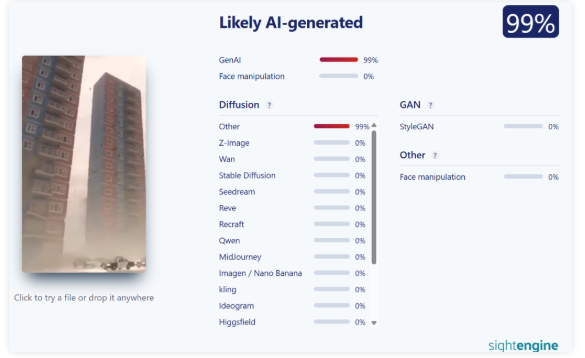
Similarly, analysis conducted using Sightengine found a 99 percent probability that the video had been created using artificial intelligence.
Conclusion
Our research found the viral claim to be false. The video showing two buildings colliding and collapsing is not related to the recent earthquakes in Venezuela. The footage was generated using artificial intelligence and is being misleadingly shared as real disaster footage.

Executive Summary
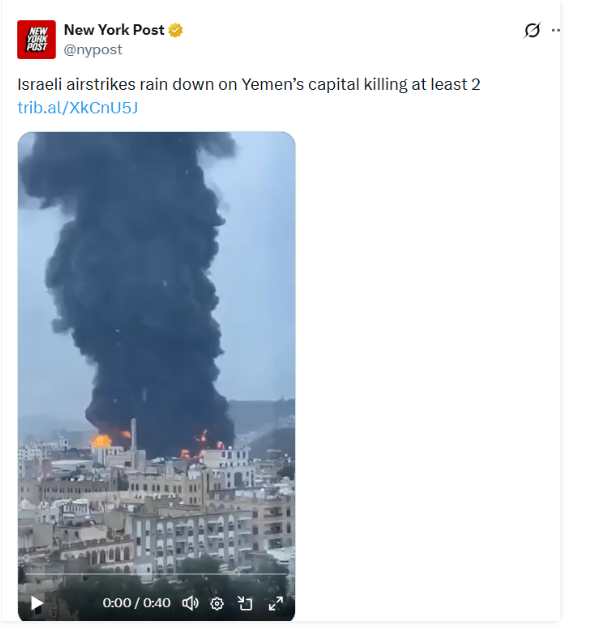
Amid the ongoing tensions in West Asia between the United States–Israel alliance and Iran since February 28, 2026, a video is rapidly going viral on social media. The clip shows buildings engulfed in flames and thick plumes of smoke following an attack. Several users are sharing it with the claim that it depicts Iran’s recent strike on Tel Aviv, Israel. However, an research by the CyberPeace found the claim to be misleading. The viral video is actually from August 2025, when Israel carried out airstrikes in Sanaa, the capital of Yemen. It has no connection to the current conflict.
Claim:
An Instagram user ‘iran_.news24’ posted the video on March 27, 2026, with the caption: “Iran has turned Israel’s largest city Tel Aviv into hell—fears that 200,000 people have died in the war so far.”
Fact Check
To verify the viral claim, keyframes of the video were extracted and searched using Google Lens. The same video was found posted on August 24, 2025, by a Facebook user ‘Mhmdmhywbalshrby5’. The accompanying text, when translated, stated that it showed Israeli bombardment of Sanaa, Yemen.

Similarly, another Instagram user ‘ae5ce’ had also shared the same video on August 24, 2025, identifying it as footage from Sanaa.

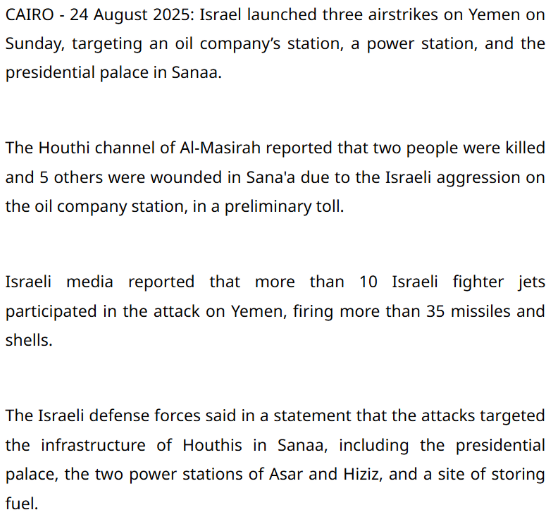
Media reports further support this finding. According to a report published by Egypt Today on August 24, 2025, Israel carried out multiple airstrikes in Sanaa targeting key locations, including an oil station, a power facility, and the presidential palace. Casualties were also reported. The strikes were said to be in response to attacks by Houthi forces.
Additionally, the New York Post shared another video of the same incident from a different angle on its X (formerly Twitter) handle on August 25, 2025.
Conclusion
The video being circulated with the claim of Iran attacking Tel Aviv is actually old footage from Israeli airstrikes in Yemen in August 2025. It is unrelated to the ongoing conflict.

Introduction
Over the past few months, cybercriminals have upped the ante with highly complex methods targeting innocent users. One such scam is a new one that exploits WhatsApp users in India and globally. A seemingly harmless picture message is the entry point to stealing money and data. Downloading seemingly harmless images via WhatsApp can unknowingly install malware on your smartphone. This malicious software can compromise your banking applications, steal passwords, and expose your personal identity. With such malware-laced instant messages now making headlines, it is advised for netizens to exercise extreme caution while handling media received on messaging platforms.
How Does the WhatsApp Photo Scam Work?
Cybercriminals began embedding malicious code in images being shared on WhatsApp. Here is how the attack typically works:
- The user receives a WhatsApp message from an unknown number with an image.
- The image may appear harmless—a greeting, meme, or holiday card—but it's packed with hidden malware.
- When the user taps to download the image, the malware gets installed on the phone in silent mode.
- Once installed, the malware is able to capture keystrokes, read messages, swipe banking applications, swipe credentials, and even hijack device functionality.
- Allegedly, in its advanced versions, it can exploit two-factor authentication (2FA) and make unauthorised transactions.
Who Is Being Targeted?
This scam targets both Android and iPhone users, with a focus on vulnerable groups like senior citizens, busy workers during peak seasons, and members of WhatsApp groups flooded with forwarded messages. Experts warn that a single careless click is enough to compromise an entire device.
What Can the Malware Do?
Upon installation, the malware grants hackers a terrifying level of access:
- Track user activity via keylogging or screen capture.
- Pilfer banking credentials and initiate fund transfers automatically.
- Obtain SMS or app-based 2FA codes, evading security layers.
- Clone identity information, such as Aadhaar details, digital wallets, and email access.
- Control device operations, including the camera and microphone.
This level of intrusion can result in not just financial loss but long-term digital impersonation or blackmail.
Safety Measures for WhatsApp Users
- Never Download Media from Suspicious Numbers
Do not download any files or pictures, even if the content appears to be familiar, unless you have faith in the source. Spread this advice among family members, particularly the older generation.
- Turn off Auto-Download in WhatsApp Settings
Navigate to Settings > Storage and Data > Media Auto-Download. Switch off auto-download for mobile data, Wi-Fi, and roaming.
- Install and Update Mobile Security Apps
Ensure your phone is equipped with a good antivirus or mobile security app that is updated from time to time.
- Block and Report Potential Scammers
WhatsApp offers the ability to block and report senders in a straightforward manner. This ensures that it notifies the platform and others as well.
- Educate Your Community
Share your knowledge on cyber hygiene with family, friends, and colleagues. Many people fall victim simply because they aren't aware of the risks, staying informed and spreading the word can make a big difference.
Advisories and Response
The Indian Cybercrime Coordination Centre (I4C) and other state cyber cells have released several alerts on increasing fraud via messaging platforms. Law enforcement agencies are appealing to the public not only to be vigilant but also to report any incident at once through the National Cybercrime Reporting Portal (cybercrime.gov.in).
Conclusion
The WhatsApp photo scam is a stark reminder that not all dangers come with a warning. A picture can now be a Trojan horse, propagating silently from device to device and draining personal money. Do not engage with unwanted media, refresh and update your privacy and security settings. Cyber criminals survive on neglect and ignorance, but through digital hygiene and vigilance, we can fight against these types of emerging threats.
References
- https://www.opswat.com/blog/how-emerging-image-based-malware-attacks-threaten-enterprise-defenses
- https://www.indiatvnews.com/technology/news/whatsapp-photo-scam-alert-downloading-random-images-could-cost-you-big-2025-05-06-988855
- https://www.hindustantimes.com/india-news/what-is-the-whatsapp-image-scam-and-how-can-you-stay-safe-from-it-101744353412848.html
- https://faq.whatsapp.com/898107234497196/?helpref=uf_share
- https://www.welivesecurity.com/en/malware/malware-hiding-in-pictures-more-likely-than-you-think/
- https://faq.whatsapp.com/573786218075805
- https://www.reversinglabs.com/blog/malware-in-images
