
#FactCheck - Misleading Claims Spread With Old Ram Idol Vandalism Video
Executive Summary
A video circulating on social media has sparked controversy, showing a man allegedly vandalising an idol of Lord Ram. Users sharing the clip claim that the incident recently took place in Ayodhya, Uttar Pradesh. The posts further allege that a Muslim individual climbed the idol and attempted to damage it. However, research by the CyberPeace found the viral claim to be misleading. The research revealed that the video is not recent but nearly three years old. At the time of the incident, the police had already arrested the accused. Social media users are now resharing the old video with false claims that it is a recent event.
Claim:
On February 14, 2026, a Facebook user shared the viral video claiming that the incident occurred in Ayodhya, where a large religious gathering was underway. The post alleged that a man identified as Mohammad Mukhtar Mandal climbed the idol of Lord Ram and attempted to break it. The post was widely circulated with inflammatory remarks. (Link and archived version of the post were provided along with a screenshot.)

Fact Check
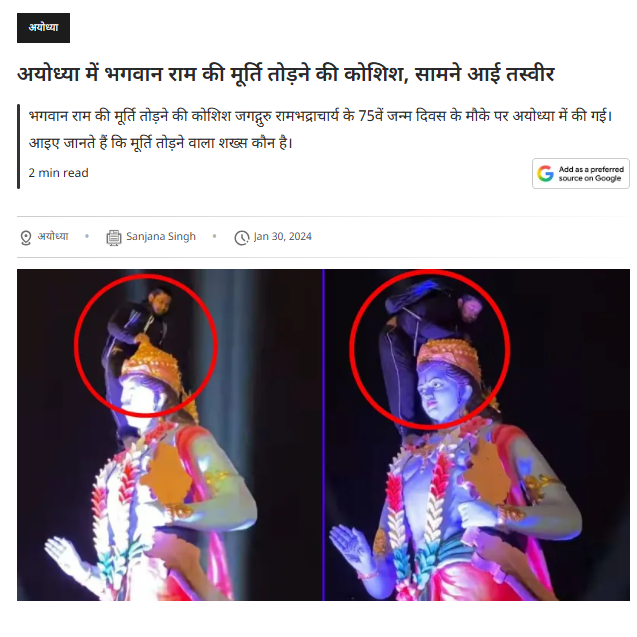
To verify the authenticity of the claim, we extracted key frames from the viral video and conducted a reverse image search using Google Lens. During the search, we found a report published on January 30, 2024, on the Hindi website of Patrika, which carried visuals matching the viral footage. According to the report, a video had surfaced showing a man climbing an idol of Lord Ram in Ayodhya and attempting to damage it. The video had gone viral at the time, following which police registered a case against the accused, Mukhtar Ali Mandal, and arrested him.
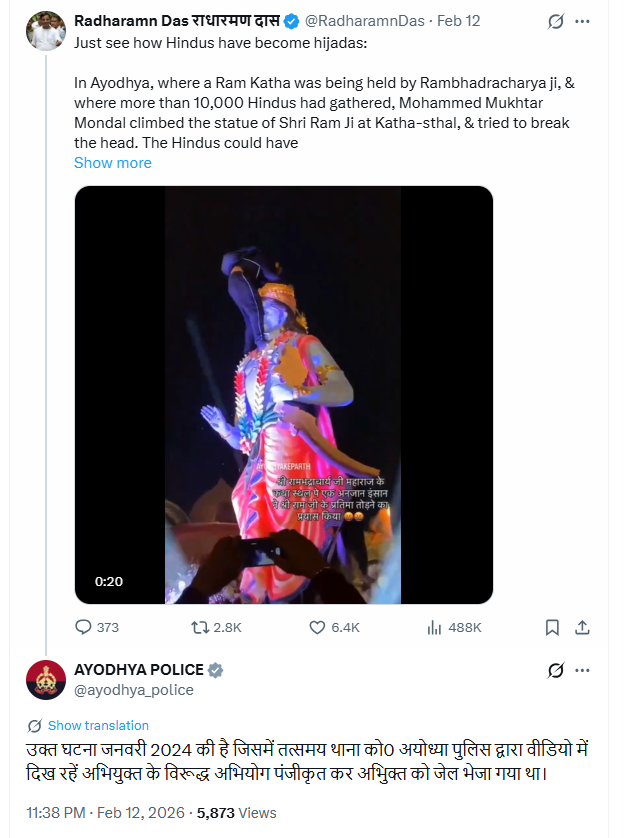
Further research led us to another Facebook post featuring the same video. In the comment section of that post, Uttar Pradesh Police clarified that the incident dated back to January 2024. The Ayodhya police had registered a case against the accused shown in the video and sent him to jail.
Conclusion:
The research confirms that the viral video is not recent but an old incident from January 2024. The accused was arrested at the time. The video is being reshared with misleading claims falsely presenting it as a recent event.

Related Blogs

Introduction
The United Nations General Assembly (UNGA) has unanimously adopted the first global resolution on Artificial Intelligence (AI), encouraging countries to take into consideration human rights, keeping personal data safe, and further monitoring the threats associated with AI. This non-binding resolution proposed by the United States and co-sponsored by China and over 120 other nations advocates the strengthening of privacy policies. This step is crucial for governments across the world to shape how AI grows because of the dangers it carries that could undermine the protection, promotion, and right to human dignity and fundamental freedoms. The resolution emphasizes the importance of respecting human rights and fundamental freedoms throughout the life cycle of AI systems, highlighting the benefits of digital transformation and safe AI systems.
Key highlights
● This is indeed a landmark move by the UNGA, which adopted the first global resolution on AI. This resolution encourages member countries to safeguard human rights, protect personal data, and monitor AI for risks.
● Global leaders have shown their consensus for safe, secure, trustworthy AI systems that advance sustainable development and respect fundamental freedom.
● Resolution is the latest in a series of initiatives by governments around the world to shape AI. Therefore, AI will have to be created and deployed through the lens of humanity and dignity, Safety and Security, human rights and fundamental freedoms throughout the life cycle of AI systems.
● UN resolution encourages global cooperation, warns against improper AI use, and emphasizes the issues of human rights.
● The resolution aims to protect from potential harm and ensure that everyone can enjoy its benefits. The United States has worked with over 120 countries at the United Nations, including Russia, China, and Cuba, to negotiate the text of the resolution adopted.
Brief Analysis
AI has become increasingly prevalent in recent years, with chatbots such as the Chat GPT taking the world by storm. AI has been steadily attempting to replicate human-like thinking and solve problems. Furthermore, machine learning, a key aspect of AI, involves learning from experience and identifying patterns to solve problems autonomously. The contemporary emergence of AI has, however, raised questions about its ethical implications, potential negative impact on society, and whether it is too late to control it.
While AI is capable of solving problems quickly and performing various tasks with ease, it also has its own set of problems. As AI continues to grow, global leaders have called for regulations to prevent significant harm due to the unregulated AI landscape to the world and encourage the use of trustworthy AI. The European Union (EU) has come up with an AI act called the “European AI Act”. Recently, a Senate bill called “The AI Consent Bill” was introduced in the US. Similarly, India is also proactively working towards setting the stage for a more regulated Al landscape by fostering dialogues and taking significant measures. Recently, the Ministry of Electronics and Information Technology (MeitY) issued an advisory on AI, which requires explicit permission to deploy under-testing or unreliable AI models related to India's Internet. The following advisory also indicates measures advocating to combat deepfakes or misinformation.
AI has thus become a powerful tool that has raised concerns about its ethical implications and the potential negative influence on society. Governments worldwide are taking action to regulate AI and ensure that it remains safe and effective. Now, the groundbreaking move of the UNGA, which adopted the global resolution on AI, with the support of all 193 U.N. member nations, shows the true potential of efforts by countries to regulate AI and promote safe and responsible use globally.
New AI tools have emerged in the public sphere, which may threaten humanity in an unexpected direction. AI is able to learn by itself through machine learning to improve itself, and developers often are surprised by the emergent abilities and qualities of these tools. The ability to manipulate and generate language, whether with words, images, or sounds, is the most important aspect of the current phase of the ongoing AI Revolution. In the future, AI can have several implications. Hence, it is high time to regulate AI and promote the safe, secure and responsible use of it.
Conclusion
The UNGA has approved its global resolution on AI, marking significant progress towards creating global standards for the responsible development and employment of AI. The resolution underscores the critical need to protect human rights, safeguard personal data, and closely monitor AI technologies for potential hazards. It calls for more robust privacy regulations and recognises the dangers associated with improper AI systems. This profound resolution reflects a unified stance among UN member countries on overseeing AI to prevent possible negative effects and promote safe, secure and trustworthy AI.
References
%20(1).webp)
Introduction
Bumble’s launch of its ‘Opening Move’ feature has sparked a new narrative on safety and privacy within the digital dating sphere and has garnered mixed reactions from users. It was launched against the backdrop of women stating that the ‘message first’ policy of Bumble was proving to be tedious. Addressing the large-scale review, Bumble launched its ‘Opening Move’ feature, whereby users can either craft or select from pre-set questions which potential matches may choose to answer to start the conversation at first glance. These questions are a segue into meaningful and insightful conversation from the get-go and overstep the traditional effort to start engaging chats between matched users. This feature is an optional feature that users may enable and as such does not prevent a user from exercising the autonomy previously in place.
Innovative Approach to Conversation Starters
Many users consider this feature as innovative; not only does it act as a catalyst for fluid conversation but also cultivates insightful dialogue, fostering meaningful interactions that are devoid of the constraint of superficial small talk. The ‘Opening Moves’ feature may also be aligned with unique scientific research indicating that individuals form their initial attractions within 3-seconds of intimate interaction, thereby proving to be a catalyst to the decision-making process of an individual in the attraction time frame.
Organizational Benefits and Data Insights
From an organisational standpoint, the feature is a unique solution towards localisation challenges faced by apps; the option of writing a personalised ‘Opening Move’ implies setting prompts that are culturally relevant and appropriate in a specific area. Moreover, it is anticipated that Bumble may enhance and improve user experience within the platform through data analysis. Data from responses to an ‘Opening Move’ may provide valuable insights into user preferences and patterns by analysing which pre-set prompts garner more responses over others and how often is a user-written ‘Opening Move’ successful in obtaining a response in comparison with Bumble’s pre-set prompts. A quick glance at Bumble’s privacy policy[1] shows that data storing and transferring of chats between users are not shared with third parties, further safeguarding personal privacy. However, Bumble does use the chat data for its own internal purposes after removing personally identifiable information from chats. The manner of such review and removal of data has not been specified, which may raise challenges depending upon whether the reviewer is a human or an algorithm.
However, some users perceive the feature as counterproductive to the company’s principle of ‘women make the first move’. While Bumble aims to market the feature as a neutral ground for matched users based on the exercise of choice, users see it as a step back into the heteronormative gender expectations that most dating apps conform to, putting the onus of the ‘first move’ on men. Many male users have complained that the feature acts as a catalyst for men to opt out of the dating app and would most likely refrain from interacting with profiles enabled with the ‘Opening Move’ feature, since the pressure to answer in a creative manner is disproportionate with the likelihood their response actually being entertained.[2] Coupled with the female users terming the original protocol as ‘too much effort’, the preset questions of the ‘Opening Move’ feature may actively invite users to categorise potential matches according to arbitrary questions that undermine real-life experiences, perspectives and backgrounds of each individual.[3]
Additionally, complications are likely to arise when a notorious user sets a question that indirectly gleans personal or sensitive, identifiable information. The individual responding may be bullied or be subjected to hateful slurs when they respond to such carefully crafted conversation prompts.
Safety and Privacy Concerns
On the corollary, the appearance of choice may translate into more challenges for women on the platform. The feature may spark an increase in the number of unsolicited, undesirable messages and images from a potential match. The most vulnerable groups at present remain individuals who identify as females and other sexual minorities.[4] At present, there appears to be no mechanism in place to proactively monitor the content of responses, relying instead on user reporting. This approach may prove to be impractical given the potential volume of objectionable messages, necessitating a more efficient solution to address this issue. It is to be noted that in spite of a user reporting, the current redressal systems of online platforms remain lax, largely inadequate and demonstrate ineffectiveness in addressing user concerns or grievances. This lack of proactiveness is violative of the right to redressal provided under the Digital Personal Data Protection Act, 2023. It is thought that the feature may actually take away user autonomy that Bumble originally aimed to grant since Individuals who identify as introverted, shy, soft-spoken, or non-assertive may refrain from reporting harassing messages altogether, potentially due to discomfort or reluctance to engage in confrontation. Resultantly, it is anticipated that there would be a sharp uptake in cases pertaining to cyberbullying, harassment and hate speech (especially vulgar communications) towards both the user and the potential match.
From an Indian legal perspective, dating apps have to adhere to the Information Technology Act, 2000 [5], the Information Technology (Intermediary and Digital Media Ethics) Rules 2021 [6] and the Digital Personal Data Protection Act, 2023, that regulates a person’s digital privacy and set standards on the kind of content an intermediary may host. An obligation is cast upon an intermediary to uprise its users on what content is not allowed on its platform in addition to mandating intimation of the user’s digital rights. The lack of automated checks, as mentioned above, is likely to make Bumble non-compliant with the ethical guidelines.
The optional nature of the ‘Opening Move’ grants users some autonomy. However, some technical updates may enhance the user experience of this feature. Technologies like AI are an effective aid in behavioural and predictive analysis. An upgraded ‘matching’ algorithm can analyse the number of un-matches a profile receives, thereby identifying and flagging a profile having multiple lapsed matches. Additionally, the design interface of the application bearing a filter option to filter out flagged profiles would enable a user to be cautious while navigating through the matches. Another possible method of weeding out notorious profiles is by deploying a peer-review system of profiles whereby a user has a singular check-box that enables them to flag a profile. Such a checkbox would ideally be devoid of any option for writing personal comments and would bear a check box stating whether the profile is most or least likely to bully/harass. This would ensure that a binary, precise response is recorded and any coloured remarks are avoided. [7]
Governance and Monitoring Mechanisms
From a governance point of view, a monitoring mechanism on the manner of crafting questions is critical. Systems should be designed to detect certain words/sentences and a specific manner of framing sentences to disallow questions contrary to the national legal framework. An onscreen notification having instructions on generally acceptable manner of conversations as a reminder to users to maintain cyber hygiene while conversing is also proposed as a mandated requirement for platforms. The notification/notice may also include guidelines on what information is safe to share in order to safeguard user privacy. Lastly, a revised privacy policy should establish the legal basis for processing responses to ‘Opening Moves’, thereby bringing it in compliance with national legislations such as the Digital Personal Data Protection Act, 2023.
Conclusion
Bumble's 'Opening Move' feature marks the company’s ‘statement’ step to address user concerns regarding initiating conversations on the platform. While it has been praised for fostering more meaningful interactions, it also raises not only ethical concerns but also concerns over user safety. While the 'Opening Move' feature can potentially enhance user experience, its success is largely dependent on Bumble's ability to effectively navigate the complex issues associated with this feature. A more robust monitoring mechanism that utilises newer technology is critical to address user concerns and to ensure compliance with national laws on data privacy.
Endnotes:
- [1] Bumble’s privacy policy https://bumble.com/en-us/privacy
- [2] Discussion thread, r/bumble, Reddit https://www.reddit.com/r/Bumble/comments/1cgrs0d/women_on_bumble_no_longer_have_to_make_the_first/?share_id=idm6DK7e0lgkD7ZQ2TiTq&utm_content=2&utm_medium=ios_app&utm_name=ioscss&utm_source=share&utm_term=1&rdt=65068
- [3] Mcrea-Hedley, Olivia, “Love on the Apps: When did Dating Become so Political?”, 8 February 2024 https://www.service95.com/the-politics-of-dating-apps/
- [4] Gewirtz-Meydan, A., Volman-Pampanel, D., Opuda, E., & Tarshish, N. (2024). ‘Dating Apps: A New Emerging Platform for Sexual Harassment? A Scoping Review. Trauma, Violence, & Abuse, 25(1), 752-763. https://doi.org/10.1177/15248380231162969
- [5] Information Technology Act, 2000 https://www.indiacode.nic.in/bitstream/123456789/13116/1/it_act_2000_updated.pdf
- [6] Information Technology (Intermediary Guidelines and Digital Media Ethics) Rules 2021 https://www.meity.gov.in/writereaddata/files/Information%20Technology%20%28Intermediary%20Guidelines%20and%20Digital%20Media%20Ethics%20Code%29%20Rules%2C%202021%20%28updated%2006.04.2023%29-.pdf
- [7] Date Confidently: Engaging Features in a Dating App (Use Cases), Consaguous, 10 July 2023 https://www.consagous.co/blog/date-confidently-engaging-features-in-a-dating-app-use-cases

Executive Summary:
A viral post on X (formerly Twitter) gained much attention, creating a false narrative of recent damage caused by the earthquake in Tibet. Our findings confirmed that the clip was not filmed in Tibet, instead it came from an earthquake that occurred in Japan in the past. The origin of the claim is traced in this report. More to this, analysis and verified findings regarding the evidence have been put in place for further clarification of the misinformation around the video.

Claim:
The viral video shows collapsed infrastructure and significant destruction, with the caption or claims suggesting it is evidence of a recent earthquake in Tibet. Similar claims can be found here and here

Fact Check:
The widely circulated clip, initially claimed to depict the aftermath of the most recent earthquake in Tibet, has been rigorously analyzed and proven to be misattributed. A reverse image search based on the Keyframes of the claimed video revealed that the footage originated from a devastating earthquake in Japan in the past. According to an article published by a Japanese news website, the incident occurred in February 2024. The video was authenticated by news agencies, as it accurately depicted the scenes of destruction reported during that event.

Moreover, the same video was already uploaded on a YouTube channel, which proves that the video was not recent. The architecture, the signboards written in Japanese script, and the vehicles appearing in the video also prove that the footage belongs to Japan, not Tibet. The video shows news from Japan that occurred in the past, proving the video was shared with different context to spread false information.

The video was uploaded on February 2nd, 2024.
Snap from viral video

Snap from Youtube video

Conclusion:
The video viral about the earthquake recently experienced by Tibet is, therefore, wrong as it appears to be old footage from Japan, a previous earthquake experienced by this nation. Thus, the need for information verification, such that doing this helps the spreading of true information to avoid giving false data.
- Claim: A viral video claims to show recent earthquake destruction in Tibet.
- Claimed On: X (Formerly Known As Twitter)
- Fact Check: False and Misleading
