
#FactCheck - AI-Generated Image Falsely Shows Tamil Nadu CM Vijay Touching Rahul Gandhi’s Feet
Executive Summary
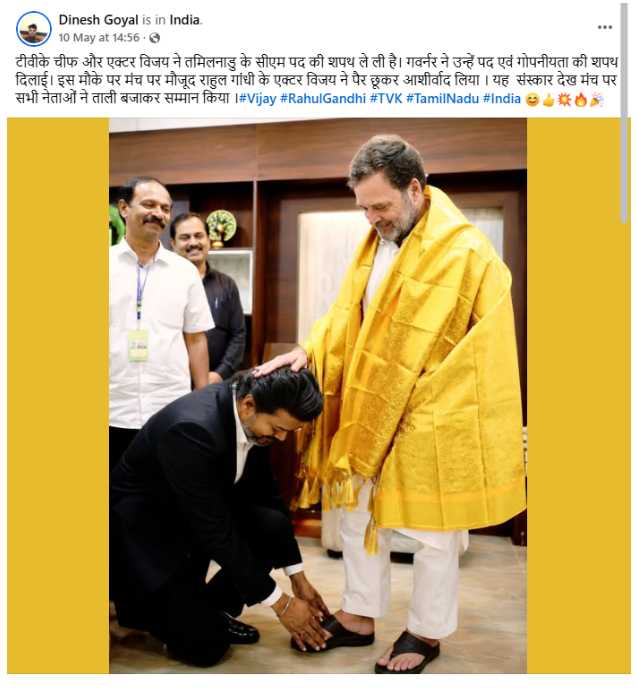
A viral image circulating on social media claims that Tamil Nadu Chief Minister C. Joseph Vijay touched the feet of Congress leader Rahul Gandhi during his swearing-in ceremony, while Congress and several other parties extended support to his government. The image is being widely shared with captions suggesting it captures a real political moment. However, CyberPeace Research Wing research has found the claim to be false. The image is AI-generated and does not depict any real event.
Claim
A Facebook user shared the viral image on May 10, 2026, claiming that TVK chief and actor Vijay had taken oath as the Chief Minister of Tamil Nadu. The post further claimed that during the ceremony, Vijay touched Rahul Gandhi’s feet to seek blessings, and the gesture was applauded by leaders present on stage. The post, along with archived links and screenshots, is being circulated as authentic evidence of the alleged incident.
- https://www.facebook.com/100057774695228/posts/1389222123013598/?rdid=FEzRYpVvSIieeUbj#
- https://archive.ph/kv4e1
Fact Check
A keyword-based search on Google did not return any credible news reports supporting the claim or confirming such an event. A closer visual examination of the image raised strong suspicions of AI manipulation, prompting verification through AI detection tools. When the image was analyzed using the SIGHTENGINE detection tool, the results indicated that the image is 99% likely to be AI-generated.

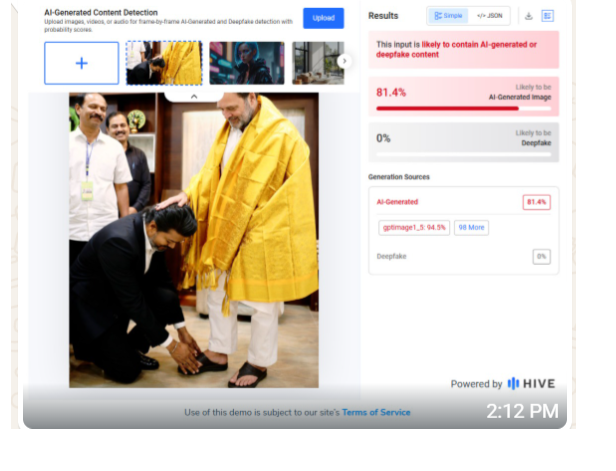
Further verification using another AI detection platform, HIVE MODERATION, also flagged the image as synthetic, showing an 81% probability of being AI-generated.
Conclusion
The research clearly shows that the viral image is not real. It has been generated using artificial intelligence and is being falsely shared as a real political event.

Related Blogs

Introduction
In an alarming event, one of India’s premier healthcare institutes, AIIMS Delhi, has fallen victim to a malicious cyberattack for the second time in the year. The Incident serves as a clear-cut reminder of the escalating threat landscape faced by the healthcare organisation in this digital age. In the attack, which unfolded with grave implications, the attackers not only explored the vulnerabilities present in the healthcare sector, but this also raised the concern about the security of patient data and the uninterrupted delivery of critical healthcare services. In this blog post, we will explore the incident, what happened, and what safety measures can be taken.
Backdrop
The cyber-security systems deployed in AIIMS, New Delhi, recently detected a malware attack. The nature and scope of the attack were both sophisticated and targeted. This second hack acts as a wake-up call for healthcare organisations nationwide. As the healthcare business increasingly depends on digital technology to improve patient care and operational efficiency, cybersecurity must be prioritised to protect sensitive data. To minimise cyber-attack dangers, healthcare organisations must invest in robust defences such as multi-factor authentication, network security, frequent system upgrades, and employee training.
The attempt was successfully prevented, and the deployed cyber-security systems neutralised the threat. The e-Hospital services remain to be fully secure and are functioning normally.
Impact on AIIMS
Healthcare services have been under hackers’ radar worldwide, and the healthcare sector has been impacted badly. The attack on AIIMS Delhi’s effects has been both immediate and far-reaching. The organisation, which is recognised for delivering excellent healthcare services and performing breakthrough medical research, faced significant interruptions in its everyday operations. Patient care and treatment processes were considerably impeded, resulting in delays, cancellations, and the inability to access essential medical documents. The stolen data raises serious concerns about patient privacy and confidentiality, raising doubts about the institution’s capacity to protect sensitive information. Furthermore, the financial ramifications of the assault, such as the cost of recovery, deploying more robust cybersecurity measures, and potential legal penalties and forensic analyses, contribute to the scale of the effect. The event has also generated public concerns about the institution’s ability to preserve personal information, undermining confidence and degrading AIIMS Delhi’s image.
Impact on Patients: The attacks not only impact the institutes but also have serious implications for the patients and here are some key highlights:
Healthcare Service Disruption: The hack has affected the seamless delivery of healthcare services at AIIMS Delhi. Appointments, surgeries, and other medical treatments may be delayed, cancelled, or rescheduled. This disturbance can result in longer wait times, longer treatment periods, and potential problems from delayed or interrupted therapy.

Patient Privacy and Confidentiality are jeopardised because of the breach of sensitive patient data. Medical data, test findings, and treatment plans may have been compromised. This breach may diminish patient faith in the institution’s capacity to safeguard their personal information, discouraging them from seeking care or submitting sensitive information in the future.
As a result of the cyberattack, patients may endure mental anguish and worry. Fear of possible exploitation of personal health information, confusion about the scope of the breach, and concerns about the security of their healthcare data can all have a negative impact on their mental health. This stress might aggravate pre-existing medical issues and impede total recovery.
Trust at stake: A data breach may harm patients’ faith and confidence in AIIMS Delhi and the healthcare system. Patients rely on healthcare facilities to keep their information secure and confidential while providing safe, high-quality care. A hack can doubt the institution’s ability to safeguard patient data, affecting patients’ overall faith in the organisation and potentially leading to patients seeking care elsewhere.
Cybersecurity Measures
To avoid future hacks and protect patient data, AIIMS Delhi must prioritize enhancing its cybersecurity procedures. The institution can strengthen its resistance to changing threats by establishing strong security practices. The following steps can be considered.
Using Multi-factor Authentication: By forcing users to submit several forms of identity to access systems and data, multi-factor authentication offers an extra layer of protection. AIIMS Delhi may considerably lower the danger of unauthorised access by applying this precaution, even in the case of leaked passwords or credentials. Biometrics and one-time passwords, for example, should be integrated into the institution’s authentication systems.
Improving Network Security and Firewalls: AIIMS Delhi should improve network security by implementing strong firewalls, intrusion detection and prevention systems, and network segmentation. These techniques serve to construct barriers between internal systems and external threats, reducing attackers’ lateral movement within the network. Regular network traffic monitoring and analysis can assist in recognising and mitigating any security breaches.
Risk Assessment: Regular penetration testing and vulnerability assessments are required to uncover possible flaws and vulnerabilities in AIIMS Delhi’s systems and infrastructure. Security professionals can detect vulnerabilities and offer remedial solutions by carrying out controlled simulated assaults. This proactive strategy assists in identifying and addressing any security flaws before attackers exploit them.
Educating and training Healthcare Professionals: Education and training have a crucial role in enhancing cybersecurity practices in healthcare facilities. Healthcare workers, including physicians, nurses, administrators, and support staff, must be well-informed about the importance of cybersecurity and trained in risk-mitigation best practices. This will empower healthcare professionals to actively contribute to protecting the patient’s data and maintaining the trust and confidence of patients.
Learnings from Incidents
AIIMS Delhi should embrace cyber-attacks as learning opportunities to strengthen its security posture. Following each event, a detailed post-incident study should be performed to identify areas for improvement, update security policies and procedures, and improve employee training programs. This iterative strategy contributes to the institution’s overall resilience and preparation for future cyber-attacks. AIIMS Delhi can effectively respond to cyber incidents, minimise the impact on operations, and protect patient data by establishing an effective incident response and recovery plan, implementing data backup and recovery mechanisms, conducting forensic analysis, and promoting open communication. Proactive measures, constant review, and regular revisions to incident response plans are critical for staying ahead of developing cyber threats and ensuring the institution’s resilience in the face of potential future assaults.

Conclusion
To summarise, developing robust healthcare systems in the digital era is a key challenge that healthcare organisations must prioritise. Healthcare organisations can secure patient data, assure the continuation of key services, and maintain patients’ trust and confidence by adopting comprehensive cybersecurity measures, building incident response plans, training healthcare personnel, and cultivating a security culture. Adopting a proactive and holistic strategy for cybersecurity is critical to developing a healthcare system capable of withstanding and successfully responding to digital-age problems.
.webp)
Executive Summary:
A widely used news on social media is that a 3D model of Chanakya, supposedly made by Magadha DS University matches with MS Dhoni. However, fact-checking reveals that it is a 3D model of MS Dhoni not Chanakya. This MS Dhoni-3D model was created by artist Ankur Khatri and Magadha DS University does not appear to exist in the World. Khatri uploaded the model on ArtStation, calling it an MS Dhoni similarity study.

Claims:
The image being shared is claimed to be a 3D rendering of the ancient philosopher Chanakya created by Magadha DS University. However, people are noticing a striking similarity to the Indian cricketer MS Dhoni in the image.


Fact Check:
After receiving the post, we ran a reverse image search on the image. We landed on a Portfolio of a freelance character model named Ankur Khatri. We found the viral image over there and he gave a headline to the work as “MS Dhoni likeness study”. We also found some other character models in his portfolio.


Subsequently, we searched for the mentioned University which was named as Magadha DS University. But found no University with the same name, instead the name is Magadh University and it is located in Bodhgaya, Bihar. We searched the internet for any model, made by Magadh University but found nothing. The next step was to conduct an analysis on the Freelance Character artist profile, where we found that he has a dedicated Instagram channel where he posted a detailed video of his creative process that resulted in the MS Dhoni character model.

We concluded that the viral image is not a reconstruction of Indian philosopher Chanakya but a reconstruction of Cricketer MS Dhoni created by an artist named Ankur Khatri, not any University named Magadha DS.
Conclusion:
The viral claim that the 3D model is a recreation of the ancient philosopher Chanakya by a university called Magadha DS University is False and Misleading. In reality, the model is a digital artwork of former Indian cricket captain MS Dhoni, created by artist Ankur Khatri. There is no evidence of a Magadha DS University existence. There is a university named Magadh University in Bodh Gaya, Bihar despite its similar name, we found no evidence in the model's creation. Therefore, the claim is debunked, and the image is confirmed to be a depiction of MS Dhoni, not Chanakya.
Introduction
A Reuters investigation has uncovered an elephant in the room regarding Meta Platforms' internal measures to address online fraud and illicit advertising. The confidential documents that Reuters reviewed disclosed that Meta was planning to generate approximately 10% of its 2024 revenue, i.e., USD 16 billion, from ads related to scams and prohibited goods. The findings point out a disturbing paradox: on the one hand, Meta is a vocal advocate for digital safety and platform integrity, while on the other hand, the internal logs of the company indicate the existence of a very large area allowing the shunning of fraudulent advertisement activities that exploit users throughout the world.
The Scale of the Problem
Internal Meta projections show that its platforms, Facebook, Instagram, and WhatsApp, are displaying a staggering 15 billion scam ads per day combined. The advertisements include deceitful e-commerce promotions, fake investment schemes, counterfeit medical products, and unlicensed gambling platforms.
Meta has developed sophisticated detection tools, but even then, the system does not catch the advertisers until they are 95% certain to be fraudsters. By having at least that threshold for removing an ad, the company is unlikely to lose much money. As a result, instead of turning the fraud adjacent advertisers down, it charges them higher ad rates, which is the strategy they call “penalty bids” internally.
Internal Acknowledgements & Business Dependence
Internal documents that date between 2021 and 2025 reveal that the financial, safety, and lobbying divisions of Meta were cognizant of the enormity of revenues generated from scams. One of the 2025 strategic papers even describes this revenue source as "violating revenue," which implies that it includes ads that are against Meta's policies regarding scams, gambling, sexual services, and misleading healthcare products.
The company's top executives consider the cost-benefit scenario of stricter enforcement. According to a 2024 internal projection, Meta's half-yearly earnings from high-risk scam ads were estimated at USD 3.5 billion, whereas regulatory fines for such violations would not exceed USD 1 billion, thus making it a tolerable trade-off from a commercial viewpoint. At the same time, the company intends to scale down scam ad revenue gradually, thus from 10.1% in 2024 to 7.3% by 2025, and 6% by 2026; however, the documents also reveal a planned slowdown in enforcement to avoid "abrupt reductions" that could affect business forecasts.
Algorithmic Amplification of Scams
One of the most alarming situations is the fact that Meta's own advertising algorithms amplify scam content. It has been reported that users who click on fraudulent ads are more likely to see other similar ads, as the platform's personalisation engine assumes user "interest."
This scenario creates a self-reinforcing feedback loop where the user engagement with scam content dictates the amount of such content being displayed. Thus, a digital environment is created which encourages deceptive engagement and consequently, user trust is eroded and systemic risk is amplified.
An internal presentation in May 2025 was said to put a number on how deeply the platform's ad ecosystem was intertwined with the global fraud economy, estimating that one-third of the scams that succeeded in the U.S. were due to advertising on Meta's platforms.
Regulatory & Legal Implications
The disclosures arrived at the same time as the US and UK governments started to closely check the company's activities more than ever before.
- The U.S. Securities and Exchange Commission (SEC) is said to be looking into whether Meta has had any part in the promotion of fraudulent financial ads.
- The UK’s Financial Conduct Authority (FCA) found that Meta’s platforms were the main sources of scams related to online payments and claimed that the amount of money lost was more than all the other social platforms combined in 2023.
Meta’s spokesperson, Andy Stone, at first denied the accusations, stating that the figures mentioned in the leak were “rough and overly-inclusive”; nevertheless, he conceded that the company’s consistent efforts toward enforcement had negatively impacted revenue and would continue to do so.
Operational Challenges & Policy Gaps
The internal documents also reveal the weaknesses in Meta's day-to-day operations when it comes to the implementation of its own policies.
- Because of the large number of employees laid off in 2023, the whole department that dealt with advertiser-brand impersonation was said to have been dissolved.
- Scam ads were categorised as a "low severity" issue, which was more of a "bad user experience" than a critical security risk.
- At the end of 2023, users were submitting around 100,000 legitimate scam reports per week, of which Meta dismissed or rejected 96%.
Human Impact: When Fraud Becomes Personal
The financial and ethical issues have tangible human consequences. The Reuters investigation documented multiple cases of individuals defrauded through hijacked Meta accounts.
One striking example involves a Canadian Air Force recruiter, whose hacked Facebook account was used to promote fake cryptocurrency schemes. Despite over a hundred user reports, Meta failed to act for weeks, during which several victims, including military colleagues, lost tens of thousands of dollars.
The case underscores not just platform negligence, but also the difficulty of law enforcement collaboration. Canadian authorities confirmed that funds traced to Nigerian accounts could not be recovered due to jurisdictional barriers, a recurring issue in transnational cyber fraud.
Ethical and Cybersecurity Implications
The research has questioned extremely important things at least from the perspective of cyber policy:
- Platform Accountability: Meta, by its practice, is giving more importance to the monetary aspect rather than the truth, and in this way, it is going against the principles of responsible digital governance.
- Transparency in Ad Ecosystems: The lack of transparency in digital advertising systems makes it very easy for dishonest actors to use automated processes with very little supervision.
- Algorithmic Responsibility: The use of algorithms that impact the visibility of misleading content and targeting can be considered the direct involvement of the algorithms in the fraud.
- Regulatory Harmonisation: The presence of different and disconnected enforcement frameworks across jurisdictions is a drawback to the efforts in dealing with cross-border cybercrime.
- Public Trust: Users’ trust in the digital world is mainly dependent on the safety level they see and the accountability of the companies.
Conclusion
Meta’s records show a very unpleasant mix of profit, laxity, and failure in the policy area concerning scam-related ads. The platform’s readiness to accept and even profit from fraudulent players, though admitting the damage they cause, calls for an immediate global rethinking of advertising ethics, regulatory enforcement, and algorithmic transparency.
With the expansion of its AI-driven operations and advertising networks, protecting the users of Meta must evolve from being just a public relations goal to being a core business necessity, thus requiring verifiable accountability measures, independent audits, and regulatory oversight. It is an undeniable fact that there are billions of users who count on Meta’s platforms for their right to digital safety, which is why this right must be respected and enforced rather than becoming optional.
References
- https://www.reuters.com/investigations/meta-is-earning-fortune-deluge-fraudulent-ads-documents-show-2025-11-06/?utm_source=chatgpt.com
- https://www.indiatoday.in/technology/news/story/leaked-docs-claim-meta-made-16-billion-from-scam-ads-even-after-deleting-134-million-of-them-2815183-2025-11-07
