
Washington Just Deputized the Private Sector Against Cybercrime. Here Is What That Actually Means
On 12 August 2026, President Donald Trump signed a National Security Presidential Memorandum titled Expanding Capabilities to Combat Transnational Cyber Enabled Crime. Stripped of its bureaucratic packaging, the document does something American law has resisted for three decades: it lets private companies, under close federal supervision, break into the systems of foreign criminal networks and, in some cases, disrupt or damage them.
That is a genuinely large policy shift, even if the memorandum itself is careful, almost defensive, about how it frames the shift. Understanding why requires separating what the text actually authorizes from the "hack back" headline that has attached itself to the story within days of signing.
The problem the memo says it is solving
The White House frames this as a response to scale, not ideology. Americans reported losing more than 20.8 billion dollars to cyber enabled crime in 2025, a sharp jump from the roughly 12.5 billion dollar figure cited when the administration's earlier March 2026 executive order on cybercrime, fraud, and predatory schemes was signed. Ransomware, phishing, financial fraud, sextortion, and impersonation scams sit at the center of that number, and the administration's own supporting material points to a grim detail buried in the numbers: one in seven young people who experienced sextortion as a minor reported harming themselves as a result.
Those crimes, the memorandum argues, are increasingly the work of organized, transnational groups operating from jurisdictions the FBI simply cannot reach. Domestic law enforcement, built for domestic crime, is structurally mismatched to a threat that lives across borders and inside encrypted infrastructure. The administration's answer is to formally recruit the resource it says is best positioned to close that gap: the American cybersecurity industry itself, which the memo describes as "the most innovative and technologically advanced in the world."
What the Program actually authorizes
The memorandum directs the National Coordination Center, a body first stood up under a 2025 executive order, to build a formal Program through which vetted Participating Companies can conduct two categories of activity against foreign Cyber Enabled Transnational Criminal Organizations, defined in the text as CE TCOs.
Cyber Surveillance Operations cover unauthorized access to a target's systems for the primary purpose of collecting information or intelligence, undertaken with the intent to remain undetected. Cyber Effects Operations go further: manipulating, disrupting, denying, degrading, or destroying information systems, the infrastructure those systems control, or the data resident on them.
Crucially, CE TCOs are defined narrowly. A foreign group only counts if it targets the US government, US persons, or US interests, and it must not be an institutional arm of a foreign state or wholly directed by one. The memo builds in a presumption of innocence at the state level too: a group is assumed not to be state controlled unless clear intelligence establishes otherwise. That distinction matters enormously, because it is the line meant to separate this Program from anything resembling private warfare against a nation state.
No operation happens unilaterally. Every proposed action must be approved in writing by two Program Executive Directors, one designated by the Attorney General and one by the Secretary of Homeland Security, coordinating with each other before signing off. Participating Companies must pass what the memo calls rigorous vetting, sign contractual agreements with DOJ or DHS, and in many cases post a bond or escrow of at least one million dollars, forfeited if they breach their agreement. Within 60 days of the memo's signing, the Program Executive Directors must publish detailed operating procedures covering everything from target adjudication to what happens if an operation accidentally hits a US person's system, in which case the company must stop, run minimization procedures, and immediately notify the Center.
There is also a hard ceiling built into the design. Operations expected to cause loss of life, serious injury, or conduct that would rise to the level of a use of force or armed attack under international law, termed Critical Outcomes in the text, cannot be approved by the Program Executive Directors at all. That ceiling is the memo's clearest attempt to keep this inside the bounds of law enforcement rather than sliding into something closer to conflict.
Multiple law firms tracking the rollout, including Wiley, have been explicit on one point worth repeating because so much coverage has blurred it: this is not a green light for companies to hack back on their own initiative. Every operation remains, on paper, an act of the federal government, merely executed through a contracted private hand.
Why experts are not popping champagne
Legal caution has not stopped a wave of professional anxiety. Cyber policy veterans interviewed by outlets like CyberScoop describe the memo as a genuine philosophical break in how Washington thinks about offense in cyberspace, and the debate that followed split fairly evenly between cautious optimism and open alarm.
The core worry, echoed across nearly every serious critique, is attribution. Cyber operations are hard to trace precisely because criminals exploit shared infrastructure, proxies, and compromised third party systems to hide, and that same fog does not lift just because a government contract sits behind the operator. A former senior CISA official, Michael Garcia, put the risk plainly: pressure to attribute quickly could push companies toward lower certainty judgments about who they are actually striking, with a realistic chance of hitting the wrong server, or worse, infrastructure tied to a foreign government rather than a criminal gang. A former Cyber Command official was blunter still, describing parts of the memo on social media as a structure that could reward companies for manufacturing billable threats rather than resolving them efficiently.
Paul Rosenzweig, a former DHS policy official, raised a separate and arguably more durable problem: jurisdiction. Whatever this memo authorizes under American law, the systems being accessed usually sit inside someone else's sovereign territory, governed by that country's own criminal statutes. Washington cannot legislate away a foreign hacking law simply by calling the American company that broke it a Participating Company.
None of this makes the memo indefensible. Supporters point out, correctly, that the private sector already does enormous amounts of active defense and threat disruption work informally, through botnet takedown litigation and coordinated infrastructure seizures, and that formalizing federal oversight over that activity is arguably safer than the current improvisation. The honest position, and probably the fair one, is that the memo trades one set of risks for another, and which set turns out worse will depend entirely on the operating procedures due inside sixty days, procedures the public has not yet seen.
CyberPeace Insights: what this means beyond America's borders
A significant share of the CE-TCO activity this memo is built to target, the ransomware crews, romance investment fraud operations, and sextortion rings running out of Southeast Asia, does not victimize Americans in isolation. The scam compounds clustered along the Myanmar, Cambodia, and Laos borders, repeatedly raided over the past two years, have held thousands of trafficked workers of dozens of nationalities, Indians consistently among the largest groups rescued, alongside Chinese, Filipino, and Malaysian nationals. India has run its own repatriation efforts out of Mae Sot in Thailand, bringing citizens home several hundred at a time, and has built its own institutional response to this threat through the Indian Cyber Crime Coordination Centre, which coordinates cybercrime enforcement across states and increasingly across borders.
That shared exposure gives India and the United States real common ground here. The criminal infrastructure this American Program is designed to disrupt is, in significant part, the same infrastructure that has trafficked and defrauded Indian citizens, which gives New Delhi genuine reason to watch this experiment closely and constructively. At the same time, the Program's underlying model, private companies conducting cross-border operations under one nation's legal authorization, is a genuinely new template in international cyber governance, and how it performs over its first year will likely shape how other major digital economies, India included, think about calibrating their own frameworks for public-private cooperation against transnational cybercrime. India and other nations should closely watch whether this becomes a template worth adapting or a cautionary tale worth avoiding.
It is pertinent to note that Justice and Homeland Security departments have 60 days to write detailed operating procedures covering everything from a target-vetting rubric to a classified operational workflow and 180 days to deliver the first status report to the White House.
References
- The White House. "Expanding Capabilities to Combat Transnational Cyber Enabled Crime." 12 August 2026. https://www.whitehouse.gov/presidential-actions/2026/08/expanding-capabilities-to-combat-transnational-cyber-enabled-crime/
- Wiley Rein LLP. "Navigating the New Presidential Memorandum on Transnational Cyber Enabled Crime." August 2026. https://www.wiley.law/alert-Navigating-the-New-Presidential-Memorandum-on-Transnational-Cyber-Enabled-Crime
- SecureWorld. "Trump Memo Lets Private Firms Hack Back at Cybercriminals." August 2026. https://www.secureworld.io/industry-news/trump-authorizes-private-firms-offensive-cyber-operations
- CyberScoop. "A bold new strategy or a dangerous precedent? Experts are divided on Trump's memo." August 2026. https://cyberscoop.com/private-sector-hacking-presidential-memo-cybersecurity/
- CyberScoop. "Trump turns to private sector in offensive hacking operations memo." August 2026. https://cyberscoop.com/trump-memo-private-sector-offensive-hacking/
- CNN Politics. "Cyber privateers: Trump issues order allowing US companies to hack overseas groups under certain conditions." August 2026. https://www.cnn.com/2026/08/13/politics/cyber-privateers-trump-order-overseas-groups-hacking
- NPR. "Trump administration wants to allow companies to hack foreign cybercriminals." August 2026. https://www.npr.org/2026/08/15/nx-s1-5930311/trump-companies-hack-foreign-cybercriminals
- The Next Web. "President Donald Trump signs memo letting US agencies hack transnational crime groups abroad." August 2026. https://thenextweb.com/news/trump-cyber-memo-transnational-crime
- Machine News. "Security firms hit back at Trump's call to hack back against international crime gangs." August 2026. https://www.machine.news/security-firms-hit-back-at-trumps-call-to-hack-back-against-international-crime-gangs/
- Lawfare. "Trump Admin Cyber Strategy Centers Private Sector in Offensive Cyber Operations." March 2026. https://www.lawfaremedia.org/article/trump-admin-cyber-strategy-centers-private-sector-in-offensive-cyber-operations
- Lawfare. "Partners or Provocateurs? Private Sector Involvement in Offensive Cyber Operations." July 2025. https://www.lawfaremedia.org/article/partners-or-provocateurs--private-sector-involvement-in-offensive-cyber-operations
- Global Indian Network. "Pig Butchering Scams in India: The Dark Intersection of Social Media, AI, and Emotional Manipulation." January 2026. https://globalindiannetwork.com/pig-butchering-scams-in-india/
- The Tribune. "India brings home scammed 549 nationals from Myanmar in 2 days." 2025. https://www.tribuneindia.com/news/india/india-brings-home-scammed-549-nationals-from-myanmar-in-2-days
- Malay Mail. "India to repatriate 500 nationals fleeing Myanmar's cyber scam hub, says Thai PM." October 2025. https://www.malaymail.com/amp/news/world/2025/10/29/india-to-repatriate-500-nationals-fleeing-myanmars-cyber-scam-hub-says-thai-pm/196399
- NBC News. "260 foreigners rescued from virtual slavery in Myanmar's online scam centers are being repatriated." 2025. https://www.nbcnews.com/news/world/260-foreigners-rescued-virtual-slavery-myanmars-online-scam-centers-ar-rcna192180
- CyberPeace Foundation. "About Us." https://cyberpeace.org/about-us
Contributors
- Maj. Vineet Kumar, Founder & Global President, CyberPeace
- Mr. Neeraj Soni, Senior Research Analyst, Policy & Advocacy, CyberPeace
List of Abbreviations
- CE‑TCO — Cyber Enabled Transnational Criminal Organization
- DOJ — Department of Justice
- DHS — Department of Homeland Security
- FBI — Federal Bureau of Investigation
- CISA — Cybersecurity and Infrastructure Security Agency
- I4C — Indian Cyber Crime Coordination Centre
- US — United States
- IT — Information Technology

Related Blogs
Executive Summary
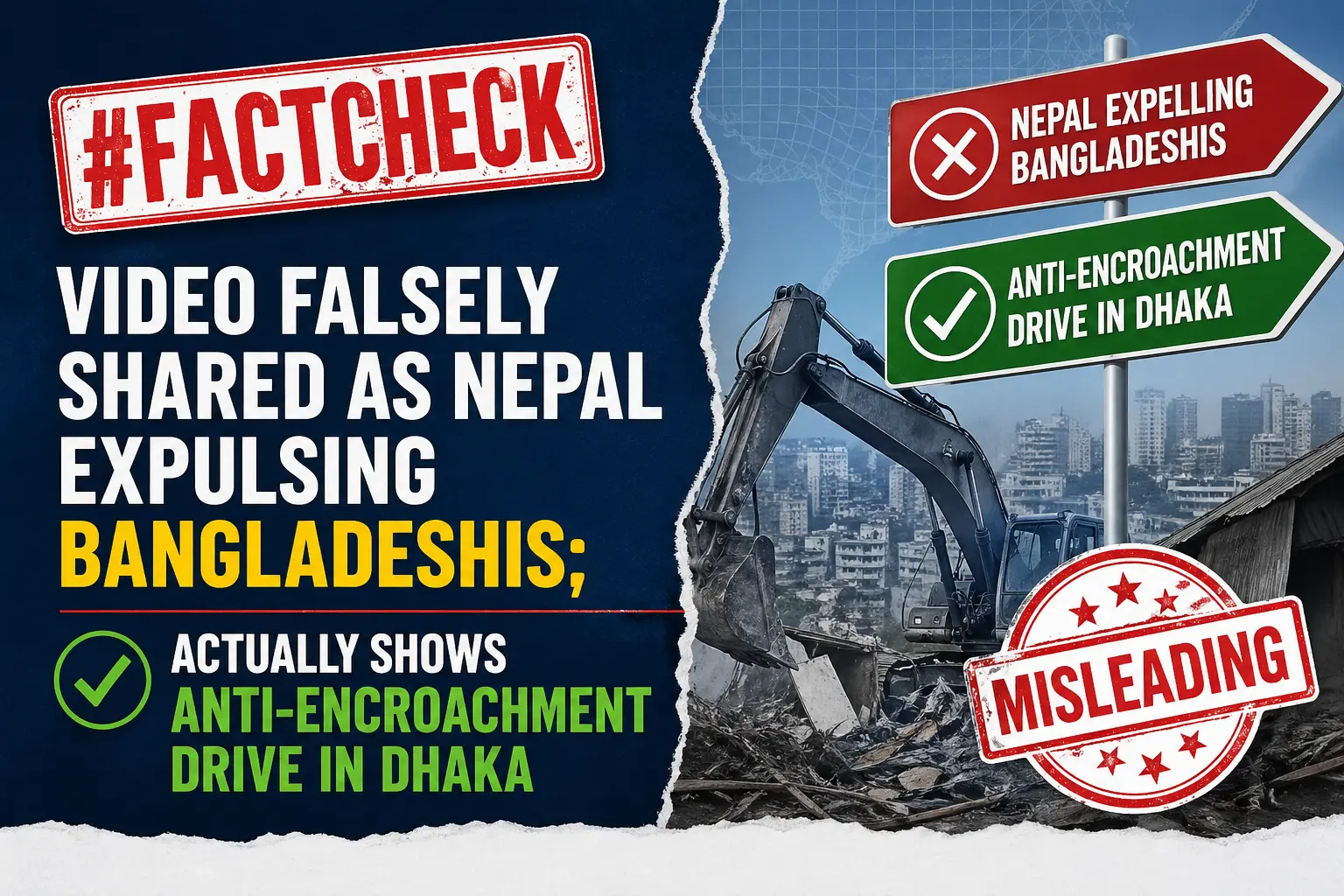
A video showing uniformed personnel removing street vendors and damaging roadside stalls is being circulated on social media with the false claim that the Nepal government has started expelling Bangladeshis from the country. The viral clip is around 49 seconds long and shows authorities clearing vendors from a public area. Nepali audio can also be heard in the background, which appears to have added to the misleading narrative.
However, an research by the CyberPeace Research Wing found that the claim is false. The video is not from Nepal, but from Bangladesh’s capital Dhaka, where authorities were carrying out an anti-encroachment operation near the National Stadium.
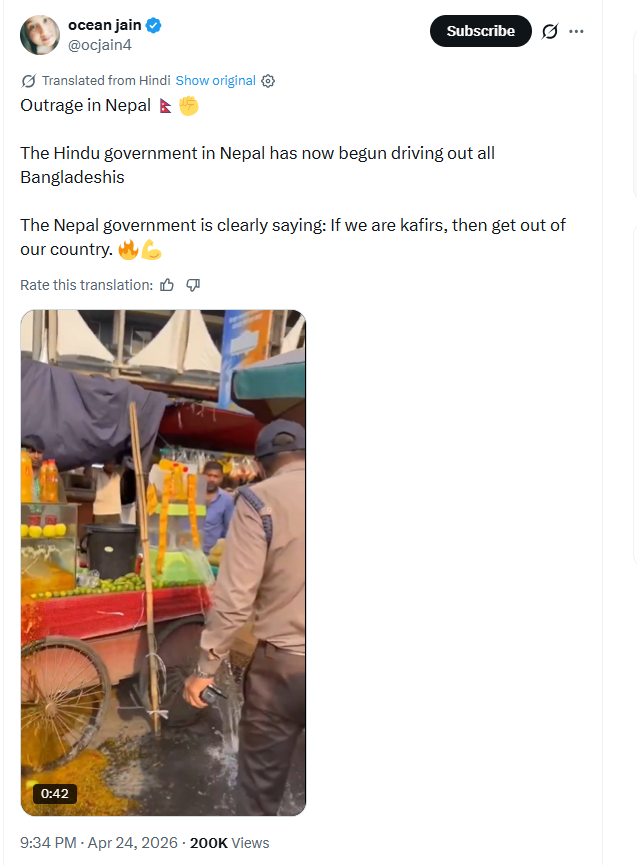
Claim:
The video was shared on X with a caption claiming that a Hindu-led government in Nepal had begun driving Bangladeshis out of the country.
Fact Check:
A close examination of the video revealed several signs contradicting the claim. Text written in Bengali can be seen at multiple places in the footage. The caps worn by uniformed personnel also appear to display “Bangladesh Police.” Investigators also noticed a stadium-like structure in the background. Comparing the visuals with street-view imagery available on Google Maps led to a match near the National Stadium area in Dhaka, Bangladesh.


Further verification found a video uploaded on March 18, 2025, by a Bangladeshi news portal on YouTube containing scenes matching the viral clip. The caption described it as footage from an anti-encroachment drive in the Gulistan area of Dhaka.

A similar version of the video was also found on a Bangladeshi Instagram account uploaded on March 17, where it was again described as police action against illegal encroachments. The video credit was attributed to a person named Zahir Rehan.
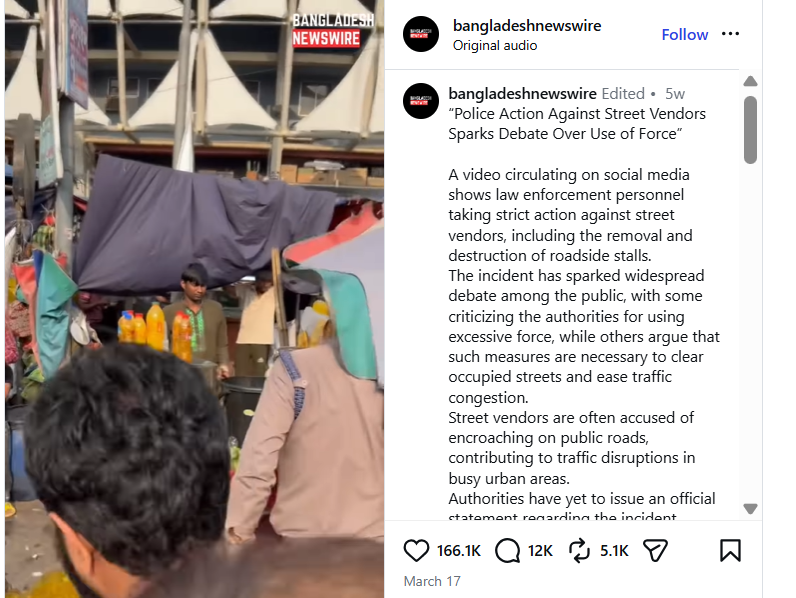
While the exact date of the original footage could not be independently confirmed, available evidence clearly links the video to Bangladesh and not Nepal.
Conclusion:
The viral claim that Nepal has begun expelling Bangladeshis is false. The video actually shows an anti-encroachment drive carried out by authorities in Dhaka, Bangladesh.

Executive Summary:
A video circulating on social media claims to show a live elephant falling from a moving truck due to improper transportation, followed by the animal quickly standing up and reacting on a public road. The content may raise concerns related to animal cruelty, public safety, and improper transport practices. A detailed examination using AI content detection tools, visual anomaly analysis indicates that the video is not authentic and is likely AI generated or digitally manipulated.
Claim:
The viral video (archive link) shows a disturbing scene where a large elephant is allegedly being transported in an open blue truck with barriers for support. As the truck moves along the road, the elephant shifts its weight and the weak side barrier breaks. This causes the elephant to fall onto the road, where it lands heavily on its side. Shortly after, the animal is seen getting back on its feet and reacting in distress, facing the vehicle that is recording the incident. The footage may raise serious concerns about safety, as elephants are normally transported in reinforced containers, and such an incident on a public road could endanger both the animal and people nearby.

Fact Check:
After receiving the video, we closely examined the visuals and noticed some inconsistencies that raised doubts about its authenticity. In particular, the elephant is seen recovering and standing up unnaturally quickly after a severe fall, which does not align with realistic animal behavior or physical response to such impact.
To further verify our observations, the video was analyzed using the Hive Moderation AI Detection tool, which indicated that the content is likely AI generated or digitally manipulated.
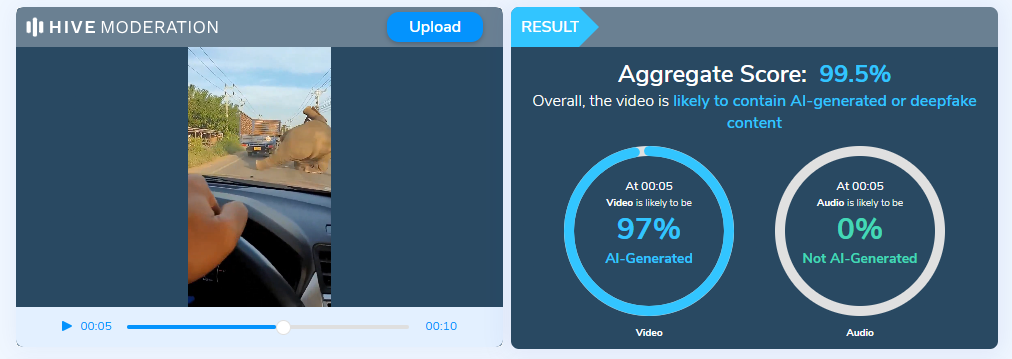
Additionally, no credible news reports or official sources were found to corroborate the incident, reinforcing the conclusion that the video is misleading.
Conclusion:
The claim that the video shows a real elephant transport accident is false and misleading. Based on AI detection results, observable visual anomalies, and the absence of credible reporting, the video is highly likely to be AI generated or digitally manipulated. Viewers are advised to exercise caution and verify such sensational content through trusted and authoritative sources before sharing.
- Claim: The viral video shows an elephant allegedly being transported, where a barrier breaks as it moves, causing the animal to fall onto the road before quickly getting back on its feet.
- Claimed On: X (Formally Twitter)
- Fact Check: False and Misleading

Executive Summary:
A viral post on X (formerly Twitter) gained much attention, creating a false narrative of recent damage caused by the earthquake in Tibet. Our findings confirmed that the clip was not filmed in Tibet, instead it came from an earthquake that occurred in Japan in the past. The origin of the claim is traced in this report. More to this, analysis and verified findings regarding the evidence have been put in place for further clarification of the misinformation around the video.

Claim:
The viral video shows collapsed infrastructure and significant destruction, with the caption or claims suggesting it is evidence of a recent earthquake in Tibet. Similar claims can be found here and here

Fact Check:
The widely circulated clip, initially claimed to depict the aftermath of the most recent earthquake in Tibet, has been rigorously analyzed and proven to be misattributed. A reverse image search based on the Keyframes of the claimed video revealed that the footage originated from a devastating earthquake in Japan in the past. According to an article published by a Japanese news website, the incident occurred in February 2024. The video was authenticated by news agencies, as it accurately depicted the scenes of destruction reported during that event.

Moreover, the same video was already uploaded on a YouTube channel, which proves that the video was not recent. The architecture, the signboards written in Japanese script, and the vehicles appearing in the video also prove that the footage belongs to Japan, not Tibet. The video shows news from Japan that occurred in the past, proving the video was shared with different context to spread false information.

The video was uploaded on February 2nd, 2024.
Snap from viral video

Snap from Youtube video

Conclusion:
The video viral about the earthquake recently experienced by Tibet is, therefore, wrong as it appears to be old footage from Japan, a previous earthquake experienced by this nation. Thus, the need for information verification, such that doing this helps the spreading of true information to avoid giving false data.
- Claim: A viral video claims to show recent earthquake destruction in Tibet.
- Claimed On: X (Formerly Known As Twitter)
- Fact Check: False and Misleading
