Search Engine Monopoly: AI and Its Impact
Introduction
As our experiments with Generative Artificial Intelligence (AI) continue, companies and individuals look for new ways to incorporate and capitalise on it. This also includes big tech companies betting on their potential through investments. This process also sheds light on how such innovations are being carried out, used, and affect other stakeholders. Google’s AI overview feature has raised concerns from various website publishers and regulators. Recently, Chegg, a US-based tech education company that provides online resources for high school and college students, has filed a lawsuit against Google alleging abuse of monopoly over the searching mechanism.
Legal Background
Google’s AI Overview/Search Generative Experience (SGE) is a feature that incorporates AI into its standard search tool and helps summarise search results. This is then presented at the top, over the other published websites, when one looks for the search result. Although the sources of the information present are linked, they are half-covered, and it is ambiguous to tell which claims made by the AI come from which link. This creates an additional step for the searcher as, to find out the latter, their user interface requires the searcher to click on a drop-down box. Individual publishers and companies like Chegg have argued that such summaries deter their potential traffic and lead to losses as they continue to bid higher for advertisement services that Google offers, only to have their target audience discouraged from visiting their websites. What is unique about the lawsuit that has been filed by Chegg, is that it is based on anti-trust law rather than copyright law, which it has dealt with previously. In August 2024, a US Federal Judge had ruled that Google had an illegal monopoly over internet search and search text advertising markets, and by November, the US Department of Justice (DOJ) filed its proposed remedy. Some of them were giving advertisers and publishers more control of their data flowing through Google’s products, opening Google’s search index to the rest of the market, and imposing public oversight over Google’s AI investments. Currently, the DOJ has emphasised its stand on dismantling the search monopoly through structural separations, i.e., divesting Google of Chrome. The company is slated to defend itself before the DC District Court Judge Amit Mehta starting April 20, 2025.
CyberPeace Insights
As per a report by Statista (Global market share of leading search engines 2015-2025), Google, as the market leader, held a search traffic share of around 89.62 per cent. It is also stated that its advertising services account for the majority of its revenue, which amounted to a total of 305.63 billion U.S. dollars in 2023. The inclusion of the AI feature is undoubtedly changing how we search for things online. Benefits for users include an immediate, convenient scan of general information pertaining to the looked-up subject, but it may also raise concerns on the part of the website publishers and their loss of ad revenue owing to fewer impressions/clicks. Even though links (sources) are mentioned, they are usually buried. Such a searching mechanism questions the incentive on both ends- the user to explore various viewpoints, as people are now satisfied with the first few results that pop up, and the incentive for a creator/publisher to create new content as well as generate an income out of it. There might be a shift to more passive consumption rather than an active one, where one looks up/or is genuinely searching for information.
Conclusion
AI might make life more convenient, but in this case, it might also take away from small businesses, their finances, and the results of their hard work. It is also necessary for regulators, publishers, and users to continue asking such critical questions to keep the accountability of big tech giants in check, whilst not compromising their creations and publications.
References
- https://www.washingtonpost.com/technology/2024/05/13/google-ai-search-io-sge/
- https://www.theverge.com/news/619051/chegg-google-ai-overviews-monopoly
- https://economictimes.indiatimes.com/tech/technology/google-leans-further-into-ai-generated-overviews-for-its-search-engine/articleshow/118742139.cms?from=mdr
- https://www.nytimes.com/2024/12/03/technology/google-search-antitrust-judge.html
- https://www.odinhalvorson.com/monopoly-and-misuse-googles-strategic-ai-narrative/
- https://cio.economictimes.indiatimes.com/news/artificial-intelligence/google-leans-further-into-ai-generated-overviews-for-its-search-engine/118748621
- https://www.techpolicy.press/the-elephant-in-the-room-in-the-google-search-case-generative-ai/
- https://www.karooya.com/blog/proposed-remedies-break-googles-monopoly-antitrust/
- https://getellipsis.com/blog/googles-monopoly-and-the-hidden-brake-on-ai-innovation/
- https://www.statista.com/statistics/266249/advertising-revenue-of-google/#:~:text=Google:%20annual%20advertising%20revenue%202001,local%20products%20are%20more%20preferred.
- https://www.statista.com/statistics/1381664/worldwide-all-devices-market-share-of-search-engines/
- https://www.techpolicy.press/doj-sets-record-straight-of-whats-needed-to-dismantle-googles-search-monopoly/

Related Blogs

Executive Summary
A video is being shared on social media claiming to show an avalanche in Kashmir. The caption of the post alleges that the incident occurred on February 6. Several users sharing the video are also urging people to avoid unnecessary travel to hilly regions. CyberPeace’s research found that the video being shared as footage of a Kashmir avalanche is not real. The research revealed that the viral video is AI-generated.
Claim
The video is circulating widely on social media platforms, particularly Instagram, with users claiming it shows an avalanche in Kashmir on February 6. The archived version of the post can be accessed here. Similar posts were also found online. (Links and archived links provided)

Fact Check:
To verify the claim, we searched relevant keywords on Google. During this process, we found a video posted on the official Instagram account of the BBC. The BBC post reported that an avalanche occurred near a resort in Sonamarg, Kashmir, on January 27. However, the BBC post does not contain the viral video that is being shared on social media, indicating that the circulating clip is unrelated to the real incident.

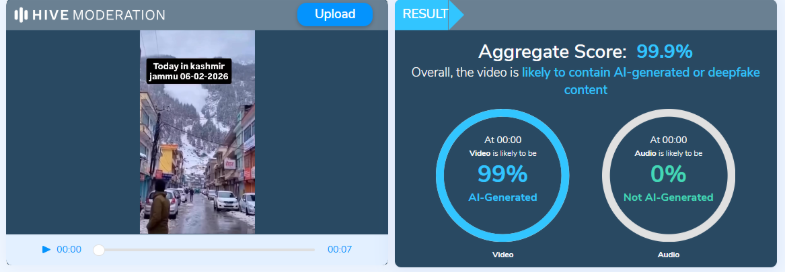
A close examination of the viral video revealed several inconsistencies. For instance, during the alleged avalanche, people present at the site are not seen panicking, running for cover, or moving toward safer locations. Additionally, the movement and flow of the falling snow appear unnatural. Such visual anomalies are commonly observed in videos generated using artificial intelligence. As part of the research , the video was analyzed using the AI detection tool Hive Moderation. The tool indicated a 99.9% probability that the video was AI-generated.
Conclusion
Based on the evidence gathered during our research , it is clear that the video being shared as footage of a Kashmir avalanche is not genuine. The clip is AI-generated and misleading. The viral claim is therefore false.

As AI language models become more powerful, they are also becoming more prone to errors. One increasingly prominent issue is AI hallucinations, instances where models generate outputs that are factually incorrect, nonsensical, or entirely fabricated, yet present them with complete confidence. Recently, ChatGPT released two new models—o3 and o4-mini, which differ from earlier versions as they focus more on step-by-step reasoning rather than simple text prediction. With the growing reliance on chatbots and generative models for everything from news summaries to legal advice, this phenomenon poses a serious threat to public trust, information accuracy, and decision-making.
What Are AI Hallucinations?
AI hallucinations occur when a model invents facts, misattributes quotes, or cites nonexistent sources. This is not a bug but a side effect of how Large Language Models (LLMs) work, and it is only the probability that can be reduced, not their occurrence altogether. Trained on vast internet data, these models predict what word is likely to come next in a sequence. They have no true understanding of the world or facts, they simulate reasoning based on statistical patterns in text. What is alarming is that the newer and more advanced models are producing more hallucinations, not fewer. seemingly counterintuitive. This has been prevalent reasoning-based models, which generate answers step-by-step in a chain-of-thought style. While this can improve performance on complex tasks, it also opens more room for errors at each step, especially when no factual retrieval or grounding is involved.
As per reports shared on TechCrunch, it mentioned that when users asked AI models for short answers, hallucinations increased by up to 30%. And a study published in eWeek found that ChatGPT hallucinated in 40% of tests involving domain-specific queries, such as medical and legal questions. This was not, however, limited to this particular Large Language Model, but also similar ones like DeepSeek. Even more concerning are hallucinations in multimodal models like those used for deepfakes. Forbes reports that some of these models produce synthetic media that not only look real but are also capable of contributing to fabricated narratives, raising the stakes for the spread of misinformation during elections, crises, and other instances.
It is also notable that AI models are continually improving with each version, focusing on reducing hallucinations and enhancing accuracy. New features, such as providing source links and citations, are being implemented to increase transparency and reliability in responses.
The Misinformation Dilemma
The rise of AI-generated hallucinations exacerbates the already severe problem of online misinformation. Hallucinated content can quickly spread across social platforms, get scraped into training datasets, and re-emerge in new generations of models, creating a dangerous feedback loop. However, it helps that the developers are already aware of such instances and are actively charting out ways in which we can reduce the probability of this error. Some of them are:
- Retrieval-Augmented Generation (RAG): Instead of relying purely on a model’s internal knowledge, RAG allows the model to “look up” information from external databases or trusted sources during the generation process. This can significantly reduce hallucination rates by anchoring responses in verifiable data.
- Use of smaller, more specialised language models: Lightweight models fine-tuned on specific domains, such as medical records or legal texts. They tend to hallucinate less because their scope is limited and better curated.
Furthermore, transparency mechanisms such as source citation, model disclaimers, and user feedback loops can help mitigate the impact of hallucinations. For instance, when a model generates a response, linking back to its source allows users to verify the claims made.
Conclusion
AI hallucinations are an intrinsic part of how generative models function today, and such a side-effect would continue to occur until foundational changes are made in how models are trained and deployed. For the time being, developers, companies, and users must approach AI-generated content with caution. LLMs are, fundamentally, word predictors, brilliant but fallible. Recognising their limitations is the first step in navigating the misinformation dilemma they pose.
References
- https://www.eweek.com/news/ai-hallucinations-increase/
- https://www.resilience.org/stories/2025-05-11/better-ai-has-more-hallucinations/
- https://www.ekathimerini.com/nytimes/1269076/ai-is-getting-more-powerful-but-its-hallucinations-are-getting-worse/
- https://techcrunch.com/2025/05/08/asking-chatbots-for-short-answers-can-increase-hallucinations-study-finds/
- https://en.as.com/latest_news/is-chatgpt-having-robot-dreams-ai-is-hallucinating-and-producing-incorrect-information-and-experts-dont-know-why-n/
- https://www.newscientist.com/article/2479545-ai-hallucinations-are-getting-worse-and-theyre-here-to-stay/
- https://www.forbes.com/sites/conormurray/2025/05/06/why-ai-hallucinations-are-worse-than-ever/
- https://towardsdatascience.com/how-i-deal-with-hallucinations-at-an-ai-startup-9fc4121295cc/
- https://www.informationweek.com/machine-learning-ai/getting-a-handle-on-ai-hallucinations

CyberPeace and Suraksha Catalyst: Building the Next Chapter of Indo-US Cybersecurity Collaboration
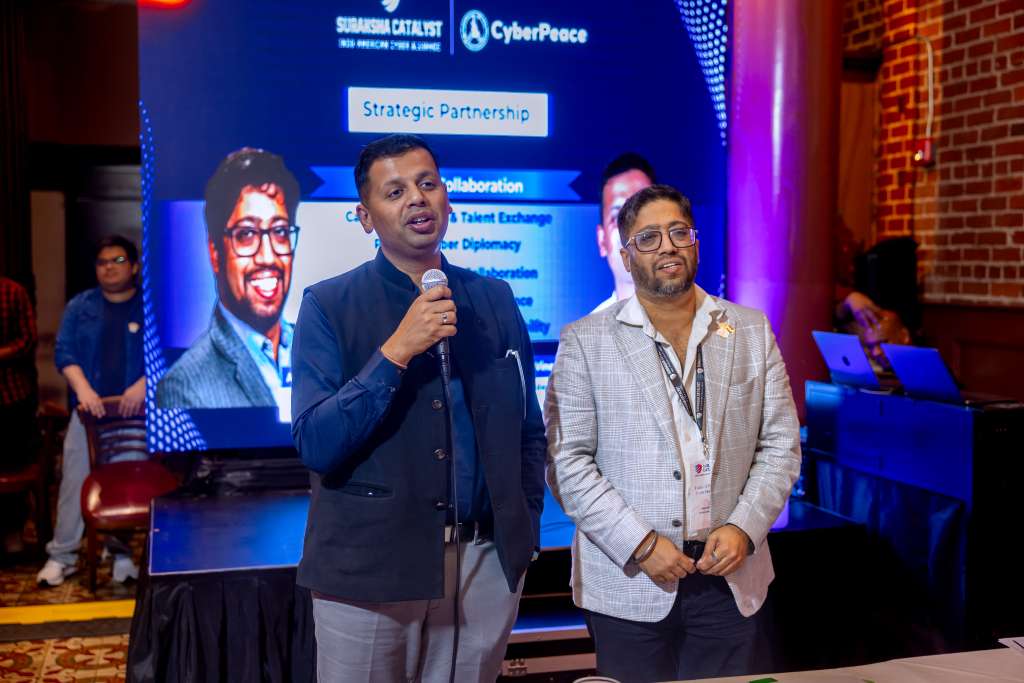
Some partnerships are transactional. Others are declarations of intent. The Memorandum of Understanding signed between CyberPeace and Suraksha Catalyst at the Indo-US Cyber Conclave 2026, held alongside the RSA Conference in San Francisco, belongs unmistakably to the latter category.
It represents more than two organisations agreeing to work together. It brings together two complementary approaches to cybersecurity—CyberPeace ’s community-centred mission and Suraksha Catalyst’s enterprise and Indo-US cybersecurity ecosystem—with a shared ambition to turn collaboration into measurable impact.
Why This Collaboration Is More Than Symbolic
It would be easy to view an MoU signed at a marquee international event as a ceremonial gesture. But the significance of this collaboration lies in what both organisations bring to the table.
CyberPeace brings deep experience in building cyber resilience across communities, institutions, students and other stakeholders. Its approach recognises that cybersecurity is not only a technical challenge; it is also a question of awareness, education, trust and collective responsibility.
Suraksha Catalyst brings a strong connection to cybersecurity leaders, industry and the broader Indo-American technology ecosystem. Its work helps create pathways between cybersecurity practitioners, enterprises, emerging innovators and strategic stakeholders.
Together, these capabilities create a bridge between community resilience and enterprise-grade cybersecurity, connecting education and awareness with industry exposure, mentorship and practical implementation.
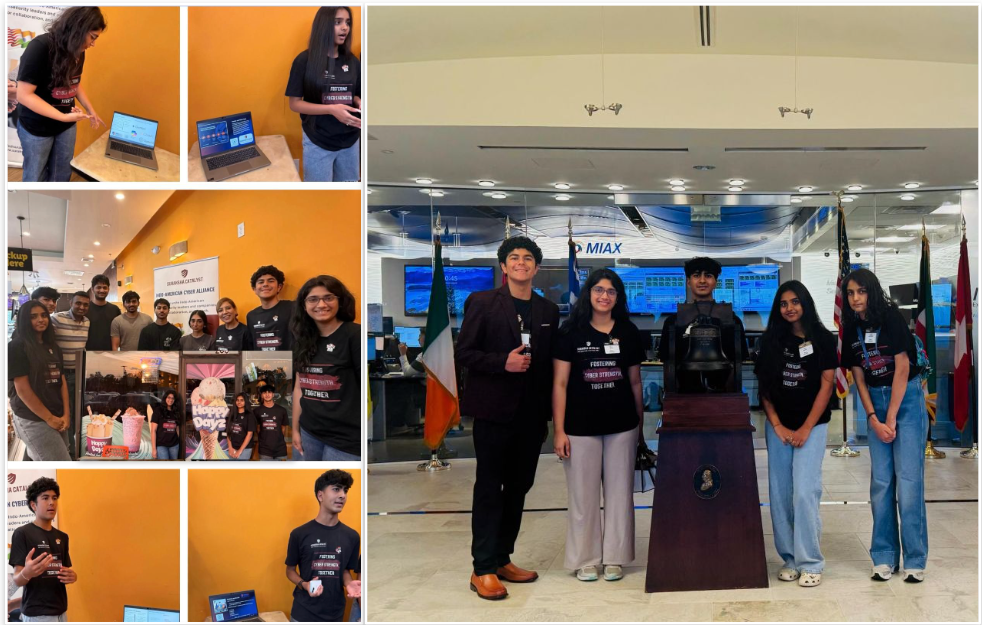
The collaboration is already reflected in the NJ Youth Chapter Mentoring Program, which focuses on inspiring high school students to pursue cybersecurity careers while empowering them to strengthen cyber resilience in their own communities. The programme brings together industry mentors and young learners through a structured five-week journey.
This makes the partnership tangible: rather than limiting collaboration to institutional dialogue, it creates opportunities for young people to learn from cybersecurity professionals and then apply that knowledge in real-world environments.
Two Different Roads to the Same Frontier
CyberPeace has built its approach around the idea that a safer digital world requires participation from multiple layers of society. Its work extends beyond cybersecurity professionals to students, educators, communities and institutions.
Suraksha Catalyst approaches the same challenge through the industry and enterprise ecosystem, creating connections among cybersecurity leaders and organisations across India and the United States.
These different starting points converge around a common principle: cybersecurity resilience becomes stronger when knowledge, expertise and opportunity move across institutional boundaries.
The NJ Youth Chapter Mentoring Program is a strong example of this convergence.
Its first pillar, Mentor Connect, connects high school students with CISOs and security practitioners through weekly 30-minute virtual mentoring sessions. Its second pillar, Community Cyber Corps, encourages students to take what they learn and use it to raise cybersecurity awareness among local small businesses.
The model therefore moves beyond conventional mentoring. Students are not simply receiving knowledge; they are being encouraged to transform that knowledge into community impact.
From Mentoring to Real-World Experience
The programme follows a five-week journey, beginning with virtual mentoring, progressing to a business visit and concluding with a share-and-reflect phase.
This structure provides students with multiple dimensions of exposure:
Learn → Experience → Apply → Reflect
During the programme, participants engage with practical cybersecurity and AI topics including:
- Passwords and passkeys
- Responsible AI use
- AI-enabled phishing
- Patching and software updates
- Deepfake and voice fraud
- Network and Wi-Fi hygiene
- Incident response
- Prompt injection basics
- Vendor and supply-chain risk
These are not presented merely as theoretical cybersecurity concepts. Students are encouraged to understand how such risks manifest in everyday organisational environments and how individuals and businesses can respond.
Turning Young Learners into Community Cyber Ambassadors
Perhaps the most important dimension of the initiative is its emphasis on community impact.
As part of the programme, mentees put their learning into practice by leading a hands-on AI and cybersecurity workshop for employees at a local business. They explored the cyber threat landscape, social engineering, safe browsing and responsible AI, while also gaining experience communicating cybersecurity concepts to a real business audience.
This creates a valuable two-way impact.
Students gain practical experience, confidence and exposure to professional cybersecurity environments. At the same time, local businesses receive access to cybersecurity and AI awareness guidance.
The underlying idea is simple but powerful: when young people are given both knowledge and the opportunity to lead, cybersecurity awareness can travel beyond the classroom and into the wider community.
Inside the Security Operations Center
The programme also provides participants with direct exposure to enterprise security operations.
During an SOC visit, mentees experienced cybersecurity and physical security operations firsthand, observed live threat dashboards and learned how access and infrastructure are secured. Industry professionals also walked them through their day-to-day responsibilities and answered their questions.
For students considering cybersecurity as a career, such exposure can make an otherwise abstract career path tangible. Seeing security professionals operate in real environments helps connect classroom learning with the realities of enterprise cybersecurity.
The Bigger Message
The partnership between CyberPeace and Suraksha Catalyst therefore carries a message that extends beyond the signing of an MoU.
Cybersecurity's most difficult challenges—from protecting communities and young people to strengthening businesses and developing the next generation of cybersecurity professionals—cannot be addressed by a single sector working independently.
They require civil society's reach, industry's expertise, mentors' experience and young people's energy to move in the same direction.
For CyberPeace collaboration with Suraksha Catalyst creates an opportunity to extend its mission of building a safer and more peaceful cyberspace into a broader Indo-US ecosystem.
For Suraksha Catalyst, the collaboration creates an opportunity to connect its industry-oriented ecosystem with community-level cybersecurity education and youth empowerment.
And for the students participating in initiatives such as the NJ Youth Chapter Mentoring Program, the partnership turns cybersecurity from something they simply study into something they can experience, communicate and apply.
From an MoU to a Movement
The real measure of this partnership will ultimately be what emerges from it: joint programmes, mentorship opportunities, community initiatives, knowledge exchange, research, capacity building and stronger connections between cybersecurity professionals and the next generation.
The NJ Youth Chapter Mentoring Program offers an early illustration of what that vision can look like in practice—industry mentors connecting with students, students engaging with real businesses, and young people taking cybersecurity knowledge back into their communities.
The Indo-US cybersecurity relationship is increasingly creating space for governments, enterprises, technology leaders, researchers, civil-society organisations and young innovators to contribute to a shared digital future.
The CyberPeace –Suraksha Catalyst collaboration adds another important layer to that ecosystem: connecting enterprise expertise with community resilience and youth empowerment.
Because the future of cybersecurity will not be shaped only by those who build the technology or defend the infrastructure. It will also be shaped by the people who learn, teach, mentor, question and carry that knowledge into the communities around them.
That is where this partnership has the potential to make its most meaningful contribution—not simply by signing an agreement, but by turning collaboration into capability, capability into confidence, and confidence into lasting cyber resilience.
Reference
- https://www.linkedin.com/posts/a-proud-milestone-for-suraksha-catalyst-share-7440575975614070784-THNR/
- https://surakshacatalyst.com/
- https://cyberpeace.org/