#FactCheck-Viral video of police parading accused is from Gujarat, not linked to Rajasthan's Sriganganagar rape case
Executive Summary
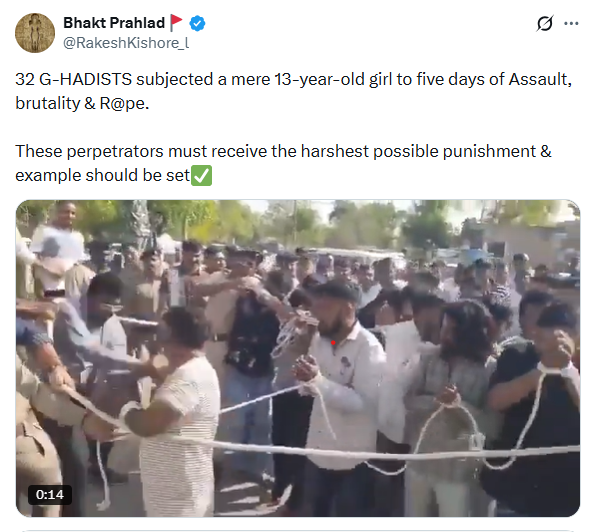
Amid nationwide outrage over the gang-rape of a 13-year-old minor in Sriganganagar, Rajasthan, a video is circulating on social media. The clip shows police officers tying the hands of several accused individuals and parading them publicly on the streets. Users sharing the video claim that these are the culprits from the Sriganganagar case being beaten by the police.
A fact-check by the CyberPeace Research Wing found this claim to be misleading. The viral video has no connection to the Rajasthan incident; it actually depicts a separate event from Patan, Gujarat, dating back to March 2026.
The Claim
On July 7, 2026, a user on X (formerly Twitter) shared the video with the caption: "32 jihadis assaulted, brutalized, and raped a 13-year-old girl for five days. These criminals must get the harshest punishment to set an example."
https://x.com/RakeshKishore_l/status/2074400280352084129
Fact Check
To verify the viral claim, keyframes from the video were extracted and analysed using Google Lens for reverse image search. During the research, we found a report published by NDTV on March 19, 2026, which carried visuals matching the viral video. The report link and screenshot are provided below:

According to the NDTV report, a video showing police personnel publicly assaulting 18 alleged accused persons in Gujarat’s Patan district had surfaced. The incident was reported to have taken place during a crime scene reconstruction exercise.
The report stated that the accused, allegedly linked to an extortion gang, were taken to Chanasma for the reconstruction process. During the exercise, police personnel were seen assaulting them. Witnesses claimed that the accused were paraded through areas where they had allegedly created fear among locals.
The accused were reportedly linked to the alleged Jhiliya gang. The incident occurred days after a violent clash in which members of the same group allegedly attacked a police team, forcing officers to retreat from the spot.
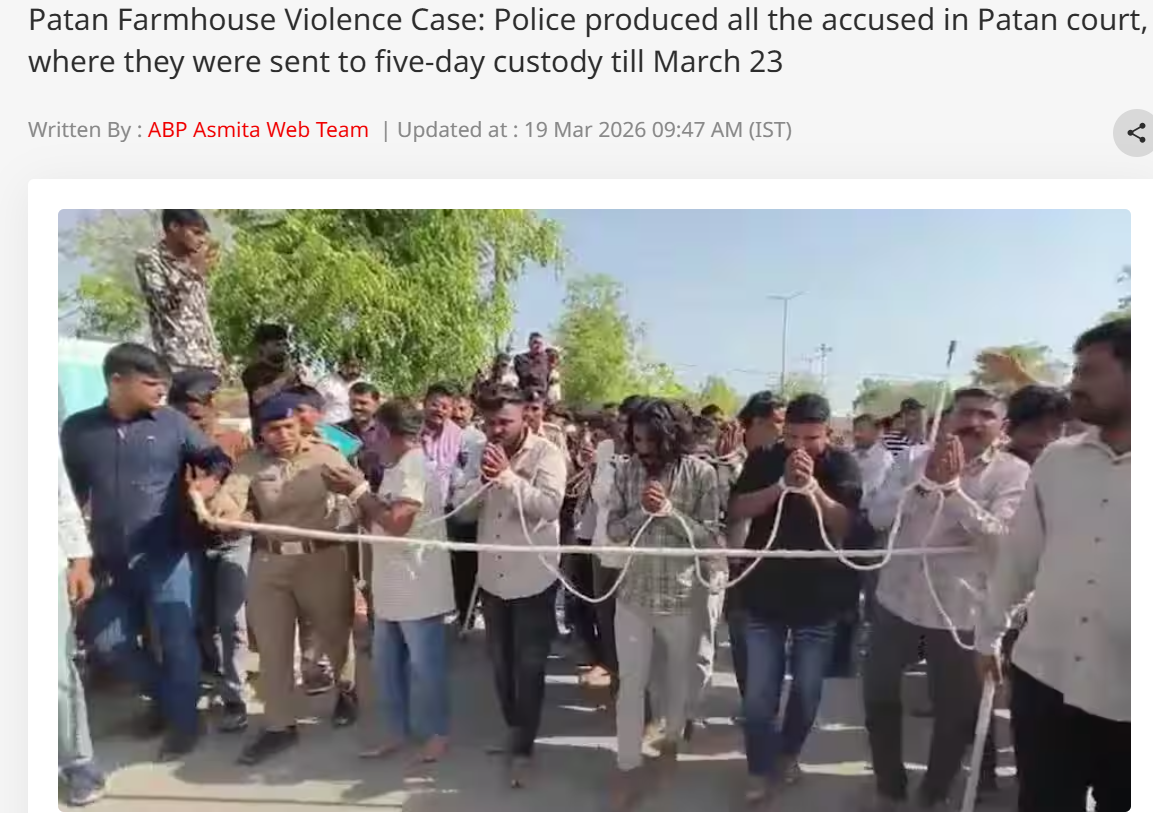
During further research, we found a report published by ABP Asmita on March 19, 2026. According to the report, the incident was linked to an old dispute over temple donations.
The report stated that the accused were produced before a court, which sent them to five days of police custody until March 23, 2026. The report link and screenshot are provided below:
Conclusion
The research found that the viral video is not related to the alleged gang rape case in Sri Ganganagar, Rajasthan. The video is being shared with a false context. The footage actually belongs to a separate incident from Gujarat’s Patan district reported in March 2026.
Related Blogs

.webp)
Introduction
Raksha Bandhan is a cherished festival which is celebrated every year on the full moon day of the Hindu month of Shravan. It is a festival that represents the love, care, and protection that siblings share. This year, Raksha Bandhan falls on 09th August 2025. On this day, sisters tie a sacred thread known as Rakhi on their brothers' wrists as a symbol of love and protection, and in return, brothers promise to safeguard them in all walks of life. The origin of this festival traces back to the Mahabharata, when lord Krishna injured his finger. To bandage the wound, Draupadi, also known as Panchali, tore a piece of her saree and tied it on Krishna's finger. Krishna was touched by her selfless gesture and promised to always protect her, a promise he fulfilled during Drapadi’s time of greatest need.
Today, in the evolving world driven by technology in all aspects of life, the nature of threats has evolved. In this digital age, physical safety alone is no longer enough. Alongside the traditional vow, there is now a growing need for another promise, the promise of Cyber Raksha (Cyber Safety). As we celebrate the spirit of Raksha Bandhan, this year also take the pledge of offering and taking care of the Cyber Suraksha of your sibling.
Ek Vaada Cyber Raksha ka
All the brothers and sisters share the bond of mutual care and responsibility. In the evolving threats of cybercrimes, they must understand the vulnerabilities they might face and the cyber safety tips they should be aware of to protect themselves. You must promise to guide, protect each other from online dangers, and help understand the importance of digital safety. Hence, this Raksha Bandhan, let’s also tie a knot of cyber awareness, responsibility, and digital protection, because true raksha in today’s age is not only about protection in the offline world, it is about protection in both the offline and online world.
CyberPeace has curated the following best practices for you to consider in your life and also to share with your sisters and brothers.
Password Security
It is most important to realise that cybercrooks mostly have their eyes on your passwords to target and gain access to your accounts or information. Scammers try multiple ways to get access to your passwords by way of various methods such as OTP frauds, Fake login pages (spoofing), Social engineering, Credential stuffing, Brute-force attacks, phishing, etc.
Quick Tips
- Use strong passwords.
- Regularly update passwords.
- Use separate passwords for different accounts.
- Use secure & trusted password managers.
- Use two-factor authentication for an extra layer of security.
- Make sure not to save passwords on random devices.
Social Media Security
There are endless cyber scams that take place through social media, such as identity theft, cyberbullying, cyber stalking, online harassment, data leaks, suspicious links leading to phishing and malware, exposure to inappropriate content, etc. It becomes important for netizens to protect their accounts, data, and online presence on social media platforms from the growing cyber threats.
Quick Tips
- Review app permissions and do not give any unnecessary app permissions.
- Keep your account private or customise your privacy settings as per your needs.
- Be cautious while interacting with strangers.
- Do not click on any suspicious or unknown links.
- Make sure to log out in case you have to log in to your social media on an unfamiliar device, and update your password to prevent unauthorised access.
- Always use Two-Factor authentication for your social media accounts.
- Avoid sharing too much of your personal information on the public story or public posts. This can be used by cybercriminals for social engineering.
- Use the report & block function to protect yourself from spam accounts and unwanted interactions.
- If you encounter any issue, report it to the ‘Platform’s reporting mechanism at the ‘Help Centre’.
- One can also reach out to the platform’s grievance officer.
Device Security
In today’s world, the interconnectedness is unavoidable, your devices, be it smartphones, tablets, laptops are not just tools, they are digital extensions of yourself. They contain your discussions, recollections, private information, and frequently your financial and professional information. Safeguarding your devices in the digital world can be equated with safeguarding your physical possessions against undesirable encroachments. Just like a sibling would never let anyone invade your privacy, you too must promise to keep your devices secured against malicious threats like malware, spyware, ransomware, and unauthorized access.
Quick Tips
- Update your apps, browsers, and operating systems frequently; these updates frequently contain security vulnerabilities.
- Install reliable anti-virus and anti-malware software, then perform routine device scans.
- Do not download files or apps from unidentified sources.
- Avoid using open or unprotected public Wi-Fi for private activities like email or banking.
- Employ screen locks (passwords, biometrics, or PINs) to stop unwanted physical access.
- Enable remote wipe or ‘find my Device’ functions in case your device is lost or stolen.
Digital Payments Security
Rakshabandhan is all about giving, but let’s not make it easy for cyber fraudsters to take! Convenience can come at a great cost. It often comes with a danger of fraud, phishing, and money-stealing schemes, as evidenced by the rise in digital payments and UPI transactions. But by being cautious, one can avoid being defrauded. Whether you’re gifting a sibling online or shopping for festive deals, promise yourself and your loved ones that you’ll transact wisely and safely.
Quick Tips
- Never give out your bank credentials, CVV, OTP, or UPI PIN to anyone, even if they seem trustworthy before extensively verifying their credentials.
- Before completing a transaction, confirm the account information or UPI ID.
- Refund or payment links sent by WhatsApp accounts or unknown numbers should not be clicked.
- Use only trusted apps (like BHIM, PhonePe, Google Pay, etc.) downloaded from official app stores.
Email Security
Your email serves as a key to your digital kingdom and serves as more than just a tool for communication. Your email frequently connects everything, from banking to social networking. Scammers use phishing assaults, malware attachments, and impersonation frauds to target it first. Just like a sibling watches your back, watch your inbox. Make a vow not to fall for the digital bait.
Quick tips
- Never open attachments or links in emails that seem strange or suspicious.
- Subject lines that evoke fear, such as “Account Suspended,” “Urgent Action Required” should be avoided.
- Verify the sender’s email address at all times because scammers frequently use little misspellings to deceive you.
- Set up two-factor authentication and create a secure, one of a kind password for your email accounts.
- Avoid using unprotected Wi-Fi networks or public computers to check your email.
- Avoid responding to spam emails or unsubscribing through dubious links as this could give the attacker your address.
Common scams to watch out for
Festive deals scams
As the festive season sales surge in India, so does the risk of cyber scams. Cyber crooks exploit the victims and urge them to share OTPs under the guise of preventing fraudulent activity, sharing malicious links to get sensitive information.
Mis-disinformation
The spread of mis-disinformation has surged on social media platforms. It spreads like wildfire across the digital landscape, and the need for effective strategies to counteract these challenges has grown exponentially in a very short period. ‘Prebunking’ and ‘Debunking’ are two approaches for countering the growing spread of misinformation online.
Deepfake and Voice cloning scams
By using the Deepfake technology, cybercriminals manipulate audio and video content which looks very realistic but, in actuality, is fake. Voice cloning is also a part of deepfake. To create a voice clone of anyone's, audio can be deepfaked too, which closely resembles a real one but, in actuality, is a fake voice created through deepfake technology.
Juice Jacking
Cybercriminals can hack your phone using or exploiting some public charging stations, such as at airports, Malls, hotel rooms, etc. When you plug your cell phone into a USB power charger, you may be plugging into a hacker. Juice jacking poses a security threat commonly at places that provide free charging stations for mobile devices.
Suspicious links & downloads
Suspicious links & downloads can lead you to a phishing site or install malware into your system, which can even lead to compromise your device, expose sensitive data, and cause financial losses.
Conclusion
This Rakhi, ensure your and your sibling’s online safety and security by being cybersafe and smart. You can seek assistance from the CyberPeace Helpline at helpline@cyberpeace.net

The recent Promotion and Regulation of Online Gaming Act, 2025, that came into force in August, has been one of the most widely anticipated regulations in the digital entertainment industry. Among provisions such as promoting esports and licensing of online gaming, the legislation notably introduces a blanket ban on real-money gaming (RMG). The rationale behind this was to reduce its addictive effects, protect minors, and limit the circulation of black-money. However, in reality, the Act has spawned apprehension about the legislative process, regulatory redundancy, and unintended consequences that can shift users and revenue to offshore operators.
From Debate to Prohibition: How the Act was Passed
The Promotion and Regulation of Online Gaming Act was passed as a central law, providing the earlier fragmented state laws on online betting and gambling with an overarching framework. Proponents argue that, among other provisions, some kind of unified national framework was needed to deal with the scale of online betting due to its detrimental impact on young users. The current Act is a direct transition to criminalisation rather than the swings of self-regulation and partial restrictions used during the previous decade of incremental experiments in regulation. Stakeholders in the industry believe that this type of sudden, blanket action creates uncertainty and erodes confidence in the system in the long run. Further, critics have pointed out that the Bill was passed without adequate Parliamentary deliberation. A question has been raised about whether procedural safeguards were upheld.
Prohibition of Online RMG
Within the Indian context, a distinction has long been drawn between games of skill and games of chance, with the latter, like a lottery or a casino, being severely prohibited under state laws, whereas the former, like rummy or fantasy sports, have generally been allowed after being recognized as skill-based by court authorities. The Online Gaming Act of 2025 abolishes this distinction on the internet, thus banning all RMG actions that include cash transactions, regardless of skill or chance. The act also criminalises the advertising, facilitation, and hosting of such sites, thereby penalizing offshore operators with an Indian customer focus, and subjecting their payment gateways, app stores, and advertisers under its jurisdiction to penalties.
The Problem of Overlap
One potential issue that the Act presents is its overlap with the existing laws. The IT Rules 2023 mandate intermediaries in the gaming sector to appoint compliance officers, submit monthly reports, and undergo due diligence. The new Act introduces a three-level classification of games, whereas the advisories of the Central Consumer Protection Authority (CCPA) under the Consumer Protection Act treat online betting as an unfair trade practice.
This multiplicity of regulations builds a maze where different Ministries and state governments have overlapping jurisdiction. Policy experts caution that such an overlap can create enforcement challenges, punish players who act within the law, and leave offshore malefactors undetected.
Unintended Consequences: Driving Users Offshore
Outright prohibition will hardly ever remove demand; it will only push it out. Offshore sites have taken advantage of the situation as Indian operators like Dream11 shut down their money games after the ban. It has already been reported that there is aggressive advertising by foreign betting companies that are not registered in India, most of which have backend infrastructure that cannot be regulated by the Act (Storyboard18).
This diversion of users to unregulated markets has two main risks. First, Indian players are deprived of the consumer protection offered to them in local regulation, and their data can be sent to suspicious foreign organizations. Second, the government loses control over the money flow that can be transferred via informal channels or cryptocurrencies or other obscure systems. Industry analysts are alerting that such developments may only worsen the issue of black-money instead of solving it (IGamingBusiness).
Advertising, Age Gating, and Digital Rights
The Act has also strengthened advertisement regulations, aligning with advisories issued by the Advertising Standards Council of India, which prohibits the targeting of minors. However, critics believe that the application remains inadequately enforced, and children can with comparative ease access unregulated overseas applications. In the absence of complementary digital literacy programs and strong parental controls, these limitations can be effectively superficial instead of real.
Privacy advocates also warn that frequent prompts, vague messages, or invasive surveillance can weaken the digital rights of users instead of strengthening them. Overregulation has also been found to create banner blindness in global contexts where users ignore warnings without first clearly understanding them.
Enforcement Challenges
The Act puts a lot of responsibilities on many stakeholders, including the Ministry of Information and Broadcasting (MIB) and the Reserve Bank of India (RBI). Platforms like Google Play and Apple App Store are expected to verify government-approved lists of compliant gaming apps and remove non-compliant or banned ones, as directed by the MIB and the RBI. Although this pressure may motivate intermediaries to collaborate, it may also have a risk of overreach when it is applied unequally or in a political way.
According to the experts, the solution should be underpinned by technology itself. Artificial intelligence can be used to identify illegal advertisements, track illegal gaming in children, and trace payment streams. At the same time, the regulators should be able to issue final lists of either compliant or non-compliant applications to advise the consumers and intermediaries alike. Without such practical provisions, enforcement risks remaining patchy.
Online Gaming Rules
On 1 October 2025, the government issued a draft of the Online Gaming Rules in accordance with the Promotion and Regulation of Online Gaming Act. The regulations focus on the creation of the compliance frameworks, define the classification of the allowed gaming activities, and prescribe grievance-redressal mechanisms aiming to promote the protection of the players and procedural transparency. However, the draft does not revisit or soften the existing blanket prohibition on real-money gaming (RMG) and, hence, the questions about the effectiveness of enforcement and regulatory clarity remain open (Times of India, 2025).
Protecting Consumers Without Stifling Innovation
The ban highlights a larger conflict, i.e., the protection of the vulnerable users without stifling an industry that has traditionally contributed to innovation, jobs, and the collection of tax revenue. Online gaming has significantly added to the GST collections, and the sudden shakeup brings fiscal concerns (Reuters).
Several legal objections to the Act have already been brought, asking whether the Act is constitutional, especially as to whether the restrictions are proportional to the right to trade. The outcome of such cases will define the future trajectory of the digital economy of India (Reuters).
Way Forward
Instead of outright prohibition, a more balanced approach that incorporates regulation and consumer protection is suggested by the experts. Key measures could include:
- A definite difference between games of skill and games of chance, with proportionate regulation.
- Age confirmation and campaign against online illiteracy to protect the underage population.
- Enhanced advertising and payments compliance requirements and enforceable non-compliance penalty.
- Coordinated oversight among different ministries to prevent duplication and regulatory struggle.
- Leveraging AI and fintech to track illegal financial activities (black money flows) and developing innovation.
Conclusion
The Online Gaming Act 2025 addresses social issues, such as addiction, monetary risk, and child safety, that require governance interventions. However, the path it follows to this end, that of total prohibition, is more likely to spawn a new set of issues instead of providing solutions because it will send consumers to offshore sites, undermine consumer rights, and slow innovation.
For India, the real challenge is not whether to prohibit online money gaming but how to create a balanced, transparent, and enforceable framework that protects users while fostering a responsible gaming ecosystem. India can reduce the adverse consequences of online betting without keeping the industry in the shadows with better coordination, reasonable use of technology, and balanced protection.
References:
- India's Dream11, top gaming apps halt money-based games after ban
- India online gambling ban could drive punters to black market
- Offshore betting firms with backend ops in India not covered by online gaming law
- The Great Gamble: India’s Online Gaming Ban, The GST Battle, And What Lies Ahead.
- Game Over for Online Money Games? An Analysis of the Online Gaming Act 2025
- Government gambles heavily on prohibiting online money gaming
- Online gaming regulation: New rules to take effect from October 1; government stresses consultative approach with industry

Data localisation refers to restrictions in the data flow by limiting the physical storage and processing of data within a given jurisdiction’s boundaries.
An obvious benefit contributing to the importance of data localisation is the privacy benefits it offers. In addition to this, data localisation also has the potential to safeguard sensitive data and decrease the probability of cyber-attacks. In India, data localisation has become a key issue in the last decade due to the increase in the discourse for data privacy.
The Legal Framework in India
India passed the Digital Personal Data Protection Act of 2023 which directs the data fiduciaries (collectors and processors of digital personal data) to store the data of Indian citizens within India. This push for data localisation aligns with India’s position to enhance privacy, national security and regulatory control. It further requires data fiduciaries to adhere to the principles of data minimisation, purposeful limitation and consent of the data principles. Further, Section 17 of the Act prohibits the transfer of sensitive personal data to foreign jurisdictions unless they meet satisfactory privacy protection standards.
The Reserve Bank of India, via a circular for Payments Data Regulation in 2018, has mandated that all payment data be stored in India, though it can be processed abroad. It requires the telecom sector to ensure local storage and local processing of subscriber information. It further prohibits the transferring of subscribers’ account information overseas.
MeitY’s Information Technology (Intermediary Guidelines and Digital Media Ethics Code) Rules, 2021, emphasise data localisation, specifically when it involves government or critical data. The main idea behind this is that data related to Indian citizens or government activities should remain accessible to Indian law enforcement agencies and is not subject to external jurisdiction.
Common Misinformation about Data Localisation and its Impact
Misconceptions fuel misinformation and influence public perception and policy debates. A common misconception is that all data must be stored in India. It should be noted that non-critical and non-sensitive data are not subject to localisation, and can be cleared for cross-border transfers under specific circumstances.
Another misconception is that data localisation alone ensures complete security. A robust cybersecurity approach, infrastructure and capabilities are what guarantee security and this holds true regardless of the location of where the data is stored.
The notion that small businesses and startups will suffer the most is untrue. While data localisation policies may lead to increased costs, they foster innovation in the domestic infrastructure and services. This potentially fuels development and innovation in these small businesses and startups. Claims that data localisation will stifle global business are unfounded.
Proper regulations for data transfers can help balance data flows, enabling international trade while ensuring data sovereignty.
Real Impact of Data Localisation
Data localisation impacts several domains and has both positive and negative outcomes.
- It can be a driver for investment in local data centres and infrastructure, thereby inducing employment generation and boosting the domestic economy. And in contrast, the compliance costs may rise especially for MNCs that need to maintain multiple data storage systems.
- It can expedite the growth of local technology ecosystems while encouraging innovation in cloud computing and data storage solutions. On the other hand, small businesses might face struggles to afford the required infrastructure updates and upgrades.
- Law enforcement agencies will be able to gain access to data more swiftly while avoiding lengthy processes such as the Mutual Legal Assistance Treaties (MLATs). However, it should be noted that storing data locally does not automatically ensure that they are immune from attacks and breaches.
- A balance between sovereignty and global partnerships is a challenge that emerges with data localisation. International Trade Relationships are vulnerable to data localisations where countries favour a free data flow. This can hamper foreign collaborations with companies that rely on global data systems.
CyberPeace Outlook
It is important to clear misinformation about data localisation, some strategies that can be undertaken are:
- Launching public awareness campaigns to educate the stakeholders about the real requirements and the benefits of data localisation. Misinformation about data restrictions and security guarantees should be tackled fairly quickly.
- A balanced approach that promotes local economic development while at the same time allowing for the necessary cross-border data flows and creating a flexible and friendly business environment is important.
- India should work on international frameworks to streamline the process of data-sharing with other nations. This would protect national interests while making global cooperation easier.
Conclusion
Data localisation in India presents a valuable opportunity to enhance privacy, bolster national security, and stimulate economic growth through local infrastructure investment. Yet, addressing common misconceptions is crucial; the belief that all data must be stored domestically or that localisation alone ensures security is misleading.
It’s vital to pair local data storage with robust cybersecurity measures and foster international cooperation. Supporting small businesses, which may face challenges due to localisation requirements, is equally important. By addressing misinformation, promoting flexible regulations, and working towards global data-sharing frameworks, India can effectively manage the complexities of data localisation, safeguarding national interests while encouraging innovation and economic development.
References
- https://www.thehindu.com/sci-tech/technology/are-data-localisation-requirements-necessary-and-proportionate/article66131957.ece
- https://carnegieendowment.org/research/2021/04/how-would-data-localization-benefit-india?lang=en
- https://www.rbi.org.in/commonperson/English/Scripts/FAQs.aspx?Id=2995
- https://www.meity.gov.in/writereaddata/files/Information%20Technology%20%28Intermediary%20Guidelines%20and%20Digital%20Media%20Ethics%20Code%29%20Rules%2C%202021%20%28updated%2006.04.2023%29-.pdf