
#FactCheck-Viral Video of Crying Girl Amid Floodwaters Is AI-Generated, Not From Nepal
Executive Summary
A video is being shared on social media showing a little girl crying while holding onto a pole amid muddy water covering a road. The video is being shared with the claim that it shows the situation during the recent floods in Nepal. A research by CyberPeace’s Research Wing found the viral claim to be false. Our research revealed that the viral video is AI-generated and is being shared with a misleading claim.
Claim:
A user on the social media platform Instagram shared the viral video with the caption: “The situation in Nepal looks extremely frightening after the floods. Floodwater has covered the area, and the frightened face of a little girl amid the water is moving everyone emotionally. Seeing the innocent girl’s condition in this difficult situation has raised concerns among people.”
https://www.instagram.com/reels/DctRY9OF0Th/

Fact Check
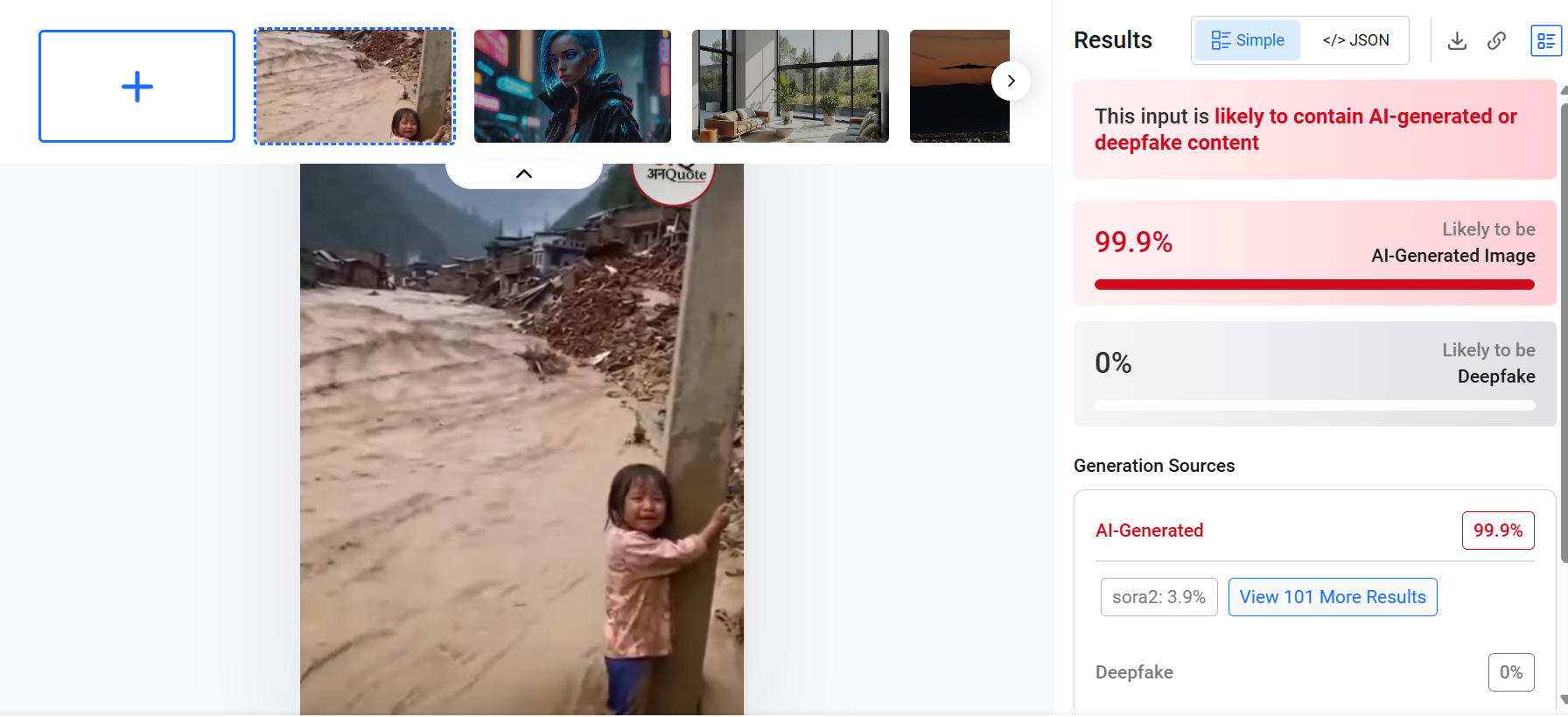
A reverse image search of keyframes from the viral video on Google did not yield any credible media reports related to the video. Upon closely examining the viral video, we suspected that it might be AI-generated. We subsequently scanned the video using the AI detection tool Hive Moderation. According to the results, the video has a 99 percent probability of being AI-generated.
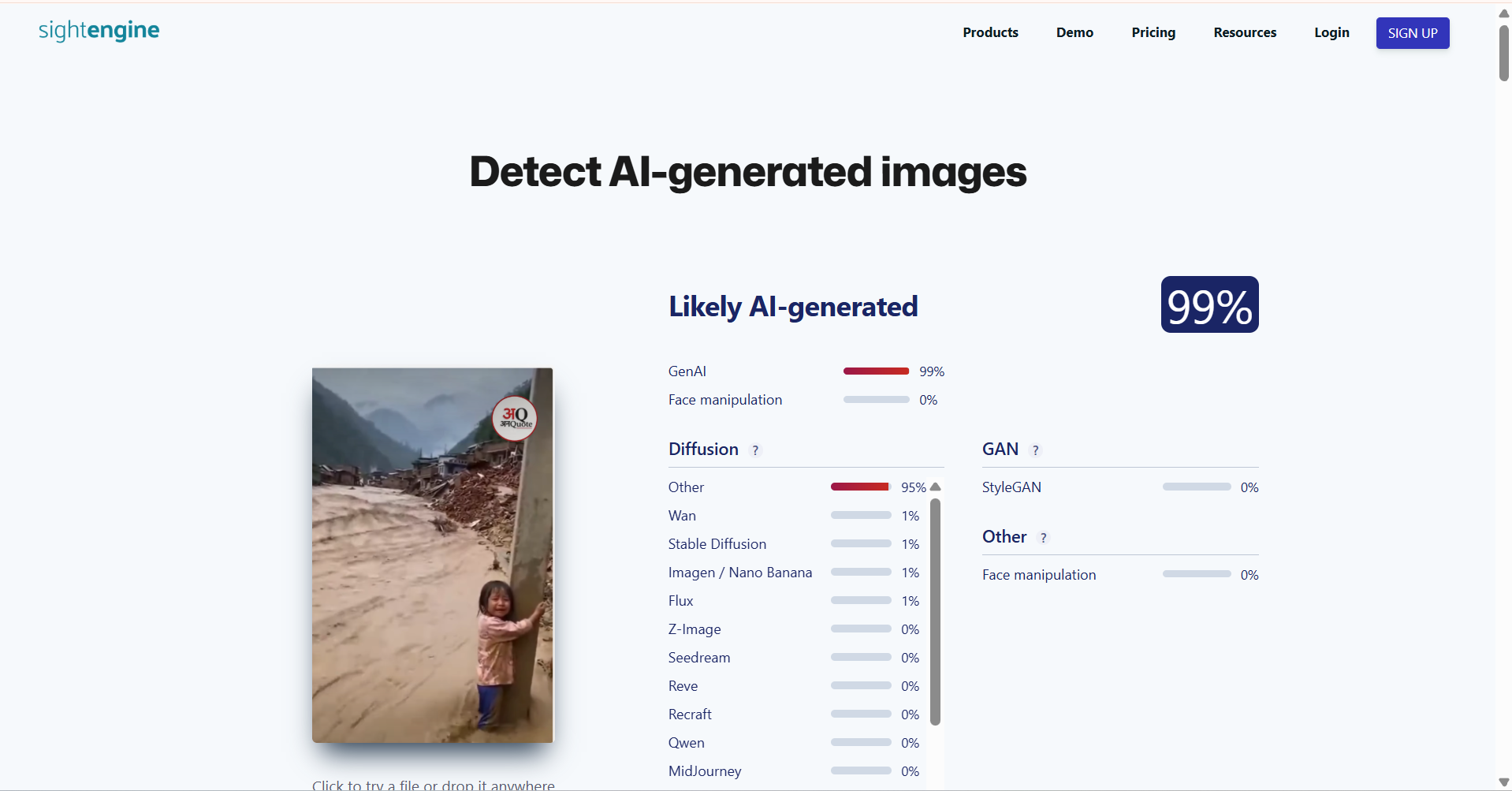
As part of the next step of ourresearch, we scanned the viral video using another AI detection tool, Sightengine. According to the results, the video has a 99 percent probability of being AI-generated.
Conclusion
Our research found that the viral video is AI-generated and is being shared with a misleading claim.

Related Blogs

Executive Summary:
Recently PAN-OS software of Palo Alto Networks was discovered with the critical vulnerability CVE-2024-3400. It is the software used to power all their networks in the next generation firewalls. This vulnerability is a common injection vulnerability which provides access to unauthenticated attackers to execute random code having root privileges on the attacked system. This has been exploited actively by threat actors, leaving many organizations at risk for severe cyberattacks. This report helps to understand the exploitation, detection, mitigations and recommendations for this vulnerability.

Understanding The CVE-2024-3400 Vulnerability:
CVE-2024-3400 impacts the particular version of PAN-OS and a certain configuration susceptible to this kind of a security issue. It is a command injection, which exists in the GlobalProtect module of the PAN-OS software. The vulnerability can be exploited by an unauthorized user to run any code on the firewall having root privileges. This targets Active Directory database (ntds.dit), important data (DPAPI), and Windows event logs (Microsoft-Windows-TerminalServices-LocalSessionManager%4Operational.evtx) and also login data, cookies, and local state data for Chrome and Microsoft Edge from specific targets leading attackers to capture the browser master key and steal sensitive information of the organization.
The CVE-2024-3400 has been provided with a critical severity rating of 10.0. The following two weaknesses make this CVE highly severe:
- CWE-77: Improper Neutralization of Special Elements used in a Command ('Command Injection')
- CWE-20: Improper Input Validation.
Impacted Products:
The affected version of PAN-OS by CVE-2024-3400 are-

Only the versions 10.2, 11.0, and 11.1, setup with GlobalProtect Gateway or GlobalProtect Portal are exploited by this vulnerability. Whereas the Cloud NGFW, Panorama appliances and Prisma Access are not affected.
Detecting Potential Exploitation:
Palo Alto Networks has confirmed that they are aware of the exploitation of this particular vulnerability by threat actors. In a recent publication they have given acknowledgement to Volexity for identifying the vulnerability. There is an increasing number of organizations that face severe and immediate risk by this exploitation. Third parties also have released the proof of concept for the vulnerability.
The suggestions were provided by Palo Alto Networks to detect this critical vulnerability. To detect this vulnerability, the following command shall be run on the command-line interface of PAN-OS device:
grep pattern "failed to unmarshal session(.\+.\/" mp-log gpsvc.log*
This command looks through device logs for specific entries related to vulnerability.
These log entries should contain a long, random-looking code called a GUID (Globally Unique Identifier) between the words "session(" and ")". If an attacker has tried to exploit the vulnerability, this section might contain a file path or malicious code instead of a GUID.
Presence of such entries in your logs, could be a sign of a potential attack to hack your device which may look like:
- failed to unmarshal session(../../some/path)
A normal, harmless log entry would look like this:
- failed to unmarshal session(01234567-89ab-cdef-1234-567890abcdef)
Further investigations and actions shall be needed to secure the system in case the GUID entries were not found and suspicious.
Mitigation and Recommendations:
Mitigation of the risks posed by the critical CVE-2024-3400 vulnerability, can be accomplished by the following recommended steps:
- Immediately update Software: This vulnerability is fixed in software releases namely PAN-OS 10.2.9-h1, PAN-OS 11.0.4-h1, PAN-OS 11.1.2-h3, and all higher versions. Updating software to these versions will protect your systems fully against potential exploitation.
- Leverage Hotfixes: Palo Alto Networks has released hotfixes for commonly deployed maintenance releases of PAN-OS 10.2, 11.0, and 11.1 for the users who cannot upgrade to the latest versions immediately. These hotfixes do provide a temporary solution while you prepare for the full upgrade.
- Enable Threat Prevention: Incase of available Threat Prevention subscription, enable Threat IDs 95187, 95189, and 95191 to block attacks targeting the CVE-2024-3400 vulnerability. These Threat IDs are available in Applications and Threats content version 8836-8695 and later.
- Apply Vulnerability Protection: Ensure that vulnerability protection has been applied in the GlobalProtect interface to prevent the exploitation on the device. It can be implemented using these instructions.
- Monitor Advisory Updates: Regularly checking for the updates to the official advisory of Palo Alto Networks. This helps to stay up to date of the new releases of the guidance and threat prevention IDs of CVE-2024-3400.
- Disable Device Telemetry – Optional: It is suggested to disable the device telemetry as an additional precautionary measure.
- Remediation: If there is an active exploitation observed, follow the steps mentioned in this Knowledge Base article by Palo Alto Networks.
Implementation of the above mitigation measures and recommendations would be in a position to greatly reduce the risk of exploitation you might face from a cyber attack targeting the CVE-2024-3400 vulnerability in Palo Alto Networks' PAN-OS software.
Conclusion:
The immediate response should be taken against the offensive use of the critical CVE-2024-3400 vulnerability found in the PAN-OS platform of Palo Alto Networks. Organizations should actively respond by implementing the suggested mitigation measures such as upgrading to the patched versions, enabling threat prevention and applying vulnerability protection to immediately protect from this vulnerability. Regular monitoring, implementing security defense mechanisms and security audits are the necessary measures that help to combat emerging threats and save critical resources.

Introduction
The increasing online interaction and popularity of social media platforms for netizens have made a breeding ground for misinformation generation and spread. Misinformation propagation has become easier and faster on online social media platforms, unlike traditional news media sources like newspapers or TV. The big data analytics and Artificial Intelligence (AI) systems have made it possible to gather, combine, analyse and indefinitely store massive volumes of data. The constant surveillance of digital platforms can help detect and promptly respond to false and misinformation content.
During the recent Israel-Hamas conflict, there was a lot of misinformation spread on big platforms like X (formerly Twitter) and Telegram. Images and videos were falsely shared attributing to the ongoing conflict, and had spread widespread confusion and tension. While advanced technologies such as AI and big data analytics can help flag harmful content quickly, they must be carefully balanced against privacy concerns to ensure that surveillance practices do not infringe upon individual privacy rights. Ultimately, the challenge lies in creating a system that upholds both public security and personal privacy, fostering trust without compromising on either front.
The Need for Real-Time Misinformation Surveillance
According to a recent survey from the Pew Research Center, 54% of U.S. adults at least sometimes get news on social media. The top spots are taken by Facebook and YouTube respectively with Instagram trailing in as third and TikTok and X as fourth and fifth. Social media platforms provide users with instant connectivity allowing them to share information quickly with other users without requiring the permission of a gatekeeper such as an editor as in the case of traditional media channels.
Keeping in mind the data dumps that generated misinformation due to the elections that took place in 2024 (more than 100 countries), the public health crisis of COVID-19, the conflicts in the West Bank and Gaza Strip and the sheer volume of information, both true and false, has been immense. Identifying accurate information amid real-time misinformation is challenging. The dilemma emerges as the traditional content moderation techniques may not be sufficient in curbing it. Traditional content moderation alone may be insufficient, hence the call for a dedicated, real-time misinformation surveillance system backed by AI and with certain human sight and also balancing the privacy of user's data, can be proven to be a good mechanism to counter misinformation on much larger platforms. The concerns regarding data privacy need to be prioritized before deploying such technologies on platforms with larger user bases.
Ethical Concerns Surrounding Surveillance in Misinformation Control
Real-time misinformation surveillance could pose significant ethical risks and privacy risks. Monitoring communication patterns and metadata, or even inspecting private messages, can infringe upon user privacy and restrict their freedom of expression. Furthermore, defining misinformation remains a challenge; overly restrictive surveillance can unintentionally stifle legitimate dissent and alternate perspectives. Beyond these concerns, real-time surveillance mechanisms could be exploited for political, economic, or social objectives unrelated to misinformation control. Establishing clear ethical standards and limitations is essential to ensure that surveillance supports public safety without compromising individual rights.
In light of these ethical challenges, developing a responsible framework for real-time surveillance is essential.
Balancing Ethics and Efficacy in Real-Time Surveillance: Key Policy Implications
Despite these ethical challenges, a reliable misinformation surveillance system is essential. Key considerations for creating ethical, real-time surveillance may include:
- Misinformation-detection algorithms should be designed with transparency and accountability in mind. Third-party audits and explainable AI can help ensure fairness, avoid biases, and foster trust in monitoring systems.
- Establishing clear, consistent definitions of misinformation is crucial for fair enforcement. These guidelines should carefully differentiate harmful misinformation from protected free speech to respect users’ rights.
- Only collecting necessary data and adopting a consent-based approach which protects user privacy and enhances transparency and trust. It further protects them from stifling dissent and profiling for targeted ads.
- An independent oversight body that can monitor surveillance activities while ensuring accountability and preventing misuse or overreach can be created. These measures, such as the ability to appeal to wrongful content flagging, can increase user confidence in the system.
Conclusion: Striking a Balance
Real-time misinformation surveillance has shown its usefulness in counteracting the rapid spread of false information online. But, it brings complex ethical challenges that cannot be overlooked such as balancing the need for public safety with the preservation of privacy and free expression is essential to maintaining a democratic digital landscape. The references from the EU’s Digital Services Act and Singapore’s POFMA underscore that, while regulation can enhance accountability and transparency, it also risks overreach if not carefully structured. Moving forward, a framework for misinformation monitoring must prioritise transparency, accountability, and user rights, ensuring that algorithms are fair, oversight is independent, and user data is protected. By embedding these safeguards, we can create a system that addresses the threat of misinformation and upholds the foundational values of an open, responsible, and ethical online ecosystem. Balancing ethics and privacy and policy-driven AI Solutions for Real-Time Misinformation Monitoring are the need of the hour.
References
- https://www.pewresearch.org/journalism/fact-sheet/social-media-and-news-fact-sheet/
- https://eur-lex.europa.eu/legal-content/EN/TXT/HTML/?uri=OJ:C:2018:233:FULL

Executive Summary
A video is being widely shared on social media with the claim that it shows the recent Assam floods, where nurses are rescuing newborn babies after water entered a hospital. The caption accompanying the viral video claims that the babies are not drowning; instead, healthcare workers and rescue teams are carrying them to safety amid floodwaters inside a hospital. It further states that the video shows humanity and courage during a time of crisis. CyberPeace Research Wing’s research found the claim to be false. The research revealed that the viral video showing healthcare workers rescuing newborn babies is not real but was created using Artificial Intelligence (AI).
Claim:
An Instagram user named kamlakritika shared the video and claimed that it showed the Assam floods. The post stated that the babies were not drowning but were being rescued by healthcare workers and rescue teams from a flooded hospital. In the viral video, several nurses can be seen running through waterlogged areas while trying to protect incubators — containers used to keep newborn babies — from being submerged or swept away. According to the caption, a devastating flood had turned the entire area into a disaster zone. It claimed that incubators containing premature newborn babies were floating in floodwaters, while nurses were running behind them amid strong water currents to save the infants. The caption further claimed that several incubators were overturning and sinking with babies inside, putting hundreds of fragile lives at risk.
https://www.instagram.com/reel/DbXvJwgz72X/?utm_source=ig_web_copy_link&igsh=NTc4MTIwNjQ2YQ==

Factcheck
To verify the claim, CyberPeace Research Wing conducted a Google search using relevant keywords. During the search, the video was found shared by several other Instagram accounts. During the research, we found a report published by News18 on August 1, 2026. Although the report was related to the Assam floods, it mentioned a different incident. According to the report, a viral video showed floodwaters surrounding houses, with water spread across the area. In the video, a rescue team member can be seen carefully carrying a newborn baby in his arms through the flooded area and handing the child over to another rescue worker near a boat so that the baby could be taken to safety.

However, during our research, we could not find any information from credible news organisations or official sources confirming the viral video showing newborn babies being rescued in incubators. As part of further research, we closely examined the viral video and noticed several indications suggesting that it could be AI-generated. The video was then analysed using the AI detection tool FauxLens, which indicated that the video was approximately 75% AI-generated.

To further verify the authenticity of the video, we also analysed it using another AI detection tool, Human Meter. The tool showed an 85% probability of the video being generated with the help of AI.

Conclusion:
CyberPeace Research Wing’s research found that the viral video claiming to show nurses rescuing newborn babies during Assam floods is false. The video is not an actual incident but an AI-generated creation.
