
#FactCheck: Video of Devotees Breaking Barricades During Ganesh Immersion Is From Hyderabad, Not Karnataka
Executive Summary
A video is being shared on social media showing several people breaking iron barricades installed along the banks of a water body. The video is being shared with the claim that people broke the barricades after the Karnataka government imposed a ban on idol immersion to prevent pollution in the river. CyberPeace Research found the viral claim to be misleading. Our Research revealed that the video is not from Karnataka but from Hyderabad, Telangana. The video shows members of The Bhagyanagar Ganesh Utsav Committee (BGUS) removing barricades installed at Tank Bund to prevent the immersion of Plaster of Paris (PoP) idols in the water body. The barricades had been installed following the High Court’s directions. Therefore, the claim linking the video to Karnataka is incorrect.
Claim:
A Facebook user shared the video with the caption: “Chaos erupts in Karnataka over the ban on idol immersion! Breaking the iron barricades, they said — ‘We will immerse the idols in the river itself!’” The post link, archive link, and screenshot are provided below.
https://www.facebook.com/watch/?v=1523733916224661
https://ghostarchive.org/archive/SJgmD
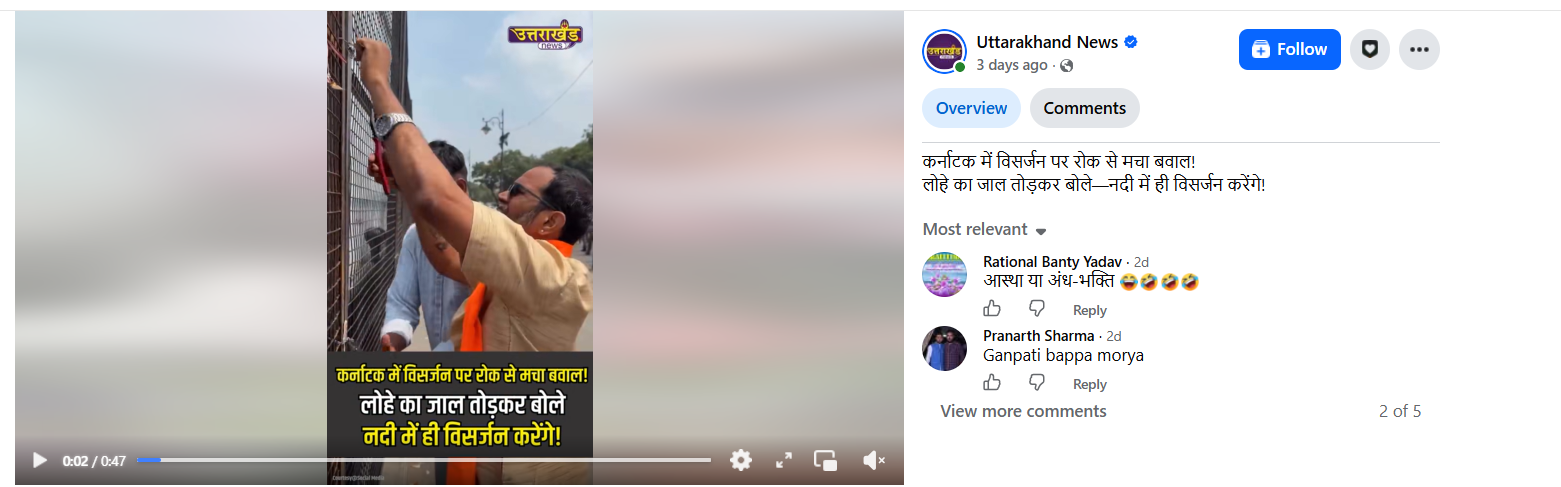
Fact Check
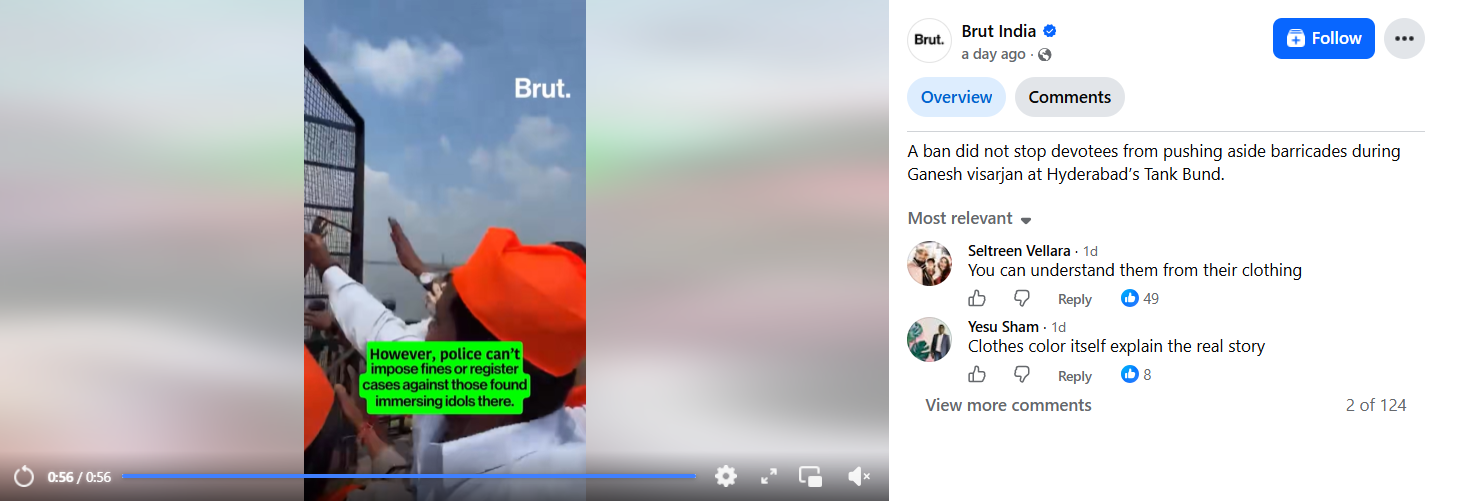
To verify the authenticity of the viral claim, we conducted a reverse image search of keyframes from the video. During the search, we found the same video on the Facebook page of Brut India. According to the post, the video is from Hyderabad. The caption states that despite the restrictions, devotees removed the barricades and made way during the Ganesh idol immersion at Hyderabad’s Tank Bund. The post link and screenshot are provided below.
https://www.facebook.com/watch/?v=2220012475615416
Taking the Research forward, we found the same video in a news report uploaded on the YouTube channel of ‘9Plus News’ on September 21, 2026. The report also includes the portion of the viral clip in which people can be seen breaking the barricades. According to the report, the incident took place in the Tank Bund area of Hyderabad. The post link and screenshot are provided below.
https://www.youtube.com/watch?v=l7GRELjqAwY

Conclusion
Our Research found that the viral video is not from Karnataka but from Hyderabad, Telangana. The video shows members of the Bhagyanagar Ganesh Utsav Committee (BGUS) removing barricades installed at Tank Bund to prevent the immersion of Plaster of Paris (PoP) idols in the water body. These barricades had been installed following the High Court’s directions. Therefore, the claim linking the video to Karnataka is false.

Related Blogs

Introduction
Advanced deepfake technology blurs the line between authentic and fake. To ascertain the credibility of the content it has become important to differentiate between genuine and manipulated or curated online content highly shared on social media platforms. AI-generated fake voice clone, videos are proliferating on the Internet and social media. There is the use of sophisticated AI algorithms that help manipulate or generate synthetic multimedia content such as audio, video and images. As a result, it has become increasingly difficult to differentiate between genuine, altered, or fake multimedia content. McAfee Corp., a well-known or popular global leader in online protection, has recently launched an AI-powered deepfake audio detection technology under Project “Mockingbird” intending to safeguard consumers against the surging threat of fabricated or AI-generated audio or voice clones to dupe people for money or unauthorisly obtaining their personal information. McAfee Corp. announced its AI-powered deepfake audio detection technology, known as Project Mockingbird, at the Consumer Electronics Show, 2024.
What is voice cloning?
To create a voice clone of anyone's, audio can be deeplyfaked, too, which closely resembles a real voice but, in actuality, is a fake voice created through deepfake technology.
Emerging Threats: Cybercriminal Exploitation of Artificial Intelligence in Identity Fraud, Voice Cloning, and Hacking Acceleration
AI is used for all kinds of things from smart tech to robotics and gaming. Cybercriminals are misusing artificial intelligence for rather nefarious reasons including voice cloning to commit cyber fraud activities. Artificial intelligence can be used to manipulate the lips of an individual so it looks like they're saying something different, it could also be used for identity fraud to make it possible to impersonate someone for a remote verification for your bank and it also makes traditional hacking more convenient. Cybercriminals have been misusing advanced technologies such as artificial intelligence, which has led to an increase in the speed and volume of cyber attacks, and that's been the theme in recent times.
Technical Analysis
To combat Audio cloning fraudulent activities, McAfee Labs has developed a robust AI model that precisely detects artificially generated audio used in videos or otherwise.
- Context-Based Recognition: Contextual assessment is used by technological devices to examine audio components in the overall setting of an audio. It improves the model's capacity to recognise discrepancies suggestive of artificial intelligence-generated audio by evaluating its surroundings information.
- Conductual Examination: Psychological detection techniques examine linguistic habits and subtleties, concentrating on departures from typical individual behaviour. Examining speech patterns, tempo, and pronunciation enables the model to identify artificially or synthetically produced material.
- Classification Models: Auditory components are categorised by categorisation algorithms for detection according to established traits of human communication. The technology differentiates between real and artificial intelligence-synthesized voices by comparing them against an extensive library of legitimate human speech features.
- Accuracy Outcomes: McAfee Labs' deepfake voice recognition solution, which boasts an impressive ninety per cent success rate, is based on a combined approach incorporating psychological, context-specific, and categorised identification models. Through examining audio components in the larger video context and examining speech characteristics, such as intonation, rhythm, and pronunciation, the system can identify discrepancies that could be signs of artificial intelligence-produced audio. Categorical models make an additional contribution by classifying audio information according to characteristics of known human speech. This all-encompassing strategy is essential for precisely recognising and reducing the risks connected to AI-generated audio data, offering a strong barrier against the growing danger of deepfake situations.
- Application Instances: The technique protects against various harmful programs, such as celebrity voice-cloning fraud and misleading content about important subjects.
Conclusion
It is important to foster ethical and responsible consumption of technology. Awareness of common uses of artificial intelligence is a first step toward broader public engagement with debates about the appropriate role and boundaries for AI. Project Mockingbird by Macafee employs AI-driven deepfake audio detection to safeguard against cyber criminals who are using fabricated AI-generated audio for scams and manipulating the public image of notable figures, protecting consumers from financial and personal information risks.
References:
- https://www.cnbctv18.com/technology/mcafee-deepfake-audio-detection-technology-against-rise-in-ai-generated-misinformation-18740471.htm
- https://www.thehindubusinessline.com/info-tech/mcafee-unveils-advanced-deepfake-audio-detection-technology/article67718951.ece
- https://lifestyle.livemint.com/smart-living/innovation/ces-2024-mcafee-ai-technology-audio-project-mockingbird-111704714835601.html
- https://news.abplive.com/fact-check/audio-deepfakes-adding-to-cacophony-of-online-misinformation-abpp-1654724

Executive Summary:
Traditional Business Email Compromise(BEC) attacks have become smarter, using advanced technologies to enhance their capability. Another such technology which is on the rise is WormGPT, which is a generative AI tool that is being leveraged by the cybercriminals for the purpose of BEC. This research aims at discussing WormGPT and its features as well as the risks associated with the application of the WormGPT in criminal activities. The purpose is to give a general overview of how WormGPT is involved in BEC attacks and give some advice on how to prevent it.
Introduction
BEC(Business Email Compromise) in simple terms can be defined as a kind of cybercrime whereby the attackers target the business in an effort to defraud through the use of emails. Earlier on, BEC attacks were executed through simple email scams and phishing. However, in recent days due to the advancement of AI tools like WormGPT such malicious activities have become sophisticated and difficult to identify. This paper seeks to discuss WormGPT, a generative artificial intelligence, and how it is used in the BEC attacks to make the attacks more effective.
What is WormGPT?
Definition and Overview
WormGPT is a generative AI model designed to create human-like text. It is built on advanced machine learning algorithms, specifically leveraging large language models (LLMs). These models are trained on vast amounts of text data to generate coherent and contextually relevant content. WormGPT is notable for its ability to produce highly convincing and personalised email content, making it a potent tool in the hands of cybercriminals.
How WormGPT Works
1. Training Data: Here the WormGPT is trained with the arrays of data sets, like emails, articles, and other writing material. This extensive training enables it to understand and to mimic different writing styles and recognizable textual content.
2. Generative Capabilities: Upon training, WormGPT can then generate text based on specific prompts, as in the following examples in response to prompts. For example, if a cybercriminal comes up with a prompt concerning the company’s financial information, WormGPT is capable of releasing an appearance of a genuine email asking for more details.
3. Customization: WormGPT can be retrained any time with an industry or an organisation of interest in mind. This customization enables the attackers to make their emails resemble the business activities of the target thus enhancing the chances for an attack to succeed.
Enhanced Phishing Techniques
Traditional phishing emails are often identifiable by their generic and unconvincing content. WormGPT improves upon this by generating highly personalised and contextually accurate emails. This personalization makes it harder for recipients to identify malicious intent.
Automation of Email Crafting
Previously, creating convincing phishing emails required significant manual effort. WormGPT automates this process, allowing attackers to generate large volumes of realistic emails quickly. This automation increases the scale and frequency of BEC attacks.
Exploitation of Contextual Information
WormGPT can be fed with contextual information about the target, such as recent company news or employee details. This capability enables the generation of emails that appear highly relevant and urgent, further deceiving recipients into taking harmful actions.
Implications for Cybersecurity
Challenges in Detection
The use of WormGPT complicates the detection of BEC attacks. Traditional email security solutions may struggle to identify malicious emails generated by advanced AI, as they can closely mimic legitimate correspondence. This necessitates the development of more sophisticated detection mechanisms.
Need for Enhanced Training
Organisations must invest in training their employees to recognize signs of BEC attacks. Awareness programs should emphasise the importance of verifying email requests for sensitive information, especially when such requests come from unfamiliar or unexpected sources.
Implementation of Robust Security Measures
- Multi-Factor Authentication (MFA): MFA can add an additional layer of security, making it harder for attackers to gain unauthorised access even if they successfully deceive an employee.
- Email Filtering Solutions: Advanced email filtering solutions that use AI and machine learning to detect anomalies and suspicious patterns can help identify and block malicious emails.
- Regular Security Audits: Conducting regular security audits can help identify vulnerabilities and ensure that security measures are up to date.
Case Studies
Case Study 1: Financial Institution
A financial institution fell victim to a BEC attack orchestrated using WormGPT. The attacker used the tool to craft a convincing email that appeared to come from the institution’s CEO, requesting a large wire transfer. The email’s convincing nature led to the transfer of funds before the scam was discovered.
Case Study 2: Manufacturing Company
In another instance, a manufacturing company was targeted by a BEC attack using WormGPT. The attacker generated emails that appeared to come from a key supplier, requesting sensitive business information. The attack exploited the company’s lack of awareness about BEC threats, resulting in a significant data breach.
Recommendations for Mitigation
- Strengthen Email Security Protocols: Implement advanced email security solutions that incorporate AI-driven threat detection.
- Promote Cyber Hygiene: Educate employees on recognizing phishing attempts and practising safe email habits.
- Invest in AI for Defense: Explore the use of AI and machine learning in developing defences against generative AI-driven attacks.
- Implement Verification Procedures: Establish procedures for verifying the authenticity of sensitive requests, especially those received via email.
Conclusion
WormGPT is a new tool in the arsenal of cybercriminals which improved their options to perform Business Email Compromise attacks more effectively and effectively. Therefore, it is critical to provide the defence community with information regarding the potential of WormGPT and its implications for enhancing the threat landscape and strengthening the protection systems against advanced and constantly evolving threats.
This means the development of rigorous security protocols, general awareness of security solutions, and incorporating technologies such as artificial intelligence to mitigate the risk factors that arise from generative AI tools to the best extent possible.

SVIMS Director and Vice-Chancellor B. Vengamma lighting a lamp to formally launch the cybercrime awareness programme conducted by the police department for the medical students in Tirupati on Wednesday.
An awareness meet on safe Internet practices was held for the students of Sri Venkateswara University University (SVU) and Sri Venkateswara Institute of Medical Sciences (SVIMS) here on Wednesday.
“Cyber criminals on the prowl can easily track our digital footprint, steal our identity and resort to impersonation,” cyber expert I.L. Narasimha Rao cautioned the college students.
Addressing the students in two sessions, Mr. Narasimha Rao, who is a Senior Manager with CyberPeace Foundation, said seemingly common acts like browsing a website, and liking and commenting on posts on social media platforms could be used by impersonators to recreate an account in our name.
Turning to the youth, Mr. Narasimha Rao said the incognito mode and Virtual Private Network (VPN) used as a protected network connection do not ensure total privacy as third parties could still snoop over the websites being visited by the users. He also cautioned them tactics like ‘phishing’, ‘vishing’ and ‘smishing’ being used by cybercriminals to steal our passwords and gain access to our accounts.
“After cracking the whip on websites and apps that could potentially compromise our security, the Government of India has recently banned 232 more apps,” he noted.
Additional Superintendent of Police (Crime) B.H. Vimala Kumari appealed to cyber victims to call 1930 or the Cyber Mitra’s helpline 9121211100. SVIMS Director B. Vengamma stressed the need for caution with smartphones becoming an indispensable tool for students, be it for online education, seeking information, entertainment or for conducting digital transactions.
