
#FactCheck-Old Video of Dangerous Auto-Rickshaw Stunt on Delhi’s Signature Bridge Falsely Linked to Prayagraj
Executive Summary
A picture is rapidly going viral on social media, showing Indian cricketer Virat Kohli and actor Anushka Sharma having breakfast together. Users are sharing this photo, presenting it as a "candid" (real) moment.
Research by the CyberPeace Research Wing revealed that the photo of Virat Kohli and Anushka Sharma having breakfast is completely fake. This image does not depict a real moment, but has been created using Artificial Intelligence (AI).
Claim
A picture is rapidly going viral on social media, showing Indian cricketer Virat Kohli and actor Anushka Sharma having breakfast together. Users are sharing this photo, presenting it as a "candid" (real) moment.
https://www.facebook.com/reel/951138134598230

Fact Check
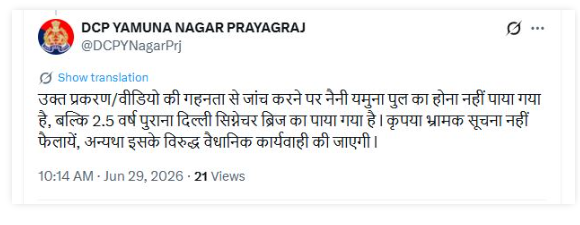
We extracted several keyframes from the viral video and searched them using the Google Lens tool. We found that this video was also quite viral on X (formerly Twitter). Responding to users, the official X handle of DCP Yamuna Nagar, Prayagraj, stated, “Upon a detailed research of the said matter/video, it has been found that it is not from the Naini Yamuna Bridge, but is a 2.5-year-old video from Delhi’s Signature Bridge. Please do not spread misleading information, otherwise legal action will be initiated against it.”
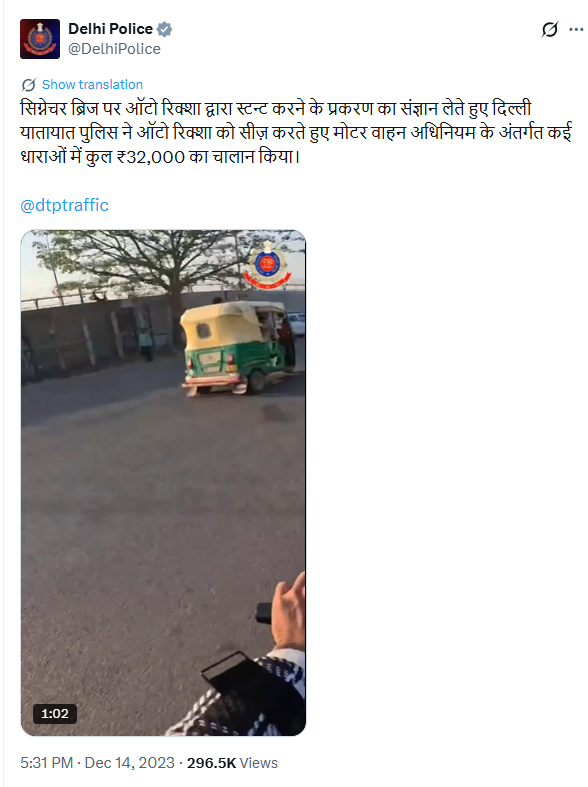
During our search, we found a post on the official X handle of the Delhi Police. Sharing the viral video, they wrote that taking cognizance of the auto-rickshaw stunt incident on the Signature Bridge, the Delhi Traffic Police seized the auto-rickshaw and issued a challan totaling ₹32,000 under various sections of the Motor Vehicles Act.
https://x.com/DelhiPolice/status/1735268792434057352?s=20
Conclusion
In our research, the viral post turned out to be fake. A video of an incident that took place on Delhi's Signature Bridge in 2023 is now being falsely circulated to spread misinformation as an incident from a bridge in Prayagraj. No such incident has taken place on the Naini Bridge in Prayagraj.

Related Blogs

Introduction
In the wake of the Spy Loan scandal, more than a dozen malicious loan apps were downloaded on Android phones from the Google Play Store, However, the number is significantly higher because they are also available on third-party marketplaces and questionable websites.
Unmasking the Scam
When a user borrows money, these predatory lending applications capture large quantities of information from their smartphone, which is then used to blackmail and force them into returning the total with hefty interest levels. While the loan amount is disbursed to users, these predatory loan apps request sensitive information by granting access to the camera, contacts, messages, logs, images, Wi-Fi network details, calendar information, and other personal information. These are then sent to loan shark servers.
The researchers have disclosed facts about the applications used by loan sharks to mislead consumers, as well as the numerous techniques used to circumvent some of the limitations imposed on the Play Store. Malware is often created with appealing user interfaces and promotes simple and rapid access to cash with high-interest payback conditions. The revelation of the Spy Loan scandal has triggered an immediate response from law enforcement agencies worldwide. There is an urgency to protect millions of users from becoming victims of malicious loan apps, it has become extremely important for law enforcement to unmask the culprits and dismantle the cyber-criminal network.
Aap’s banned: here is the list of the apps banned by Google Play Store :
- AA Kredit: इंस्टेंट लोन ऐप (com.aa.kredit.android)
- Amor Cash: Préstamos Sin Buró (com.amorcash.credito.prestamo)
- Oro Préstamo – Efectivo rápido (com.app.lo.go)
- Cashwow (com.cashwow.cow.eg)
- CrediBus Préstamos de crédito (com.dinero.profin.prestamo.credito.credit.credibus.loan.efectivo.cash)
- ยืมด้วยความมั่นใจ – ยืมด่วน (com.flashloan.wsft)
- PréstamosCrédito – GuayabaCash (com.guayaba.cash.okredito.mx.tala)
- Préstamos De Crédito-YumiCash (com.loan.cash.credit.tala.prestmo.fast.branch.mextamo)
- Go Crédito – de confianza (com.mlo.xango)
- Instantáneo Préstamo (com.mmp.optima)
- Cartera grande (com.mxolp.postloan)
- Rápido Crédito (com.okey.prestamo)
- Finupp Lending (com.shuiyiwenhua.gl)
- 4S Cash (com.swefjjghs.weejteop)
- TrueNaira – Online Loan (com.truenaira.cashloan.moneycredit)
- EasyCash (king.credit.ng)
- สินเชื่อปลอดภัย – สะดวก (com.sc.safe.credit)
Risks with several dimensions
SpyLoan's loan application violates Google's Financial Services policy by unilaterally shortening the repayment period for personal loans to a few days or any other arbitrary time frame. Additionally, the company threatens users with public embarrassment and exposure if they do not comply with such unreasonable demands.
Furthermore, the privacy rules presented by SpyLoan are misleading. While ostensibly reasonable justifications are provided for obtaining certain permissions, they are very intrusive practices. For instance, camera permission is ostensibly required for picture data uploads for Know Your Customer (KYC) purposes, and access to the user's calendar is ostensibly required to plan payment dates and reminders. However, both of these permissions are dangerous and can potentially infringe on users' privacy.
Prosecution Strategies and Legal Framework
The law enforcement agencies and legal authorities initiated prosecution strategies against the individuals who are involved in the Spy Loan Scandal, this multifaced approach involves international agreements and the exploration of innovative legal avenues. Agencies need to collaborate with International agencies to work on specific cyber-crime, leveraging the legal frameworks against digital fraud furthermore, the cross-border nature of the spy loan operation requires a strong legal framework to exchange information, extradition requests, and the pursuit of legal actions across multiple jurisdictions.
Legal Protections for Victims: Seeking Compensation and Restitution
As the legal battle unfolds in the aftermath of the Spy loan scam the focus shifts towards the victims, who suffer financial loss from such fraudulent apps. Beyond prosecuting culprits, the pursuit of justice should involve legal safeguards for victims. Existing consumer protection laws serve as a crucial shield for Spy Loan victims. These laws are designed to safeguard the rights of individuals against unfair practices.
Challenges in legal representation
As the legal hunt for justice in the Spy Loan scam progresses, it encounters challenges that demand careful navigation and strategic solutions. One of the primary obstacles in the legal pursuit of the Spy loan app lies in the jurisdictional complexities. Within the national borders, it’s quite challenging to define the jurisdiction that holds the authority, and a unified approach in prosecuting the offenders in various regions with the efforts of various government agencies.
Concealing the digital identities
One of the major challenges faced is the anonymity afforded by the digital realm poses a challenge in identifying and catching the perpetrators of the scam, the scammers conceal their identity and make it difficult for law enforcement agencies to attribute to actions against the individuals, this challenge can be overcome by joint effort by international agencies and using the advance digital forensics and use of edge cutting technology to unmask these scammers.
Technological challenges
The nature of cyber threats and crime patterns are changing day by day as technology advances this has become a challenge for legal authorities, the scammers explore vulnerabilities, making it essential, for law enforcement agencies to be a step ahead, which requires continuous training of cybercrime and cyber security.
Shaping the policies to prevent future fraud
As the scam unfolds, it has become really important to empower users by creating more and more awareness campaigns. The developers of the apps need to have a transparent approach to users.
Conclusion
It is really important to shape the policies to prevent future cyber frauds with a multifaced approach. Proposals for legislative amendments, international collaboration, accountability measures, technology protections, and public awareness programs all contribute to the creation of a legal framework that is proactive, flexible, and robust to cybercriminals' shifting techniques. The legal system is at the forefront of this effort, playing a critical role in developing regulations that will protect the digital landscape for years to come.
Safeguarding against spyware threats like SpyLoan requires vigilance and adherence to best practices. Users should exclusively download apps from official sources, meticulously verify the authenticity of offerings, scrutinize reviews, and carefully assess permissions before installation.
References
.webp)
Introduction
The rise of artificial intelligence has transformed how individuals search for information, buy and compare products online. Unlike the traditional search engines like Google that presents the user with a set of links and directs users to websites, AI-powered systems provide synthesised answers and recommendations which means we don't have to click through every link to find what we are looking for, we simply have to ask an LLM and it provides recommendations based on our needs expressed through prompt. This development has raised important legal and commercial questions, one such question was addressed in the judgement of Indiamart Inter Mesh Limited v. Open AI Inc. and Others (2026 SCC OnLine Cal 5738) decided by HMJ Ravi Krishan Kapur of Calcutta High court on 20 May 2026. If an AI platform becomes a primary source of information, can a business demand inclusion in its responses? Is it a legal injury if the LLM omits a business? More fundamentally, how do the existing laws classify technologies that not only process information, but also generate new content? These were the questions that came before Calcutta High Court. Although the dispute arose from Indiamart’s complaint regarding visibility on ChatGPT search, the judgement explored beyond the disagreement between two private entities.
The Dispute
IndiaMart is one of India’s largest electronic business-to-business marketplaces since 1996, serving millions of buyers and sellers across India. They also have registered trademarks and their entire business depends on visibility on the internet considering the digitalisation of the market. Open AI launched ChatGPT search in October 2024, which is a feature that supplements AI responses with links to relevant web sources. Indiamart alleged that ChatGPT was not displaying links to their online platform in the same way that it displayed links to other competing services or individual sellers. A major grievance raised by Indiamart was that ChatGPT allegedly bypassed IndiaMart market listings by directing users to sellers’ individual websites while continuing to provide platform level links for other competing platforms. Hence, they contended that this practice diverted users away from their platform and negatively affected their business interests. The company argued that such exclusion amounted to discriminatory treatment and resulted in economic harm, diluted its trademarks and amounted to disparagement. They alleged that it violated their rights under article 14, 19, 21 under the constitution and rights under IT Act and IT Rules also. When IndiaMart sought an explanation from OpenAI, the company stated that its decision was influenced by the inclusion of IndiaMart in the United States Trade Representative (USTR) Review of Notorious Markets for Counterfeiting and Piracy 2024, a U.S. government report that identifies online and physical marketplaces alleged to facilitate intellectual property infringements. IndiaMart challenged this justification, arguing that the USTR report has no statutory or binding force in India. It further alleged selective discrimination, pointing out that several other platforms featured on the same USTR list including DHGate, Pinduoduo, Shopee, and Taobao continued to remain accessible through ChatGPT-generated responses. Consequently, IndiaMart approached the Calcutta High Court seeking interim relief directing ChatGPT to display and provide access to IndiaMart links in its responses.
ARGUMENTS BEFORE THE COURT
IndiaMart's contentions: They argued that ChatGPT, because its search feature, performs the role of an "intermediary" within the meaning of Section 2(1)(w) of the IT Act and is therefore required to comply with the obligations imposed under the Information Technology (Intermediary Guidelines and Digital Media Ethics Code) Rules, 2021. Relying on Rule 3(1)(n), IndiaMart argued that an intermediary cannot engage in discriminatory treatment of platforms or selectively restrict access to information. IndiaMart further maintained that users have a right to access information relating to its platform and that the omission of IndiaMart links from ChatGPT's responses violated this interest. They alleged violation of Articles 14, 19, and 21 of the Constitution, along with the broader principle of a user's "right to know", to argue that OpenAI owed an obligation to display IndiaMart listings in response to relevant queries. In addition, IndiaMart alleged that the exclusion of its links caused commercial harm, diluted its trademarks, amounted to disparagement, and constituted an unfair trade practice that adversely affected its business and reputation.
OpenAI's contentions: OpenAI asserted that IndiaMart had no legally enforceable ‘Right to visibility’ on ChatGPT. They argued that neither contract, statute, nor constitutional law imposed any obligation on OpenAI to display, prioritise, or recommend IndiaMart links in response to user queries. In the absence of any recognised legal right, there could be no actionable injury and therefore no valid cause of action. OpenAI also challenged the classification of ChatGPT as an "intermediary" under the Information Technology Act, 2000. According to OpenAI, ChatGPT does not merely host, transmit, or facilitate access to third-party content but also generates responses through its large language model (LLM) and therefore functions more closely as an "originator" than an intermediary. Consequently, the obligations applicable to intermediaries under the Information Technology (Intermediary Guidelines and Digital Media Ethics Code) Rules, 2021, including those relied upon by IndiaMart, were inapplicable. With respect to the USTR Notorious Markets List, OpenAI submitted that its reliance on the report formed part of its internal risk-management and business policies. Such decisions, it argued, were matters of private commercial judgment and not ordinarily subject to judicial review. OpenAI further pointed out that IndiaMart had also previously blocked ChatGPT from accessing and crawling its website that weakened the company's demand for greater visibility within ChatGPT-generated responses.
Court’s decision: The court rejected Indiamart's claim that they were entitled to be displayed in ChatGPT searches. The court emphasised the autonomy of private businesses, the court held that the right to carry on trade and business is "inviolable" and that no law can compel one private entity to operate their platform for the benefit of another, which is based on foundational economic philosophy of laissez faire. Unless there is a contractual, statutory or constitutional obligation, a platform has no duty to the other platform to promote or advance their economic interest. Applying this principle, the court found no such duty or “vested legal right” that entitled IndiaMart’s visibility on ChatGPT. The court reasoned that even if users possess the ‘right to know’, Indiamart could not convert that interest into an enforceable claim under article 19(1)(g) or other legal provision. The court looked at the dispute as one arising from commercial disadvantage rather than violation of any legally protected right. Although the reduced visibility may have had economic consequences, economic harm does not by itself create a cause of action.
The court also took into consideration whether ChatGPT should be classified as an intermediary under Section 2(1)(w) of the Information Technology Act, 2000 or as an originator under Section 2(1)(za). This was an important distinction, because the intermediaries can claim safe harbour protection under section 79 of the IT act, but the originators cannot. The court expressed a preliminary view that ChatGPT is generative capabilities, place it closer to an originator than an intermediary because, unlike conventional search engines, which identify and rank existing information, Generative AI systems, analyse the data and produce new output based on algorithms, which is in response to the user’s prompt. The Court also referenced the NITI Aayog National Strategy for Artificial Intelligence (pages 7 to 12) to support its observations that ChatGPT does not merely store, host or transmit information, it can produce essays, research material, code, creative writing, and other forms of content that did not previously exist in that exact form, hence extending beyond the conventional understanding of an intermediary. The court also recognised that it is a vexed issue and remains unsettled because AI systems operate in response to users instructions and do not function independently, which is why the court refrained from providing a definitive classification and acknowledged that the question may ultimately require legislative clarification as well.
In addition to this, the Court took the view that the IndiaMart’s grievances did not amount to an Intellectual property dispute, as they found no trademark infringement or dilution because any reference to the "IndiaMart" mark was merely descriptive and did not constitute commercial use "in the course of trade" under Section 29(4) of the Trade Marks Act. IndiaMart also hadn’t demonstrated any false or misleading use of its trademark.
Similarly, the Court found that claims of disparagement, trade libel, and injurious falsehood were unsustainable because such claims require the publication of a false statement that harms reputation and since ChatGPT had not published any derogatory statement about IndiaMart, the mere omission of links could not amount to disparagement or libel. The Court relied on Tech Plus Media v. Jyoti Janda, that allegations of unfairness or copyright infringement must be supported by specific pleadings and evidence.
Beyond the immediate dispute, the judgment shed light on the growing difficulty of applying legal categories created for an earlier internet era to generative AI systems. The Information Technology Act was enacted at a time when internet regulation focused primarily on websites, service providers, and electronic communications and therefore existing classifications may not adequately address the hybrid nature of contemporary AI technologies. The Court acknowledged OpenAI's concern that granting IndiaMart's request could trigger floodgates of litigation on similar claims from businesses dissatisfied with AI-generated visibility, however, it clarified that such concerns cannot outweigh genuine legal claims or fundamental rights. The Court suggested that legislative intervention may eventually be necessary.
Conclusion
This judgement not only addressed the visibility issue in AI generated responses, but also whether visibility itself can become a legally protected interest in AI-driven searches? As more and more users rely on AI generated output for their preference rather than traditional search engine output, the power to decide what information is displayed and what is not will eventually become economically significant. The Calcutta High Court through this judgement declined to create any such right through judicial interventions and also highlighted that the existing legal framework is not adequately equipped to address the novel challenges posed by generative AI.
(This blog is based on the judgment in Indiamart Inter Mesh Limited v. Open AI Inc. and Others, 2026 SCC OnLine Cal 5738, decided on May 20, 2026 by the Calcutta High Court, and related reporting by LiveLaw and SCC Times.)
References
- https://www.livelaw.in/high-court/calcutta-high-court/no-right-to-visibility-exists-on-private-ai-platforms-calcutta-high-court-refuses-to-direct-chatgpt-to-display-indiamart-links-536891
- https://www.scconline.com/blog/post/2026/06/03/chatgpt-intermediary-originator-it-act-calcutta-high-court/
- https://indiankanoon.org/doc/198449710/

Introduction
Misinformation is, to its basic meaning, incorrect or misleading information, it may or may not include specific malicious intent and includes inaccurate, incomplete, misleading, or false information and selective or half-truths. The main challenges in dealing with misinformation are defining and distinguishing misinformation from legitimate content. This complexity arises due to the rapid evolution and propagation which information undergoes on the digital platforms. Additionally, balancing the fundamental right of freedom of speech and expression with content regulation by state actors poses a significant challenge. It requires careful consideration to avoid censorship while effectively combating harmful misinformation.
Acknowledging the severe consequences of misinformation and the critical need to combat misinformation, Bharatiya Nyaya Sanhita (BNS), 2023 has implemented key measures to address misinformation in India. These new provisions introduced under the new criminal laws in India penalise the deliberate creation, distribution, or publication of inaccurate information. Previously missing from the IPC, these sections offer an additional legal resource to counter the proliferation of falsehoods, complementing existing laws targeting the same issue.
Section 353 of the BNS on Statements Conducing to Public Mischief criminalises making, publishing, or circulating statements, false information, rumours, or reports, including through electronic means, with the intent or likelihood of causing various harmful outcomes.
This section thus brings misinformation into its ambit, since misinformation has been traditionally used to induce public fear or alarm that may lead to offences against the State or public tranquillity or inciting one class or community to commit offences against another. The section also penalizes the promotion of enmity, hatred, or ill will among different religious, racial, linguistic, or regional groups.
BNS also prescribes punishment of imprisonment for up to three years, a fine, or both for offences under section 353. Interestingly, a longer imprisonment of up to 5 years along with a fine has been prescribed to curb such offences in places of worship or during religious ceremonies. The only exception that may be availed under this section is granted to unsuspecting individuals who, believing the misinformation to be true, spread misinformation without any ill intent. However, this exception may not be as effective in curbing misinformation, since at the outset, the offence is hard to trace and has multiple pockets for individuals to seek protection without any mechanism to verify their intent.
The BNS also aims to regulate misinformation through Section 197(1)(d) on Imputations, assertions prejudicial to national integration. Under this provision, anyone who makes or publishes false or misleading information, whether it is in the form of spoken words, written, by signs, in visible representations, or through electronic communication, therefore, results in jeopardising the sovereignty, unity, integrity, or security of India is liable to face punishment in the form of imprisonment for up to three years, a fine, or both and if it occurs in a place of worship or during religious ceremonies, the quantum of punishment is increased to imprisonment for up to five years and may include a fine. Additionally, Section 212 (a) & (b) provides against furnishing false information. If a person who is legally obligated to provide information to a public servant, knowingly or reasonably believes that the information is false, and still furnishes it, they now face a punishment of six months imprisonment or a fine up to five thousand rupees or both. However, if the false information pertains to the commission or prevention of an offence, or the apprehension of an offender, the punishment increases to imprisonment for up to two years, a fine, or both.
Enforcement Mechanisms: CyberPeace Policy Wing Outlook
To ensure the effective enforcement of these provisions, coordination between the key stakeholders, i.e., the law enforcement agencies, digital platforms, and judicial oversight is essential. Law enforcement agencies must utilize technology such as data analytics and digital forensics for tracking and identifying the origins of false information. This technological capability is crucial for pinpointing the sources and preventing the further spread of misinformation. Simultaneously, digital platforms associated with misinformation content are required to implement robust monitoring and reporting mechanisms to detect and address the generated misleading content proactively. A supporting oversight by judicial bodies plays a critical role in ensuring that enforcement actions are conducted fairly and in line with legal standards. It helps maintain a balance between addressing misinformation and upholding fundamental rights such as freedom of speech. The success of the BNS in addressing these challenges will depend on the effective integration of these mechanisms and ongoing adaptation to the evolving digital landscape.
Resources:
- Bharatiya Nyaya Sanhita, 2023 https://www.mha.gov.in/sites/default/files/250883_english_01042024.pdf
- https://www.foxmandal.in/changes-brought-forth-by-the-bharatiya-nyaya-sanhita-2023/
- https://economictimes.indiatimes.com/news/india/spreading-fake-news-could-land-people-in-jail-for-three-years-under-new-bharatiya-nyaya-sanhita-bill/articleshow/102669105.cms?from=mdr
