
#FactCheck: Old Moscow fire video falsely shared as Houthi attack on Saudi Arabia’s Riyadh airport
Executive Summary
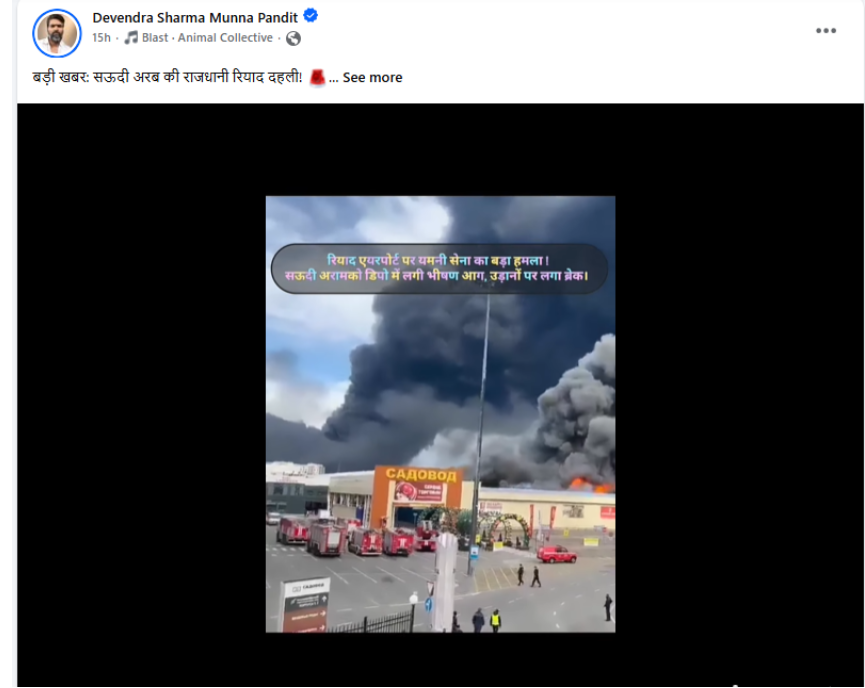
A video is being shared on social media with the claim that it shows a recent Houthi attack on King Khalid International Airport in Riyadh, the capital of Saudi Arabia. The video shows people running inside a building amid chaos, followed by a loud explosion that appears to shatter glass. The post claims that the visuals show the Riyadh airport during a Houthi missile attack. However, CyberPeace Research Wing’s research found that the video is actually from Russia.
Claim:
A social media post is being shared with the claim that the video shows a Houthi attack on Riyadh Airport in Saudi Arabia.
https://www.facebook.com/reel/1491107586179716
https://ghostarchive.org/archive/O9X4A
Fact Check
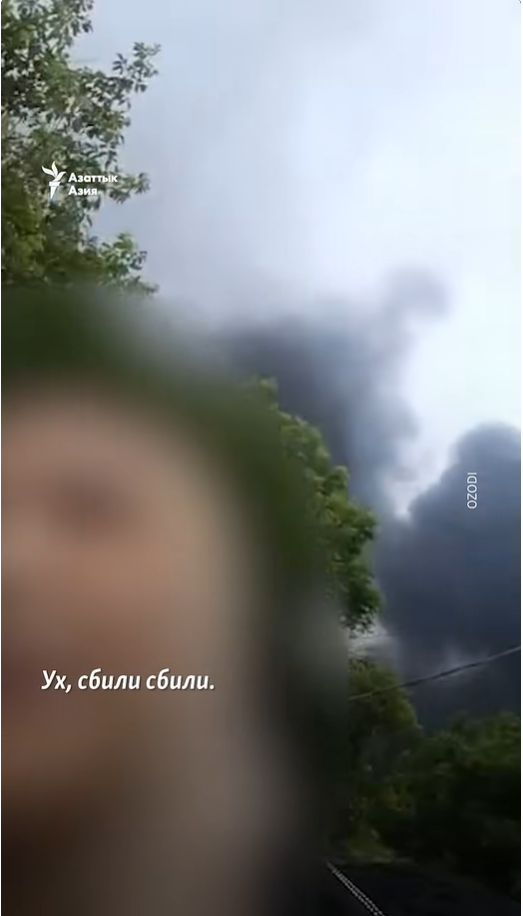
To verify the truth behind the video being shared with the claim that it shows a Houthi attack on an airport in Riyadh, Saudi Arabia, we conducted a reverse image search of its keyframes. During the search, we found a video uploaded on June 19, 2026, by the Kazakh YouTube account @AzattyqAsia, which contains the same visuals seen in the viral video. According to the report, the video shows Russia’s Sadovod Market, where a massive fire broke out following a drone attack.
https://www.youtube.com/shorts/D2-m4l5Obc8
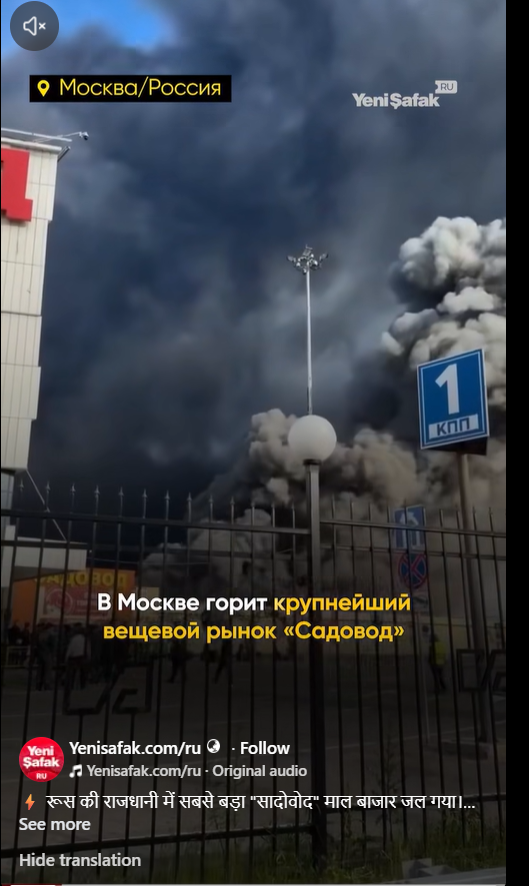
Additionally, we found another video shot from a different angle on the Facebook account Yenisafak.com/ru, uploaded on June 18, 2026. The video contains the same visuals seen in the viral clip. The post states that the video was filmed at Moscow’s Sadovod Market, where a massive fire broke out at a complex following a drone attack.
https://www.facebook.com/reel/980820447900927
Conclusion
The evidence gathered during our research makes it clear that the viral video does not show a Houthi attack on an airport in Saudi Arabia, but is actually from Moscow, the capital of Russia.

Related Blogs

Executive Summary
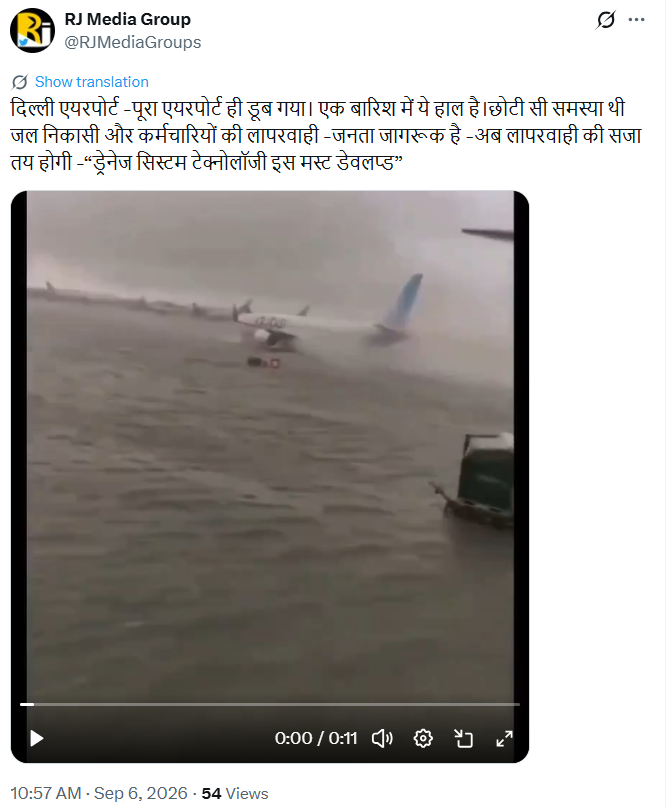
A post is being widely circulated on social media claiming that the entire Delhi airport was submerged following heavy rainfall. The post questions the airport’s drainage system and attributes the situation to the negligence of its staff. The post further claims that the airport’s arrangements were exposed after just one spell of rain and that its drainage system needs to be upgraded using better technology. A research by the research wing of CyberPeace found that the viral video is not from Delhi airport but dates back to April 2024. At the time, heavy rainfall in Dubai caused flood-like conditions at the airport, affecting flight operations on waterlogged runways as well. Thus, an old video from Dubai is being falsely shared on social media as footage of Delhi airport.
Claim:
A user on the social media platform X (formerly Twitter) shared the viral video with the caption: “Delhi Airport — the entire airport is submerged. This is the situation after just one spell of rain. A minor issue of drainage and negligence by the staff — the public is aware — now the negligence will be punished. ‘The drainage system technology must be developed.’”
https://x.com/RJMediaGroups/status/2096470339060736149
Factcheck
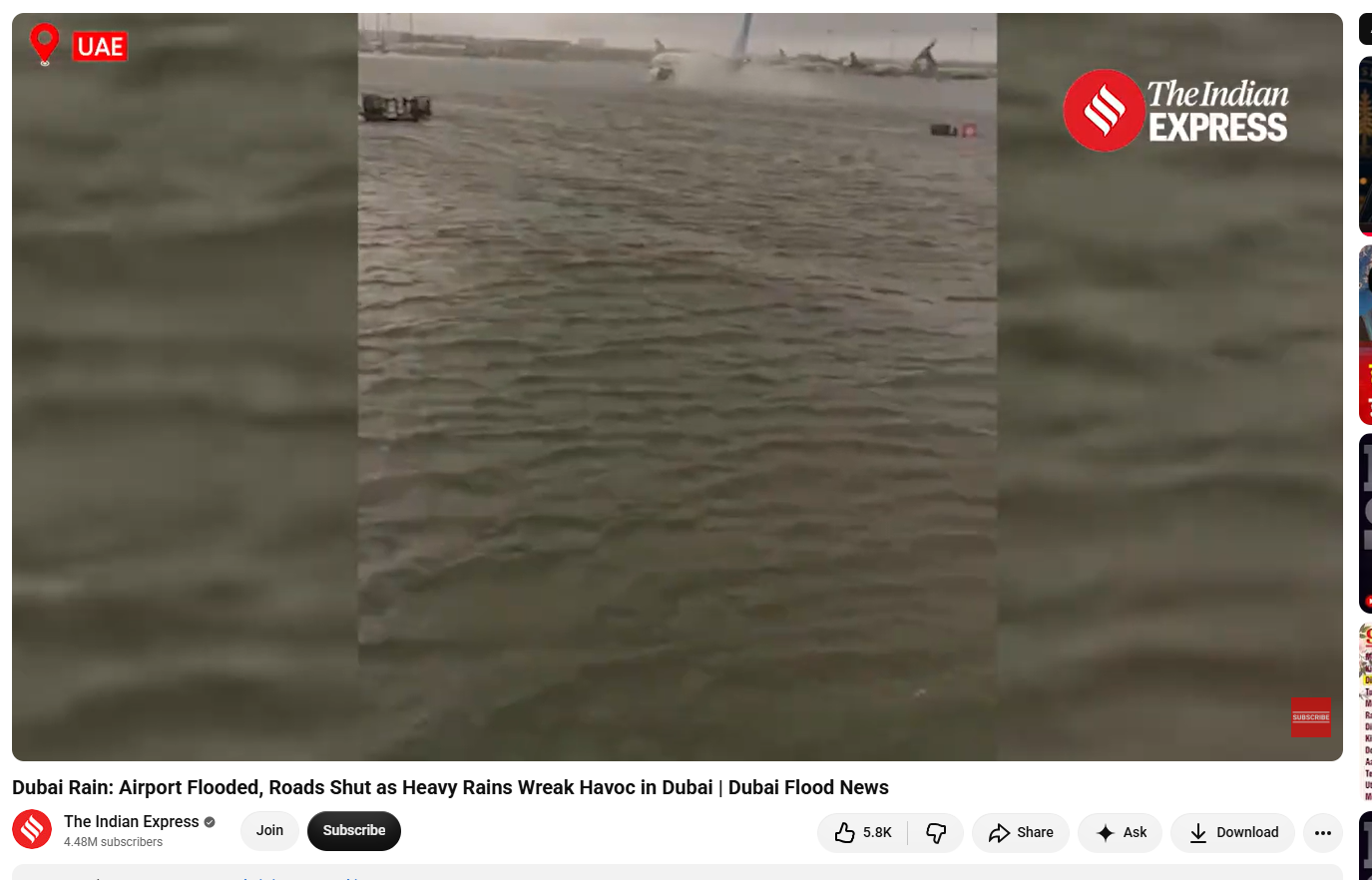
As part of our investigation, we conducted a reverse image search of keyframes from the video. During the search, we found the original video on a YouTube channel named The Indian Express, which was uploaded on April 17, 2024. According to the video description, the incident took place in Dubai. The post link and screenshot are provided below.
https://www.youtube.com/watch?v=O9F1qTMIO5M
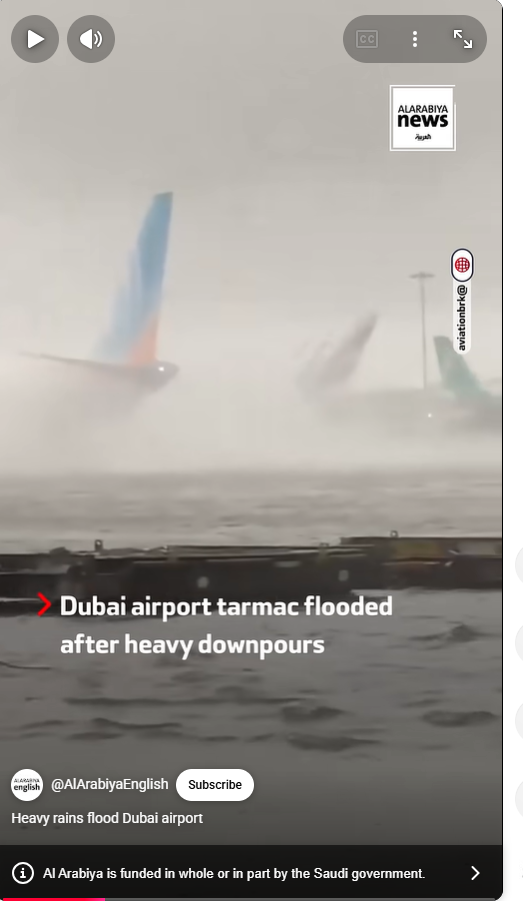
During our investigation, we found visuals similar to those in the viral video on the YouTube channel AlArabiyaEnglish. The video was uploaded on April 16, 2024. According to the information provided in the video description, several parts of the UAE were affected by flooding following sudden heavy rainfall on April 16, 2024. The heavy rains also affected operations at Dubai Airport, disrupting several flights. According to the report, the UAE recorded a record 254 mm of rainfall in less than 24 hours. In view of the adverse weather conditions, Dubai Airport advised passengers to travel only if absolutely necessary. The post link and screenshot are provided below.
https://www.youtube.com/shorts/KzIstkiOdp4
Conclusion:
Our investigation found that the viral video does not show Delhi Airport after heavy rainfall. The visuals are actually from Dubai Airport, where severe rainfall in the UAE in April 2024 led to flooding and disruptions to airport operations. Therefore, the viral video is old and has been falsely shared on social media with the misleading claim that it shows the current condition of Delhi Airport.

Executive Summary:
A widely circulated social media post claims that the Government of India has reportedly opened an account—Army Welfare Fund Battle Casualty—at Canara Bank to support the modernization of the Indian Army and assist injured or martyred soldiers. Citizens can voluntarily contribute starting from ₹1, with no upper limit. The fund is said to have been launched based on a suggestion by actor Akshay Kumar, which was later acknowledged by the Prime Minister of India through Mann Ki Baat and social media platforms. However, the fact is that no such decision has been taken by the cabinet recently, and no such decision has been officially announced.

Claim:
A viral social media post claims that the Government of India has launched a new initiative aimed at modernizing the Indian Army and supporting battle casualties through public donations. According to the post, a special bank account has been created to enable citizens to contribute directly toward the procurement of arms and equipment for the armed forces.
It further states that this initiative was introduced following a Cabinet decision and was inspired by a suggestion from Bollywood actor Akshay Kumar, which was reportedly acknowledged by the Prime Minister during his Mann Ki Baat address.
The post encourages individuals to donate any amount starting from ₹1, with no upper limit, and estimates that widespread public participation could generate up to ₹36,000 crore annually to support the armed forces. It also lists two bank accounts—one at Canara Bank (Account No: 90552010165915) and another at State Bank of India (Account No: 40650628094)—allegedly designated for the "Armed Forces Battle Casualties Welfare Fund."
The statement said,” The government established a range of welfare schemes for soldiers killed or disabled while undertaking military operations in recent combat. In 2020, the government established the 'Armed Forces Battle Casualty Welfare Fund (AFBCWF)', which is used to provide immediate financial assistance to families of soldiers, sailors and airmen who lose their lives or sustain grievous injury as a result of active military service.”

We also found a similar post from the past, which can be seen here.
Fact Check:
The Press Information Bureau (PIB) have responded to the viral post stating that it is misleading, and the Government has not launched any message inviting public donations towards the modernisation of the Indian Army or for purchasing Weapons for the army. The only known official initiative by the Ministry of Defence is the "Armed Forces Battle Casualties Welfare Fund", which is an initiative set up to support the families of our soldiers who have been marshalled or grievously disabled in the line of duty, not for buying military equipment.

In addition, the bank account details mentioned in the Viral post are false, and donations and charitable donations submitted to the account have been dishonoured.
The other false claim says that actor Akshay Kumar is promoting or heading this message-there is no official/disclosure record or announcement related to him leading or sponsoring this project. Having said that in 2017, Akshay Kumar encouraged public contributions of just one rupee per month to support the armed forces, through a web portal called “Bharat Ke Veer”. The platform was developed in partnership with the Ministry of Home Affairs


Citizens have to rely on only official government sources and ignore misleading messages on such social media platforms.
Conclusion:
The viral social media post suggesting that the Government of India has initiated a donation drive for the modernisation of the Indian Army and the purchase of weapons is misleading and inaccurate. According to the Press Information Bureau (PIB), no such initiative has been launched by the government, and the bank account details provided in the post are false, with reported cases of dishonoured transactions. The only legitimate initiative is the Armed Forces Battle Casualties Welfare Fund (AFBCWF), which provides financial assistance to the families of soldiers who are martyred or seriously injured in the line of duty. While actor Akshay Kumar played a key role in launching the Bharat Ke Veer portal in 2017 to support paramilitary personnel, he has no official connection to the viral claims.
- Claim: The government has launched a public donation message to fund Army weapon purchases.
- Claimed On: Social Media
- Fact Check: False and Misleading

Introduction
Over the past few years, the virtual space has been an irreplaceable livelihood platform for content creators and influencers, particularly on major social media platforms like YouTube and Instagram. Yet, if this growth in digital entrepreneurship is accompanied by anything, it is a worrying trend, a steep surge in account takeover (ATO) attacks against these actors. In recent years, cybercriminals have stepped up the quantity and level of sophistication of such attacks, hacking into accounts, jeopardising the follower base, and incurring economic and reputational damage. They don’t just take over accounts to cause disruption. Instead, they use these hijacked accounts to run scams like fake livestreams and cryptocurrency fraud, spreading them by pretending to be the original account owner. This type of cybercrime is no longer a nuisance; it now poses a serious threat to the creator economy, digital trust, and the wider social media ecosystem.
Why Are Content Creators Prime Targets?
Content creators hold a special place on the web. They are prominent users who live for visibility, public confidence, and ongoing interaction with their followers. Their social media footprint tends to extend across several interrelated platforms, e.g., YouTube, Instagram, X (formerly Twitter), with many of these accounts having similar login credentials or being managed from the same email accounts. This interconnectivity of their online presence crosses multiple platforms and benefits workflow, but makes them appealing targets for hackers. One entry point can give access to a whole chain of vulnerabilities. Attackers, once they control an account, can wield its influence and reach to share scams, lead followers to phishing sites, or spread malware, all from the cover of a trusted name.
Popular Tactics Used by Attackers
- Malicious Livestream Takeovers and Rebranding - Cybercriminals hijack high-subscriber channels and rebrand them to mimic official channels. Original videos are hidden or deleted, replaced with scammy streams using deep fake personas to promote crypto schemes.
- Fake Sponsorship Offers - Creators receive emails from supposed sponsors that contain malware-infected attachments or malicious download links, leading to credential theft.
- Malvertising Campaigns - These involve fake ads on social platforms promoting exclusive software like AI tools or unreleased games. Victims download malware that searches for stored login credentials.
- Phishing and Social Engineering on Instagram - Hackers impersonate Meta support teams via DMs and emails. They direct creators to login pages that are cloned versions of Instagram's site. Others pose as fans to request phone numbers and trick victims into revealing password reset codes.
- Timely Exploits and Event Hijacking - During major public or official events, attackers often escalate their activity. Hijacked accounts are used to promote fake giveaways or exclusive live streams, luring users to malicious websites designed to steal personal information or financial data.
Real-World Impact and Case Examples
The reach and potency of account takeover attacks upon content creators are far-reaching and profound. In a report presented in 2024 by Bitdefender, over 9,000 malicious live streams were seen on YouTube during a year, with many having been streamed from hijacked creator accounts and reassigned to advertise scams and fake content. Perhaps the most high-profile incident was a channel with more than 28 million subscribers and 12.4 billion total views, which was totally taken over and utilised for a crypto fraud scheme live streaming. Additionally, Bitdefender research indicated that over 350 scam domains were utilised by cybercriminals, directly connected via hijacked social media accounts, to entice followers into phishing scams and bogus investment opportunities. Many of these pieces of content included AI-created deep fakes impersonating recognisable personalities like Elon Musk and other public figures, providing the illusion of authenticity around fake endorsements (CCN, 2024). Further, attackers have exploited popular digital events such as esports events, such as Counter-Strike 2 (CS2), by hijacking YouTube gaming channels and livestreaming false giveaways or referring viewers to imitated betting sites.
Protective Measures for Creators
- Enable Multi-Factor Authentication (MFA)
Adds an essential layer of defence. Even if a password is compromised, attackers can't log in without the second factor. Prefer app-based or hardware token authentication.
- Scrutinize Sponsorships
Verify sender domains and avoid opening suspicious attachments. Use sandbox environments to test files. In case of doubt, verify collaboration opportunities through official company sources or verified contacts.
- Monitor Account Activity
Keep tabs on login history, new uploads, and connected apps. Configure alerts for suspicious login attempts or spikes in activity to detect breaches early. Configure alerts for suspicious login attempts or spikes in activity to detect breaches early.
- Educate Your Team
If your account is managed by editors or third parties, train them on common phishing and malware tactics. Employ regular refresher sessions and send mock phishing tests to reinforce awareness.
- Use Purpose-Built Security Tools
Specialised security solutions offer features like account monitoring, scam detection, guided recovery, and protection for team members. These tools can also help identify suspicious activity early and support a quick response to potential threats.
Conclusion
Account takeover attacks are no longer random events, they're systemic risks that compromise the financial well-being and personal safety of creators all over the world. As cybercriminals grow increasingly sophisticated and realistic in their scams, the only solution is a security-first approach. This encompasses a mix of technical controls, platform-level collaboration, education, and investment in creator-centric cybersecurity technologies. In today's fast-paced digital landscape, creators not only need to think about content but also about defending their digital identity. As digital platforms continue to grow, so do the threats targeting creators. However, with the right awareness, tools, and safeguards in place, a secure and thriving digital environment for creators is entirely achievable.
References
- https://www.bitdefender.com/en-au/blog/hotforsecurity/account-takeover-attacks-on-social-media-a-rising-threat-for-content-creators-and-influencers
- https://www.arkoselabs.com/account-takeover/social-media-account-takeover/
- https://www.imperva.com/learn/application-security/account-takeover-ato/
- https://www.security.org/digital-safety/account-takeover-annual-report/
- https://www.niceactimize.com/glossary/account-takeover/
