
#FactCheck: False Claim Says All Public Sector Banks Will Remain Closed Every Saturday
Executive Summary
Employees’ organisations of public sector banks had recently announced a nationwide strike, with one of their key demands being a five-day work week, including holidays on all Saturdays. Against this backdrop, a claim is being circulated on social media that the bank unions’ demand has been accepted and that all public sector banks will now remain closed every Saturday.
However, CyberPeace Research found that the claim that banks will observe holidays on all Saturdays is false. Neither the government nor bank employees’ unions have made any official announcement regarding the implementation of a five-day work week or holidays on all Saturdays.
Claim:
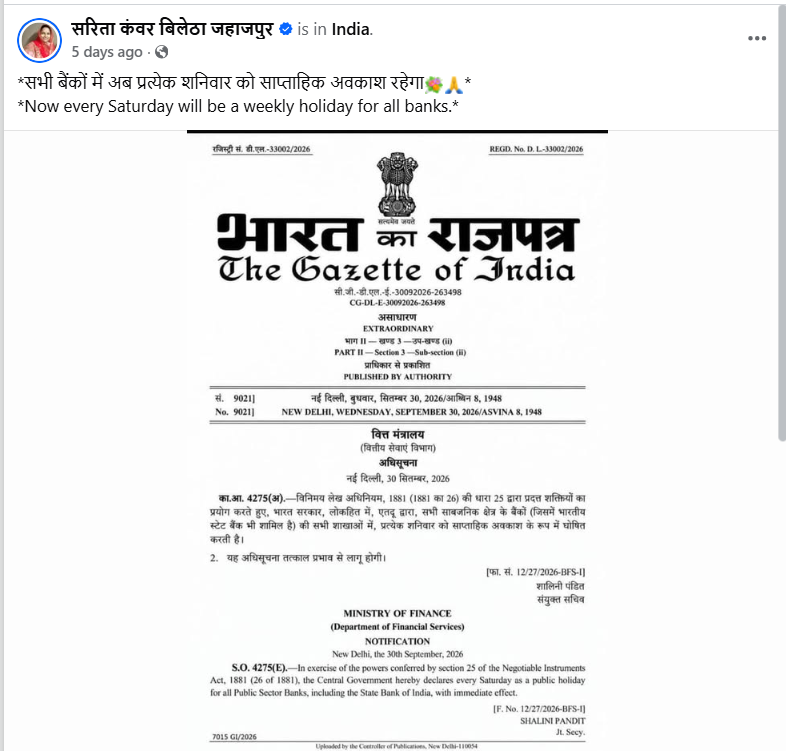
A user on the social media platform Facebook shared what was purportedly an Indian Gazette document, claiming that all banks will now observe a weekly holiday on every Saturday.
https://www.facebook.com/photo/?fbid=122234792282534138&set=a.122114627672534138
Fact Check
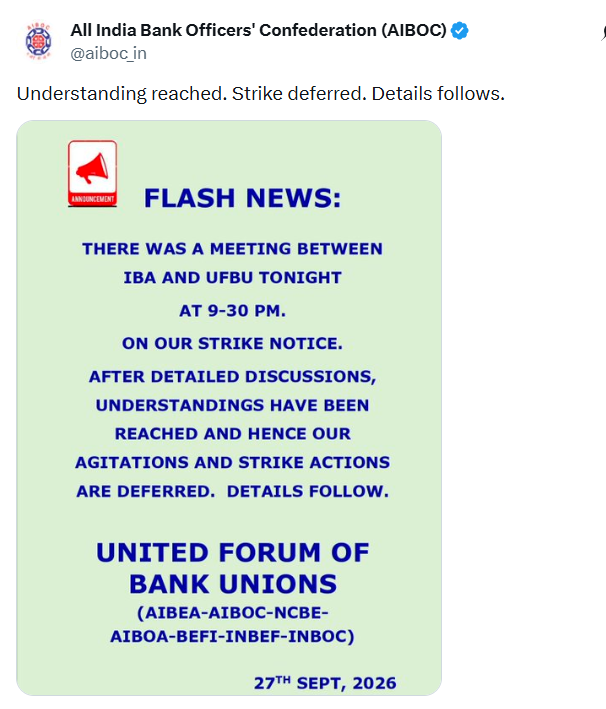
We reviewed all the announcements issued by the organisations that had called for the bank strike. None of these organisations issued any statement confirming that their demands had been accepted. We found a statement from the All India Bank Officers’ Confederation (AIBOC), in which the organisation stated in an X post that the strike scheduled for September 28–30, 2026, had been postponed following discussions. However, the organisation did not state anywhere that the demand for holidays on all Saturdays had been accepted.
https://x.com/aiboc_in/status/2104262645507612777?s=20
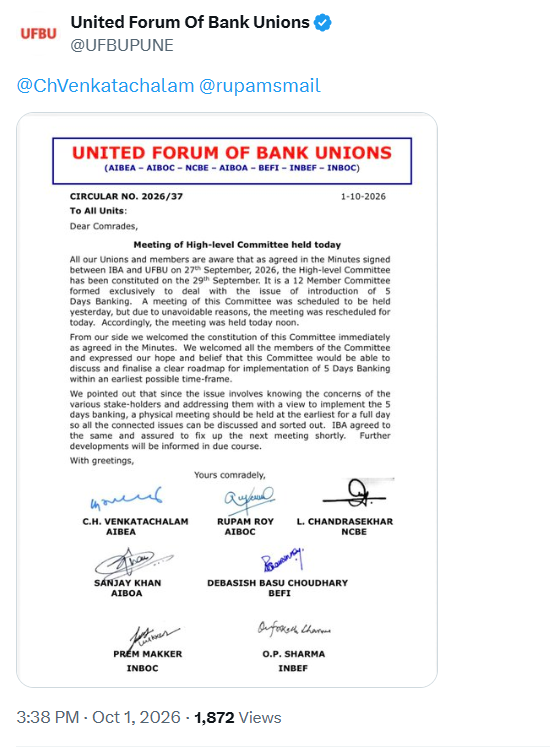
The United Forum of Bank Unions (UFBU), a joint platform of seven bank employees’ unions, issued a statement on October 1, making it clear that there has been no confirmation so far that the unions’ demands have been accepted. The statement said that a five-member committee has been constituted to consider the demand for holidays on all Saturdays, and the committee will soon prepare a roadmap for taking the matter forward.
https://x.com/UFBUPUNE/status/2105600756795707456
Conclusion:
The claim circulating on social media that all public sector banks will remain closed every Saturday from now on is false. CyberPeace Research found that neither the government nor bank employees’ unions have made any official announcement regarding the declaration of holidays on all Saturdays. Therefore, the claim being circulated on social media is misleading.

Related Blogs

Executive Summary:
Amid the ongoing conflict in West Asia involving the United States, Israel and Iran, a video is being widely circulated on social media with the claim that Iran attacked the headquarters of tech giants Apple and Microsoft in Israel. The clip shows a building engulfed in flames, with firefighters attempting to douse the fire. However, research by the CyberPeace found that the viral video is AI-generated and is being falsely linked to the ongoing conflict to spread misinformation.
Claim:
An Instagram user ‘bharat_updatenews’ shared the video on March 19, 2026, claiming that Iran had launched an attack on major tech company headquarters, including Apple and Microsoft, in Israel. The post suggested that the incident had raised serious security concerns and was being widely reported by international media.
Link: https://www.instagram.com/bharat_updatenews/reel/DWEUhLEAKaw

Fact Check:
To verify the claim, we extracted keyframes from the viral video and conducted a reverse search using Google Lens. During this process, we found the same video on a TikTok account named ‘dailyupdate122’, where it had been uploaded on March 15, 2026.

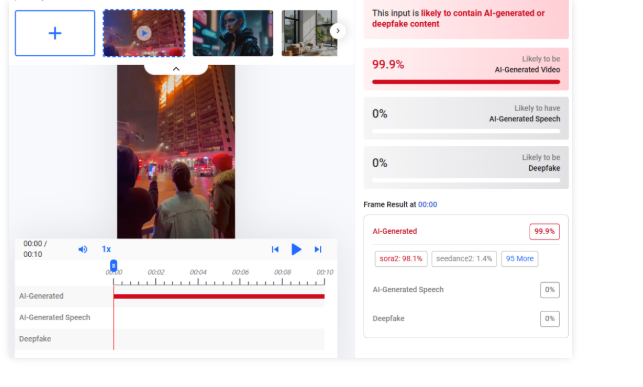
The video on this account was clearly labelled as “AI-generated media.” The account also featured several other AI-generated videos, raising doubts about the authenticity of the viral clip. Following this, we analysed the video using the AI detection tool Hive Moderation. The results indicated that the video is nearly 100 percent AI-generated. The tool further suggested with over 98 percent probability that the clip may have been created using OpenAI’s Sora or a similar AI video generation model.
Conclusion:
The viral claim that Iran attacked Apple and Microsoft headquarters in Israel is false. The video circulating online is AI-generated and has no connection to the ongoing conflict in West Asia.

Introduction
In India, the rights of children with regard to protection of their personal data are enshrined under the Digital Personal Data Protection Act, 2023 which is the newly enacted digital personal data protection law of India. The DPDP Act requires that for the processing of children's personal data, verifiable consent of parents or legal guardians is a necessary requirement. If the consent of parents or legal guardians is not obtained then it constitutes a violation under the DPDP Act. Under section 2(f) of the DPDP act, a “child” means an individual who has not completed the age of eighteen years.
Section 9 under the DPDP Act, 2023
With reference to the collection of children's data section 9 of the DPDP Act, 2023 provides that for children below 18 years of age, consent from Parents/Legal Guardians is required. The Data Fiduciary shall, before processing any personal data of a child or a person with a disability who has a lawful guardian, obtain verifiable consent from the parent or the lawful guardian. Section 9 aims to create a safer online environment for children by limiting the exploitation of their data for commercial purposes or otherwise. By virtue of this section, the parents and guardians will have more control over their children's data and privacy and they are empowered to make choices as to how they manage their children's online activities and the permissions they grant to various online services.
Section 9 sub-section (3) specifies that a Data Fiduciary shall not undertake tracking or behavioural monitoring of children or targeted advertising directed at children. However, section 9 sub-section (5) further provides room for exemption from this prohibition by empowering the Central Government which may notify exemption to specific data fiduciaries or data processors from the behavioural tracking or target advertising prohibition under the future DPDP Rules which are yet to be announced or released.
Impact on social media platforms
Social media companies are raising concerns about Section 9 of the DPDP Act and upcoming Rules for the DPDP Act. Section 9 prohibits behavioural tracking or targeted advertising directed at children on digital platforms. By prohibiting intermediaries from tracking a ‘child's internet activities’ and ‘targeted advertising’ - this law aims to preserve children's privacy. However, social media corporations contended that this limitation adversely affects the efficacy of safety measures intended to safeguard young users, highlighting the necessity of monitoring specific user signals, including from minors, to guarantee the efficacy of safety measures designed for them.
Social media companies assert that tracking teenagers' behaviour is essential for safeguarding them from predators and harmful interactions. They believe that a complete ban on behavioural tracking is counterproductive to the government's objectives of protecting children. The scope to grant exemption leaves the door open for further advocacy on this issue. Hence it necessitates coordination with the concerned ministry and relevant stakeholders to find a balanced approach that maintains both privacy and safety for young users.
Furthermore, the impact on social media platforms also extends to the user experience and the operational costs required to implement the functioning of the changes created by regulations. This also involves significant changes to their algorithms and data-handling processes. Implementing robust age verification systems to identify young users and protect their data will also be a technically challenging step for the various scales of platforms. Ensuring that children’s data is not used for targeted advertising or behavioural monitoring also requires sophisticated data management systems. The blanket ban on targeted advertising and behavioural tracking may also affect the personalisation of content for young users, which may reduce their engagement with the platform.
For globally operating platforms, aligning their practices with the DPDP Act in India while also complying with data protection laws in other countries (such as GDPR in Europe or COPPA in the US) can be complex and resource-intensive. Platforms might choose to implement uniform global policies for simplicity, which could impact their operations in regions not governed by similar laws. On the same page, competitive dynamics such as market shifts where smaller or niche platforms that cater specifically to children and comply with these regulations may gain a competitive edge. There may be a drive towards developing new, compliant ways of monetizing user interactions that do not rely on behavioural tracking.
CyberPeace Policy Recommendations
A balanced strategy should be taken into account which gives weightage to the contentions of social media companies as well as to the protection of children's personal information. Instead of a blanket ban, platforms can be obliged to follow and encourage openness in advertising practices, ensuring that children are not exposed to any misleading or manipulative marketing techniques. Self-regulation techniques can be implemented to support ethical behaviour, responsibility, and the safety of young users’ online personal information through the platform’s practices. Additionally, verifiable consent should be examined and put forward in a manner which is practical and the platforms have a say in designing the said verification. Ultimately, this should be dealt with in a manner that behavioural tracking and targeted advertising are not affecting the children's well-being, safety and data protection in any way.
Final Words
Under section 9 of the DPDP Act, the prohibition of behavioural tracking and targeted advertising in case of processing children's personal data - will compel social media platforms to overhaul their data collection and advertising practices, ensuring compliance with stricter privacy regulations. The legislative intent behind this provision is to enhance and strengthen the protection of children's digital personal data security and privacy. As children are particularly vulnerable to digital threats due to their still-evolving maturity and cognitive capacities, the protection of their privacy stands as a priority. The innocence of children is a major cause for concern when it comes to digital access because children simply do not possess the discernment and caution required to be able to navigate the Internet safely. Furthermore, a balanced approach needs to be adopted which maintains both ‘privacy’ and ‘safety’ for young users.
References
- https://www.meity.gov.in/writereaddata/files/Digital%20Personal%20Data%20Protection%20Act%202023.pdf
- https://www.firstpost.com/tech/as-govt-of-india-starts-preparing-rules-for-dpdp-act-social-media-platforms-worried-13789134.html#google_vignette
- https://www.business-standard.com/industry/news/social-media-platforms-worry-new-data-law-could-affect-child-safety-ads-124070400673_1.html

Introduction
The Data Protection Data Privacy Act 2023 is the most essential step towards protecting, prioritising, and promoting the users’ privacy and data protection. The Act is designed to prioritize user consent in data processing while assuring uninterrupted services like online shopping, intermediaries, etc. The Act specifies that once a user provides consent to the following intermediary platforms, the platforms can process the data until the user withdraws the rights of it. This policy assures that the user has the entire control over their data and is accountable for its usage.
A keen Outlook
The Following Act also provides highlights for user-specific purpose, which is limited to data processing. This step prevents the misuse of data and also ensures that the processed data is being for the purpose for which it was obtained at the initial stage from the user.
- Data Fudiary and Processing of Online Shopping Platforms: The Act Emphasises More on Users’ Consent. Once provided, the Data Fudiary can constantly process the data until it is specifically withdrawn by the Data Principal.
- Detailed Analysis
- Consent as a Foundation: The Act places the user's consent as a backbone to the data processing. It sets clear boundaries for data processing. It can be Collecting, Processing, and Storing, and must comply with users’ consent before being used.
- Uninterrupted Data processing: With the given user consent, the intermediaries are not time-restrained. As long as the user does not obligate their consent, the process will be ongoing.
- Consent and Order Fulfillment: Consent, once provided, encloses all the activities related to the specific purpose for which it was meant to the data it was given for subsequent actions such as order fulfilment.
- Detailed Analysis
- Purpose-Limited Consent: The consent given is purpose-limited. The platform cannot misuse the obtained data for its personal use.
- Seamless User Experience: By ensuring that the user consent covers the full transactions, spared from the unwanted annoyance of repeated consent requests from the actual ongoing activities.
- Data Retention and Rub Out on Online Platforms: Platforms must ensure data minimisation post its utilisation period. This extends to any kind of third-party processors they might take on.
- Detailed Analysis
- Minimization and Security Assurance: By compulsory data removal on post ultization,This step helps to reduce the volume of data platforms hold, which leads to minimizing the risk to data.
- Third-Party Accountability, User Privacy Protection.
Influence from Global frameworks
The impactful changes based on global trends and similar legislation( European Union’s GDPR) here are some fruitful changes in intermediaries and social media platforms experienced after the implementation of the DPDP Act 2023.
- Solidified Consent Mechanism: Platforms and intermediatries need to ensure the users’ consent is categorically given, and informed, and should be specific to which the data is obtained. This step may lead to user-friendly consent forms activities and prompts.
- Data Minimizations: Platforms that tend to need to collect the only data necessary for the specific purpose mentioned and not retain information beyond its utility.
- Transparency and Accountability: Data collecting Platforms need to ensure transparency in data collecting, data processing, and sharing practices. This involves more detailed policy and regular audits.
- Data Portability: Users have the right to request for a copy of their own data used in format, allowing them to switch platforms effectively.
- Right to Obligation: Users can have the request right to deletion of their data, also referred to as the “Right to be forgotten”.
- Prescribed Reporting: Under circumstances of data breaches, intermediary platforms are required to report the issues and instability to the regulatory authorities within a specific timeline.
- Data Protection Authorities: Due to the increase in data breaches, Large platforms indeed appoint data protection officers, which are responsible for the right compliance with data protection guidelines.
- Disciplined Policies: Non-compliance might lead to a huge amount of fines, making it indispensable to invest in data protection measures.
- Third-Party Audits: Intermediaries have to undergo security audits by external auditors to ensure they are meeting the expeditions of the following compliances.
- Third-Party Information Sharing Restrictions: Sharing personal information and users’ data with third parties (such as advertisers) come with more detailed and disciplined guideline and user consent.
Conclusion
The Data Protection Data Privacy Act 2023 prioritises user consent, ensuring uninterrupted services and purpose-limited data processing. It aims to prevent data misuse, emphasising seamless user experiences and data minimisation. Drawing inspiration from global frameworks like the EU's GDPR, it introduces solidified consent mechanisms, transparency, and accountability. Users gain rights such as data portability and data deletion requests. Non-compliance results in significant fines. This legislation sets a new standard for user privacy and data protection, empowering users and holding platforms accountable. In an evolving digital landscape, it plays a crucial role in ensuring data security and responsible data handling.
References:
- https://www.meity.gov.in/writereaddata/files/Digital%20Personal%20Data%20Protection%20Act%202023.pdf
- https://www.mondaq.com/india/privacy-protection/1355068/data-protection-law-in-india-analysis-of-dpdp-act-2023-for-businesses--part-i
- https://www.hindustantimes.com/technology/explained-indias-new-digital-personal-data-protection-framework-101691912775654.html
