
#FactCheck: False Claim of Ex-CDS Anil Chauhan’s Arrest Linked to Old 2021 Srinagar Police Bus Attack Video
Executive Summary
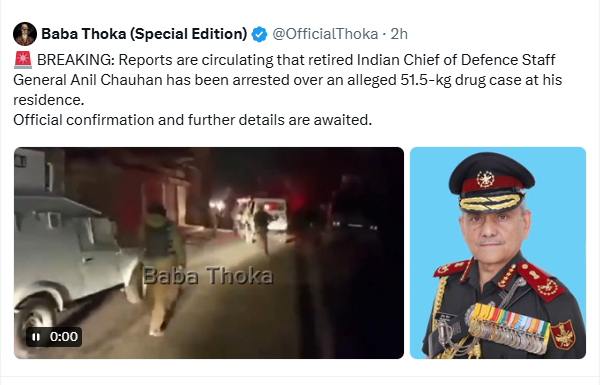
A post is being shared on social media claiming that retired Chief of Defence Staff (CDS) General Anil Chauhan was arrested from his residence in connection with a 51.5-kg drug case. The post states that official confirmation of the case is awaited. Some Army personnel can also be seen in the video, which is being shared as evidence to support the claim. CyberPeace Research found the viral claim to be false. We found that General Anil Chauhan had retired as CDS in May 2026. According to the Ministry of Defence, his tenure ended on May 30, 2026. However, we did not find any credible report confirming General Anil Chauhan’s arrest in connection with a 51.5-kg drug case. Therefore, the claim being shared on social media is misleading and false. Furthermore, according to the available information, the video is related to the December 2021 terrorist attack on a Jammu and Kashmir Police bus in the Pantha Chowk area of Srinagar.
Claim:
On September 18, 2026, a user on the social media platform X claimed that retired CDS General Anil Chauhan was arrested from his residence in connection with a 51.5-kg drug case.
https://x.com/i/birdwatch/t/2100860615887892915?source=6
Fact Check:
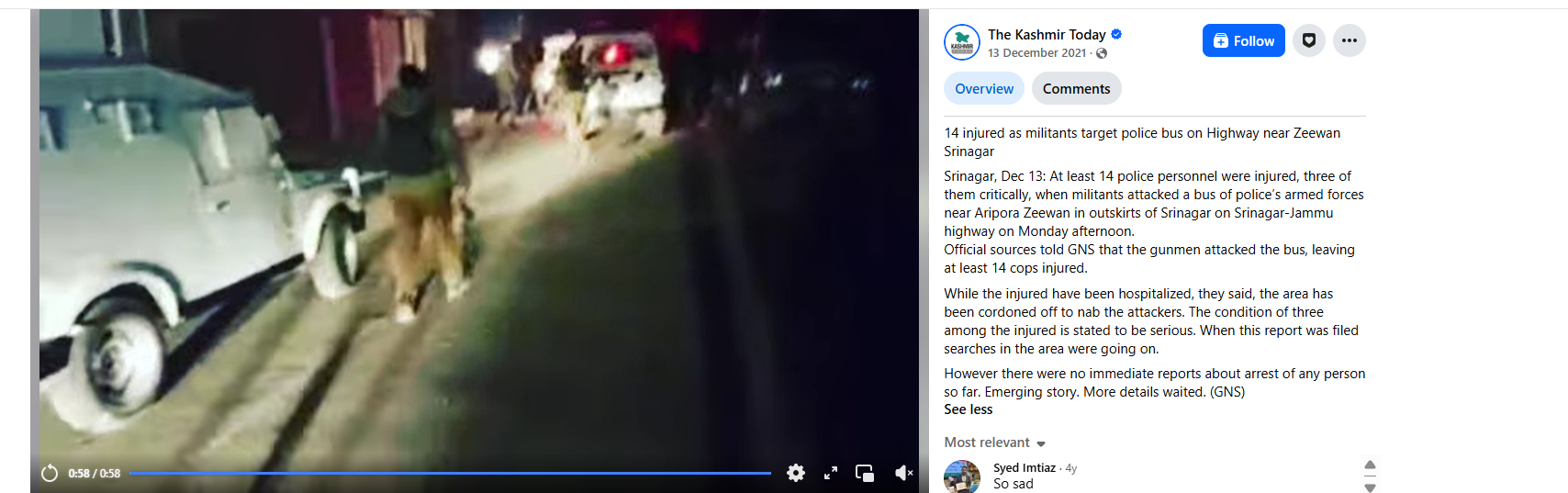
To verify the viral claim, we conducted a Google search using relevant keywords. During the search, we did not find any credible media report supporting the claim. As part of our research, we conducted a reverse image search of keyframes from the video. During the search, we found the same video on the Facebook page of The Kashmir Today, where it was posted on December 13, 2021. The 58-second video also contains the portion seen in the viral video in its final six seconds. According to the information accompanying the video, militants attacked a police bus near Aripora Zewan on the Srinagar-Jammu highway in the outskirts of Srinagar on Monday afternoon. At least 14 police personnel were injured in the attack, three of whom were reported to be in critical condition.
According to official sources cited in the report, the gunmen’s attack injured 14 police personnel, who were subsequently admitted to a hospital. The area was cordoned off and a search operation was underway to apprehend the attackers. At the time, there were no reports of any arrests.
https://www.facebook.com/watch/?v=422219106288318
Based on the clue found on Facebook, we conducted a Google search using relevant keywords. During the search, we found a report published on The Times of India website on December 14, 2021, carrying the same claim.

Conclusion
Our research found that the video being shared on social media is not recent but dates back to December 2021. During the reverse image search, we found the same video on The Kashmir Today’s Facebook page, where it was posted on December 13, 2021. The viral portion of the video is also present in the original 58-second clip. According to the available information, the video is related to the December 2021 terrorist attack on a Jammu and Kashmir Police bus in the Pantha Chowk area of Srinagar. The attack resulted in the deaths of two police personnel, while 14 others were injured. Therefore, the old video is being shared with a misleading claim by linking it to a recent incident.

Related Blogs

Executive Summary
Amid rising tensions in the Middle East following attacks on Iran by the United States and Israel, a video is being shared on social media claiming that it shows a recent attack at Dubai International Airport. Research by the CyberPeace found the viral claim to be false. Our research revealed that the viral video is not real but has been created using artificial intelligence technology.
Claim:
An Instagram user shared the viral video on March 1, 2026, claiming it shows an attack at Dubai Airport. The link to the post, the archive link, and a screenshot are provided below.

Fact Check:
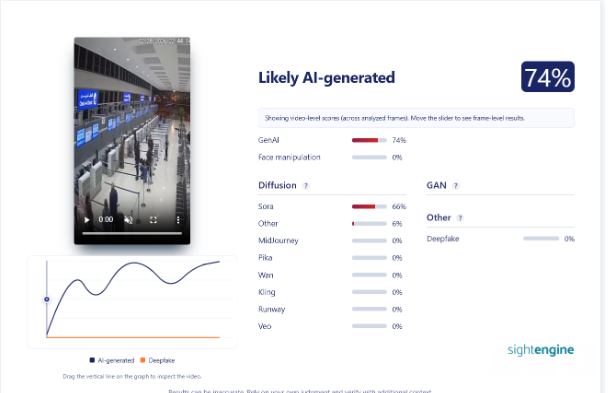
To verify the viral claim, we searched Google using relevant keywords. However, we did not find any credible media report confirming the claim.On closely examining the viral video, we noticed several unusual visuals and technical inconsistencies, raising suspicion that it might be AI-generated. To verify this, we scanned the video using the AI detection tool Sightengine. According to the results, around 74 percent of the video shows the likelihood of being AI-generated.
Conclusion:
Our research found that the viral video is not real but has been created using artificial intelligence technology.
Introduction
On June 11, 2026, the Ministry of Home Affairs (MHA) India released one of the most critical Indian government advisories concerning cybersecurity by the Indian Cyber Crime Coordination Centre (I4C) under the National Cybercrime Threat Analytics Unit (NCTAU) concerning the immediate and escalating threat posed by the weaponization of generative artificial intelligence to forge synthetic biometric identities capable of bypassing the existing facial verification mechanisms in India. This advisory is arguably one of the most explicit Indian government recognitions of the deep-seated threats associated with AI-generated deepfakes in the country’s digital financial infrastructure. As many Indian financial service providers embrace facial recognition and biometric verification systems for customer onboarding and authentications, the myth that biometric traits are in themselves secure is slowly unraveling.
The advisory states that cybercriminals are deploying sophisticated AI tools to forge such credible digital simulacrums that exhibit such a precise similarity of facial expressions, eye movements, eye blinks, head movements, and voice patterns that they are virtually indistinguishable from the originals for identity verification mechanisms. Such a confluence of easy AI technology, mass onboarding of digital identities, and underdeveloped infrastructure to detect these synthetics requires urgent regulatory, institutional, and technological intervention.
The I4C Advisory: Core Findings and Threat Architecture
In its advisory, NCTAU describes a complex, multi-step attack chain used by scammers to capture biometric information and perpetrate fraud using everyday social interactions. The attackers typically use social media accounts, chat messengers, online job applications, dating applications, or direct phone calls to reach their targets. These interactions are presented as innocuous, such as for video calls, job interviews, identity checks, or just normal conversation with the intention of recording facial and vocal data.
During these interactions, victims may be asked to perform gestures commonly seen in legitimate video calls, such as look directly at the camera, blink, turn their head, or say specific phrases. However, the perpetrators record this video feed without the victim's knowledge and then use deep learning generative AI technologies to process it. Through methods such as Generative Adversarial Networks (GANs) and diffusion models, the scammers create photorealistic synthetic duplicates of the target, capable of mirroring all physical and vocal attributes, such as facial expressions, blinking patterns, head movements, and even voice tones.
The advisory explicitly states that these synthetic identities can be used for a variety of fraudulent activities, such as spoofing face authentication systems, circumventing liveness detection checks, successfully completing video KYC, enabling fraudulent account recovery processes, and illegally accessing bank and financial services. NCTAU also cautions that these voice deepfakes may be paired with facial deepfakes in an attempt to undermine multi-modal authentication methods, and the occurrence of related SIM-swap attacks can eliminate the last layer of security in OTP verification and facilitate a complete account compromise.
The scale of India's Digital Financial Ecosystem
The scale of I4C's detected threat can be better understood by considering India's entire digital financial landscape. In 2025 India has witnessed over 228 billion UPI transactions, with 21.63 billion in December alone, an annual growth rate of 29% from 2024, and an active user base of over 500 million by the beginning of 2026. Furthermore, total e-KYC transactions by April 2025 have exceeded 2,393 crore, and thus, it can be seen the extent to which these aspects of finance (banking, insurance, and credit) are now conducted via remote digital verification. The transformation, although instrumental in increasing financial inclusion, has, according to some analysts, created an attack surface of historic scale. As hundreds of millions more become financially integrated via the very same channels that now form the country's infrastructure and systems of identity, the threat from identity-based fraud becomes astronomically large.
Indian government data further illustrates the extent to which such frauds are a growing concern. Cybercrime cases jumped 42% year-on-year to 2.27 million in 2024, resulting in losses amounting to nearly 228.45 billion. Within that, 1.34 million UPI cases, worth 1,087 crore, occurred in FY2024 alone, while cybercrimes in general soared from 260,000 cases in 2021 to nearly 2.8 million by 2025, totaling cybercrime losses of 22,931 crore.
How Do Deepfakes Defeat Biometric Systems?
Deepfake fraud, in particular, is extremely difficult to counteract due to the direct attack it poses on the assumptions underlying traditional verification systems. Passive techniques for verifying a live person from a static photo or video existed that primarily looked for similarities in textures, lighting, and geometrical properties or challenged subjects to perform an action in real-time. But the generation of real-time face swapping that contains blinks, head motion, and speaking can now be produced on even cheap machines. Cybercriminals can exploit these by using virtual camera drivers to "inject" the false image feed into the live verification session, nullifying any passive liveness checks. Data from the industry clearly shows the extent of this problem: iProov, a leading authenticator, documented a 7.8-fold rise in injection attacks in 2024; Jumio noted an 88% increase in deepfake-induced fraud in 2025; and voice-deepfake attacks on financial call centres saw a 6.8-fold increase in 2024.
Gartner had also predicted that 30% of organizations would have lost trust in facial verification alone by 2026, and work by Kubam (2024) confirmed a lack of multi-factor authentication such as cross-validation of biometric, document, and device integrity signals used within KYC platforms. Such fears have been corroborated by FATF's 2025 Horizon Scan, which classified deepfakes as an emerging threat to the AML/CDD framework and digital identity verification.
Recommendations by I4C
I4C's advisory goes beyond merely warning about threats and lists actionable recommendations to both institutions and citizens. Banks, NBFCs, fintech companies, and onboarding platforms have been advised to incorporate advanced deepfake and synthetic content detection techniques into their verification flows, given that first-generation liveness checks are not enough. They should employ a multi-modal strategy that considers face features along with the device, network signals, behavioral biometrics, and alignment of face and voice. They also have been advised to make a more robust upgrade of their onboarding and verification platforms, as much of the current remote verification architecture was built in a less sophisticated threat context. This aligns with the KYC Master Direction of the RBI that specifies end-to-end encryption, IP-based access controls, geotagging, and technology platforms and systems are to be upgraded frequently. Citizens are advised by I4C to keep their biometric information secure; be careful of unsolicited video calls and online interviews; keep an eye on transaction-related SMS and emails; and report suspicious instances through the National Cybercrime Reporting Portal and through the telephone number 1930. It is clarified that this advisory aims to create awareness of developing AI-based identity fraud schemes, and it is not a declaration that any specific organization, platform, or service is vulnerable.
The Legislative Dimension: India's Evolving Response to Synthetic Media
The problem highlighted by I4C is evolving in a heavily legislated environment, not a legal void. The first-ever legal definition of "synthetic media" in India came into force in the Information Technology Amendment Rules 2026 on February 20, 2026. These rules oblige significant platforms to remove deepfakes and non-consensual intimate media within three hours and two hours, respectively, or lose their safe harbor protection under Section 79 of the IT Act. While the provision focuses on harm stemming from content, this creates a new legal and normative precedent on dealing with AI-induced deception. However, financial frauds facilitated through deepfakes are not content but involve the use of remote identity verification and customer onboarding systems, which require specific technical standards. The overall policy environment when viewed in light of the FATF Horizon Scan, RBI KYC rules, and recent I4C advisory already offers significant scope to define and introduce mandatory deepfake detection and identity assurance standards even before these are explicitly legislated.
Institutional and Technical Recommendations
- For Financial Institutions and Fintech platforms: The existing verification systems (liveness detection) must be replaced with multi-layered deep-fake detection processes, including injection attack detection, behavioral biometrics, cross-modal facial and voice verification, device integrity check, and hardware attestation during onboarding itself.
- For Regulators: The RBI and Ministry of Home Affairs should work together to release technical standards that specify minimum deepfake-detection requirements for video-KYC and remote onboarding systems in line with FATF digital identity guidance and the upcoming EU AI Act.
- For researchers and academia: Dedicated studies on deepfake detection performance across varied demographic, linguistic, and regional populations of India should be prioritized. Current models are mostly trained on Western data.
- For citizens: Face recordings and other biometric information should be treated with the same caution as sensitive financial details. Be wary of unsolicited video calls, remote interviews, or verification requests from unknown people, and report suspicious activities on any account immediately via the National Cybercrime Helpline (1930) or cybercrime.gov.in.
Conclusion
The I4C advisory of June 2026 marks a critical recognition that advances in generative AI have fundamentally challenged the reliability of facial biometric authentication. For a country whose digital financial ecosystem relies heavily on remote identity verification, the implications are significant. The integrity of India's financial inclusion framework now depends on rapidly strengthening identity assurance mechanisms. Addressing this threat will require coordinated action by regulators, financial institutions, technology developers, researchers, and citizens to develop robust technical standards, enhance detection capabilities, and build public awareness at a pace matching the evolution of AI-enabled fraud.
References and Sources
- I4C / NCTAU Advisory, June 2026 — National Cybercrime Threat Analytics Unit, Indian Cyber Crime Coordination Centre, Ministry of Home Affairs, Government of India. Advisory on AI-Enabled Deepfake Identity Fraud. Issued 11 June 2026.
- shuftipro.com/blog/key-takeaways-from-fatf-horizon-scan-report-on-deepfakes
- https://timesofindia.indiatimes.com/india/fraudsters-creating-deepfakes-to-bypass-facial-authentication-i4c/articleshow/131668958.cms
- hyperverge.co/blog/what-is-a-deepfake
- iproov.com/reports/threat-intelligence-report-2026
- arxiv.org/pdf/2601.06241

Introduction
Discussions took place focused on cybersecurity measures, specifically addressing cybercrime in the context of emerging technologies such as Non-Fungible Tokens (NFTs), Artificial Intelligence (AI), and the Metaverse. Session 5 of the conference focused on the interconnectedness between the darknet and cryptocurrency and the challenges it poses for law enforcement agencies and regulators. They discussed that Understanding AI is necessary for enterprises. AI models have difficulties, but we are looking forward to trustworthy AIs. and AI technology must be transparent.
Darknet and Cryptocurrency
The darknet refers to the hidden part of the internet where illicit activities have proliferated in recent years. It was initially developed to provide anonymity, privacy, and protection to specific individuals such as journalists, activists, and whistleblowers. However, it has now become a playground for criminal activities. Cryptocurrency, particularly Bitcoin, has been widely adopted on the darknet due to its anonymous nature, enabling anti-money laundering and unlawful transactions.
Three major points emerge from this relationship: the integrated nature of the darknet and cryptocurrency, the need for regulations to prevent darknet-based crimes, and the importance of striking a balance between privacy and security.
Key Challenges:
- Integrated Relations: The darknet and cryptocurrency have evolved independently, with different motives and purposes. It is crucial to understand the integrated relationship between them and how criminals exploit this connection.
- Regulatory Frameworks: There is a need for effective regulations to prevent crimes facilitated through the darknet and cryptocurrency while striking a balance between privacy and security.
- Privacy and Security: Privacy is a fundamental right, and any measures taken to enhance security should not infringe upon individual privacy. A multistakeholder approach involving tech companies and regulators is necessary to find this delicate balance.
Challenges Associated with Cryptocurrency Use:
The use of cryptocurrency on the darknet poses several challenges. The risks associated with darknet-based cryptocurrency crimes are a significant concern. Additionally, regulatory challenges arise due to the decentralised and borderless nature of cryptocurrencies. Mitigating these challenges requires innovative approaches utilising emerging technologies.
Preventing Misuse of Technologies:
The discussion emphasised that we can step ahead of the people who wish to use these beautiful technologies meant and developed for a different purpose, to prevent from using them for crime.
Monitoring the Darknet:
The darknet, as explained, is an elusive part of the internet that necessitates the use of a special browser for access. Initially designed for secure communication by the US government, its purpose has drastically changed over time. The darknet’s evolution has given rise to significant challenges for law enforcement agencies striving to monitor its activities.
Around 95% of the activities carried out on the dark net are associated with criminal acts. Estimates suggest that over 50% of the global cybercrime revenue originates from the dark net. This implies that approximately half of all cybercrimes are facilitated through the darknet.
The exploitation of the darknet has raised concerns regarding the need for effective regulation. Monitoring the darknet is crucial for law enforcement, national agencies, and cybersecurity companies. The challenges associated with the darknet’s exploitation and the criminal activities facilitated by cryptocurrency emphasise the pressing need for regulations to ensure a secure digital landscape.
Use of Cryptocurrency on the Darknet
Cryptocurrency plays a central role in the activities taking place on the darknet. The discussion highlighted its involvement in various illicit practices, including ransomware attacks, terrorist financing, extortion, theft, and the operation of darknet marketplaces. These applications leverage cryptocurrency’s anonymous features to enable illegal transactions and maintain anonymity.
AI's Role in De-Anonymizing the Darknet and Monitoring Challenges:
- 1.AI’s Potential in De-Anonymizing the Darknet
During the discussion, it was highlighted how AI could be utilised to help in de-anonymizing the darknet. AI’s pattern recognition capabilities can aid in identifying and analysing patterns of behaviour within the darknet, enabling law enforcement agencies and cybersecurity experts to gain insights into its operations. However, there are limitations to what AI can accomplish in this context. AI cannot break encryption or directly associate patterns with specific users, but it can assist in identifying illegal marketplaces and facilitating their takedown. The dynamic nature of the darknet, with new marketplaces quickly emerging, adds further complexity to monitoring efforts.
- 2.Challenges in Darknet Monitoring
Monitoring the darknet poses various challenges due to its vast amount of data, anonymous and encrypted nature, dynamically evolving landscape, and the need for specialised access. These challenges make it difficult for law enforcement agencies and cybersecurity professionals to effectively track and prevent illicit activities.
- 3.Possible Ways Forward
To address the challenges, several potential avenues were discussed. Ethical considerations, striking a balance between privacy and security, must be taken into account. Cross-border collaboration, involving the development of relevant laws and policies, can enhance efforts to combat darknet-related crimes. Additionally, education and awareness initiatives, driven by collaboration among law enforcement, government entities, and academia, can play a crucial role in combating darknet activities.
The panel also addressed the questions from the audience
- How law enforcement agencies and regulators can use AI to detect and prevent crimes on the darknet and cryptocurrency? The panel answered that- Law enforcement officers should also be AI and technology ready, and that kind of upskilling program should be there in place.
- How should lawyers and the judiciary understand the problem and regulate it? The panel answered that AI should only be applied by looking at the outcomes. And Law has to be clear as to what is acceptable and what is not.
- Aligning AI with human intention? Whether it’s possible? Whether can we create an ethical AI instead of talking about using AI ethically? The panel answered that we have to understand how to behave ethically. AI can beat any human. We have to learn AI. Step one is to focus on our ethical behaviour. And step two is bringing the ethical aspect to the software and technologies. Aligning AI with human intention and creating ethical AI is a challenge. The focus should be on ethical behaviour both in humans and in the development of AI technologies.
Conclusion
The G20 Conference on Crime and Security shed light on the intertwined relationship between the darknet and cryptocurrency and the challenges it presents to cybersecurity. The discussions emphasised the need for effective regulations, privacy-security balance, AI integration, and cross-border collaboration to tackle the rising cybercrime activities associated with the darknet and cryptocurrency. Addressing these challenges will require the combined efforts of governments, law enforcement agencies, technology companies, and individuals committed to building a safer digital landscape.
