
#FactCheck: AI-Manipulated Video Falsely Shows Army Chief General Dhiraj Seth Dancing With Major’s Wife
Executive Summary
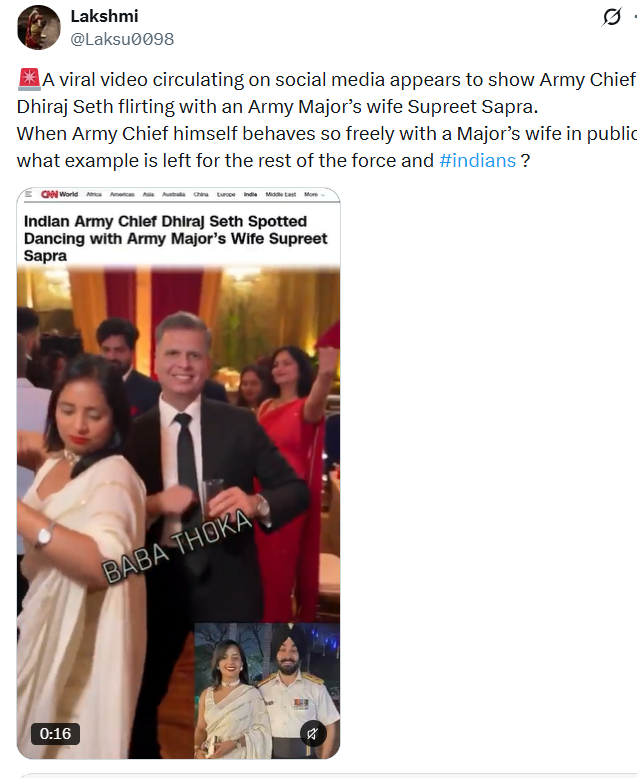
A video is going viral on social media, purportedly showing Indian Army Chief General Dhiraj Seth dancing with a woman. The video is being shared with the claim that Army Chief General Dhiraj Seth was seen dancing with Supreet Sapra, the wife of an Army Major. The video also uses a format resembling the CNN website, and several social media users are sharing it as genuine. However, CyberPeace Research found the video to be completely fake. In reality, an original video was manipulated using AI technology and circulated as part of a disinformation campaign targeting the Army Chief. The Indian Army has also denied the claim.
Claim
An X handle, ‘@Laksu0098’, shared a purported CNN report on September 29. It featured a video allegedly showing Army Chief General Dhiraj Seth dancing with an Army Major’s wife, Supreet Sapra, while holding a glass of alcohol. The bottom portion of the video also displayed a photograph of a woman with an Army officer, implying that the woman in the photograph was the same person seen dancing with the Army Chief. The claim shared along with the video read: “A viral video circulating on social media appears to show Army Chief Dhiraj Seth flirting with an Army Major’s wife, Supreet Sapra. When the Army Chief himself behaves so freely with a Major’s wife in public, what example is left for the rest of the force and Indians?”
https://x.com/Laksu0098/status/2104830327059566641?s=20
Fact Check
We began our research into the viral video by conducting a keyword search. Since the video uses the name and format of CNN, we first searched CNN for any news report related to the video. However, we did not find any such report.
In the next stage of our research, we closely examined the video to assess its authenticity. The movements of the people shown in the viral video, as well as the alcohol in the glasses they were holding, appeared unnatural. Normally, when a person dances while holding a glass filled with liquid, the liquid would show some movement. However, no such movement can be seen in the viral video. This raised suspicions that the video may have been generated or manipulated using AI.
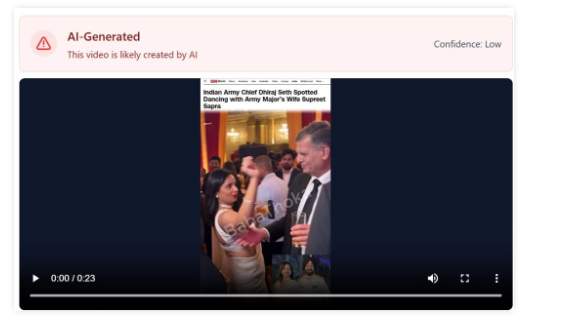
As part of the next step in our research, we used AI detection tools to analyse the video. We first analysed the video using ZeroGPT, which indicated that the viral video was likely AI-generated.
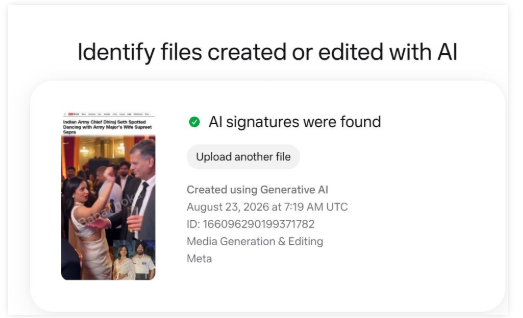
Taking our research forward, we analysed the viral video using Meta AI’s detection tool. The tool’s results indicated that the video had been altered using AI on August 23, 2026.
Conclusion
Our research found that the video being circulated in the name of Army Chief General Dhiraj Seth is fake. The Indian Army has also denied the claim. In reality, the viral video was created and circulated using AI technology.

Related Blogs

Introduction
In recent times the evolution of cyber laws has picked up momentum, primarily because of new and emerging technologies. However, just as with any other law, the same is also strengthened and substantiated by judicial precedents and judgements. Recently Delhi High Court has heard a matter between Tata Sky and Linkedin, where the court has asked them to present their Chief Grievance Officer details and SoP per the intermediary guidelines 2021.
Furthermore, in another news, officials from RBI and Meity have been summoned by the Parliamentary Standing Committee in order to address the rising issues of cyber securities and cybercrimes in India. This comes on the very first day of the monsoon session of the parliament this year. As we move towards the aspects of digital India, addressing these concerns are of utmost importance to safeguard the Indian Netizen.
The Issue
Tata Sky changed its name to Tata Play last year and has since then made its advent in the OTT sector as well. As the rebranding took place, the company was very cautious of anyone using the name Tata Sky in a bad light. Tata Play found that a lot of people on Linkedin had posted their work experience in Tata Sky for multiple years, as any new recruiter cannot verify the same. This poses a misappropriation of the brand’s name. This issue was reported to Linkedin multiple times by officials of Tata Play, but no significant action was seen. This led to an issue between the two brands; hence, a matter has been filed in front of the Hon’ble Delhi High Court to address the issue. The court has taken due cognisance of the issue, and hence in accordance with the Intermediary Guidelines 2021, the court has directed Linkedlin to provide the details of their Cheif Grievance Officer in the public domain and also to share the SoP for the redressal of issues and grievances. The guidelines made it mandatory for all intermediaries to set up a dedicated office in India and appoint a Chief Grievance Officer responsible for effective and efficient redressal of the platform-related offences and grievances within the stipulated period.
The job platform has also been ordered to share the SoPs and the various requirements and safety checks for users to create profiles over Linkedin. The policy of Linkedin is focused towards the users as well as the companies existing on the platform in order to create a synergy between the two.
RBI and Meity Official at Praliament
As we go deeper into cyberspace, especially after the pandemic, we have seen an exponential rise in cybercrimes. Based on statistics, 4 out of 10 people have been victims of cybercrimes in 2022-23, and it is estimated that 70% of the population has been subjected to direct or indirect cybercrime. As per the latest statistics, 85% of Indian children have been subjected to cyberbullying in some form or the other.
The government has taken note of the rising numbers of such crimes and threats, and hence the Parliamentary Committee has summoned the officials from RBI and the Ministery of Electronics and Information Technology to the parliament on July 20, 2023, i.e. the first day of monsoon session at the parliament. This comes at a very crucial time as the Digital Personal Data Protection Bill is to be tabled in the parliament this session and this marks the revamping of the legislation and regulations in the Indian cyberspace. As emerging technologies have started to surround us it is pertinent to create legal safeguards and practices to protect the Indian Netizen at large.
Conclusion
The legal crossroads between Tata Sky and Linkedin will go a long way in establishing the mandates under the Intermediary guidelines in the form of legal precedents. The compliance with the rule of law is the most crucial aspect of any democracy. Hence the separation of power between the Legislature, Judiciary and Execution has been fundamental in safeguarding basic and fundamental rights. Similarly, the RBI and Meity officials being summoned to the parliament shows the transparency in the system and defines the true spirit of democracy., which will contribute towards creating a safe and secured Indian Cyberspace.
Introduction
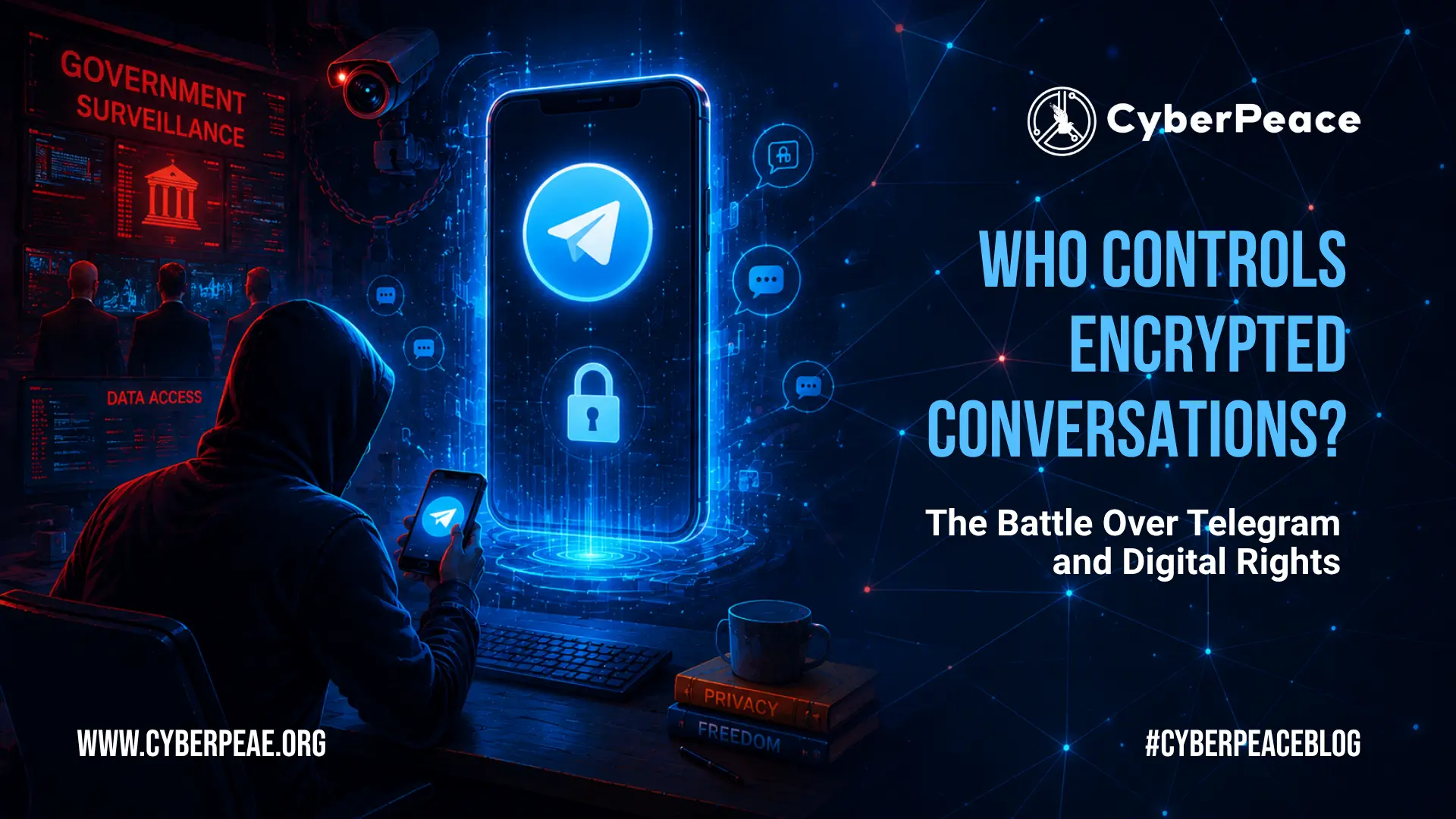
In June 2026, the Government of India temporarily restricted access to Telegram amid concerns that the platform had been used to facilitate examination related malpractice, including the alleged circulation of leaked question papers during the NEET UG re examination. The move reignited a familiar debate about the responsibility of digital platforms for unlawful activities carried out through them.
Critics of such restrictions raise a fundamental question: if a traffic accident occurs on a road, do we shut down the road? If theft takes place inside a shopping mall, do we close the entire mall? By the same logic, is it reasonable to block a communication platform because some individuals misuse it? These questions lie at the heart of a broader conflict between state interests in maintaining public order and the protection of digital rights, privacy, and freedom of communication in an increasingly interconnected world.
The controversy surrounding Telegram therefore extends beyond a single examination or messaging application. It raises a deeper and more pressing question: who should bear responsibility for illegal acts committed through encrypted digital platforms, and where should the law draw the line between effective enforcement and the preservation of fundamental digital freedoms?
Beyond mere communication for millions of students in India, Telegram is a classroom in the digital sense, an archive for their notes, practice papers, lecture recordings, and community groups that hundreds of millions of candidates refer to every single day. Therefore, why on a routine day in June 2026 did the messaging app top every other channel? Temporary internet restriction on the platform had become necessary to stop examination-related malpractice like leakage of question papers and was temporarily suspended, with reports suggesting that this move by the government was on the occasion of the NEET-UG re-examination.
This ban once again brings up a bigger question that cannot be contained within one particular examination. When has it become okay to hold a communication platform responsible and accountable for illegal acts committed over it? Or are the perpetrators solely to blame, and the service can be prohibited? Ultimately, where is the line drawn between public interest, law enforcement, and digital rights and privacy?
End-to-End Encryption: Architecture and Benefits
At the heart of these discussions of Telegram and other apps lies a technology referred to as "end-to-end encryption" or "E2EE." Quite literally, it means a message is locked with cryptography on the sender's device and can only be unlocked by the intended recipient. Not even the tech platform running the communication app can decipher it for everyone else; it just looks like random gibberish.
The Process
This kind of modern communication relies on public key cryptography. Each person has a public key they can share with anyone and a private key that stays only on their devices. When they send you a message, it is scrambled with crypto that can be unlocked by only your private key. WhatsApp and Signal, for example, use the Signal Protocol, which features "perfect forward secrecy" and is designed to protect communications from ever being unlocked even if one key is compromised. Telegram's approach is a bit unique. By default, Telegram messages aren't encrypted with end-to-end crypto; this only comes via an optional feature called "Secret Chats," a key difference in the regulatory debate.
The Dark Side: Crime, Misuse, and the Moderation Dilemma
The very features that make end-to-end messaging popular among everyday people are privacy, speed, anonymity, and mass reach which also make end-to-end messaging popular among criminals. That, unfortunately, is the catch for policymakers globally: The technology designed to protect innocent users is also the technology that facilitates criminal activity.
3.1 Criminal Abuse
Telegram, in particular, has frequently come under fire for its role in hosting a spectrum of criminal activities, most notably in the recent controversy in India regarding NEET-UG 2026 examination papers where channels allegedly advertised leaked question papers for enormous sums, convincing desperate candidates. In these instances, messages could be altered or deleted using Telegram’s message editing feature, fabricating evidence of prior leaks. However, this extends to illicit marketplaces, drug trafficking, financial fraud, money laundering, and distributing other prohibited content. Telegram's usage in disseminating extremist propaganda and aiding criminal organizations is also frequently cited, leading to bans or restrictions in countries ranging from Brazil to Nepal to Somalia to Vietnam.
3.2 The Moderation Dilemma
But the difficulty is not just with misuse; it’s also about effective moderation. Moderation, however, requires content transparency. Strong encryption is built to obscure just that. Many end-to-end messaging services like Signal and WhatsApp emphasize that even if they wanted to, they would have been able to decipher the content of a user’s message due to their architecture. Telegram has been in scrutiny for years due to its limited cooperation with law enforcement agencies because its default chats are not completely end-to-end encrypted, though there has been an attempt by Pavel Durov, the platform’s founder, to increase cooperation following his 2024 arrest in France.
This gives policymakers the following challenge: How can governments require increased access to fight crime without forcing tech companies to weaken security for everyone? As cryptographers point out, a specific "backdoor" intended to allow access to law enforcement officials can be easily exploited by hackers, foreign governments, and any other actor with nefarious intent.
Comparison of Regulatory Approaches Worldwide
4.1 Authoritarian Countries' Responses
China, for instance, has had the app blocked as part of its strategy to control access to the internet since 2015, and Iran did so in 2018 when the app was used to help organize protests against the government. An infamous Russian bid to block Telegram in 2018 turned into a cautionary story. Trying to censor the service disrupted the IPs of millions of computers, including significant services like those run by Amazon and Google. The move was met by a surge of users turning to VPNs to get access. It’s an expensive, disruptive, and incomplete form of censorship.
4.2 Democratic Countries' Approaches
Democratic jurisdictions generally prefer targeted interventions. Telegram was suspended in Brazil in 2022 and 2023, though again, only in response to a judge’s order in relation to particular investigations, and was lifted when it came into compliance. The EU’s approach has been to build on an established approach of regulation by use of a broader legislative framework, including the Digital Services Act and the Digital Markets Act, aimed at platform liability rather than outlawing encryption outright.
Meanwhile, the proposed scanning of encrypted communications has run into strong judicial headwinds, with the European courts stressing the danger of backdoors to privacy.
4.3 The United Kingdom Approach
The UK offers a middle way. With its Investigatory Powers Act, the government can oblige tech companies to collaborate in legitimate investigations. But this came to a head earlier this year with the case of Apple and the government's attempts to force it to unlock encrypted iCloud backups. Apple not only refused to reduce its encryption but also decided instead to disable some of its features for British users. This has created a problem for democracies across the world: how to balance access for investigators against the need to maintain the security that makes our systems safer.
Judicial and Legislative Perspectives: India and Beyond
In the Indian context, to have a perspective about the legal frameworks concerning content moderation, let’s explore some of the foundational decisions from the Supreme Court. Three decisions have laid the building block for digital rights laws: the first being Shreya Singhal v. Union of India (2015), where Section 69A of the IT Act, 2000, was upheld, but only by laying rigorous conditions on the review process and chance of challenging the said decision. Another important decision in this sphere is Justice K.S. Puttaswamy v. Union of India (2017) which stated that the right to privacy is fundamental in nature under Article 21 of the Constitution and stipulated the constitutional requirements of legality, legitimacy, and proportionality against the state’s interventions in fundamental rights. The most recent important case law to consider, in this context, would be Anuradha Bhasin v. Union of India (2020) which set certain limitations, such as any internet shut-downs or orders have to be temporary, proportional, and have scope for appeal. Further, the Supreme Court demanded transparency around any and all orders of blocking.
These principles of proportionality and legal limitations are highly pertinent to the Telegram issue, especially since Section 69A confers powers to block information in case of concerns about public order, national security, etc., but activists often cite this power to target specific content rather than entire platforms like Telegram. The ban on Telegram in June 2026 and disabling of message editing will force authorities to justify not only their statutory authority but also the need for proportionate means.
These aspects are amplified by IT Rules, 2021, which mandate that some instant messaging platforms may require identification of the ‘first originator’ of messages, and the Digital Personal Data Protection Act, 2023, to protect digital personal data by ensuring it does not undermine national security exceptions to this end.
Moreover, the use of encryption to ensure secure and private communications is becoming an important point of legal discourse globally. Recently, the European Court of Human Rights in Podchasov v. Russia (2024) held that mandating decryption on devices as a tool of investigative power constituted a disproportionate interference with an individual's right to privacy implying that while states may indeed have authority to regulate communication and digital services, any such measures limiting the scope of encryption will have to meet strict requirements of legality, necessity, and proportionality to be legally justifiable.
Constitutional Validity of the Ban
The government's case for a constitutional ban on Telegram rests upon its ability to satisfy the proportionality framework established by Puttaswamy and Anuradha Bhasin.
- Legitimate aim: The state's strong suit. This is the government's best argument. Protection of the integrity of NEET-UG, a high-stakes test with close to 2.4 million students, can indeed be a legitimate state objective. Given that there is evidence of channels that allegedly were involved in selling leaked question papers, the action is presumably justifiable under section 69A for preventing the incitement or occurrence of public disorder or preventing cognizable offenses.
- Necessity: The National Testing Agency (NTA) itself admitted that localized removal of suspicious accounts on Telegram had already mitigated the risks, while Telegram insisted that it had independently taken down numerous channels. The fact that the block affected more than 150 million users in India, where the medium is widely used for personal communication and is also utilized on other platforms like WhatsApp, Discord, and Instagram to a similar or higher extent, raises the responsibility to justify a strict platform-wide ban. Moreover, there is a significant legal question regarding the state’s authority under section 69A to direct Telegram to disable its message-editing capability.
- Proportionality and process: The block, even though it was temporary and intended to ensure fairness in the examination system, severely undermined legitimate uses of the platform by students who used it to share educational materials and organize study groups. Moreover, the opaqueness around the section 69A order is itself hard to reconcile with the transparency requirements set out in Anuradha Bhasin.
Thus, while the objectives of preventing exam fraud may be legitimate, the necessity and proportionality of single platform-wide bans remain highly suspect under Indian constitutional law.
Policy Recommendations and the Path Forward
The Telegram controversy points to the need for a better balancing act in platform governance in India. Firstly, instead of blanket platform shutdowns, action should target specific channels, bots, or URLs, as may be the case. Secondly, any attempt to dictate changes to features, such as disabling message editing, should be based on specific statutory provisions, not an expansive reading of Section 69A. Furthermore, there is a dire need for increased transparency; blocking orders must state the justification for the order, what is being blocked, and for how long, as far as possible. In the long run, stricter cross-border cooperation via streamlined MLATs, or through the appointment of local legal representatives by foreign platforms, would facilitate easier enforcement. Ultimately, all major blocking decisions must be accompanied by proportionality assessments. Lastly, India must resist pressure to provide access to encryption backdoors; while this might ease investigative burdens, doing so would severely jeopardise the cybersecurity of India, its businesses, and citizens.
Conclusion
The Telegram ban is an example of the tricky equilibrium between protection of public interest and protection of digital liberties in our hyper-connected world. While the intent to counter exam fraud is justifiable, a blanket ban on any platform has much broader implications on questions of necessity, proportionality and transparency. India has a well-developed constitutional and legal framework to deal with this issue already, and the challenge will be to see if those powers are used appropriately.
References
Cases:
- Shreya Singhal v. Union of India (2015) 5 SCC 1 — Supreme Court of India
- Justice K.S. Puttaswamy v. Union of India (2017) 10 SCC 1 — Supreme Court of India (Nine-Judge Bench)
- Anuradha Bhasin v. Union of India (2020) 3 SCC 637 — Supreme Court of India
- Podchasov v. Russia, European Court of Human Rights (Application No. 33696/19, February 2024)
- Apple Inc. v. United States (In re Search of an Apple iPhone, C.D. Cal. 2016)
- Telegram Messenger Inc. v. Union of India & Anr., Delhi High Court (June 2026) — Sub judice
Legislation & Rules:
- Information Technology Act, 2000 (India) — Sections 69A, 79
- IT (Procedure and Safeguards for Blocking Access to Information by Public) Rules, 2009
- IT (Intermediary Guidelines and Digital Media Ethics Code) Rules, 2021
- Digital Personal Data Protection Act, 2023 (India) & DPDP Rules, 2025
- EU Digital Services Act, 2022 (Regulation 2022/2065)
- EU Digital Markets Act, 2022 (Regulation 2022/1925)
- EU Child Sexual Abuse Regulation (CSAR) Proposal — In Trilogue, June 2026
- UK Investigatory Powers Act, 2016
Policy Sources:
- Internet Freedom Foundation, Statement on Telegram Block, 16 June 2026
- European Commission, ProtectEU Security Strategy, June 2025
- MeitY Section 69A Blocking Order re: Telegram (June 2026)
- NTA Press Release on NEET-UG 2026 Re-Examination, 16 June 2026
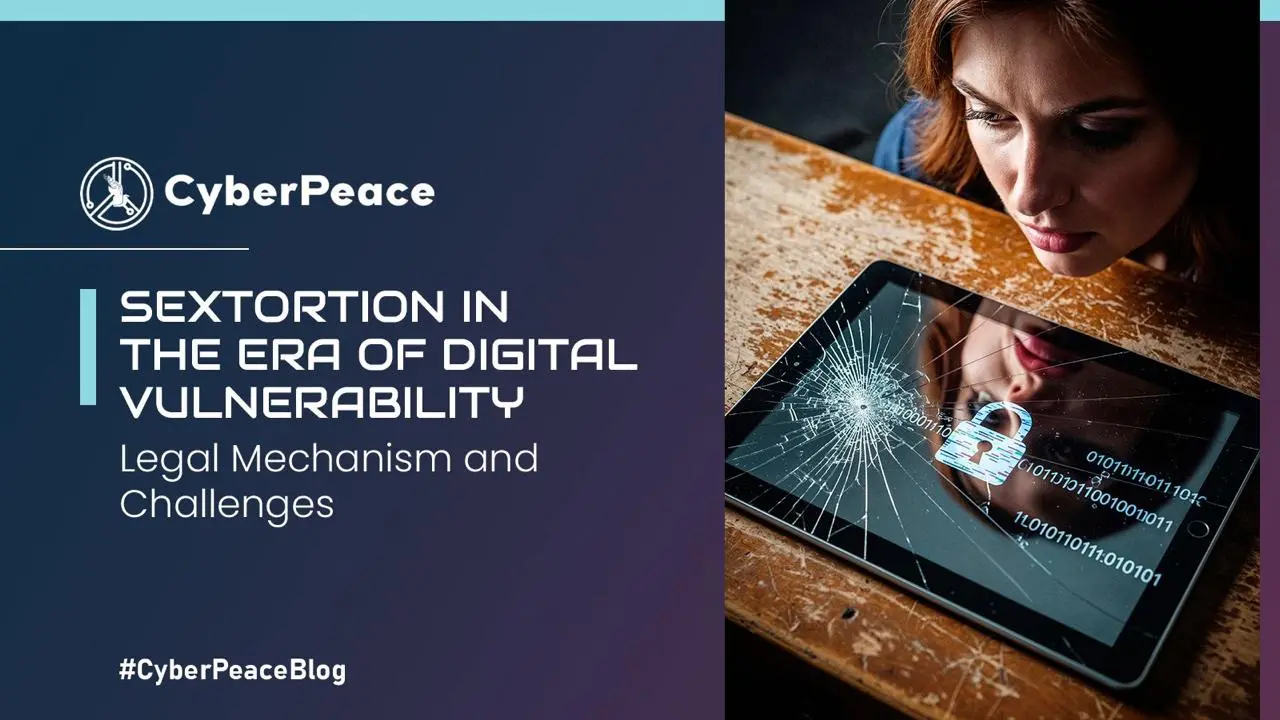
Introduction
We inhabit an era where digital connectivity, while empowering, has also unleashed a relentless tide of cyber vulnerabilities, where personal privacy is constantly threatened, and crimes like sextortion are the perfect example of the sinister side of our hyperconnected world. Social media platforms, instant messaging apps, and digital content-sharing tools have all grown rapidly, changing how people communicate with one another and making it harder to distinguish between the private and public domains. The rise of sophisticated cybercrimes that use the very tools meant to connect us is the price paid for this unparalleled convenience. Sextortion, a portmanteau of “sex’ and “extortion”, stands out among them as a particularly pernicious kind of internet exploitation. Under the threat of disclosing their private information, photos, or videos, people are forced to engage in sexual behaviours or provide intimate content. Sextortion’s psychological component is what makes it particularly harmful, it feeds on social stigma, shame, and fear, which discourage victims from reporting the crime and feed the cycle of victimisation and silence. This cybercrime targets vulnerable people from all socioeconomic backgrounds and is not limited by age, gender, or location.
The Economy of Shame: Sextortion as a Cybercrime Industry
A news report from June 03, 2025, reveals a sextortion racket busted in Delhi, where a money trail of over Rs. 5 crore was identified by different teams of the Crime branch. From synthetic financial identities to sextortion and other cyber frauds, a recipe for a sophisticated cybercrime chain was found. To believe this is an aberration is to overlook the reality that it is symptomatic of a much wider and largely uncharted criminal framework. According to the FBI’s 2024 IC3 report, “extortion (including sextortion)” has skyrocketed to 86,415 complaints with losses of $143 million reported in the United States (US) alone. This indicates that coercive image-based threats are no longer an isolated cybercrime but an everyday occurrence. Sextortion is no longer an isolated cybercrime; it has metamorphosed into a systematic, industrialised criminal enterprise. Another news report dated 19th July, 2025, where Delhi Police has detained four people suspected of participating in a sextortion scheme that targeted a resident of the Bhagwanpur Khera neighbourhood of Shahdara. The suspected people were allegedly arrested on a complaint wherein the victim was manipulated and fell prey to a dating site.
The threat is amplified by the usage of deepfake technology, which allows offenders to create obscene content that looks believable. The approach, which relies on the stigma attached to sexual imagery in conservative societies like India, is that victims frequently give in to requests out of fear of damaging their reputations. The combination of cybercrime and cutting-edge technology highlights the lopsided power that criminals possess, leaving victims defenceless and law enforcement unable to keep up.
Legal Remedies and the Evolving Battle Against Sextortion
Given the complexity of these crimes, India has recognised sextortion and similar cyber-enabled financial crimes under a number of legal frameworks. A change to recognising cyber-enabled sexual exploitation as an organised criminal business is shown by the introduction of specific provisions like Section 111 in the Bhartiya Nyaya Sanhita (BNS), 2023, which classifies organised cybercrimes including extortion and frauds which fall under its expansive interpretation, as a serious offence. Similarly, Section 318 (2) criminalises cheating with a maximum sentence of three years in prison or a fine, whereas Section 336 (2) makes digital forgery a crime with a maximum sentence with a maximum sentence of two years in prison or a fine. In addition to these regulations, cheating by personation through computer resources is punishable by the Information Technology Act, 2000, specifically Section 66D, which carries a maximum sentence of three years in prison and a maximum fine of Rs. 1 lakh. Due to issues with attribution, cross-border jurisdiction, and the discreet nature of digital evidence, enforcement is still inconsistent even with current statutory restrictions.
The government and its agencies recognise that laws achieve real impact only when backed by awareness initiatives and accessible, localised mechanisms for redressal. Several Indian states and the Department of Telecommunications launched numerous campaigns to educate the public about and safeguard their mobile communication assets against identity theft, financial fraud, and cyberscams. Initiatives like Cyber Saathi Initiative and Cyber Dost by MHA, with the goal of improving forensic and victim reporting skills.
Conclusion
At CyberPeace, we understand that the best defence against online abuse is prevention. Our goal is to provide people with the information and resources to identify, avoid and report sextortion attempts like CyberPeace Helpline and organise awareness campaigns on safe digital habits. In order to remain updated with the constantly looming danger, our research and policy advocacy also focus on developing more robust legal and technological safeguards.
To every reader: think before you share, secure your accounts, and never let shame silence you. If you or someone you know becomes a victim, report it immediately, help is available, and justice is possible. Together we can reclaim the internet as a space of trust, not terror.
References
- https://www.hindustantimes.com/india-news/delhi-police-busts-sextortion-cyberfraud-rackets-6-held-101748959601825.html
- https://timesofindia.indiatimes.com/city/delhi/delhi-police-arrests-four-for-sextortion-and-blackmail-in-shahdara/articleshow/122767656.cms
- https://cdn.ncw.gov.in/wp-content/uploads/2025/05/CyberSaheli.pdf
