
#FactCheck: AI-manipulated image falsely shows Indian High Commission official at PoK-related protest in UK
Executive Summary:
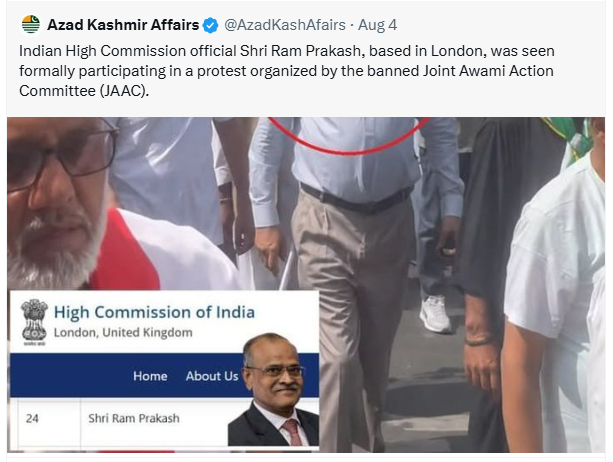
A photo is being circulated on social media with the claim that it shows Ram Prakash, an official from the Indian High Commission in the United Kingdom (UK), participating in a protest organised over issues related to PoK. CyberPeace Research Wing’s research found the claim associated with the image to be false. The research confirmed that the image was digitally modified using OpenAI’s AI tools.
Claim:
A user on social media platform X (formerly Twitter) shared the viral image on August 4, 2026, claiming that Shri Ram Prakash, an official from the Indian High Commission in London, was seen formally participating in a protest organised by the banned Joint Awami Action Committee (JAAC). The post link, archive link, and screenshot are provided below:
https://x.com/i/birdwatch/t/2084551118189904105?source=6
Fact Check:
During the research, we conducted a Google search using relevant keywords. We traced the original source of the viral visual to a social media post shared by Pakistani media outlet GEO News’ UK Bureau Chief Murtaza Ali Shah on August 2, 2024.
The post featured a video of a protest held in Luton, United Kingdom, where a large number of British Kashmiris were seen marching to express concerns over the situation in Pakistan-occupied Kashmir (PoK). At the time, the Joint Awami Action Committee (JAAC) was leading a prolonged protest in the region.
https://www.facebook.com/reel/1383400640416385

At the 1:23 mark of the video shared by the Pakistani journalist, we found the same scene that appears in the viral image. However, the individual seen in the viral image does not appear in the original footage. Instead, the video shows a different person participating in the protest.

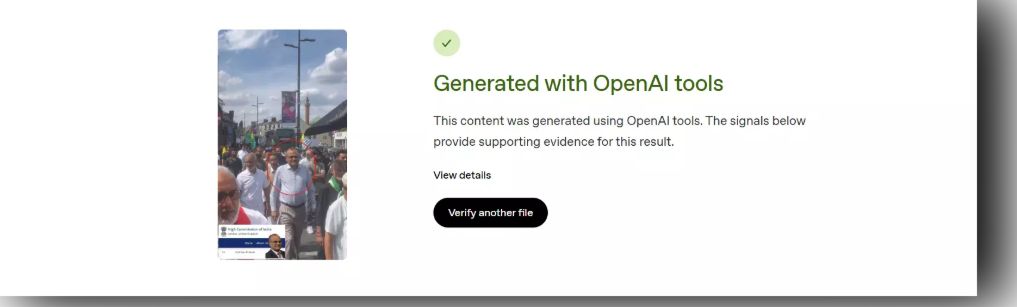
To further verify the authenticity of the image, we analysed it using multiple AI detection tools, including OpenAI’s image detection tool. The analysis detected provenance signals associated with OpenAI tools such as ChatGPT, OpenAI API, or Codex. These signals indicate that the image was created or modified using OpenAI’s AI tools.
Conclusion:
The research established that the viral image has been manipulated to falsely portray Indian High Commission official Ram Prakash as a participant in the protest. The original footage shows a different individual, while AI analysis confirmed that the image was modified using OpenAI tools. Therefore, the claim circulating with the image is misleading.

Related Blogs

Executive Summary
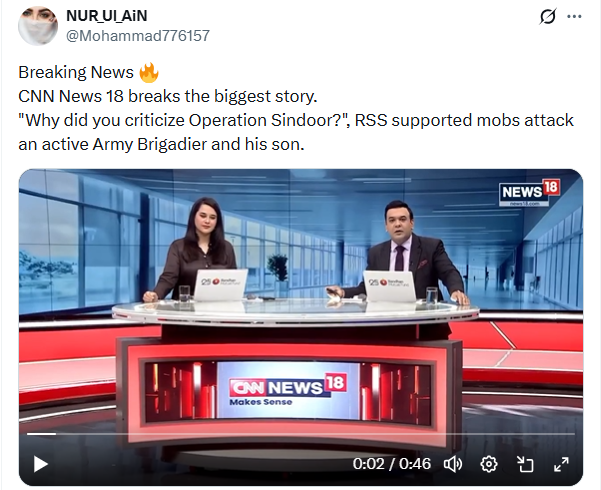
A video clip bearing the logo of News18 is being widely shared on social media with the claim that a serving Indian Army brigadier and his son were attacked in Delhi by an RSS-supporting mob for criticising the government over “Operation Sindoor.” The clip features an anchor allegedly explaining the motive behind the assault. However, research by the CyberPeace Research Wing found the claim to be false. The viral video has been digitally manipulated, with its audio altered to include misleading information.
Claim
An X user (@Mohammad776157) shared a video clip from Network18 on April 13, claiming that a serving Indian Army brigadier and his son were attacked in Delhi by an RSS-supporting mob for criticising the government over “Operation Sindoor.”
- https://x.com/Mohammad776157/status/2043691737609347166?s=20
- https://archive.ph/5EpbJ
To verify the claim, we extracted multiple keyframes from the viral video using the InVid tool and conducted reverse image searches via Google Lens. The same clip was found circulating across several social media platforms with similar claims.
- https://www.facebook.com/reel/2397972117364665
- https://www.instagram.com/reels/DXE4FFdjcnq/
- https://archive.ph/hjG3b
- https://archive.ph/9IkTY
Fact Check
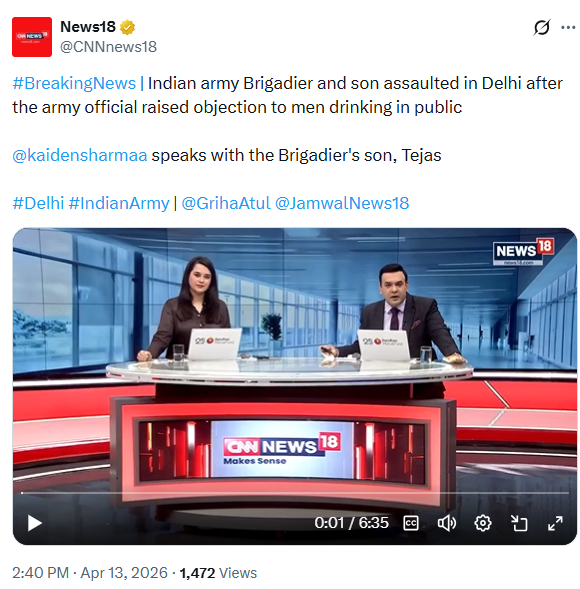
Since the video carried the News18 logo, we examined the outlet’s official social media handles. We found the original video on its X account, where the visuals matched the viral clip. However, a detailed analysis of the original footage showed that the anchor never stated that the brigadier and his son were attacked for criticising the government over “Operation Sindoor.”
In the authentic version, the anchor reported that the assault took place in Delhi’s Vasant Enclave after the brigadier objected to two individuals consuming alcohol inside a car parked outside his residence. This clearly indicates that the audio in the viral clip was tampered with to insert a false narrative.
For further verification, we extracted the audio segment from the viral clip and analysed it using Resemble AI. The tool indicated that the portion describing the motive behind the attack had been digitally manipulated.
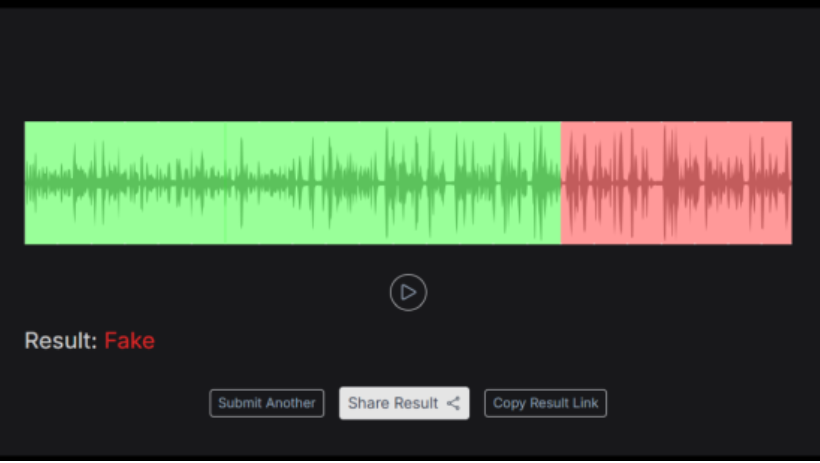
Conclusion
The viral claim is false. The video has been altered by modifying its audio to mislead viewers. In reality, the assault was not related to “Operation Sindoor” but occurred after the brigadier objected to public drinking near his residence.

Executive Summary
Employees’ organisations of public sector banks had recently announced a nationwide strike, with one of their key demands being a five-day work week, including holidays on all Saturdays. Against this backdrop, a claim is being circulated on social media that the bank unions’ demand has been accepted and that all public sector banks will now remain closed every Saturday.
However, CyberPeace Research found that the claim that banks will observe holidays on all Saturdays is false. Neither the government nor bank employees’ unions have made any official announcement regarding the implementation of a five-day work week or holidays on all Saturdays.
Claim:
A user on the social media platform Facebook shared what was purportedly an Indian Gazette document, claiming that all banks will now observe a weekly holiday on every Saturday.
https://www.facebook.com/photo/?fbid=122234792282534138&set=a.122114627672534138
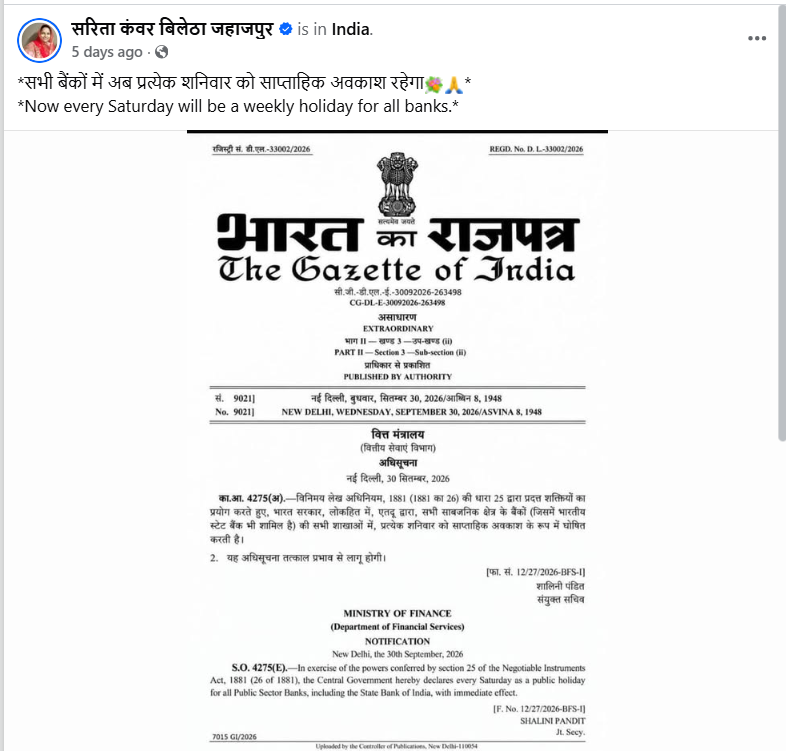
Fact Check
We reviewed all the announcements issued by the organisations that had called for the bank strike. None of these organisations issued any statement confirming that their demands had been accepted. We found a statement from the All India Bank Officers’ Confederation (AIBOC), in which the organisation stated in an X post that the strike scheduled for September 28–30, 2026, had been postponed following discussions. However, the organisation did not state anywhere that the demand for holidays on all Saturdays had been accepted.
https://x.com/aiboc_in/status/2104262645507612777?s=20
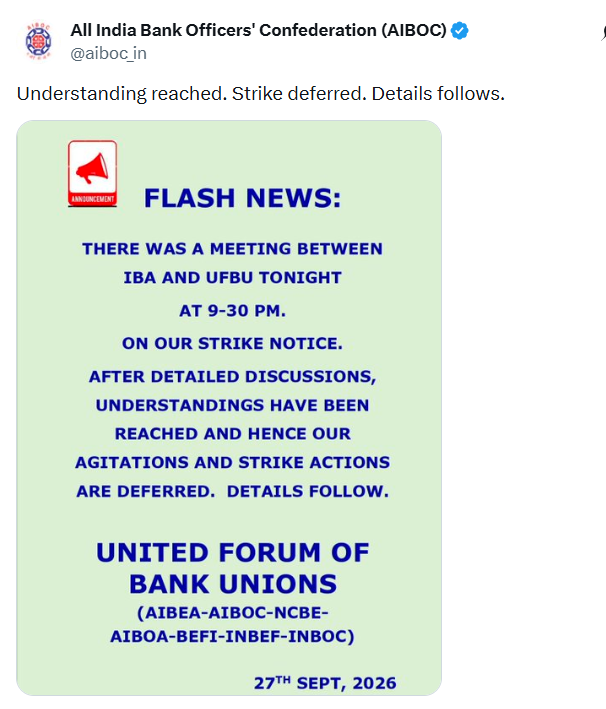
The United Forum of Bank Unions (UFBU), a joint platform of seven bank employees’ unions, issued a statement on October 1, making it clear that there has been no confirmation so far that the unions’ demands have been accepted. The statement said that a five-member committee has been constituted to consider the demand for holidays on all Saturdays, and the committee will soon prepare a roadmap for taking the matter forward.
https://x.com/UFBUPUNE/status/2105600756795707456
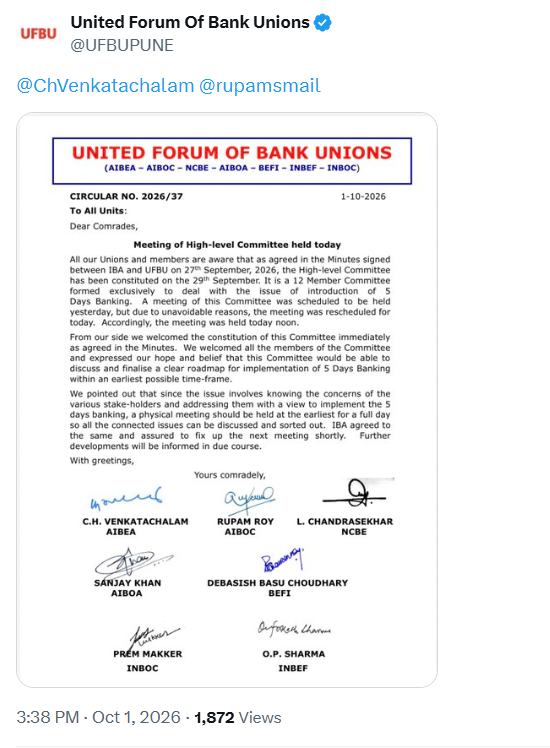
Conclusion:
The claim circulating on social media that all public sector banks will remain closed every Saturday from now on is false. CyberPeace Research found that neither the government nor bank employees’ unions have made any official announcement regarding the declaration of holidays on all Saturdays. Therefore, the claim being circulated on social media is misleading.

Introduction
“GPS Spoofing” though formerly was confined to conflict zones as a consequence, has lately become a growing hazard for pilots and aircraft operators across the world, and several countries have been facing such issues. This definition stems from the US Radio Technical Commission for Aeronautics, which delivers specialized advice for government regulatory authorities. Global Positioning System (GPS) is considered an emergent part of aviation infrastructure as it supersedes traditional radio beams used to direct planes towards the landing. “GPS spoofing” occurs when a double-dealing radio signal overrides a legitimate GPS satellite alert where the receiver gets false location information. In the present times, this is the first time civilian passenger flights have faced such a significant danger, though GPS signal interference of this character has existed for over a decade. According to the Agency France-Presse (AFP), false GPS signals mislead onboard plane procedures and problematise the job of airline pilots that are surging around conflict areas. GPS spoofing may also be the outcome of military electronic warfare systems that have been deployed in zones combating regional tension. GPS spoofing can further lead to significant upheavals in commercial aviation, which include arrivals and departures of passengers apart from safety.
Spoofing might likewise involve one country’s military sending false GPS signals to an enemy plane or drone to impede its capability to operate, which has a collateral impact on airliners operating at a near distance. Collateral impairment in commercial aircraft can occur as confrontations escalate and militaries send faulty GPS signals to attempt to thwart drones and other aircraft. It could, therefore, lead to a global crisis, leading to the loss of civilian aircraft in an area already at a high-risk zone close to an operational battle area. Furthermore, GPS jamming is different from GPS Spoofing. While jamming is when the GPS signals are jammed or obstructed, spoofing is very distinct and way more threatening.
Global Reporting
An International Civil Aviation Organization (ICAO) assessment released in 2019 indicated that there were 65 spoofing incidents across the Middle East in the preceding two years, according to the C4ADS report. At the beginning of 2018, Euro control received more than 800 reports of Global Navigation Satellite System (GNSS) interference in Europe. Also, GPS spoofing in Eastern Europe and the Middle East has resulted in up to 80nm divergence from the flight route and aircraft impacted have had to depend on radar vectors from Air Traffic Control (ATC). According to Forbes, flight data intelligence website OPSGROUP, constituted of 8,000 members including pilots and controllers, has been reporting spoofing incidents since September 2023. Similarly, over 20 airlines and corporate jets flying over Iran diverted from their planned path after they were directed off the pathway by misleading GPS signals transmitted from the ground, subjugating the navigation systems of the aircraft.
In this context, vicious hackers, however at large, have lately realized how to override the critical Inertial Reference Systems (IRS) of an airplane, which is the essential element of technology and is known by the manufacturers as the “brains” of an aircraft. However, the current IRS is not prepared to counter this kind of attack. IRS uses accelerometers, gyroscopes and electronics to deliver accurate attitude, speed, and navigation data so that a plane can decide how it is moving through the airspace. GPS spoofing occurrences make the IRS ineffective, and in numerous cases, all navigation power is lost.
Red Flag from Agencies
The European Union Aviation Safety Agency (EASA) and the International Air Transport Association (IATA) correspondingly hosted a workshop on incidents where people have spoofed and obstructed satellite navigation systems and inferred that these direct a considerable challenge to security. IATA and EASA have further taken measures to communicate information about GPS tampering so that crew and pilots can make sure to determine when it is transpiring. The EASA had further pre-cautioned about an upsurge in reports of GPS spoofing and jamming happenings in the Baltic Sea area, around the Black Sea, and regions near Russia and Finland in 2022 and 2023. According to industry officials, empowering the latest technologies for civil aircraft can take several years, and while GPS spoofing incidents have been increasing, there is no time to dawdle. Experts have noted critical navigation failures on airplanes, as there have been several recent reports of alarming cyber attacks that have changed planes' in-flight GPS. As per experts, GPS spoofing could affect commercial airlines and cause further disarray. Due to this, there are possibilities that pilots can divert from the flight route, further flying into a no-fly zone or any unauthorized zone, putting them at risk.
According to OpsGroup, a global group of pilots and technicians first brought awareness and warning to the following issue when the Federal Aviation Administration (FAA) issued a forewarning on the security of flight risk to civil aviation operations over the spate of attacks. In addition, as per the civil aviation regulator Directorate General of Civil Aviation (DGCA), a forewarning circular on spoofing threats to planes' GPS signals when flying over parts of the Middle East was issued. DGCA advisory further notes the aviation industry is scuffling with uncertainties considering the contemporary dangers and information of GNSS jamming and spoofing.
Conclusion
As the aviation industry continues to grapple with GPS spoofing problems, it is entirely unprepared to combat this, although the industry should consider discovering attainable technologies to prevent them. As International conflicts become convoluted, technological solutions are unrestricted and can be pricey, intricate and not always efficacious depending on what sort of spoofing is used.
As GPS interference attacks become more complex, specialized resolutions should be invariably contemporized. Improving education and training (to increase awareness among pilots, air traffic controllers and other aviation experts), receiver technology (Creating and enforcing more state-of-the-art GPS receiver technology), ameliorating monitoring and reporting (Installing robust monitoring systems), cooperation (collaboration among stakeholders like government bodies, aviation organisations etc.), data/information sharing, regulatory measures (regulations and guidelines by regulatory and government bodies) can help in averting GPS spoofing.
References
- https://economictimes.indiatimes.com/industry/transportation/airlines-/-aviation/false-gps-signal-surge-makes-life-hard-for-pilots/articleshow/108363076.cms?from=mdr
- https://nypost.com/2023/11/20/lifestyle/hackers-are-taking-over-planes-gps-experts-are-lost-on-how-to-fix-it/
- https://www.timesnownews.com/india/planes-losing-gps-signal-over-middle-east-dgca-flags-spoofing-threat-article-105475388
- https://www.firstpost.com/world/gps-spoofing-deceptive-gps-lead-over-20-planes-astray-in-iran-13190902.html
- https://www.forbes.com/sites/erictegler/2024/01/31/gps-spoofing-is-now-affecting-airplanes-in-parts-of-europe/?sh=48fbe725c550
- https://www.insurancejournal.com/news/international/2024/01/30/758635.htm
- https://airwaysmag.com/gps-spoofing-commercial-aviation/
- https://www.wsj.com/articles/aviation-industry-to-tackle-gps-security-concerns-c11a917f
- https://www.deccanherald.com/world/explained-what-is-gps-spoofing-that-has-misguided-around-20-planes-near-iran-iraq-border-and-how-dangerous-is-this-2708342
