
#FactCheck: AI-Generated Video of Monkeys Frightened by Fireworks Falsely Linked to Diwali Celebrations
Executive Summary
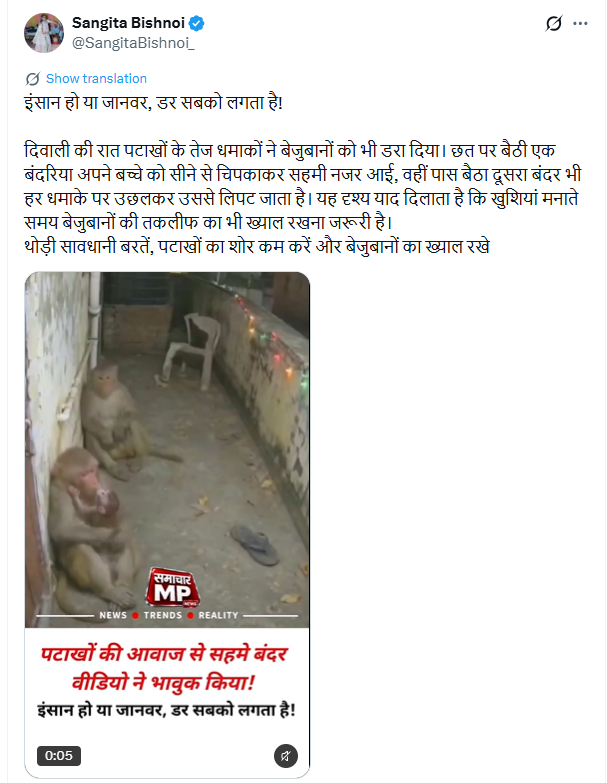
A disturbing video showing monkeys frightened amid fireworks is going viral on social media. The video shows two monkeys sitting on the balcony of a house. Amid loud explosions, a female monkey can be seen holding her baby close to her chest. The video is being shared with the claim that the visuals are from Diwali celebrations, when fireworks were being set off. Amid flashes of bright light and loud explosions, the mother monkey appears to be shielding her baby from the noise by holding it close to her chest. Meanwhile, another monkey also appears frightened by the loud sounds and clings to the female monkey.
However, CyberPeace Research found that the video was created using AI.
Claim:
A female monkey, frightened by loud firecracker explosions on Diwali night, is seen holding her baby close to her chest, while another monkey nearby also clings to her out of fear.
https://x.com/SangitaBishnoi_/status/2119792165740294304
Fact Check
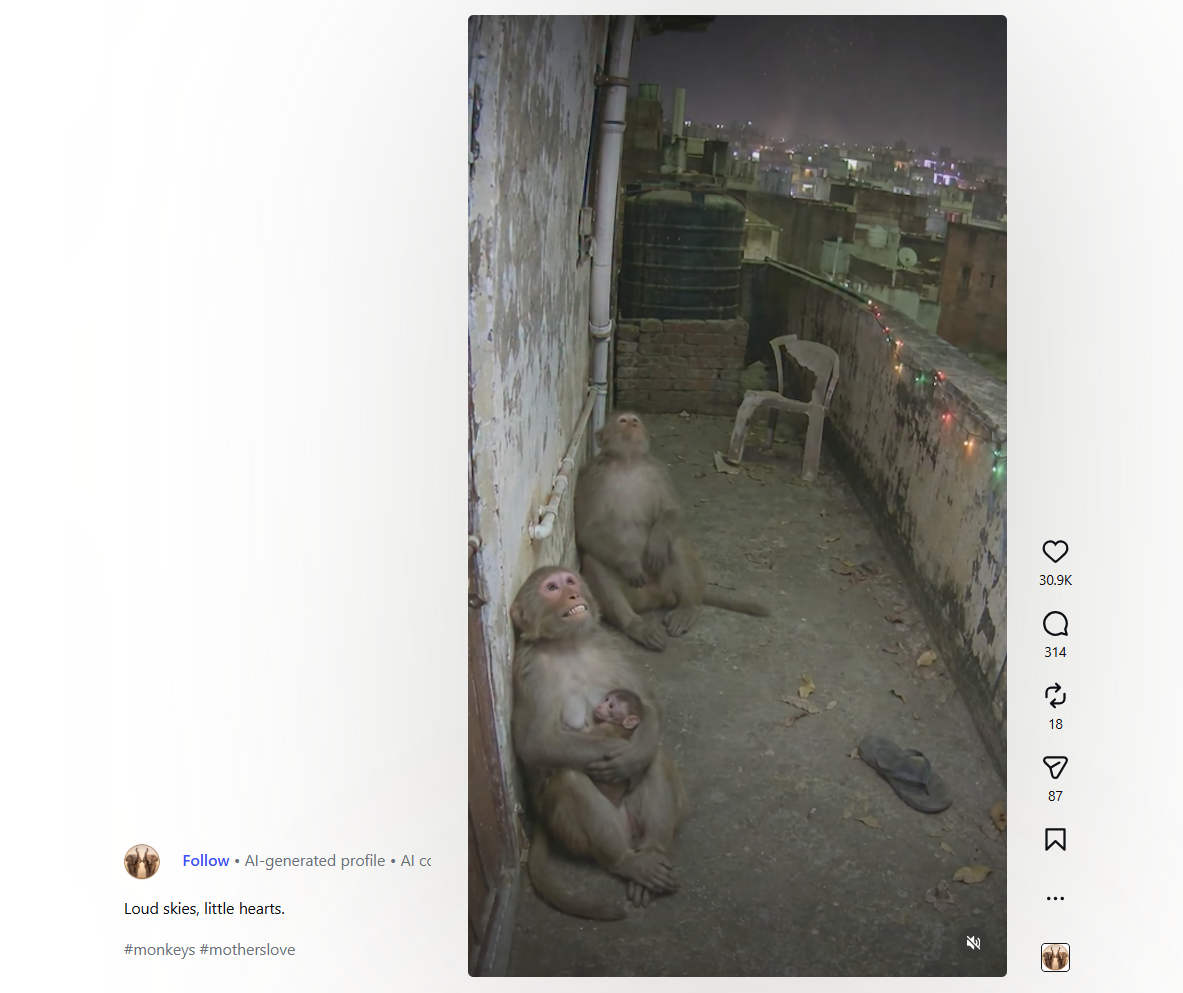
To verify the authenticity of the viral video claiming that monkeys were frightened by fireworks during Diwali celebrations, we conducted a reverse image search on its keyframes. During the search, we did not find any credible media reports featuring the video or linking it to Diwali celebrations. However, we found the same video uploaded on November 1, 2026, on the Instagram account of ‘@love.nature.48’. The post did not provide any specific details in its caption but carried an ‘AI Content’ label. This established that the video was already available online nearly a week before Diwali.
https://www.instagram.com/reels/DfM3BvpzB0y/
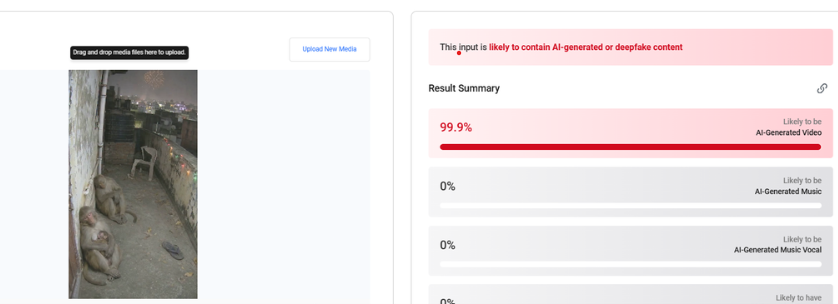
To further verify the viral video, we analysed it using the AI detection tool Hive Detect. The tool identified the video as 99.9 per cent likely to be AI-generated.
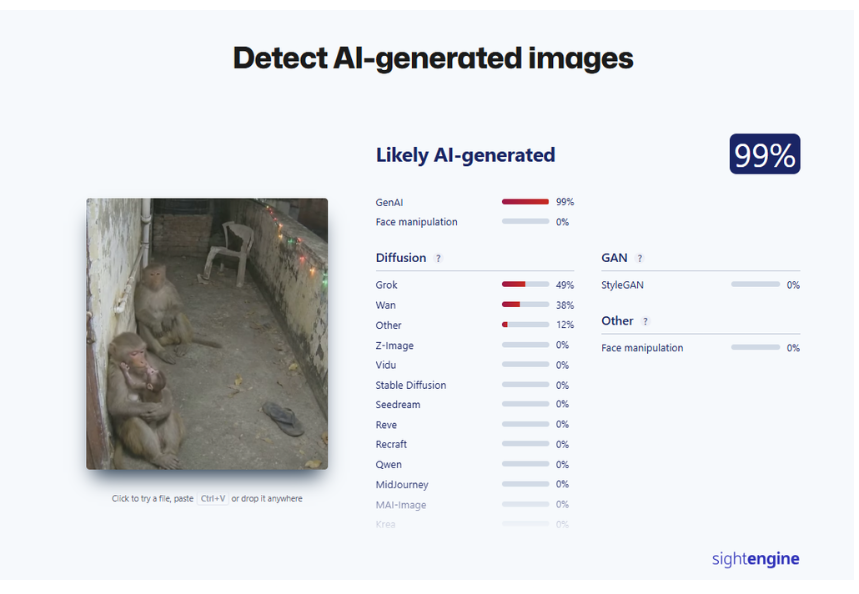
We then analysed the keyframes of the viral video using another AI detection tool, Sightengine. The tool also identified the visuals in the video as likely AI-generated, assigning them a score of 99 per cent.
Conclusion
The evidence gathered during our research clearly establishes that the video showing monkeys frightened by fireworks is not from Diwali celebrations but was created using AI.

Related Blogs

There has been a struggle to create legal frameworks that can define where free speech ends and harmful misinformation begins, specifically in democratic societies where the right to free expression is a fundamental value. Platforms like YouTube, Wikipedia, and Facebook have gained a huge consumer base by focusing on hosting user-generated content. This content includes anything a visitor puts on a website or social media pages.
The legal and ethical landscape surrounding misinformation is dependent on creating a fine balance between freedom of speech and expression while protecting public interests, such as truthfulness and social stability. This blog is focused on examining the legal risks of misinformation, specifically user-generated content, and the accountability of platforms in moderating and addressing it.
The Rise of Misinformation and Platform Dynamics
Misinformation content is amplified by using algorithmic recommendations and social sharing mechanisms. The intent of spreading false information is closely interwoven with the assessment of user data to identify target groups necessary to place targeted political advertising. The disseminators of fake news have benefited from social networks to reach more people, and from the technology that enables faster distribution and can make it more difficult to distinguish fake from hard news.
Multiple challenges emerge that are unique to social media platforms regulating misinformation while balancing freedom of speech and expression and user engagement. The scale at which content is created and published, the different regulatory standards, and moderating misinformation without infringing on freedom of expression complicate moderation policies and practices.
The impacts of misinformation on social, political, and economic consequences, influencing public opinion, electoral outcomes, and market behaviours underscore the urgent need for effective regulation, as the consequences of inaction can be profound and far-reaching.
Legal Frameworks and Evolving Accountability Standards
Safe harbour principles allow for the functioning of a free, open and borderless internet. This principle is embodied under the US Communications Decency Act and the Information Technology Act in Sections 230 and 79 respectively. They play a pivotal role in facilitating the growth and development of the Internet. The legal framework governing misinformation around the world is still in nascent stages. Section 230 of the CDA protects platforms from legal liability relating to harmful content posted on their sites by third parties. It further allows platforms to police their sites for harmful content and protects them from liability if they choose not to.
By granting exemptions to intermediaries, these safe harbour provisions help nurture an online environment that fosters free speech and enables users to freely express themselves without arbitrary intrusions.
A shift in regulations has been observed in recent times. An example is the enactment of the Digital Services Act of 2022 in the European Union. The Act requires companies having at least 45 million monthly users to create systems to control the spread of misinformation, hate speech and terrorist propaganda, among other things. If not followed through, they risk penalties of up to 6% of the global annual revenue or even a ban in EU countries.
Challenges and Risks for Platforms
There are multiple challenges and risks faced by platforms that surround user-generated misinformation.
- Moderating user-generated misinformation is a big challenge, primarily because of the quantity of data in question and the speed at which it is generated. It further leads to legal liabilities, operational costs and reputational risks.
- Platforms can face potential backlash, both in instances of over-moderation or under-moderation. It can be considered as censorship, often overburdening. It can also be considered as insufficient governance in cases where the level of moderation is not protecting the privacy rights of users.
- Another challenge is more in the technical realm, including the limitations of AI and algorithmic moderation in detecting nuanced misinformation. It holds out to the need for human oversight to sift through the misinformation that is created by AI-generated content.
Policy Approaches: Tackling Misinformation through Accountability and Future Outlook
Regulatory approaches to misinformation each present distinct strengths and weaknesses. Government-led regulation establishes clear standards but may risk censorship, while self-regulation offers flexibility yet often lacks accountability. The Indian framework, including the IT Act and the Digital Personal Data Protection Act of 2023, aims to enhance data-sharing oversight and strengthen accountability. Establishing clear definitions of misinformation and fostering collaborative oversight involving government and independent bodies can balance platform autonomy with transparency. Additionally, promoting international collaborations and innovative AI moderation solutions is essential for effectively addressing misinformation, especially given its cross-border nature and the evolving expectations of users in today’s digital landscape.
Conclusion
A balance between protecting free speech and safeguarding public interest is needed to navigate the legal risks of user-generated misinformation poses. As digital platforms like YouTube, Facebook, and Wikipedia continue to host vast amounts of user content, accountability measures are essential to mitigate the harms of misinformation. Establishing clear definitions and collaborative oversight can enhance transparency and build public trust. Furthermore, embracing innovative moderation technologies and fostering international partnerships will be vital in addressing this cross-border challenge. As we advance, the commitment to creating a responsible digital environment must remain a priority to ensure the integrity of information in our increasingly interconnected world.
References
- https://www.thehindu.com/opinion/op-ed/should-digital-platform-owners-be-held-liable-for-user-generated-content/article68609693.ece
- https://www.thehindu.com/opinion/op-ed/should-digital-platform-owners-be-held-liable-for-user-generated-content/article68609693.ece
- https://hbr.org/2021/08/its-time-to-update-section-230
- https://www.cnbctv18.com/information-technology/deepfakes-digital-india-act-safe-harbour-protection-information-technology-act-sajan-poovayya-19255261.htm

Executive Summary:
Assembly elections are underway in several Indian states, including West Bengal, Assam, Kerala, Tamil Nadu, and Puducherry. While voting has already taken place in Assam, Kerala, and Puducherry, polling is still pending in West Bengal. In view of the elections, central security forces have been deployed across West Bengal. Amid this, a video showing a group of people pelting stones at a security vehicle is being widely shared on social media. Some users claim that the incident took place in West Bengal and allege that Muslims attacked an army vehicle. However, research by CyberPeace found the claim to be false. The viral video is from Pakistan and has no connection to West Bengal.
Claim
A social media user shared the video on April 5, 2026, claiming that an army vehicle was attacked in West Bengal.
Post links:

Fact Check
To verify the claim, we extracted keyframes from the viral video and conducted a reverse image search using Google Lens. This led us to a video posted on a Facebook page on October 13, 2025. The caption of that post indicated that the video was from Lahore, showing clashes between members of Tehreek-e-Labbaik and the police.

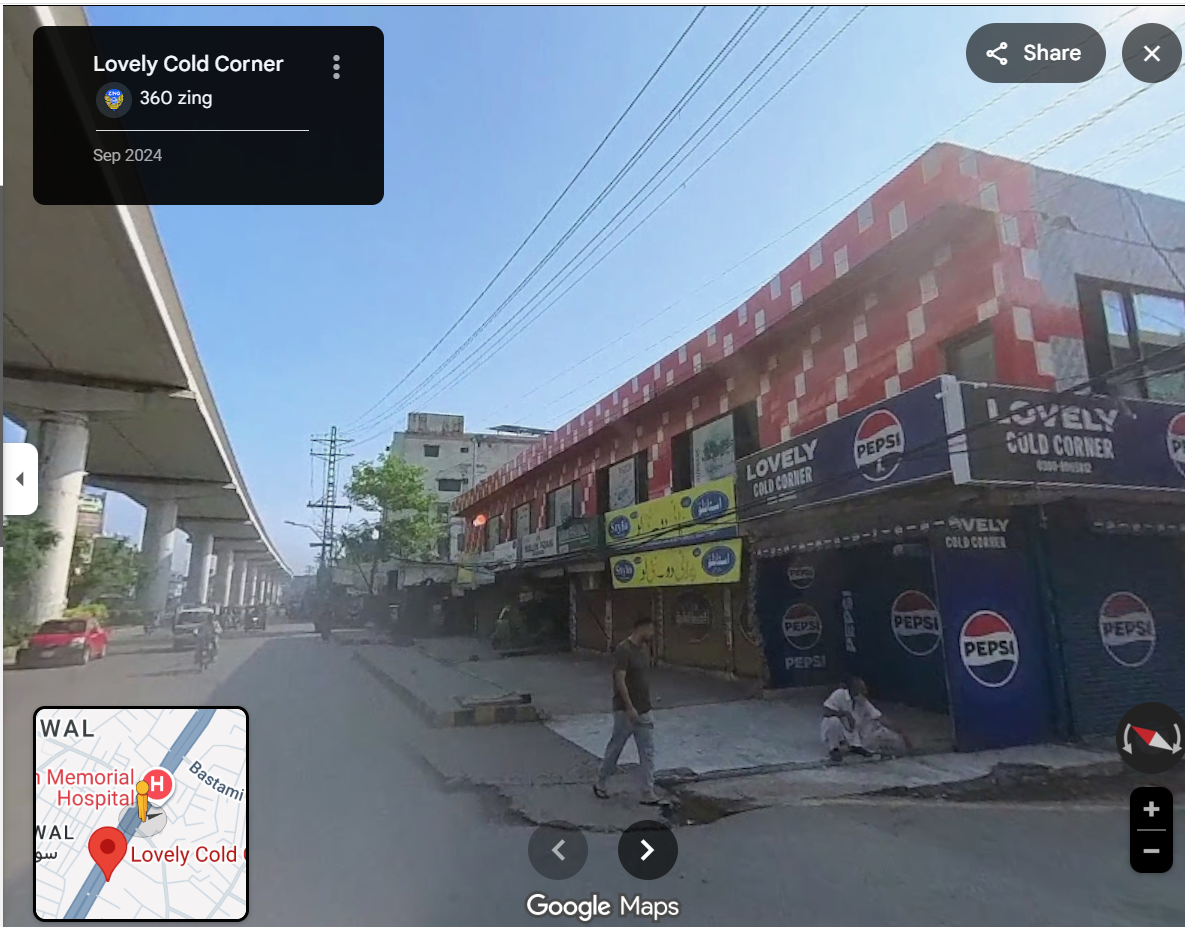
Further clues in the video also pointed to Pakistan. A shop sign reading “Lovely Drink Corner” is visible in the footage. A Google search confirmed that this establishment is located in Lahore, Pakistan.
Conclusion
The viral claim is misleading. Although central forces have been deployed in West Bengal for the ongoing elections, the video showing stone-pelting on a security vehicle is not from the state. It is an old video from Lahore, Pakistan, and is being falsely shared with a communal angle to mislead users.
Introduction
The two-day Apple’s Worldwide Developer Conference (WWDC) 2023, which was held on the 6th & 7th of June, has become an essential and highly anticipated part of our calendar as frequently as the trend. This year’s keynote announcements will include all of the usual enhancements for iOS, iPadOS, watchOS, macOS, and more. However, this year is also unique due to the unveiling of the Vision Pro headset, a brand-new Apple product.
In this blog, we will examine the exciting announcements made at Apple WWDC 2023, which was a ground-breaking event.
macOS Sonoma
macOS Sonoma, the new presentation of macOS disclosed at the WWDC full of exciting features. It comes with stunning video screensavers that show stunning scenes from all over the world. Gadgets can now be added genuinely to the work area and adjusted totally based on the client’s action. Also, it changes variety and blurring out of the spotlight while utilising applications. In addition, Death Stranding: Directors Cut for Mac announced that the Game Mode is added to make Macs more suitable for gaming. A presenter overlay enhances video presentations, and viewers can respond to them with interactive responses. Updated Safari is also included in the WebApp feature that turns frequently used websites into dedicated windows, a new Profile system for separating browsing history, and secure password sharing. Currently, the developer beta is available and the public beta will be available in July, and the final release is anticipated for the fall.
ios 16
Apple WWDC 2023 shows the following iOS, and iOS 16 replication, offering plenty of energising highlights for iPhone and iPad clients. Apple maintains its commitment to privacy with iOS 16, which introduces enhanced privacy settings that give users even more control over their data and online privacy. Users can also personalise their devices according to their preferences thanks to the new operating system’s refinement and customisable user interface.Improved multitasking capabilities like redesigned Files app and advanced note-taking features are just a few of the productivity enhancements included in the iOS 16. With iOS 16, Apple also improves its AR capabilities, allowing developers to develop even more immersive and interactive AR experiences.

WatchOS 9
Apple WWDC 2023 carried energising updates to the Apple Watch with the presentation of watchOS 9. The Apple Watch is an essential companion for sustaining a healthy lifestyle because the most recent version of the operating system includes cutting-edge health and fitness features. WatchOS 9 gives users unprecedented control over their health, offering personalised fitness recommendations and advanced sleep tracking.
Additionally, new watch faces were added, enhancing communication capabilities and improving app performance in watchOS 9, making the Apple Watch even easier to use daily.
ios 17
Rather than focusing on major features, Apple focused on quality-of-life enhancements when it announced iOS 17 at WWDC 2023. Live Voicemail with real-time transcripts of voicemails, personalised personal contact “posters,” and video voicemails for FaceTime are all part of the update. Search filters, a catch-up arrow, live location sharing, and a safety feature called Check-In are all available in Messages. AirDrop now supports NameDrop for transferring contact information; stickers have been expanded. The autocorrect and recording features on the keyboard have been improved for accuracy. Standby in the lock screen is an intelligent home display that shows the weather, upcoming appointments, and notifications. Siri works on Standby and adjusts itself for the night. The developer beta is currently available now, and a public beta will take place next month before the full release is in the fall.
Vision Pro VR Headset
Apple unveiled the Vision Pro AR headset, their first foray into virtual reality (VR), during the WWDC keynote. The Vision Pro is a virtual reality headset that competes with PlayStation VR2 and Meta Quest 3. This is in contrast to the long-awaited Apple smart glasses. Apple put a lot of effort into making a thin and light headset by using premium materials when needed. Voice, hand, and eye commands are all used to operate the Digital Crown-equipped device. The showcases offer extraordinary clarity, which is fueled by Apple’s M2 processor with a committed R1 chip. The Vision Pro combines virtual reality (VR) and augmented reality (AR), enabling users to interact with Apple apps and gain access to the company’s existing ecosystem. The expanded reality space created by the headset’s sensors and cameras allows users to place apps in real-world environments and adjust their level of concentration. Optic ID is a security and unlocking eye-tracking technology that is incorporated into the Vision Pro. It allows for a more immersive screen experience because it is compatible with Apple accessories like Magic Keyboard and Mac. At launch, the Vision Pro supports over a hundred Apple game galleries. Disney gave a hint that Apple and Disney might work together in the future by announcing support for the Vision Pro and making the Disney Plus app available immediately. The show highlighted the headset’s lightweight plan and recommended Apple clients wear it for extended periods. However, widespread adoption may be difficult due to the high price of $3,499 (₹289,093.01 approx). Apple is expected to release the Vision Pro for public use in 2024.

15-inch MacBook Air
At the WWDC event, Apple revealed a new MacBook Air with a larger 15-inch model instead of the standard 13-inch model. The 15-inch MacBook Air features a powerful Apple M2 processor, a thin, light, and long-lasting design, and a stunning 15.3-inch Retina display. It comes in four colours and has a headphone jack, two USB-C ports, and MagSafe charging. The display has six spatial speakers, a 1080p webcam, and 500 nits of brightness. Apple claims a battery life of up to 18 hours.
Conclusion
At Apple’s 2023 WWDC, the company demonstrated its commitment to developing technology that is user-friendly and accessible to all. Apple’s commitment to improving the user experience across all of its products is demonstrated in the updates to operating systems, improvements of Siri, breakthroughs in augmented reality, and enhancements to health and fitness.By making complex innovations more like-minded and easy to understand, Apple is enabling people to use the maximum capacity of their gadgets. Apple’s innovations at WWDC 2023 are expected to shape the future of technology, simplifying everyday tasks and revolutionising how we interact with the digital world.As we push ahead, it is exciting to guess what these advancements will proceed to develop and decidedly mean for our lives. The future holds even more incredible possibilities for all of us because of Apple’s focus on privacy, user-centric design, and pushing the boundaries of innovation. Thus, prepare to embrace a future where innovation flawlessly incorporates into our lives because of the endeavours displayed at Apple WWDC 2023.
