
#FactCheck: AI-Generated Video Falsely Shows Congress Workers Selling Copies of Sonia Gandhi’s New Book on Footpath
Executive Summary
Congress senior leader Sonia Gandhi’s book, ‘Belonging: A Journey of Love’, hit the market a week ago and has been making headlines ever since. However, its formal launch is scheduled to take place in Delhi on November 16. Against this backdrop, a video circulating on social media is being shared by some users with the claim that the Congress had distributed copies of Sonia Gandhi’s new book among its party workers to distribute among the public, but the workers instead sold them on the footpath. CyberPeace Research found that the viral video was generated using artificial intelligence (AI).
Claim:
A person on X shared the video with the caption: “Look at the fate of the ‘Queen Mother’s’ love. First, the public rejected it, then party workers treated it as waste paper, and now even the market is refusing to give it any value!”
https://x.com/sumit1kalra/status/2121951974514167832

Fact Check
Upon closely examining the video, we noticed several inconsistencies that suggest it may have been generated using artificial intelligence (AI).
We scanned the video using the AI detection tool Sightengine. According to the results, the video is 99 per cent likely to be AI-generated.
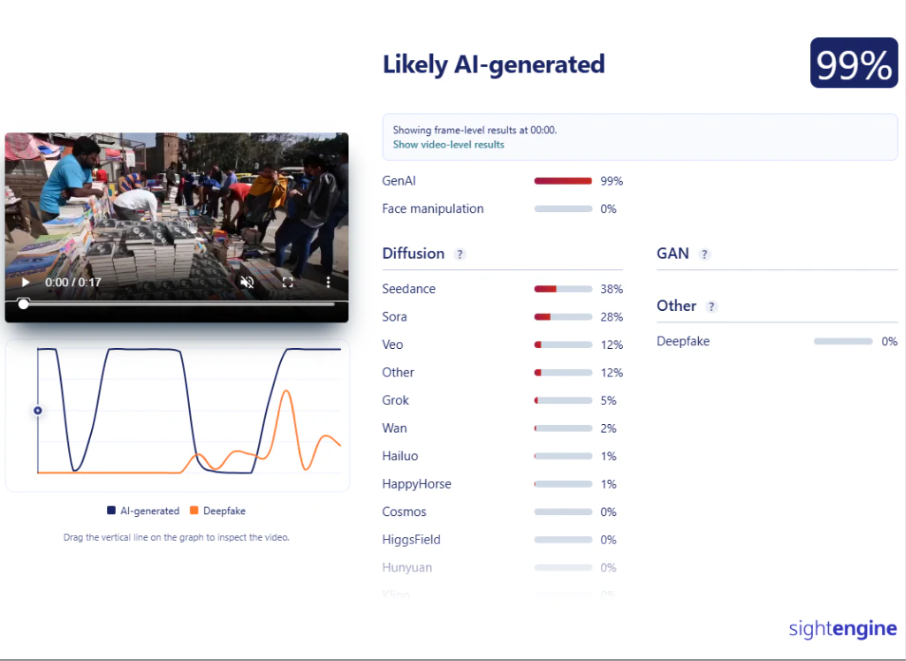
As part of our further research, we scanned the video using another AI detection tool, HumanMeter. According to the results, the viral video is 99 per cent likely to be AI-generated.

Conclusion
Our research found that the viral video claiming that Congress workers sold copies of Sonia Gandhi’s newly released book, ‘Belonging: A Journey of Love’, on the footpath instead of distributing them among the public is misleading. The video was generated using artificial intelligence (AI), as confirmed by two AI detection tools, Sightengine and HumanMeter, both of which indicated a 99 per cent likelihood of AI generation.

Related Blogs

Introduction
In today’s cybersecurity landscape, ransomware has emerged as one of the most significant and rapidly growing cyber threats. What began as attacks carried out by individual hackers has evolved into a highly organised criminal enterprise, with groups operating through structured business models and global networks. The emergence of The Gentlemen ransomware group reflects this transformation, demonstrating how modern threat actors can quickly expand their operations and target organisations across multiple sectors. Their rise highlights the increasing sophistication of ransomware campaigns and the growing challenges faced by organisations in defending against them. The attribution of the group's administrator to an identified individual in Izhevsk, Russia, provides a valuable lens through which to examine three interconnected developments: the maturation of ransomware-as-a-service (RaaS) business models, the inherent operational security (OPSEC) weaknesses that emerge over the course of cybercriminal careers, and the geopolitical environments that enable such actors to operate with relative impunity. Together, these dynamics illustrate the industrialisation of modern cybercrime.
The Industrialisation of Ransomware-as-a-Service
The remarkable rapid rise of The Gentlemen is impossible without discussing the maturation of ransomware-as-a-service (RaaS). RaaS systems utilize network intrusion experts as affiliates who conduct networks intrusions and secure access in exchange for a cut of the total ransoms paid, while a core group builds and maintains the ransomware framework itself. Although Reveton, one of the earliest Raas providers, can be credited with bringing early iterations of RaaS to fruition in 2012, the potential scale was truly evident in the mid-2020s. By 2025 it was estimated that there were over 100 active ransomware gangs operating; this proliferation is the direct result of the franchise-like system, which has lowered the barriers to entry for cybercrime.
The marketplace surrounding RaaS is intensely competitive, and this is clearly exemplified in the business structure of The Gentlemen: while many of the top ransomware groups provide an 80/20 profit share (with the majority of the profit going to the affiliates), The Gentlemen has an exceptionally profitable 90/10 split (affiliates keep 90% of the profit share) for affiliates, likely to draw experienced operators away from their rivals given recent decreases in victim willingness to pay and corresponding increases in the incentives RaaS platforms are required to offer.
The operational efficiency of the group is representative of a successful enterprise. They attack vulnerable internet-facing VPNs and firewalls and generally complete the network encryption within a matter of hours, leaving defenders with very little time to respond, as confirmed by Check Point Software, a renowned cybersecurity vendor.
Additionally, PRODAFT reports that the administrator of The Gentlemen, known by the alias Zeta88 (previously known as Hastalamuerte), directly provides affiliates with SSL VPN credentials, often obtained through brutal force attacks or their own private leaked databases, indicating an unusually high level of vertical integration for RaaS groups.
AI as a Force Multiplier in Ransomware Development
A particularly significant aspect of the Hastalamuerte case is PRODAFT's finding that the administrator employs artificial intelligence to develop and maintain ransomware, support associated tooling, and assist post-exploitation operations. This reflects a broader trend observed across the 2025–2026 threat landscape, where AI has increasingly lowered the capability threshold for participation in organised cybercrime. Researchers have documented its role in automating stages of intrusion, accelerating malware development cycles, and simplifying the maintenance of malicious infrastructure. These capabilities have been leveraged by both nation-state actors and criminal enterprises.
The trajectory of Hastalamuerte is especially illustrative. Cybersecurity Forum posts during 2019-2020 depict a hacker who is fairly novice at fundamental penetration testing procedures. A subsequent emergence as the operator of a top-tier ransomware-as-a-service operation indicates that AI-assisted development may be responsible for dramatically reducing the skill level and time necessary to create a successful criminal enterprise in cyberspace. The evolution of these tools should make the route from novice forum user to accomplished ransomware operator more attainable for a wider array of perpetrators in the future.
The OPSEC Paradox: How Cybercriminals Leave a Trail
The attribution of Hastalamuerte's identity by researchers from Intel 471, Flashpoint, and Constella Intelligence demonstrates the effectiveness of modern open-source and commercial intelligence methodologies. A forum registration traceable to an IP address from Izhevsk, Russia linked a Protonmail address, which linked to an Apple account, a GitHub profile, a Telegram handle, a Russian phone number, and finally to a 36 year old marketing professional named Alexander Andreevich Yapaev who was also living in Izhevsk. Investigators did not use an advanced capability in their attribution, but rather a simple OPSEC mistake of consistently reusing credentials. Every username and email address and every phone number creates a linkage between disparate data points, eventually building into a real-world persona.
It has also come out in the forum discussion that while training for a penetration testing course in 2020, Hastalamuerte displayed the kind of inexperience that a novice would display in traceable, recorded fashion to intelligence databases. It's an example of a broader rule about attribution; attacker mistakes provide the most value. With Russians the lack of apparent consequences may contribute to a lack of need to maintain tight OPSEC from the start.
The Russian Safe Haven: Conditional Impunity and Its Limits
Yapaev's base in Izhevsk is emblematic of the geostrategic situation that has allowed Russian cybercriminality to prosper. Security researchers routinely label Russia's policy as one of "controlled impunity," where the cybercriminality directed at foreign entities is ignored or implicitly condoned, while that directed at Russian interests will prompt a law enforcement response. This constitutes what has been called a "managed market" rather than an "unconditional sanctuary," where many of the named defendants could and likely will continue their illegal enterprise with little fear of reprisal, provided that they do not threaten the interests of the Russian state and do not attempt to move their operations outside of Russian control.
Yet this protection is neither absolute nor permanent. In May 2024, the transnational Operation Endgame campaign highlighted the growing global appetite for damaging the cybercrime ecosystem rooted in Russia. Russian authorities did indeed pursue and seize some assets and operators, but arrests seem largely confined to the lower-rung facilitators of these attacks (hosting providers and payment services), and it seems higher-end ransomware operators continue to evade scrutiny. Selective enforcement thus further bolsters the perception that protection is accorded according to strategic value, not legal standards. For operators such as Hastalamuerte, who possess no publicly documented intelligence connections, growing attribution capabilities, and sustained international pressure may gradually erode the security traditionally associated with operating from within Russia.
Attribution as a Deterrence Instrument
The public identification of Alexander Andreevich Yapaev as Hastalamuerte/Zeta88 shows the continued struggle with the utility of attribution in situations where immediate prosecution is not feasible. Its utility is far more extensive than simply an ability to make an arrest. Functionally, public naming forces a perpetrator into an open evidentiary space and can lead to alterations in their operational habits and effectiveness. Strategically, attribution provides future leverage for sanctions, indictments, financial restrictions, or extradition if the target can leave their safe haven country. The logic behind US rewards programs (paying up to $10 million for the capture and conviction of ransomware operators) relies on this principle. The analytical insight provided by the case cannot be understated either. Hastalamuerte's trajectory from a relative amateur forum participant on Nulled and Raidforums in 2019 to leading a significant ransomware operation by 2026 offers an invaluable look into the career progression of a cyber criminal. It confirms one of the lessons learned through deterrence and attribution: pseudonymity is not everlasting, and many years of OPSEC failures can be pieced together to establish a real-world identity.
Conclusion
The Gentlemen incident is emblematic of the three broad themes that currently characterise cyber warfare: ransomware-as-a-service through innovative competition, common OPSEC failures that enable attribution, and a new, conditional regime of protection for Russian cybercriminals. The obvious defense lesson: increasing attack surfaces require stronger identity, behavioural monitoring, and intelligence capacities. The policy lesson: effective attribution is still an essential tool for comprehension, deterrence, and disruption in an increasingly industrialised environment of criminals supporting each other's operations in ransomware-as-a-service.
References
- https://krebsonsecurity.com/2026/06/who-runs-the-ransomware-group-the-gentlemen/
- https://www.recordedfuture.com/
- https://www.vectra.ai/topics/ransomware-as-a-service
- https://www.trmlabs.com/es/resources/blog/new-disruption-opportunities-in-the-evolving-ransomware-ecosystem
Introduction
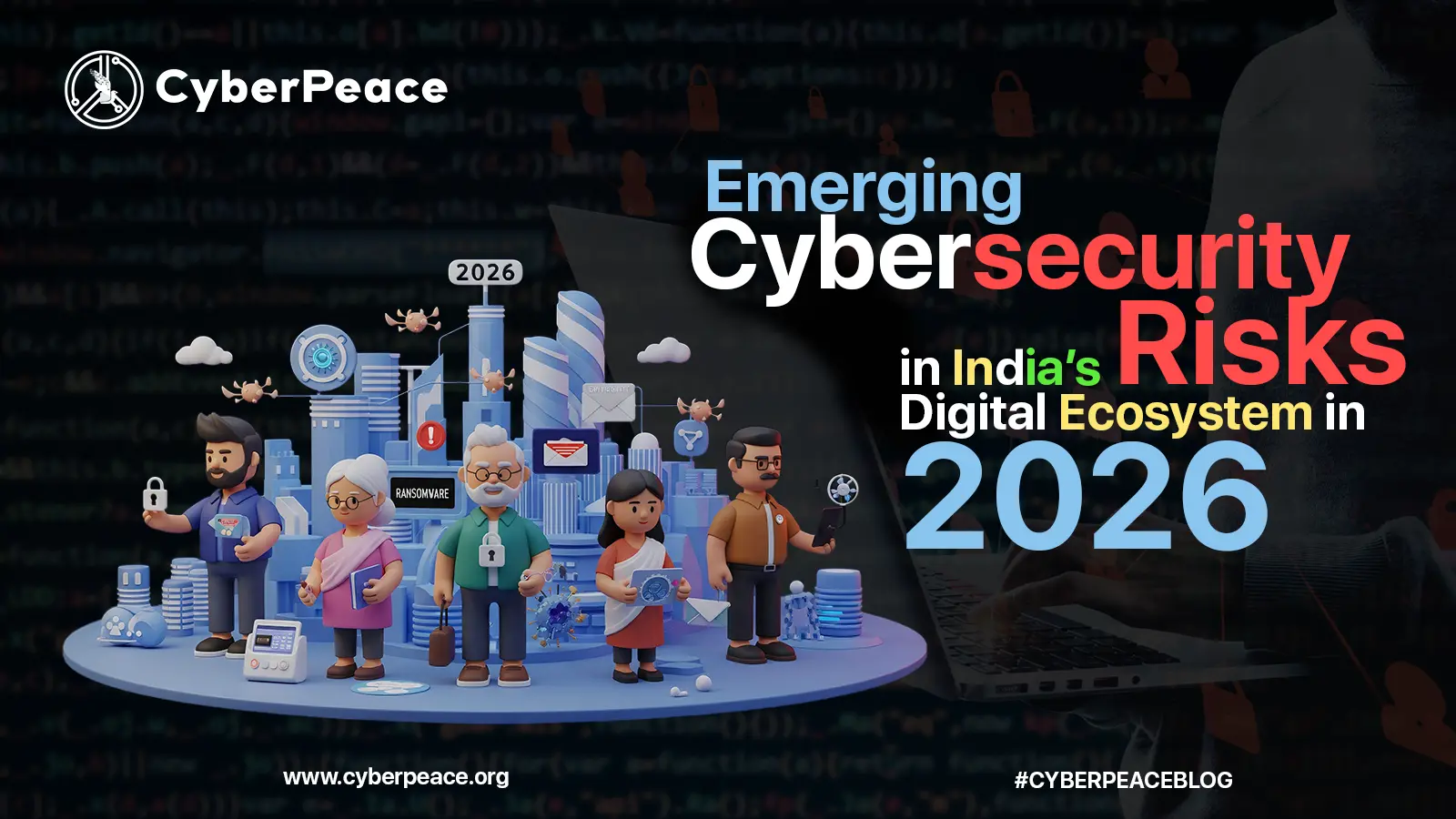
The digital landscape of the nation has reached a critical point in its evolution. The rapid adoption of technologies such as cloud computing, mobile payment systems, artificial intelligence, and smart infrastructure has led to a high degree of integration between digital systems and governance, commercial activity, and everyday life. As dependence on these systems continues to grow, a wide range of cyber threats has emerged that are complex, multi-layered, and closely interconnected. By 2026, cyber security threats directed at India are expected to include an increasing number of targeted, well-organised, and strategic cyber attacks. These attacks are likely to focus on exploiting the trust placed in technology, institutions, automation, and the fast pace of technological change.
1. Social Engineering 2.0: Hyper-Personalised AI Phishing & Mobile Banking Malware
Cybercriminals have moved from generalised methods to hyper-targeted attacks through AI-based psychological manipulation. In addition to social media profiles, data breaches, and digital/tracking footprints, the latest types of cybercrimes expected in 2026 will involve AI-based analysis of this information to create and increase the use of hyper-targeted phishing emails.
Phishing emails are capable of impersonating banks, employers, and even family members, with all the same regionally or culturally relevant tone, language, and context as would be done if these persons were sending the emails in person.
With malicious applications disguised as legitimate service apps, cybercriminals have the ability to intercept and capture One-Time Passwords (OTPs), hijack user sessions, and steal money from user accounts in a matter of minutes.
These types of attempts or attacks are successful not only because of their technical sophistication, but because they take advantage of human trust at scale, giving them an almost limitless reach into the financial systems of people around the world through their computers and mobile devices.
2. Cloud and Supply Chain Vulnerabilities
As Indian organisations increasingly migrate to cloud infrastructure, cloud misconfigurations are emerging as a major cybersecurity risk. Weak identity controls, exposed storage, and improper access management can allow attackers to bypass traditional network defences. Alongside this, supply chain attacks are expected to intensify in 2026.
In supply chain attacks, cybercriminals compromise a trusted software vendor or service provider to infiltrate multiple downstream organisations. Even entities with strong internal security can be affected through third-party dependencies. For India’s startup ecosystem, government digital platforms, and IT service providers, this presents a systemic risk. Strengthening vendor risk management and visibility across digital supply chains will be essential.
3. Threats to IoT and Critical Infrastructure
By implementing smart cities, digital utilities, and connected public services, IoT has opened itself up to increased levels of operational technology (OT) through India’s initiative. However, there is currently a lack of adequate security in the form of strong authentication, encryption, and update methods available on many IoT devices. By the year 2026, attackers are going to be able to exploit these vulnerabilities much more than they already are.
Cyberattacks on critical infrastructure such as energy, transportation, healthcare, and telecom systems have far-reaching consequences that extend well beyond data loss; they directly affect the provision of essential services, can damage public safety, and raise concerns over national security. Effectively securing critical infrastructure needs to involve dedicated security solutions to deal with the specific needs of critical infrastructure, in contrast to conventional IT security.
4. Hidden File Vectors and Stealth Payload Delivery
SVG File Abuse in Stealth Attacks
Cybercriminals are continually searching for ways to bypass security filters, and hidden file vectors are emerging as a preferred tactic. One such method involves the abuse of SVG (Scalable Vector Graphics) files. Although commonly perceived as harmless image files, SVGs can contain embedded scripts capable of executing malicious actions.
By 2026, SVG-based attacks are expected to be used in phishing emails, cloud file sharing, and messaging platforms. Because these files often bypass traditional antivirus and email security systems, they provide an effective stealth delivery mechanism. Indian organisations will need to rethink assumptions about “safe” file formats and strengthen deep content inspection capabilities.
5. Quantum-Era Cyber Risks and “Harvest Now, Decrypt Later” Attacks
Although practical quantum computers are still emerging, quantum-era cyber risks are already a present-day concern. Adversaries are believed to be intercepting and storing encrypted data now with the intention of decrypting it in the future once quantum capabilities mature—a strategy known as “harvest now, decrypt later.” This poses serious long-term confidentiality risks.
Recognising this threat, the United States took early action during the Biden administration through National Security Memorandum 10, which directed federal agencies to prepare for the transition to quantum-resistant cryptography. For India, similar foresight is essential, as sensitive government communications, financial data, health records, and intellectual property could otherwise be exposed retrospectively. Preparing for quantum-safe cryptography will therefore become a strategic priority in the coming years.
6. AI Trust Manipulation and Model Exploitation
Poisoning the Well – Direct Attacks on AI Models
As artificial intelligence systems are increasingly used for decision-making—ranging from fraud detection and credit scoring to surveillance and cybersecurity—attackers are shifting focus from systems to models themselves. “Poisoning the well” refers to attacks that manipulate training data, feedback mechanisms, or input environments to distort AI outputs.
In the context of India's rapidly growing digital ecosystem, compromised AI models can result in biased decisions, false security alerts or denying legitimate services. The big problem with these types of attacks is they may occur without triggering conventional security measures. Transparency, integrity and continuous monitoring of AI systems will be key to creating and maintaining stakeholder confidence in the decision-making process of the automated systems.
Recommendations
Despite the increasing sophistication of malicious cyber actors, India is entering this phase with a growing level of preparedness and institutional capacity. The country has strengthened its cyber security posture through dedicated mechanisms and relevant agencies such as the Indian Cyber Crime Coordination Centre, which play a central role in coordination, threat response, and capacity building. At the same time, sustained collaboration among government bodies, non-governmental organisations, technology companies, and academic institutions has expanded cyber security awareness, skill development, and research. These collective efforts have improved detection capabilities, response readiness, and public resilience, placing India in a stronger position to manage emerging cyber threats and adapt to the evolving digital environment.
Conclusion
By 2026, complexity, intelligence, and strategic intent will increasingly define cyber threats to the digital ecosystem. Cyber criminals are expected to use advanced methods of attack, including artificial intelligence assisted social engineering and the exploitation of cloud supply chain risks. As these threats evolve, adversaries may also experiment with quantum computing techniques and the manipulation of AI models to create new ways of influencing and disrupting digital systems. In response, the focus of cybersecurity is shifting from merely preventing breaches to actively protecting and restoring digital trust. While technical controls remain essential, they must be complemented by strong cybersecurity governance, adherence to regulatory standards, and sustained user education. As India continues its digital transformation, this period presents a valuable opportunity to invest proactively in cybersecurity resilience, enabling the country to safeguard citizens, institutions, and national interests with confidence in an increasingly complex and dynamic digital future.
References
- https://www.seqrite.com/india-cyber-threat-report-2026/
- https://www.uscsinstitute.org/cybersecurity-insights/blog/ai-powered-phishing-detection-and-prevention-strategies-for-2026
- https://www.expresscomputer.in/guest-blogs/cloud-security-risks-that-should-guide-leadership-in-2026/130849/
- https://www.hakunamatatatech.com/our-resources/blog/top-iot-challenges
- https://csrc.nist.gov/csrc/media/Presentations/2024/u-s-government-s-transition-to-pqc/images-media/presman-govt-transition-pqc2024.pdf
- https://www.cyber.nj.gov/Home/Components/News/News/1721/214

Introduction
Cyber slavery has emerged as a serious menace. Offenders target innocent individuals, luring them with false promises of employment, only to capture them and subject them to horrific torture and forced labour. According to reports, hundreds of Indians have been imprisoned in 'Cyber Slavery' in certain Southeast Asian countries. Indians who have travelled to South Asian nations such as Cambodia in the hopes of finding work and establishing themselves have fallen victim to the illusion of internet slavery. According to reports, 30,000 Indians who travelled to this region on tourist visas between 2022 and 2024 did not return. India Today’s coverage demonstrated how survivors of cyber slavery who have somehow escaped and returned to India have talked about the terrifying experiences they had while being coerced into engaging in cyber slavery.
Tricked by a Job Offer, Trapped in Cyber Slavery
India Today aired testimonials of cyber slavery victims who described how they were trapped. One individual shared that he had applied for a well-paying job as an electrician in Cambodia through an agent in Delhi. However, upon arriving in Cambodia, he was offered a job with a Chinese company where he was forced to participate in cyber scam operations and online fraudulent activities.
He revealed that a personal system and mobile phone were provided, and they were compelled to cheat Indian individuals using these devices and commit cyber fraud. They were forced to work 12-hour shifts. After working there for several months, he repeatedly requested his agent to help him escape. In response, the Chinese group violently loaded him into a truck, assaulted him, and left him for dead on the side of the road. Despite this, he managed to survive. He contacted locals and eventually got in touch with his brother in India, and somehow, he managed to return home.
This case highlights how cyber-criminal groups deceive innocent individuals with the false promise of employment and then coerce them into committing cyber fraud against their own country. According to the Ministry of Home Affairs' Indian Cyber Crime Coordination Center (I4C), there has been a significant rise in cybercrimes targeting Indians, with approximately 45% of these cases originating from Southeast Asia.
CyberPeace Recommendations
Cyber slavery has developed as a serious problem, beginning with digital deception and progressing to physical torture and violent actions to commit fraudulent online acts. It is a serious issue that also violates human rights. The government has already taken note of the situation, and the Indian Cyber Crime Coordination Centre (I4C) is taking proactive steps to address it. It is important for netizens to exercise due care and caution, as awareness is the first line of defence. By remaining vigilant, they can oppose and detect the digital deceit of phony job opportunities in foreign nations and the manipulative techniques of scammers. Netizens can protect themselves from significant threats that could harm their lives by staying watchful and double-checking information from reliable sources.
References
- CyberPeace Highlights Cyber Slavery: A Serious Concern https://www.cyberpeace.org/resources/blogs/cyber-slavery-a-serious-concern
- https://www.indiatoday.in/india/story/india-today-operation-cyber-slaves-stories-of-golden-triangle-network-of-fake-job-offers-2642498-2024-11-29
- https://www.indiatoday.in/india/video/cyber-slavery-survivors-narrate-harrowing-accounts-of-torture-2642540-2024-11-29?utm_source=washare
