
#FactCheck: AI-Generated Video Falsely Shows Captain Smith Machhar’s Image Displayed on Burj Khalifa
Executive Summary
On September 30, 2026, reports emerged that Captain Smith Machhar, the Indian pilot of flydubai flight FZ1073 travelling from Dubai to Tel Aviv, was attacked by his co-pilot in the cockpit. Despite sustaining serious injuries, Captain Machhar reportedly managed to land the aircraft safely, saving the lives of all 174 passengers. Following the incident, a video is going viral on social media with the claim that a picture of Captain Smith Machhar was displayed on Dubai’s Burj Khalifa in his honour.
However, CyberPeace Research found the claim to be false. Our research found that the viral video is AI-generated and is being circulated on social media with a misleading claim.
Claim:
A user on the social media platform X (formerly Twitter) shared the viral video on October 5, 2026, with the caption: “A Sanatani Hindu pilot, Smith Machhar, has made India proud on Dubai’s Burj Khalifa. Congressis, Samajwadis, Lalu supporters, Mamata supporters, Leftists, AAP supporters and cockroaches, become true Indians and make India proud.” The post link, archive link and screenshot are provided below.
https://x.com/PNRai1/status/2106966191386611900
https://ghostarchive.org/archive/3RroW

Fact Check
To verify the viral claim, we conducted a Google search using relevant keywords. During the search, we did not find any credible media report confirming the claim.In the next stage of our research, we closely examined the video.
We noticed several inconsistencies that raised suspicions that it was AI-generated. In the video, the building’s texture appears to blend and shift strangely into a person’s clothing. Such changes do not appear natural or consistent with a genuine video. We then analysed the viral video using the AI detection tool ISFAKEAI. According to the results, the viral video is 99 per cent AI-generated.

In the next stage of our research, we analysed the viral video using the AI detection tool FauxLens. According to the results, the viral video is 92 per cent AI-generated.
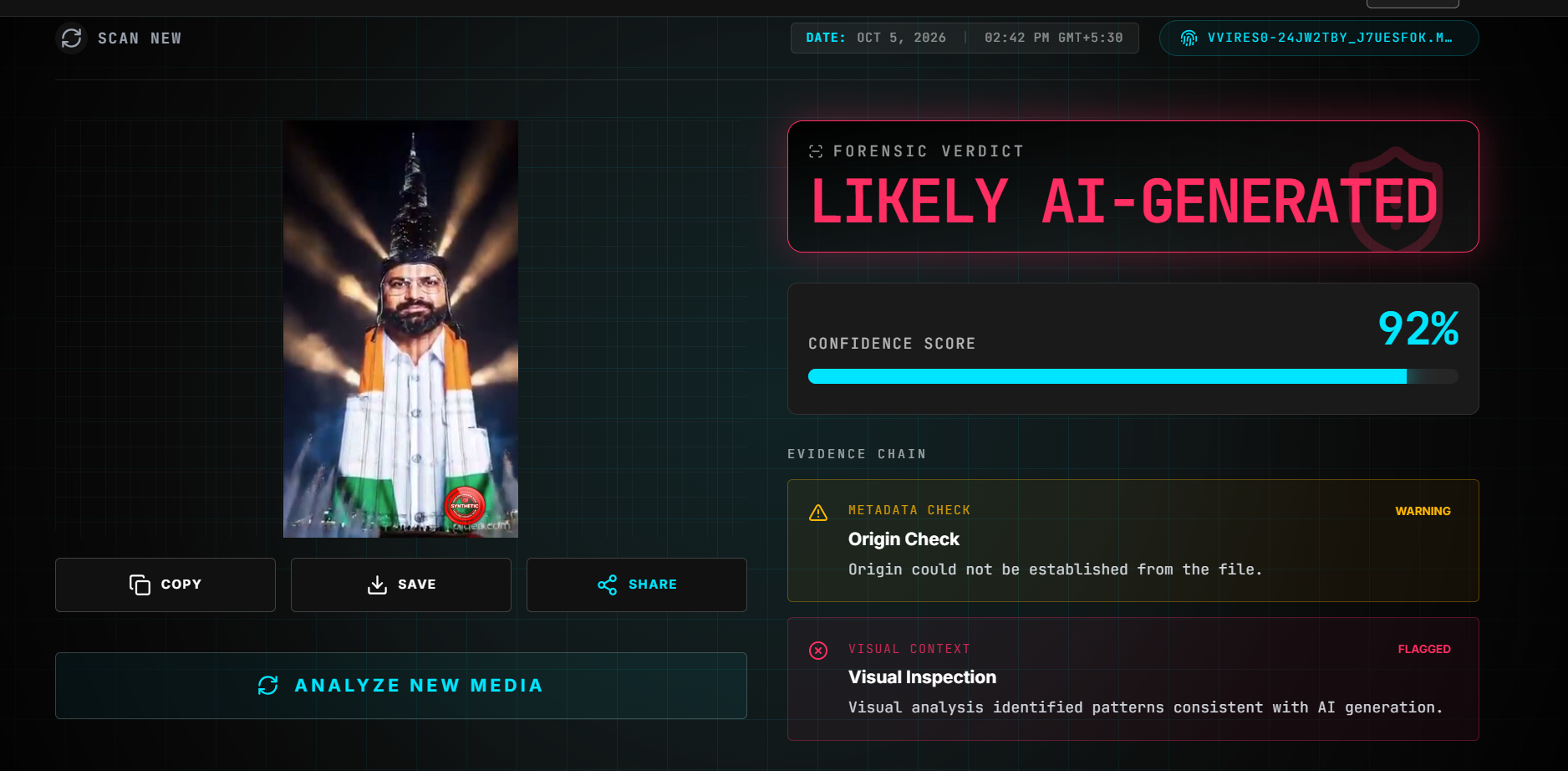
At the end of our research, we analysed the viral video using the AI detection tool Undetectable AI. According to the tool’s results, the viral video is 93 per cent AI-generated.

Conclusion
Our research found that the viral video is AI-generated and is being circulated on social media with a misleading claim. The video does not provide authentic evidence that a picture of Captain Smith Machhar was displayed on the Burj Khalifa. The visual inconsistencies observed in the video, along with the results of multiple AI detection tools, further indicate that the video has been digitally created or manipulated using AI.

Related Blogs

A report by MarketsandMarkets in 2024 showed that the global AI market size is estimated to grow from USD 214.6 billion in 2024 to USD 1,339.1 billion in 2030, at a CAGR of 35.7%. AI has become an enabler of productivity and innovation. A Forbes Advisor survey conducted in 2023 reported that 56% of businesses use AI to optimise their operations and drive efficiency. Further, 51% use AI for cybersecurity and fraud management, 47% employ AI-powered digital assistants to enhance productivity and 46% use AI to manage customer relationships.
AI has revolutionised business functions. According to a Forbes survey, 40% of businesses rely on AI for inventory management, 35% harness AI for content production and optimisation and 33% deploy AI-driven product recommendation systems for enhanced customer engagement. This blog addresses the opportunities and challenges posed by integrating AI into operational efficiency.
Artificial Intelligence and its resultant Operational Efficiency
AI has exemplary optimisation or efficiency capabilities and is widely used to do repetitive tasks. These tasks include payroll processing, data entry, inventory management, patient registration, invoicing, claims processing, and others. AI use has been incorporated into such tasks as it can uncover complex patterns using NLP, machine learning, and deep learning beyond human capabilities. It has also shown promise in improving the decision-making process for businesses in time-critical, high-pressure situations.
AI-driven efficiency is visible in industries such as the manufacturing industry for predictive maintenance, in the healthcare industry for streamlining diagnostics and in logistics for route optimisation. Some of the most common real-world examples of AI increasing operational efficiency are self-driving cars (Tesla), facial recognition (Apple Face ID), language translation (Google Translate), and medical diagnosis (IBM Watson Health)
Harnessing AI has advantages as it helps optimise the supply chain, extend product life cycles, and ultimately conserve resources and cut operational costs.
Policy Implications for AI Deployment
Some of the policy implications for development for AI deployment are as follows:
- Develop clear and adaptable regulatory frameworks for the ongoing and future developments in AI. The frameworks need to ensure that innovation is not hindered while managing the potential risks.
- As AI systems rely on high-quality data that is accessible and interoperable to function effectively and without proper data governance, these systems may produce results that are biased, inaccurate and unreliable. Therefore, it is necessary to ensure data privacy as it is essential to maintain trust and prevent harm to individuals and organisations.
- Policy developers need to focus on creating policies that upskill the workforce which complements AI development and therefore job displacement.
- To ensure cross-border applicability and efficiency of standardising AI policies, the policy-makers need to ensure that international cooperation is achieved when developing the policies.
Addressing Challenges and Risks
Some of the main challenges that emerge with the development of AI are algorithmic bias, cybersecurity threats and the dependence on exclusive AI solutions or where the company retains exclusive control over the source codes. Some policy approaches that can be taken to mitigate these challenges are:
- Having a robust accountability mechanism.
- Establishing identity and access management policies that have technical controls like authentication and authorisation mechanisms.
- Ensure that the learning data that AI systems use follows ethical considerations such as data privacy, fairness in decision-making, transparency, and the interpretability of AI models.
Conclusion
AI can contribute and provide opportunities to drive operational efficiency in businesses. It can be an optimiser for productivity and costs and foster innovation for different industries. But this power of AI comes with its own considerations and therefore, it must be balanced with proactive policies that address the challenges that emerge such as the need for data governance, algorithmic bias and risks associated with cybersecurity. A solution to overcome these challenges is establishing an adaptable regulatory framework, fostering workforce upskilling and promoting international collaborations. As businesses integrate AI into core functions, it becomes necessary to leverage its potential while safeguarding fairness, transparency, and trust. AI is not just an efficiency tool, it has become a stimulant for organisations operating in a rapidly evolving digital world.
References
- https://indianexpress.com/article/technology/artificial-intelligence/ai-indian-businesses-long-term-gain-operational-efficiency-9717072/
- https://www.marketsandmarkets.com/Market-Reports/artificial-intelligence-market-74851580.html
- https://www.forbes.com/councils/forbestechcouncil/2024/08/06/smart-automation-ais-impact-on-operational-efficiency/
- https://www.processexcellencenetwork.com/ai/articles/ai-operational-excellence
- https://www.leewayhertz.com/ai-for-operational-efficiency/
- https://www.forbes.com/councils/forbestechcouncil/2024/11/04/bringing-ai-to-the-enterprise-challenges-and-considerations/

Introduction
Data protection has been a critical aspect of advocacy and governance all across the world. Data fuels our cyber-ecosystem and strengthens the era of emerging technologies. All industries and sectors are now dependent upon the data of the user. The governments across the world have been deliberating internally to address the issue and legality of Data protection and privacy. The Indian government has witnessed various draft bills and policies focusing on Data protection over the years, and the contemporary bill is the Digital Personal Data Protection Bill, 2023, which was tabled at the Lok Sabha (Lower House of Parliament) on 03 August for discussions and parliamentary assent.
What is DPDP, 2023?
The goal of the complete and comprehensive Digital Personal Data Protection Bill of 2023 is to establish a framework for the protection of personal data in India. The measure acknowledges the significance of protecting personal data and seeks to strike a balance between the necessity to process personal data for legitimate purposes and the right of individuals to do so. The bill establishes a number of crucial expressions and ideas associated with the protection of personal data, including “data fiduciary,” “data principal,” and “sensitive personal data.” It also emphasises the duties of data fiduciaries, including the need to establish suitable security measures to preserve personal data and the need to secure data principals’ consent before processing their personal information. The measure also creates the Data Protection Board of India, which would implement its requirements and guarantee data fiduciaries’ compliance. The board will have the authority to look into grievances, give directives, and impose sanctions for non-compliance.
Key Features of the Bill
The bill tabled at the parliament has the following key features:
- The 2023 bill imposes reasonable obligations on data fiduciaries and data processors to safeguard digital personal data.
- Under the 2023 bill, a new Data Protection Board is established, which will ensure compliance, remedies and penalties.
- Under the new bill, the Board has been entrusted with the power equivalent to a civil court, such as the power to take cognisance in response to personal data breaches, investigate complaints, imposing penalties. Additionally, the Board can issue directions to ensure compliance with the act.
- The 2023 bill also secures more rights of Individuals and establishes a balance between user protection and growing innovations.
- The bill creates a transparent and accountable data governance framework by giving more rights to individuals.
- There is an Incorporation of Business-friendly provisions by removing criminal penalties for non-compliance and facilitating international data transfers.
- The new 2023 bill balances out fundamental privacy rights and puts reasonable limitations on those rights.
- The new data protection board will carefully examine the instance of non-compliance by imposing penalties on non-compiler.
- The bill does not provide any express clarity in regards to compensation to be granted to the Data Principal in case of a Data Breach.
- Under 2023 Deemed consent is there in its new form as ‘Legitimate Users’ pertaining to the conditions in regard to Sovernity and Intergrity of India.
- There is an introduction of the negative list, which restricts cross-data transfer.
Additionally, the measure makes special provisions for the processing of children’s personal data and acknowledges the significance of protecting children’s privacy. Additionally, it highlights the rights of the data subjects, including their right to access their personal information, their right to have wrong information corrected, and their right to be forgotten.
Drive4CyberPeace
A campaign was undertaken by CyberPeace to gain a critical understanding of what people understand about Data privacy and protection in India. The 4-month long campaign led to a pan-India interaction with netizens from different areas and backgrounds. The thoughts and opinions of the netizens were understood and collated in the form of a whitepaper which was, in turn, presented to Parliamentarians and government officials. The whitepaper laid the foundation of the recommendations submitted to the Ministry of Electronics and Information Technology as part of the stakeholder consultation.
Conclusion
Overall, the Digital Personal Data Protection Bill of 2023 is an important step towards safeguarding Indian citizens’ privacy and personal data. It creates a regulatory agency to guarantee compliance and enforcement and offers a thorough framework for data protection. The law includes special measures for the protection of sensitive personal data and the personal data of children and acknowledges the significance of striking a balance between the right to privacy and the necessity of data processing.

Introduction
Picture every paper trade document, such as bills of lading, certificates of origin, letters of credit, and packing lists, stacked one on top of another. By one industry estimate, the roughly four billion such documents in circulation each year would form a tower over 500 kilometres high, well past the edge of space. This absurd image reflects a simple truth, global trade has relied on paper for centuries, making transactions slow, expensive, and vulnerable to loss, forgery, and disputes.
Today, however, we complete many activities that once depended on paper through digital platforms. We open bank accounts through mobile applications, sign contracts electronically, file taxes online, and access government services through websites, all without handling a single physical document. Global trade is now undergoing a similar transformation. Yet, as trade moves online, the challenge is no longer managing stacks of paper, but protecting digital trade from cyber threats. The success of this transition will therefore depend as much on robust cybersecurity as on the adoption of digital technologies.
From Paper Trails to Platforms
For decades, an Indian exporter clearing a container needed physical stamps from customs, port authorities, banks, and multiple regulatory agencies, each on its own timeline. That has been changing under India's National Trade Facilitation Action Plan, now in its third iteration (NTFAP 3.0, 2024–27), which set out to close the remaining gaps in paperless trading systems. The shift shows up in international benchmarks: India's score on the UN's Global Survey on Digital and Sustainable Trade Facilitation has climbed sharply, with the institutional-cooperation component alone improving from under 67% to nearly 89% in recent rounds. A 2026 policy brief jointly released by ICRIER, RIS, and the Centre for WTO Studies concludes that India has achieved full implementation of domestic paperless trade measures, a rare distinction globally even as cross-border digitalisation continues to deepen.
The Building Blocks: ICEGATE to BharatTradeNet
This transformation rests on a stack of interlocking platforms. ICEGATE, the customs electronic data-interchange gateway, lets traders file declarations digitally rather than in person. SWIFT, the Single Window Interface for Facilitating Trade, connects multiple regulatory agencies so a trader deals with one portal instead of dozens. e-SANCHIT digitises supporting documents for customs clearance, cutting paperwork once attached to every consignment. Faceless assessment, rolled out under the CBIC's "Turant Customs" push, separates the assessing officer from the physical location of the goods, reducing scope for delay and discretion. The newest addition, BharatTradeNet, announced in the Union Budget 2025-26, is unified digital public infrastructure linking DGFT, GSTN, banks, shipping lines, and exporters on one platform for trade documentation and financing built to complement the Unified Logistics Interface Platform and align with international conventions.
None of this works without a legal backbone. India's proposed Trade Facilitation Bill aims to give electronic trade documents the same legal standing as paper ones, closing an interoperability gap that has long complicated cross-border recognition of digital records. Recent trade agreements have also begun embedding firmer commitments on paperless trade, a sign that digitalisation is no longer a back-office IT project but a live item in trade diplomacy.
What's at Stake Economically
The economic case is straightforward: paper costs money and time. Digitised customs and documentation shrink dwell times at ports, cut transaction costs, and reduce the discretion-driven delays that disproportionately hurt smaller firms. That matters for India's MSMEs, whose export contribution has grown from roughly ₹3.95 lakh crore to ₹12.39 lakh crore in recent years, aided by platforms such as the Government e-Marketplace and ONDC, which together have onboarded well over a million sellers. Electronics exports touched a record $47 billion in 2025, helped along by production-linked incentives and smoother compliance. With India's total merchandise exports crossing $714 billion in the first ten months of FY 2025-26, the efficiency gains from digitalisation compound across an ever-larger base and help Indian firms plug into global value chains that increasingly expect real-time, verifiable documentation rather than faxed certificates.
India's Regional Moment
Beyond its own backyard, India has regional aspirations. Following deliberations at the Asia-Pacific Trade Facilitation Forum and Paperless Trade Week 2026 in Bangkok last May, international experts were of the opinion that most of the necessary digital and regulatory infrastructure for India to join the UN Framework Agreement on Facilitation of Cross-Border Paperless Trade in Asia and the Pacific (CPTA – a treaty-based and intended to make paperless trade globally, not just internationally, interoperable) had been laid in place. Joining CPTA will also allow India to have a say on digital trade frameworks in the region and thus be a game-changer in integrating SAARC, ASEAN and global supply chains together while reducing costs of trade.
The Cybersecurity Imperative
The catch is that every portal, system and API that takes the place of a paper stamp has the potential to become an attack vector. The increase in overall ransomware activity reached more than 50% worldwide in 2025, and supply-chain attacks almost doubled. These types of attacks hit manufacturing, now a key part of India's export basket, hardest of all industrial ransomware attacks.
The notorious NotPetya attack in 2017, which effectively brought Maersk's worldwide shipping operations to a halt and shut down container movement at Mumbai's Jawaharlal Nehru Port, serves as a painful reminder that the compromise of even a single system can bring physical cargo movement within a network to a standstill.
For a trade ecosystem running on digital trust, the nature of risks include: ransomware that immobilizes ports and customs systems, supply-chain attacks that leverage a single trusted service provider to get access to dozens of downstream clients, data theft revealing shipment and financial data, impostor fraud to trick people into assuming the identity of a banks or exporter, modification of digital bills of lading, certificates of origin or other essential trade documents. When an original physical document is misplaced, it has no effect on anyone but its keeper. A corrupted digital file, on the other hand, can be stealthily changed and propagate across every system it touches instantly.
Building Trust by Design
It is a prerequisite to digital commerce to have these systems so they can even be trusted. This means a zero-trust architecture where all users and devices are authenticated rather than just assumed to be safe once you cross an organisational boundary; transport-level encryption; digital signatures & PKI for crypto-validating shipping documents; identity & access controls ensuring access to shipment data is limited to authorised persons; and anomaly detection to alert on intrusions before the problems can snowball. India's legal & policy framework for cybersecurity is indeed evolving, with the Digital Personal Data Protection Act, 2023 (and its rules finalised Jan 2025) obligating data fiduciaries & stipulating breaches must be reported within 6 hours to CERT-In; the National Cyber Security Reference Framework provides a foundational blueprint for digital public infrastructure, all under the stewardship of the National Critical Information Infrastructure Protection Centre, which monitors systems vital for the functioning of commerce.
Conclusion
India's digitised trade infrastructure from ICEGATE and SWIFT to e-SANCHIT, BharatTradeNet, and faceless customs has effectively brought it into the running for the title of regional digital trade leader. However, the success of this transformation will ultimately be measured not by the number of digital platforms it deploys, but by the trust, security, and resilience of the ecosystem that supports them. As trade becomes increasingly digital, robust cybersecurity will remain the foundation for protecting commercial data, maintaining confidence among trading partners, and ensuring that India's digital trade ambitions translate into sustainable economic growth.
Sources
- Cyble — Ransomware Attacks and Supply Chain Threats in 2025
- Chambers and Partners — Cybersecurity 2026: India
- Drishti IAS — Key Cyberthreats India is Facing and Key Measures India has Adopted to Strengthen Cybersecurity
- Protium — MSME Export Contribution Has Grown from ₹3.95 Lakh Crore to ₹12.39 Lakh Crore
- IBEF — India's E-commerce Boom: Growth, Trends & Future Prospects
- News on Air — India Achieves Record Electronics Exports of $47 Billion in 2025
