
#FactCheck:AI-generated video falsely shared as thief evading police in Indore
Executive Summary
A video is being shared on social media with the claim that a thief in Indore, Madhya Pradesh, performed dangerous stunts to evade the police. In the viral video, several police personnel can be seen chasing a man. The man appears to dodge vehicles on the road to escape the police and then climbs onto the roof of a moving bus. He later jumps from the bus and climbs onto a roadside hoarding. The video is being shared with the claim that a clever thief gave the police a tough time in Indore. Research by CyberPeace Research Wing found that the video is AI-generated and is being shared with a misleading claim.
Claim:
A high-voltage, filmy-style chase between police and a clever thief took place in a busy market in Indore. The police later surrounded the accused and detained him. Archive of the post can be seen here. Similar posts can be seen here and here.
https://www.facebook.com/reel/1356598853312128

Fact Check:
To verify the claim, we conducted a reverse image search of keyframes from the viral video using Google Lens. During the search, we found the same video posted on August 8 on the X account of a user named Rahul Nanda. The post stated that the video had been created using AI.
https://x.com/rahulnanda86/status/2086001127762657614
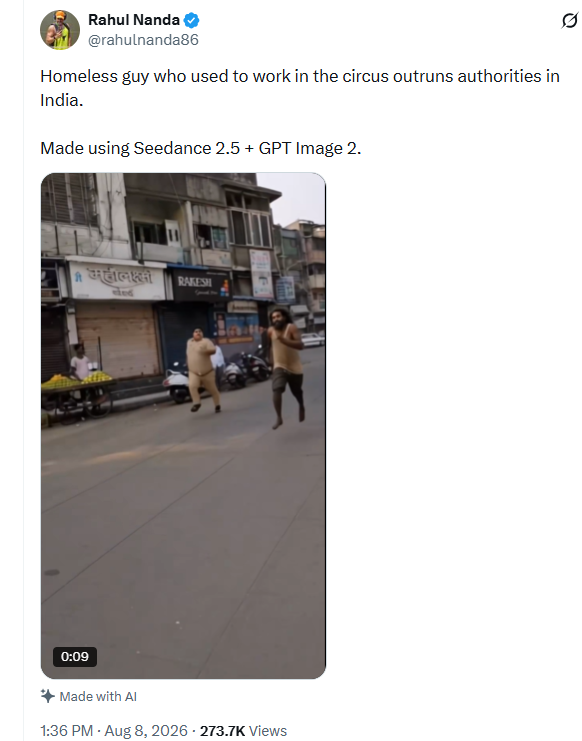
We then analysed the viral video using the AI detection tool Hive Moderation. The tool gave the video a 99.8 per cent score for being potentially AI-generated.

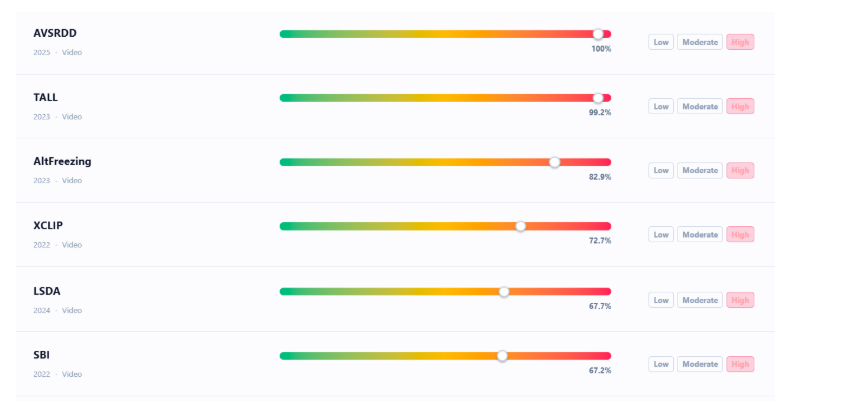
As part of the research, we also checked the video using another AI detection tool, Deepfake-O-Meter. Six different detectors on the tool indicated a high probability that the video was AI-generated.
Conclusion
The evidence gathered during our research establishes that the viral video claiming to show a thief evading police in Indore is AI-generated. Therefore, the claim is misleading.

Related Blogs

Executive Summary
A video of BJP MP Ravi Kishan is being widely circulated on social media with the claim that the Gorakhpur MP was mocking Prime Minister Narendra Modi and criticizing his working style and frequent foreign visits.In the viral clip, Ravi Kishan can be heard saying that “he likes to travel,” “comes to Parliament only for a few minutes,” and does not like pressure or responsibility. The clip also features him using phrases such as “azad panchhi” (free bird) and “azad parinda.” However, CyberPeace Research Wingresearch found the claim to be misleading. The research revealed that in the original video, Ravi Kishan was actually criticizing Congress leader Rahul Gandhi. A cropped portion of his statement is being shared out of context with a false claim.
Claim
An X (formerly Twitter) user shared the viral clip and wrote that Ravi Kishan was referring to Prime Minister Narendra Modi, alleging that Modi enjoys travelling abroad, spends little time in Parliament, and feels uncomfortable under pressure.
- https://x.com/Aarti202/status/2058523226305900586
- https://archive.ph/j5MaV

Fact Check
To verify the viral claim, we performed a reverse search using key frames from the video. During the research, we found the original video uploaded on the Facebook page of ANI on May 13, 2026.
The caption of the post read:“War does not seem to be ending…” Ravi Kishan warns the country about the ongoing conflict in the Middle East.At around the 4-minute-40-second timestamp, an ANI reporter asks Ravi Kishan about Rahul Gandhi distancing himself from the CBI Director selection process. Responding to that question, Ravi Kishan makes the remarks that later went viral.

This clearly establishes that Ravi Kishan was not referring to Prime Minister Narendra Modi, but was commenting on Rahul Gandhi. In his response, he says that “it is good that he has freed himself” and refers to Rahul Gandhi as an “azad parinda” (free bird).
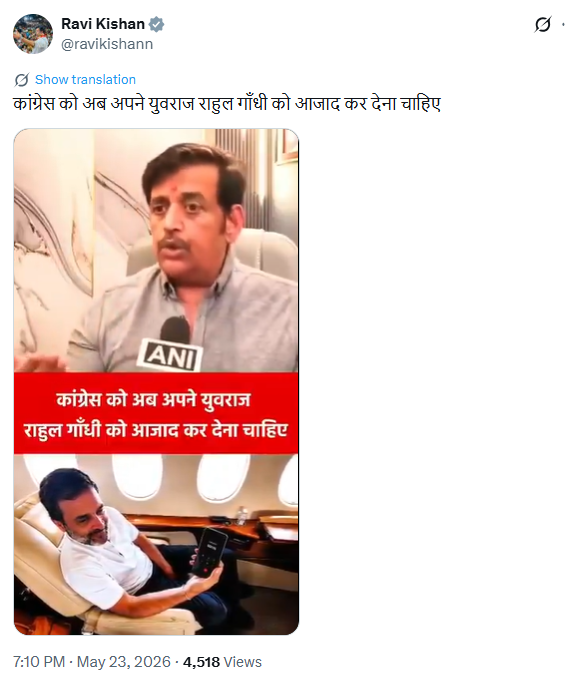
During the research, we also found the same video posted on Ravi Kishan’s official X account on May 23. The caption of the post stated:“Congress should now free its prince Rahul Gandhi.”This further confirms that the viral clip has been misleadingly edited and shared out of context
Conclusion
The research found that Ravi Kishan’s remarks in the original video were directed at Rahul Gandhi, not Prime Minister Narendra Modi. An edited portion of the video has been falsely shared with a misleading claim.
Introduction
In real-time warfare scenarios of this modern age, where actions occur without delay, the relevance of edge computing emerges as paramount. By processing data close to the source in the battlefield with the help of a drone or through video imaging from any military vehicle or aircraft, the concept of edge computing allows the military to point targets faster and strike with accuracy. It also enables local processing to relay central data, helping ground troops get intelligence inputs to act rapidly in critical mission scenarios.
As the global security landscape experiences a significant transformation in different corners of the world, it presents unprecedented challenges in the present scenario. In this article, we will try to understand how countries can maintain their military capabilities with the help of advanced technologies like edge computing.
Edge Computing in Modern Warfare
Edge computing involves the processing and storage of data at the point of collection on the battlefield, for example, through vehicles and drones, instead of relying on centralized data centers. This enables faster decision-making in real-time. This approach creates a resilient and secure network by reducing reliance on potentially compromised external connections, supporting autonomous systems, precision-based targeting, and data sharing among military personnel, drones, and command centers amidst a challenging environment.
A report released by the US Department of Defence in March 2025 found a crucial reality surrounding the operation of hardware relying on outdated industrial-age processes in the digital era. In the case of applications with video, edge computing helps to deliver significant advantages to a wide range of crucial military operations, which include:
- Situational awareness with real-time data processing that provides improved battlefield visibility and proper threat detection.
- Autonomous warfare systems such as drones, which use a tactical edge cloud computing to get the capability to navigate faster.
- Developing a strong communication and networking capability to secure low-latency communication for troops to stay connected in challenging environments.
- Ensuring predictive maintenance with the help of effective sensors to carry out edge detection and attrition at an early point, thereby reducing equipment failures.
- Developing effective targeting and weapons systems to ensure faster processing to enable precision-based targeting and response, besides a strong logistics and supply chain that can provide real-time tracking to improve delivery accuracy and resource management.
This report also highlighted that the DoD is rapidly updating its software and investing in AI enablers like data sets or MLOps tools. This also stresses the breaking down of integration barriers by enforcing MOSA (Modular Open Systems Approaches), APIs (Application Programming Interface), and modular interfaces to ensure interoperability across platforms, sensors, and networks to make software-defined warfare an effective strategy.
Developing Edge with Artificial Intelligence for Future Warfare
A significant insight from the work of the US Department of Defense is its emphasis on the importance of edge computing in shaping the future of warfare. In that context, the Annual Threat Assessment Report highlights a key limitation of traditional AI strategies that rely on centralised cloud computing, since these might not be suitable for modern battlefields with congested networks and limited bandwidth. The need for real-time data processing requires a distributed and edge-based AI solution to address contemporary threats. This report also directly supports the deployment of effective edge with AI in a defined, disrupted, intermittent, and limited-bandwidth (DDIL) environment. In that case, when the communication networks fail, the edge servers at the edge of the network offer crucial advantages that cloud-dependent systems cannot. This ability to analyse data and make decisions without consistent connectivity and operate with limited computational resources is a strategic necessity.
The scenario of warfare is a phenomenon that requires maintaining a strong strategic and tactical approach, which, in the present times, is being examined through the domain of digital platforms. Modern warfare patterns demand faster decision-making and edge computing deliveries by shifting the power of distant servers to the frontlines. The US military is already moving in the direction of deploying edge-enabled systems to prove the nature of sensors and networks to compute at the tactical edge to transform warfighting.
However, it can be understood with the help of an example, as creating fusion in the skies with F-35s. As they have showcased the capability of edge computing by fusing sensor data with MADL (Multi-Functional Advanced Data Link) to create a unified picture, making the squadrons a force multiplier. An example of this was visible when an F-35 relayed real-time tracking data, enabling a navy ship to neutralise a missile beyond its range.
Conclusion: The Way Ahead
As the changing nature of warfare moves towards adopting software-defined systems, where edge computing thrives as a futuristic military technology, it calls for the need for integration across all domains of warfighting. But at the same time, several imperatives do emerge, such as:
- Developing an open architecture that enables both flexibility and innovation.
- Ensuring an effective connectivity that actually combines a confluence of legacy systems.
- Developing interoperability among the systems that can function in synergy with all platforms and can function across all domains.
- Prioritising edge-native AI development systems, where it is also necessary to ensure the shift to adopting cloud-based AI models to create solutions optimised from the ground up for edge deployment.
- Investing in edge infrastructure to establish a robust edge computing infrastructure that enables rapid deployment by testing and updating AI capabilities across diverse hardware platforms. Like the way the military training academies in India are developing training infrastructures for training officer cadets or personnel to handle drones and all forms of advanced warfare tactics emerging in this age.
- Fostering talent and expertise by embracing commercial solutions where software talent could be enabled across the enterprises with expertise in edge computing capabilities and AI. In this case, the role of the commercial sector can help to drive innovations in edge AI, and the only way to move in this direction is by leveraging these advances through partnerships and collaborative efforts.
Taking the example of the ARPANET, which once seeded the modern internet, edge computing can also help to create a transformative network effect within the digital battlespace. In conclusion, future conflicts will be defined by the speed and accuracy provided by the edge, as nations integrating AI and robust edge infrastructures can hold a strong advantage in the multi-domain battlefields in the future.
References
- https://www.idsa.in/mpidsanews/rk-narangs-article-what-the-regions-first-drone-warfare-taught-us-published-in-the-new-indian-express
- https://latentai.com/blog/software-defined-warfare-why-edge-ai-is-critical-to-americas-defense-future/
- https://www.boozallen.com/s/insight/blog/how-the-us-military-is-using-edge-computing.html
- https://capsindia.org/wp-content/uploads/2022/08/RK-Narang-3.pdf
- https://www.newindianexpress.com/opinions/2025/May/12/what-the-regions-first-drone-warfare-taught-us
- https://www.maris-tech.com/blog/edge-computing-in-the-military-challenges-and-solutions/#:~:text=In%20modern%20warfare%2C%20decisions%20need,enables%20precision%20targeting%20and%20response
- https://cassindia.com/digital-soldiers/

BharOS’s successful testing grabbed massive online attention after Ashwini Vaishnaw, Minister of Communications and Electronics & IT, and Union Education Minister Dharmendra Pradhan unveiled the new mobile operating system. On Data Privacy Day, January 28, it’s appropriate to discuss the safety factors.
The OS is developed by JandKops, which has been incubated by IIT Madras Pravartak Technologies Foundation. It is claimed that BharOS will ensure the prevention of the “execution of any malware” and “execution of any malicious application”.
Even though it is called a Made in India OS, there are many people who disagree with this. It is because the OS is based on an AOSP (Android Open Source Project). It includes similar methodologies, functionalities, and basics used in Google Android.
Global safety factor
Security and data safety has been worldwide issue. A few years ago, Alphabet CEO Sundar Pichai also testified in front of US Congress while facing questions related to privacy, data collection, and location tracking.
While experts say that Android’s app ecosystem is a privacy and security disaster, a study that examined 82,501 apps pre-installed on 1,742 Android smartphones sold by 214 vendors concluded that users are woefully unaware of the significant security and privacy risks posed by pre-installed applications.
Even Apple, which takes cybersafety issues as a top priority, sometimes finds itself in a vulnerable situation. For example, last year Apple users were advised to update their devices to protect against a pair of security flaws that could allow attackers to take complete control.
It was said that one of the software flaws affected the kernel, the deepest layer of the OS shared by all Apple devices, while the other had an impact on WebKit, the technology that powers the Safari web browser.
Security researchers, including NordVPN, said that Apple’s closed development OS makes it more difficult for hackers to develop exploits, while Android raises the threat level since anyone can see its source code to develop exploits.
BharOS is not like iOS but it is kind of similar to Android and based on AOSP. So the question is, how safe would this OS be?
‘Security blanket’
Sandip Kumar Panda, Co-founder and CEO of InstaSafe, told News18: “BharOS acts as a security blanket for devices. The framework is designed in a manner that it prevents the execution of any malicious app and verifies each app on the devices before making it live on the BharOS platform.”
There are no apps without any vulnerabilities, he said. “As the app development progresses, vulnerabilities get introduced either in the form of insecure coding practices or third-party software vulnerabilities integrated with the platform. Since several Android vulnerabilities were discovered over the years, all those bugs would have been fixed now and updates would already have been for AOSP, which will be much more mature now,” he added.
Vineet Kumar, Founder and President of CyberPeace Foundation, believes that “the use of AOSP as the foundation for BharOS is a positive step” as it is a robust platform.
But according to him, it is important to note that no OS can be completely immune to all forms of cyber threats. “The key to staying safe online is to stay vigilant, use security software, keep your software updated, and be mindful of the apps you install and the websites you visit,” he said,
Furthermore, the expert stated that it is possible to make an OS more secure by implementing a variety of security features and technologies such as sandboxing, whitelisting, and application control, as well as rigorous testing and code review processes.
Kumar said: “It would be important for an independent, reputable security firm to evaluate BharOS and test its security features before it can be stated with certainty that it is more secure than other OSs.”
It is difficult to say whether the BharOS will be free of cybersecurity issues without more information about the specific features and security measures that have been implemented, he noted while adding that this OS has to go through a rigorous testing and certification process.
“It will be important to see how it measures up against established security standards and how well it can withstand real-world attacks,” the expert stated.
Reference Link : https://www.news18.com/amp/news/tech/data-privacy-day-how-safe-is-bharos-what-do-cybersecurity-experts-say-you-are-about-to-find-out-6932521.html
