
#FactCheck-AI-Generated Video Falsely Shared as Real Footage of Iran Attack
Executive Summary
A video showing flames and thick smoke rising over a densely populated city at night is being widely circulated on social media. The video is being shared with the claim that it shows the actual visuals of explosions and destruction caused by an attack on Iran. CyberPeace Research Wing ’s research found the viral claim to be false. Our research revealed that the video is not real footage but an AI-generated video, which is being circulated with a false claim.
Claim
A user on social media platform Instagram shared the viral video on July 17, 2026, claiming that it shows the real visuals of an attack on Iran and the massive explosions caused by it.
https://www.instagram.com/reel/Da1_gaXyyoP/?utm_source=ig_web_copy_link&igsh=NTc4MTIwNjQ2YQ==

Fact Check
To verify the authenticity of the viral claim, we extracted multiple keyframes from the video and conducted a reverse image search using Google Lens. During the research, we did not find any credible news report, verified video, or authentic source confirming that the footage was related to any attack on Iran. To further examine the authenticity of the video, we analysed it using multiple AI detection tools. First, we scanned the video using Hive Moderation. The tool’s analysis indicated that the video had a 94.9% probability of being AI-generated, suggesting that the footage may have been created using Artificial Intelligence.
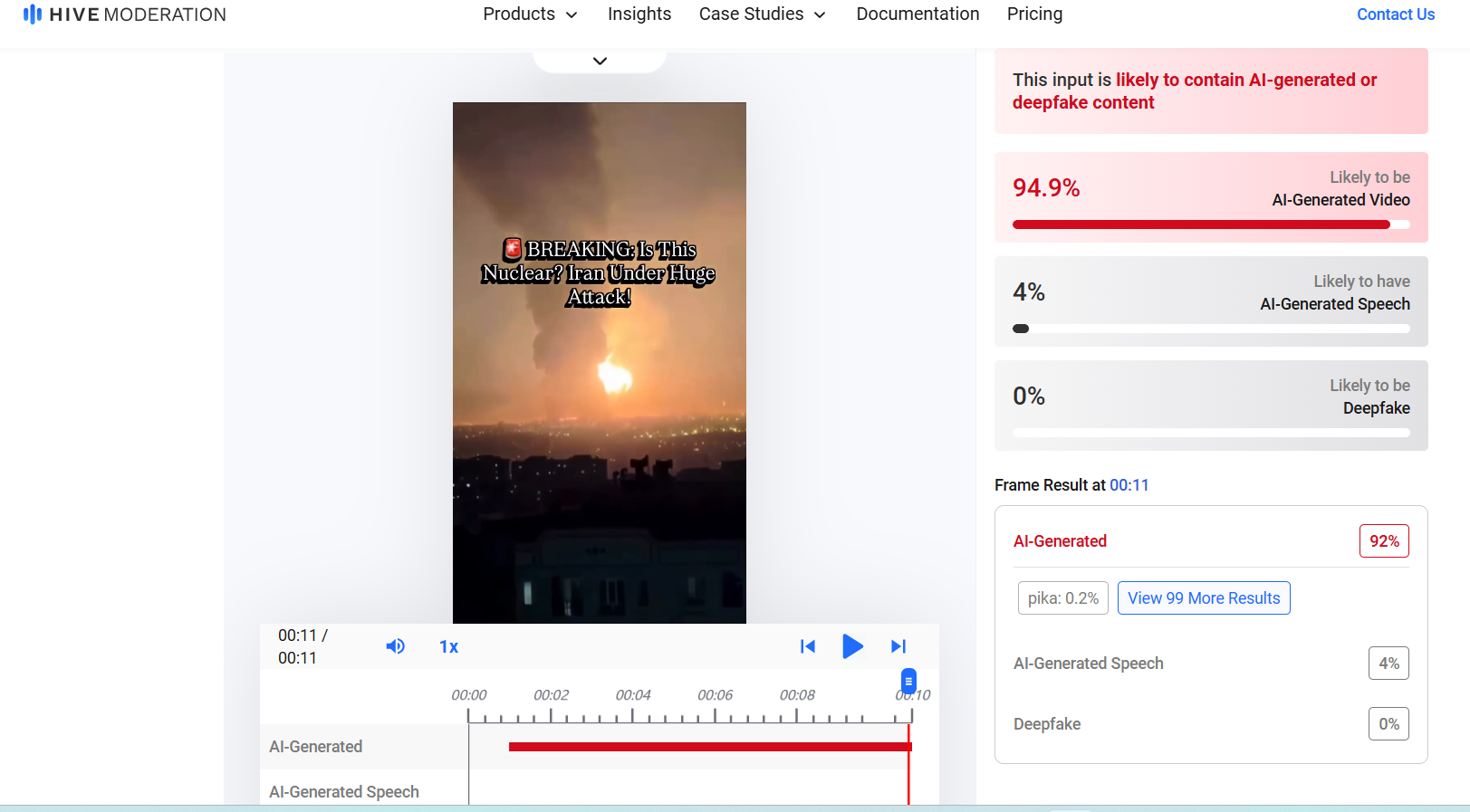
For additional verification, we analysed the video using DetectVideo AI. The tool also indicated that the video was likely AI-generated, with an estimated 80% probability.

We further checked the video using another AI detection tool, AI or Not, which suggested that the footage had a 64% probability of being AI-generated.

At the final stage of verification, we used WasIt.AI, which also indicated that the video was likely AI-generated, with an 88% probability.

Conclusion
CyberPeace Research Wing ’s research found that the viral video does not show real footage of an attack on Iran.The video was created using Artificial Intelligence (AI) and is being falsely shared as authentic visuals of explosions and destruction caused by an attack on Iran. Users are advised to verify such sensational claims before sharing them online.

Related Blogs
![Securing Digital Banking: RBI Mandates Migration to [.]bank[.]in Domains](https://cdn.prod.website-files.com/64b94adadbfa4c824629b337/6818602cfbcc953fcae859a1_POLICY%20TEAM%20COVER%20PAGES%20-21%20(1).webp)
Introduction
The Reserve Bank of India (RBI) has mandated banks to switch their digital banking domains to 'Bank.in' by October 31, 2025, as part of a strategy to modernise the sector and maintain consumer confidence. The move is expected to provide a consistent and secure interface for online banking, as a response to the increasing threats posed by cybercriminals who exploit vulnerabilities in online platforms. The RBI's directive is seen as a proactive measure to address the growing concerns over cybersecurity in the banking sector.
RBI Circular - Migration to '.bank.in' domain
The official circular released by the RBI dated April 22, 2025, read as follows:
“It has now been decided to operationalise the ‘. bank.in’ domain for banks through the Institute for Development and Research in Banking Technology (IDRBT), which has been authorised by National Internet Exchange of India (NIXI), under the aegis of the Ministry of Electronics and Information Technology (MeitY), to serve as the exclusive registrar for this domain. Banks may contact IDRBT at sahyog@idrbt.ac.in to initiate the registration process. IDRBT shall guide the banks on various aspects related to application process and migration to new domain.”
“All banks are advised to commence the migration of their existing domains to the ‘.bank.in’ domain and complete the process at the earliest and in any case, not later than October 31, 2025.”
CyberPeace Outlook
The Reserve Bank of India's directive mandating banks to shift to the 'Bank.in' domain by October 31, 2025, represents a strategic and forward-looking measure to modernise the nation’s digital banking infrastructure. With this initiative, the RBI is setting a new benchmark in cybersecurity by creating a trusted, exclusive domain that banks must adopt. This move will drastically reduce cyber threats, phishing attacks, and fake banking websites, which have been major sources of financial fraud. This fixed domain will simplify verification for consumers and tech platforms to more easily identify legitimate banking websites and apps. Furthermore, a strong drop in online financial fraud will have a long-term effect by this order. Since phishing and domain spoofing are two of the most prevalent forms of cybercrime, a shift to a strictly regulated domain name system will remove the potential for lookalike URLs and fraudulent websites that mimic banks. As India’s digital economy grows, RBI’s move is timely, essential, and future-ready.
References
Executive Summary:
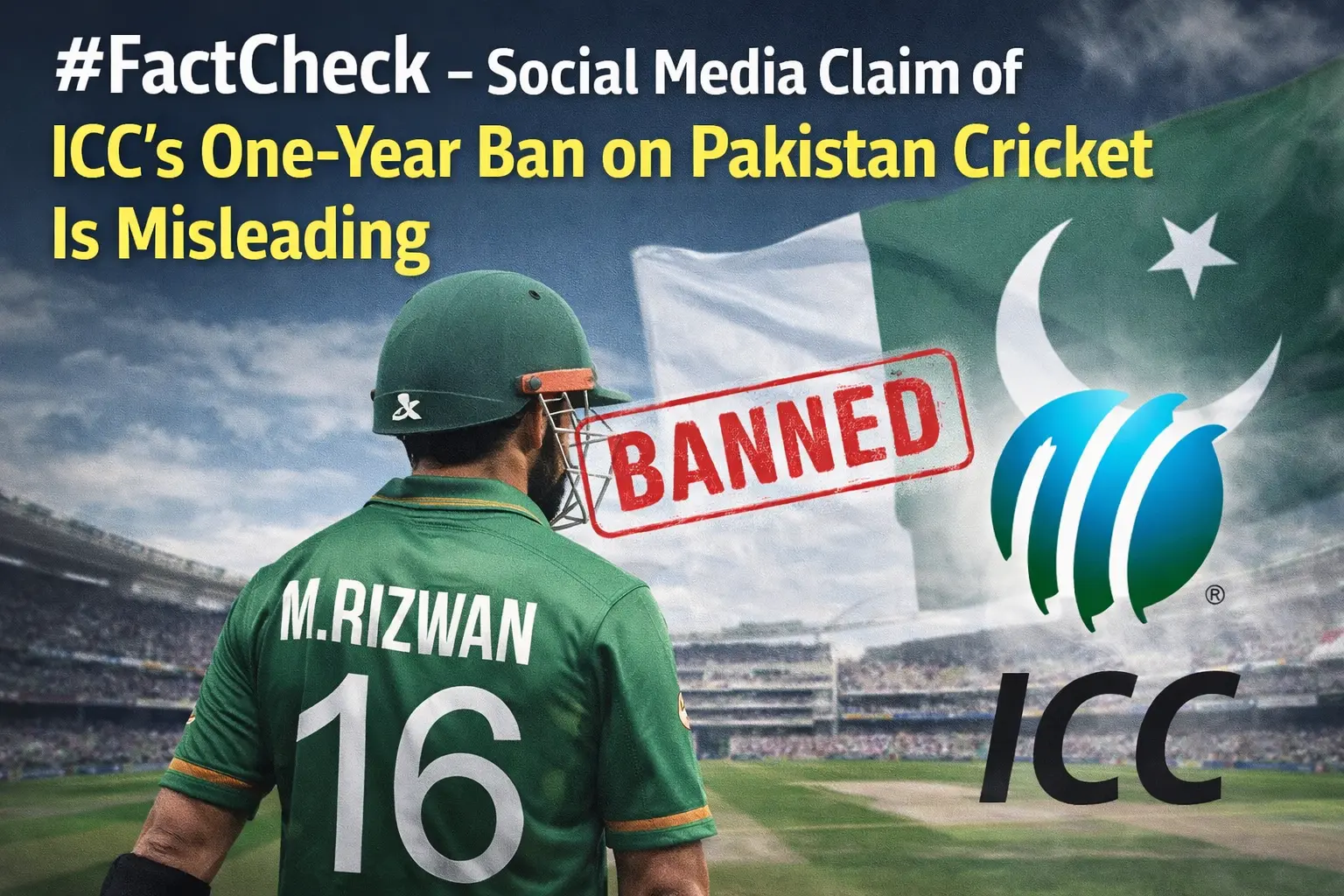
A purported media release allegedly issued in the name of the International Cricket Council (ICC) is being widely circulated on social media. The release claims that the ICC has decided to impose a one-year ban on Pakistan cricket. CyberPeace’s research found this claim to be false.The research revealed that the media release circulating on social media is fake, and no such letter or official statement has been issued by the ICC.
Claim:
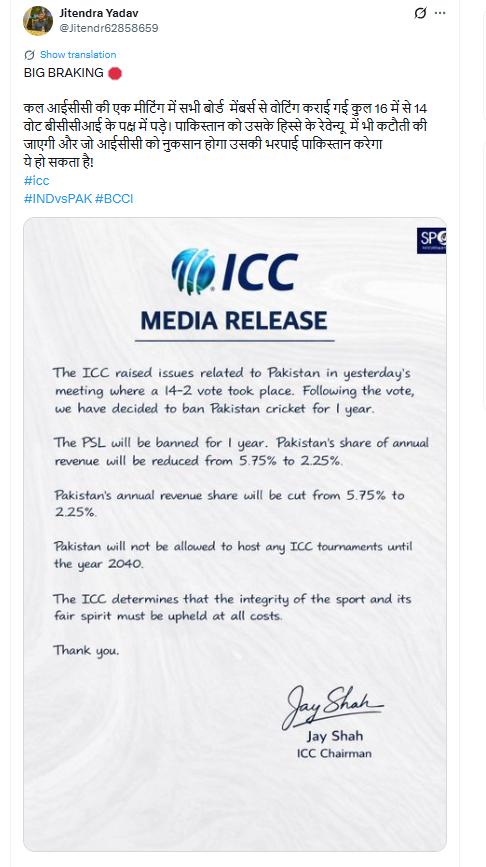
On social media platform X (formerly Twitter), a user shared the viral letter on February 3, 2026, claiming that an ICC meeting was held in which board members voted on issues related to Pakistan. The post alleged that 14 out of 16 votes were cast in favour of the BCCI. The user further claimed that Pakistan’s share of ICC revenue would be reduced and that Pakistan might be asked to compensate for losses incurred by the ICC.
The viral letter, written in English, stated that matters related to Pakistan were discussed in an ICC meeting and that a 14–2 majority vote led to the decision to impose a one-year ban on Pakistan cricket. It further claimed that the Pakistan Super League (PSL) would be suspended for one year, Pakistan’s annual revenue share would be reduced from 5.75 percent to 2.25 percent, and Pakistan would not be allowed to host any ICC tournaments until 2040. The letter also claimed that these decisions were taken to safeguard the integrity and spirit of the game. Links to the viral post, archive link, and screenshots can be seen below.
Fact Check:
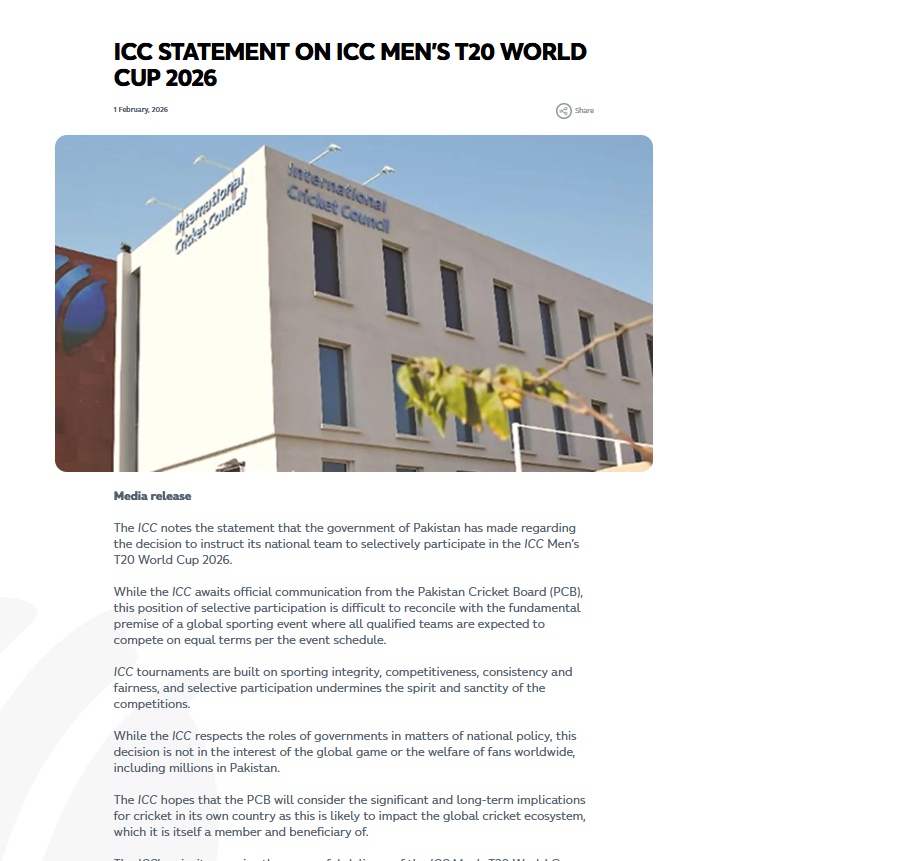
To verify the viral claim, CyberPeace conducted a Google search using relevant keywords. However, no credible or reliable media reports supporting the claim were found. In the next step of the research , an official press release uploaded on DD Sports’ Facebook page on February 2, 2026, was found. The press release responded to Pakistan’s decision not to play against India in a Group A match. The DD Sports statement said that the Pakistan Cricket Board should consider the long-term and serious implications of such a decision, as it could impact the global cricket ecosystem—of which Pakistan is itself a member and beneficiary.
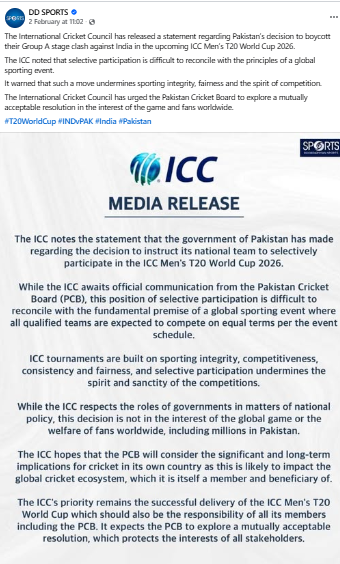
Notably, the official press release made no mention of any ban on Pakistan cricket, reduction in revenue share, suspension of the PSL, or restrictions on hosting ICC tournaments, contrary to the claims made in the viral letter. Further, the same official statement was found published on the ICC’s website on February 1, 2026. This release also did not mention any decision related to banning Pakistan cricket or barring the country from hosting ICC tournaments for the next 40 years.
Conclusion
CyberPeace concludes that the media release circulating on social media is fake. The ICC has not issued any official letter or statement announcing a one-year ban on Pakistan cricket, revenue cuts, or restrictions on hosting ICC tournaments.
Executive Summary
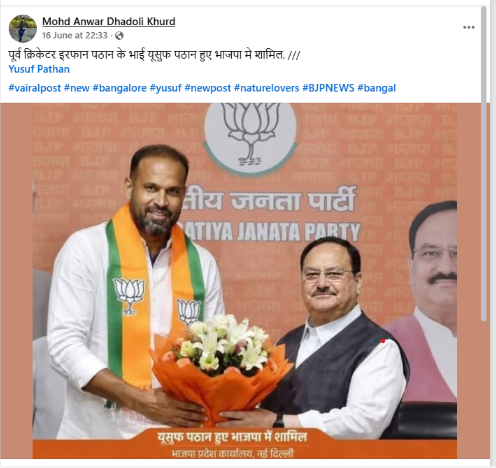
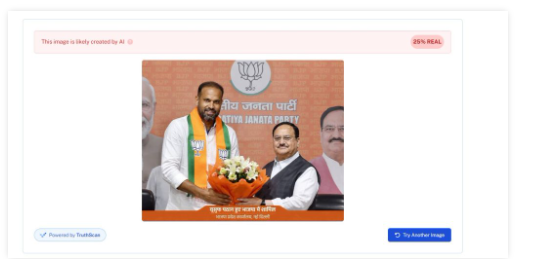
Amid political developments following the 2026 West Bengal Assembly elections, a photo is being widely circulated on social media claiming that former cricketer and Baharampur MP Yusuf Pathan has joined the Bharatiya Janata Party (BJP). The viral image shows Pathan wearing a BJP scarf and standing alongside Union Health Minister JP Nadda. CyberPeace Research Wing research found the claim to be false. The image in circulation is AI-generated and does not depict any real event.
Claim:
A Facebook user ‘Mohd Anwar Dhadoli Khurd’ shared the viral image on June 16, 2026, claiming that Yusuf Pathan has joined the BJP. The post has since been widely shared across platforms.
Post link: https://www.facebook.com/mohd.anwar.dhadoli.khurd/posts/pfbid02WAo4uXhhM1qEVTMbxTjKpTHkoeAbfEztwkX6tWLWpN8WBzNavgtJgKV8JoBGULSul
Archive link: https://perma.cc/4A3H-YTPL
Fact Check:
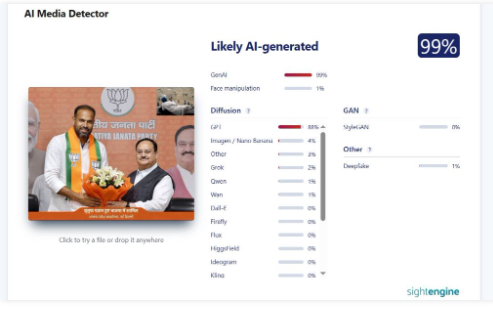
A reverse image search of the viral photo did not yield any credible news reports or authentic sources linking the image to any such political development. No related information was found on Yusuf Pathan’s official social media accounts either, raising suspicion about the authenticity of the image. The image was then analysed using AI detection tools. Sightengine reported a 99% probability of the image being AI-generated.
Additionally, analysis using “Undetectable.ai” also indicated a high likelihood of AI manipulation.
Conclusion:
The research confirms that the viral image claiming Yusuf Pathan’s entry into the BJP is AI-generated and does not reflect any real-world event.
