
#FactCheck-AI-Generated Video Falsely Claims Snake Was Spotted on Aircraft Wing During Flight
Executive Summary
A video showing a snake crawling on the wing of an aircraft during a flight is being widely circulated on social media. The video is being shared with the claim that the sighting of a snake on the aircraft wing caused panic among passengers and crew members during the flight. Several users are sharing the video as a genuine incident. CyberPeace Research Wing ’s research found the viral claim to be misleading. The research revealed that the video does not show a real incident and was created using artificial intelligence (AI).
Claim:
A Facebook user shared the viral video on July 26, 2026, claiming that a snake was spotted on an aircraft during a flight, causing panic. The post stated, “Snake spotted on aircraft during flight, video goes viral!”
The link to the post, archive link and screenshot are provided below:
https://www.facebook.com/reel/2845827375780035

Factcheck
To verify the authenticity of the viral video, the Desk analysed several key frames from the footage and conducted a reverse image search.
However, no credible news report, official information, or reliable source was found linking the video to any real incident involving a snake on an aircraft during a flight.
Upon closely examining the video, the Desk suspected that it may have been generated using AI. To verify this, the video was analysed using the AI detection tool HIVE Moderation. The tool’s analysis also indicated that the video was likely AI-generated, suggesting that it does not depict an actual incident.

As part of further verification, the key frames of the video were also examined using another AI detection tool, Sightengine. The tool’s analysis indicated a 99 per cent probability that the visuals were AI-generated.

Conclusion:
The research established that the viral video does not show a real incident of a snake crawling on an aircraft wing during a flight. The video was created using artificial intelligence (AI) and is being circulated on social media with a misleading claim.

Related Blogs

Introduction
Rajeev Chandrasekhar, the Union minister of state for information technology (IT), said that the Global Partnership on Artificial Intelligence (GPAI) Summit, which brings together 29 member governments, including the European Union, announced on 13th December 2023 that the New Delhi Declaration had been adopted. The proclamation committed to developing AI applications for medical treatment and agribusiness jointly and taking the needs of the Global South into account when developing AI.
In addition, signing countries committed to leveraging the GPAI infrastructure to establish a worldwide structure for AI safety and trust, as well as to make AI advantages and approaches accessible to all. In order to complete the recommended structure in six months, India also submitted a proposal to host the GPAI Global Governance Summit.
“The New Delhi Declaration, which aims to place GPAI at the forefront of defining the future of AI in terms of both development and building cooperative AI across the partner states, has been unanimously endorsed by 29 GPAI member countries. Nations have come to an agreement to develop AI applications in healthcare, agriculture, and numerous other fields that affect all of our nations and citizens,” Chandrasekhar stated.
The statement highlights GPAI's critical role in tackling modern AI difficulties, such as generative AI, through submitted AI projects meant to maximize benefits and minimize related risks while solving community problems and worldwide difficulties.
GPAI
Global Partnership on Artificial Intelligence (GPAI) is an organisation of 29 countries from the Americas (North and South), Europe and Asia. It has important players such as the US, France, Japan and India, but it excludes China. The previous meeting took place in Japan. In 2024, India will preside over GPAI.
In order to promote and steer the responsible implementation of artificial intelligence based on human rights, multiculturalism, gender equality, innovation, economic growth, the surroundings, and social impact, this forum was established in 2020. Its goal is to bring together elected officials and experts in order to make tangible contributions to the 2030 Agenda and the UN Sustainable Development Goals (SDGs).
Given the quick and significant advancements in artificial intelligence over the previous year, the meeting in New Delhi attracted particular attention. They have sparked worries about its misuse as well as enthusiasm about its possible advantages.
The Summit
The G20 summit, which India hosted in September 2023, provided an atmosphere for the discussions at the GPAI summit. There, participants of this esteemed worldwide economic conference came to an agreement on how to safely use AI for "Good and for All."
In order to safeguard people's freedoms and security, member governments pledged to address AI-related issues "in a responsible, inclusive, and human-centric manner."
The key tactic devised is to distribute AI's advantages fairly while reducing its hazards. Promoting international collaboration and discourse on global management for AI is the first step toward accomplishing this goal.
A major milestone in that approach was the GPAI summit.
The conversation on AI was started by India's Prime Minister Narendra Modi, who is undoubtedly one of the most tech-aware and tech-conscious international authorities.
He noted that every system needs to be revolutionary, honest, and trustworthy in order to be sustained.
"There is no doubt that AI is transformative, but it is up to us to make it more and more transparent." He continued by saying that when associated social, ethical, and financial concerns are appropriately addressed, trust will increase.
After extensive discussions, the summit attendees decided on a strategy to establish global collaboration on a number of AI-related issues. The proclamation pledged to place GPAI at the leading edge of defining AI in terms of creativity and cooperation while expanding possibilities for AI in healthcare, agriculture, and other areas of interest, according to Union Minister Rajeev Chandrasekhar.
There was an open discussion of a number of issues, including disinformation, joblessness and bias, protection of sensitive information, and violations of human rights. The participants reaffirmed their dedication to fostering dependable, safe, and secure AI within their respective domains.
Concerns raised by AI
- The issue of legislation comes first. There are now three methods in use. In order to best promote inventiveness, the UK government takes a "less is more" approach to regulation. Conversely, the European Union (EU) is taking a strong stance, planning to propose a new Artificial Intelligence Act that might categorize AI 'in accordance with use-case situations based essentially on the degree of interference and vulnerability'.
- Second, analysts say that India has the potential to lead the world in discussions about AI. For example, India has an advantage when it comes to AI discussions because of its personnel, educational system, technological stack, and populace, according to Markham Erickson of Google's Centers for Excellence. However, he voiced the hope that Indian regulations will be “interoperable” with those of other countries in order to maximize the benefits for small and medium-sized enterprises in the nation.
- Third, there is a general fear about how AI will affect jobs, just as there was in the early years of the Internet's development. Most people appear to agree that while many jobs won't be impacted, certain jobs might be lost as artificial intelligence develops and gets smarter. According to Erickson, the solution to the new circumstances is to create "a more AI-skilled workforce."
- Finally, a major concern relates to deepfakes defined as 'digital media, video, audio and images, edited and manipulated, using Artificial Intelligence (AI).'
Need for AI Strategy in Commercial Businesses
Firstly, astute or mobile corporate executives such as Shailendra Singh, managing director of Peak XV Partners, feel that all organisations must now have 'an AI strategy'.
Second, it is now impossible to isolate the influence of digital technology and artificial intelligence from the study of international relations (IR), foreign policy, and diplomacy. Academics have been contemplating and penning works of "the geopolitics of AI."
Combat Strategies
"We will talk about how to combine OECD capabilities to maximize our capacity to develop the finest approaches to the application and management of AI for the benefit of our people. The French Minister of Digital Transition and Telecommunications", Jean-Noël Barrot, informed reporters.
Vice-Minister of International Affairs for Japan's Ministry of Internal Affairs and Communications Hiroshi Yoshida stated, "We particularly think GPAI should be more inclusive so that we encourage more developing countries to join." Mr Chandrasekhar stated, "Inclusion of lower and middle-income countries is absolutely core to the GPAI mission," and added that Senegal has become a member of the steering group.
India's role in integrating agribusiness into the AI agenda was covered in a paragraph. The proclamation states, "We embrace the use of AI innovation in supporting sustainable agriculture as a new thematic priority for GPAI."
Conclusion
The New Delhi Declaration, which was adopted at the GPAI Summit, highlights the cooperative determination of 29 member nations to use AI for the benefit of all people. GPAI, which will be led by India in 2024, intends to influence AI research with an emphasis on healthcare, agriculture, and resolving ethical issues. Prime Minister Narendra Modi stressed the need to use AI responsibly and build clarity and confidence. Legislative concerns, India's potential for leadership, employment effects, and the difficulty of deepfakes were noted. The conference emphasized the importance of having an AI strategy in enterprises and covered battle tactics, with a focus on GPAI's objective, which includes tolerance for developing nations. Taken as a whole, the summit presents GPAI as an essential tool for navigating the rapidly changing AI field.
References
- https://www.thehindu.com/news/national/ai-summit-adopts-new-delhi-declaration-on-inclusiveness-collaboration/article67635398.ece
- https://www.livemint.com/news/india/gpai-meet-adopts-new-delhi-ai-declaration-11702487342900.html
- https://startup.outlookindia.com/sector/policy/global-partnership-on-ai-member-nations-unanimously-adopt-new-delhi-declaration-news-10065
- https://gpai.ai/

Executive Summary:
A photo circulating on the web that claims to show the future design of the Bhabha Atomic Research Center, BARC building, has been found to be fake after fact checking has been done. Nevertheless, there is no official notice or confirmation from BARC on its website or social media handles. Through the AI Content Detection tool, we have discovered that the image is a fake as it was generated by an AI. In short, the viral picture is not the authentic architectural plans drawn up for the BARC building.

Claims:
A photo allegedly representing the new outlook of the Bhabha Atomic Research Center (BARC) building is reigning over social media platforms.


Fact Check:
To begin our investigation, we surfed the BARC's official website to check out their tender and NITs notifications to inquire for new constructions or renovations.
It was a pity that there was no corresponding information on what was being claimed.

Then, we hopped on their official social media pages and searched for any latest updates on an innovative building construction, if any. We looked on Facebook, Instagram and X . Again, there was no information about the supposed blueprint. To validate the fact that the viral image could be generated by AI, we gave a search on an AI Content Detection tool by Hive that is called ‘AI Classifier’. The tool's analysis was in congruence with the image being an AI-generated computer-made one with 100% accuracy.

To be sure, we also used another AI-image detection tool called, “isitai?” and it turned out to be 98.74% AI generated.

Conclusion:
To conclude, the statement about the image being the new BARC building is fake and misleading. A detailed investigation, examining BARC's authorities and utilizing AI detection tools, proved that the picture is more probable an AI-generated one than an original architectural design. BARC has not given any information nor announced anything for such a plan. This makes the statement untrustworthy since there is no credible source to support it.
Claim: Many social media users claim to show the new design of the BARC building.
Claimed on: X, Facebook
Fact Check: Misleading

Executive Summary
A video is being widely shared on social media claiming that members of the so-called ‘Cockroach Janta Party (CJP)’ caught a police officer in Chhattisgarh red-handed while accepting a bribe of ₹30,000. The viral posts also claim that the group has intensified its so-called campaign to “clean the rotten system.” However, CyberPeace Research Wing research found the claim to be misleading.The research revealed that the video has no connection with the ‘Cockroach Janta Party (CJP)’. The original footage dates back to February 2026 and shows Chhattisgarh Police sub-inspector Abdul Munaf being caught by the Anti-Corruption Bureau (ACB) in an alleged ₹25,000 bribery case.
Claim
A Facebook user shared the viral video on May 23, 2026, claiming that members of the “Cockroach Janta Party” caught a police officer red-handed taking a ₹30,000 bribe. The post further stated that the group had intensified its campaign against corruption. The link and archived post are provided.

Fact Check
To verify the claim, we extracted key frames from the viral video and conducted a reverse image search. During the research, we found a report published on the Navbharat Times website dated February 26, 2026, which contained visuals matching the viral vi
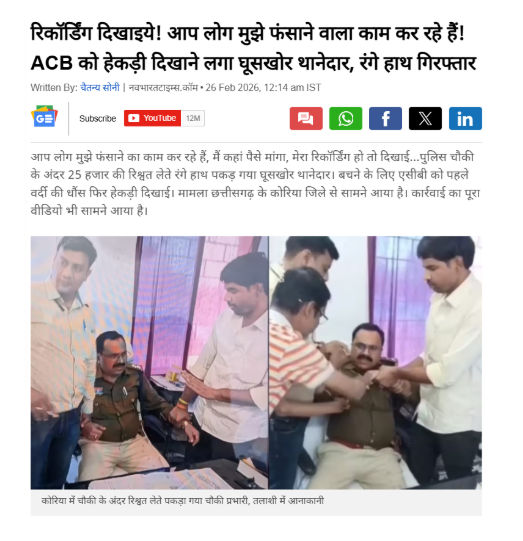
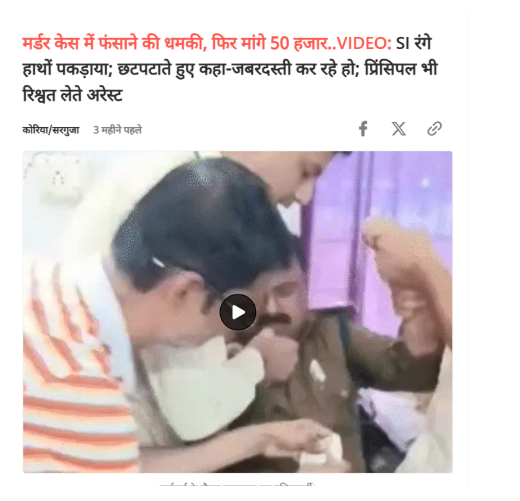
According to the report, the Anti-Corruption Bureau (ACB) in Korea district, Chhattisgarh, arrested a corrupt police station in-charge while accepting a bribe of ₹25,000. After being caught, the officer attempted to assert authority using his uniform and resisted the search procedure, but soon gave up. Further verification using keywords from the Navbharat Times report led to a similar story published by Dainik Bhaskar, which also contained the same visuals.
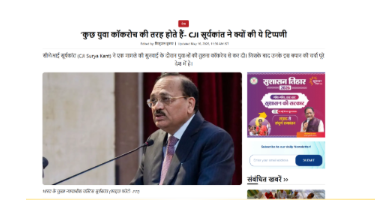
Additionally, a related context about the satirical “Cockroach Janta Party (CJP)” trend was found in a Times Now Hindi report, which explains that the term emerged as an online satire following a controversial remark attributed to the Chief Justice of India regarding unemployed youth. The statement was later clarified.
Conclusion
The research confirms that the viral video has no connection with the ‘Cockroach Janta Party (CJP)’. The original footage is from a February 2026 incident in which Chhattisgarh Police sub-inspector Abdul Munaf was arrested by the ACB in a bribery case involving ₹25,000. The video has been falsely linked to a misleading narrative on social media.
