
#FactCheck-AI-Generated Audio Falsely Attributed to Rajnath Singh in Viral Video on Student Protest
Executive Summary
A video featuring Union Defence Minister Rajnath Singh is being widely circulated on social media with the claim that he issued a strict warning against student protesters. In the viral clip, Singh is allegedly heard saying that the government would not tolerate “anarchy” and that strict action would be taken against those blocking roads, disturbing public order, or damaging government property. CyberPeace Research Wing’s research found the claim to be false. The research revealed that the original video available on Rajnath Singh’s official YouTube channel was digitally altered by adding AI-generated audio. The statement heard in the viral video is not genuine and was created using artificial intelligence.
Claim:
An account on social media platform X (formerly Twitter), with the username @ForumDefence, shared a video on July 22, 2026, claiming that Union Defence Minister Rajnath Singh had issued a warning regarding the ongoing student protest. The video features an AI-generated voice attributed to Rajnath Singh, in which he is allegedly heard saying: “Taking advantage of the student movement, the unrest and violence being spread over the past few days are strongly condemned by the government. Expressing one’s views is a democratic right, but breaking the law and creating difficulties for the public in its name will not be tolerated. The government will not tolerate such anarchy. Anyone attempting to block roads, disturb peace, or damage government property will face strict action.”
The link, archive link and screenshot of the post are provided below:
https://x.com/ForumDefence/status/2079960247888756775

Fact Check:
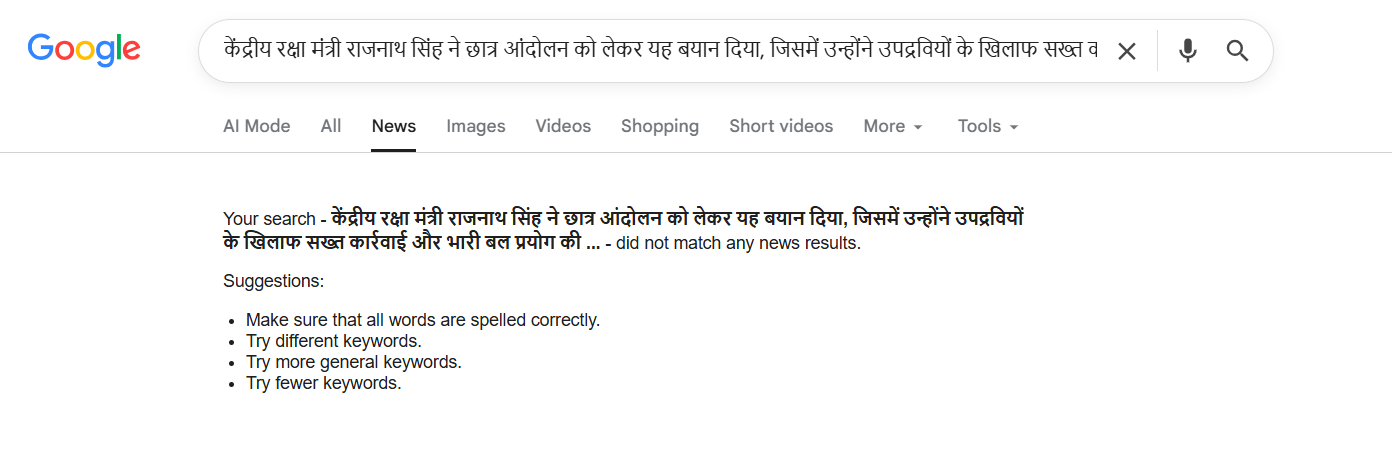
To verify the viral claim, the Desk conducted a keyword search on Google. However, no credible news report or official statement was found confirming that Rajnath Singh had made such remarks regarding the student protest.
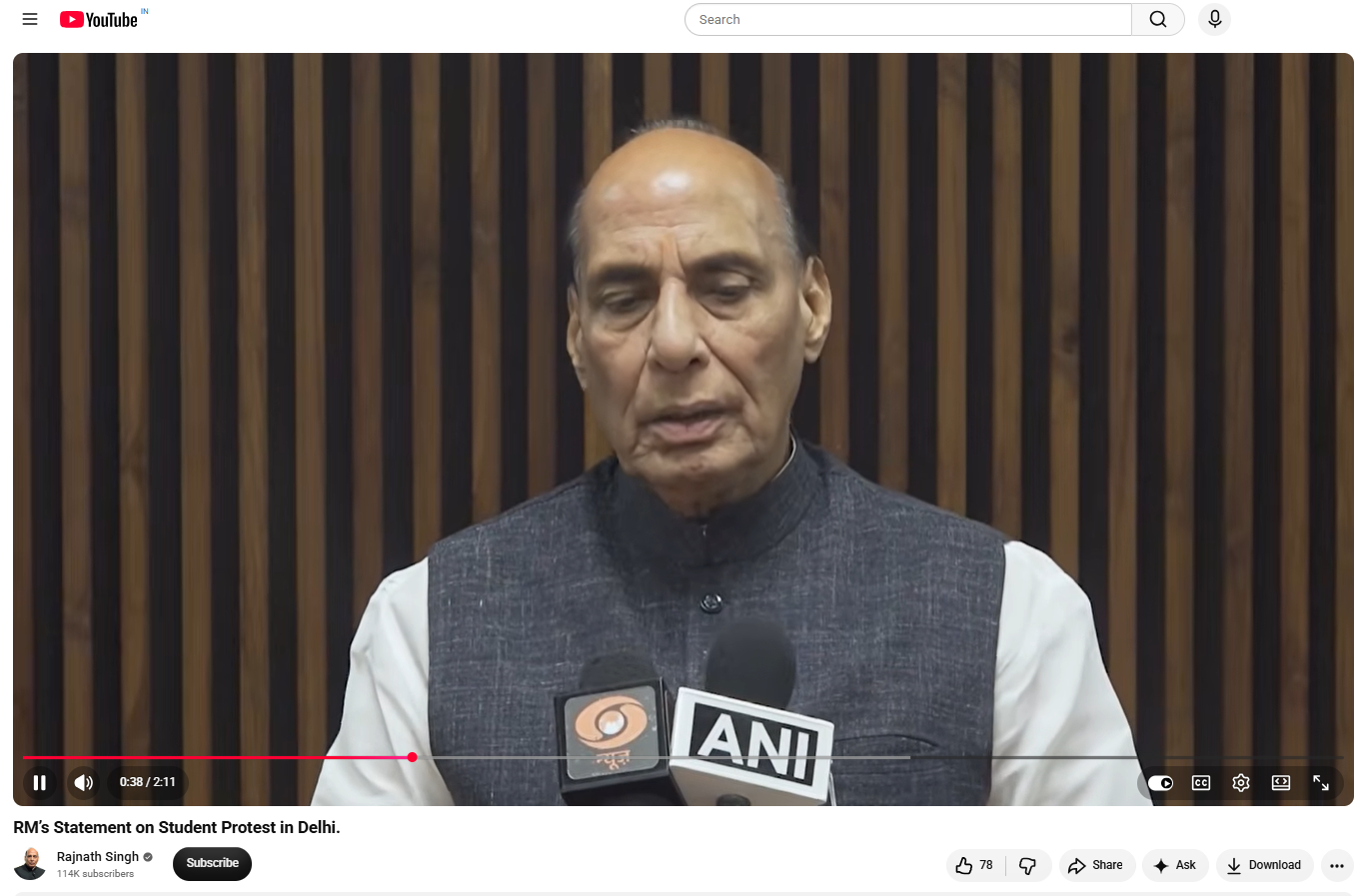
During further research, the Desk found the original video on the official YouTube channel of Union Defence Minister Rajnath Singh. A comparison between the viral clip and the original video showed that the statements attributed to Singh in the viral video did not match his actual remarks. In the original video, Rajnath Singh was speaking about the ongoing protests in Delhi. He said that the protests were a matter of serious concern and expressed that it was unfortunate that some people were attempting to use students and youth as a political tool for their own interests.
He further stated that the government was committed to addressing the concerns of students and youth, and that dialogue and discussion were the appropriate ways to resolve issues in a democracy.
The original video from Rajnath Singh’s official YouTube channel can be accessed here:
https://www.youtube.com/watch?v=w73iPTEfKCA
Further analysis of the viral video’s audio was conducted using the AI detection tool Resemble AI. The analysis indicated that the audio had a 99.10 per cent probability of being AI-generated.

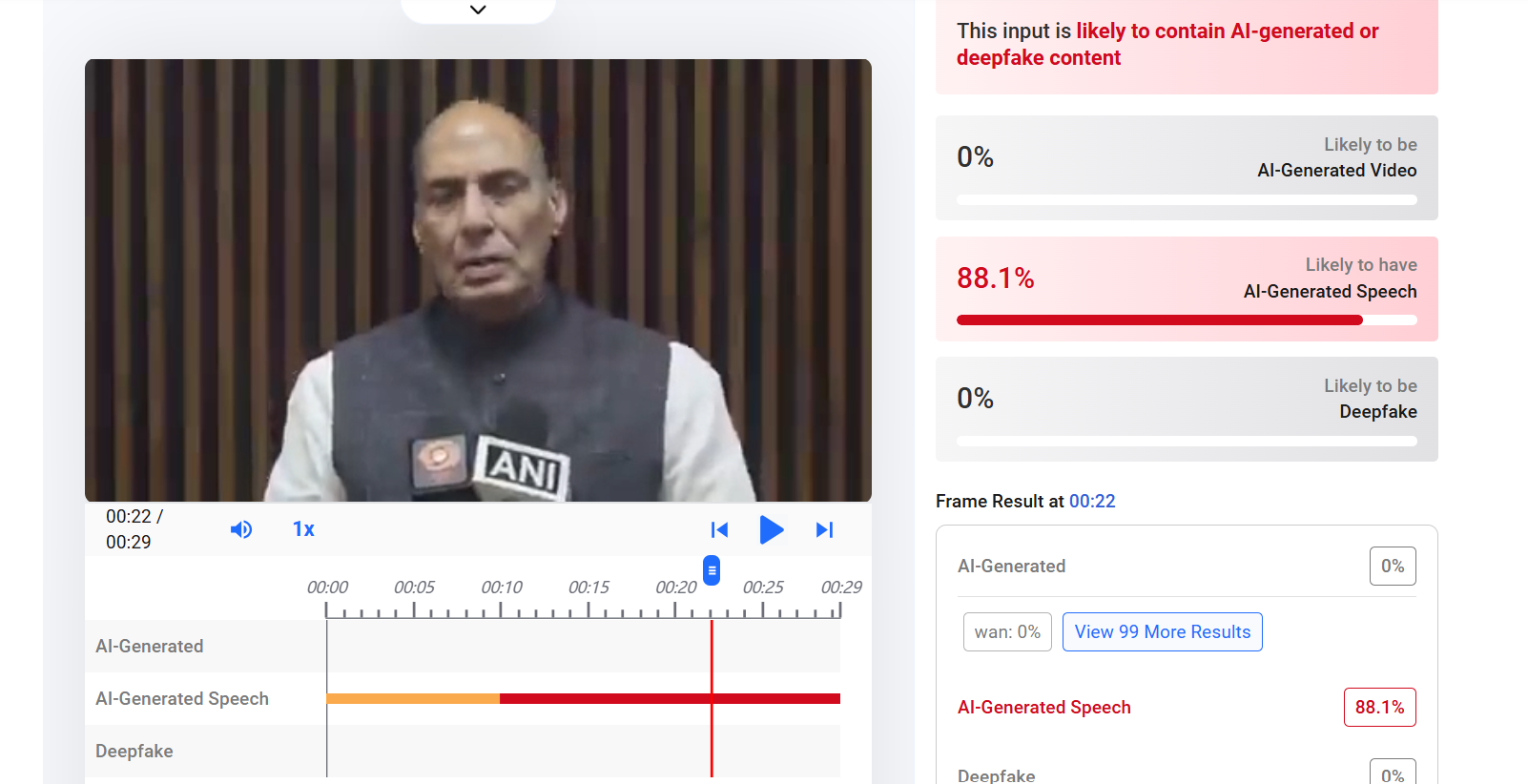
The Desk also examined the viral video using the AI detection tool HIVE Moderation. The analysis suggested that the speech used in the video had an 88.1 per cent probability of being AI-generated.
Conclusion:
The research established that the viral video featuring Union Defence Minister Rajnath Singh has been digitally manipulated by adding AI-generated audio. The statement attributed to Singh regarding strict action against student protesters is not genuine. The original video available on Rajnath Singh’s official YouTube channel contains different remarks, and the viral clip has been circulated with a false and misleading claim.

Related Blogs
Most laws regulate what people do. This one regulates what clock everyone is doing it by, and once you sit with that idea for a moment, it stops sounding like a bureaucratic footnote and starts sounding like something genuinely foundational.
On 27 August 2026, India's Department of Consumer Affairs notified the Legal Metrology (Indian Standard Time) Rules, 2026, making Indian Standard Time the single legally binding reference for every legal, administrative, commercial, and official purpose across the country. The Rules will come into force 180 days after their publication in the Official Gazette, giving government departments, businesses, and institutions a compliance runway to align their systems before the requirement actually bites.
Why time needed a law at all
It might seem strange that a country needs legislation to tell everyone what time it is. India has used IST, a single time zone five and a half hours ahead of Coordinated Universal Time, since 1947. But using a time zone informally and legally mandating it as the sole authoritative reference for every official and commercial transaction are two very different things, and the gap between them is exactly where this rule lives.
The government's own reasoning, laid out in its official statement, centres on a shift most people experience daily without ever thinking about its plumbing. Banking and digital payments, telecommunications networks, railways, power grids, and government record systems all depend on accurate, synchronised time stamps to function correctly. When different systems quietly draw their time from different sources, even by fractions of a second, the resulting inconsistencies can affect the coordination and recording of transactions in ways that are invisible until something goes wrong. A trade executed on a stock exchange, a UPI payment cleared between banks, a railway signal handoff between two junctions, and an emergency service dispatch all depend on every clock in the chain agreeing with every other clock, and until now, India had no single rule compelling that agreement.
The quieter, more interesting part of the rule
Buried inside the announcement is a detail that matters more than the headline. The Rules do not simply declare IST the law of the land; they also authorise the use of NavIC, India's own satellite navigation system, alongside other approved domestic timing sources, as legitimate means of disseminating that time. The government's stated rationale is candid about the current state of affairs: several critical Indian systems presently draw their time from foreign satellite based sources, and building domestic timing infrastructure through NavIC and legal metrology laboratories is intended to reduce that dependence going forward.
That single sentence carries real weight once you consider how global positioning and timing systems actually work. Most of the world's precise digital time synchronisation ultimately traces back to GPS, the American satellite constellation, whose signals also happen to be notoriously easy to disrupt. GPS and other satellite navigation signals arrive at receivers on Earth as extremely weak radio transmissions, weak enough that they can be jammed with cheap equipment or spoofed, meaning an attacker broadcasts a counterfeit signal that mimics a legitimate one closely enough to fool a receiver into accepting false position or timing data. Researchers and government reports going back years have flagged that a large share of critical infrastructure sectors, power grids, financial markets, telecommunications, and transport among them, carry meaningful dependence on GPS derived timing, and a 2017 UK government assessment specifically warned that systematic satellite signal jamming could cause serious disruption to a country's financial, electricity, and communications systems all at once. Cybersecurity researchers have separately demonstrated proof of concept attacks where a deliberately falsified timing signal, rather than a falsified position, was enough to destabilise systems that assumed their clock could always be trusted.
Seen against that backdrop, embedding NavIC as an approved domestic timing source inside a legal metrology framework is not merely a nationalistic footnote about self reliance. It is a genuine resilience decision. A country that can generate, verify, and distribute its own trusted time signal, independent of a foreign satellite constellation that it does not control and cannot secure on its own, has a meaningfully smaller attack surface for an entire category of infrastructure disruption that rarely makes headlines until it actually happens.
Who actually built this, and why that composition matters
The drafting process itself offers a useful clue about how seriously this was treated. Reports on the rule making process indicate the Rules were shaped by a high powered inter ministerial committee chaired by the Secretary of Consumer Affairs, with representation from the National Physical Laboratory and the Indian Space Research Organisation for the underlying science and satellites, IIT Kanpur for engineering expertise, the National Informatics Centre and CERT In for network infrastructure and its security, the Securities and Exchange Board of India for financial market implications, and the Railways, Telecom, and Financial Services departments for the systems that will actually have to run on this new standard day to day. That is not a committee assembled around a single ministry's convenience; it is a committee assembled around the actual shape of the problem, spanning physics, engineering, finance, and network security together. As part of the broader One Nation, One Time initiative, a White Rabbit Technology based IST Dissemination Demonstration Network was already commissioned at the Regional Reference Standard Laboratory in Bengaluru back in July 2026, suggesting the infrastructure groundwork was underway well before the legal framework caught up to it.
What the 180 day window actually means in practice
It is worth being precise about what compliance actually requires here. This is not a deadline demanding new hardware overnight; for most organisations, it means auditing which internal systems currently reference time from an unverified or foreign source and ensuring they align with certified IST going forward, alongside institutions preparing to receive that certified time through the domestic infrastructure the government is simultaneously building out. The six month runway exists precisely because this touches an unusually wide spread of sectors at once, and forcing an abrupt cutover would create more operational risk than the rule is designed to remove.
The bigger picture
A rule about what time it is legally does not sound like cybersecurity news, and on the surface, it is not. But underneath the administrative language sits a genuinely forward looking recognition: as more of daily life, banking, communication, transport, and governance runs on systems that must agree, down to the second, on a shared reference point, the integrity of that reference point becomes critical infrastructure in its own right. India choosing to build, verify, and legally anchor its own trusted time source, rather than continuing to quietly rely on a foreign satellite system it cannot secure independently, is less about symbolism and more about closing a vulnerability most people never knew existed until they were asked to think about it.
References
- OpenGov Asia, "India Issues Rules to Standardise National Time Reference Systems." https://opengovasia.com/india-issues-rules-to-standardise-national-time-reference-systems/?c=us
- Daily Excelsior, "Centre notifies rules mandating IST as common time reference; 180 day window for compliance." https://www.dailyexcelsior.com/centre-notifies-rules-mandating-ist-as-common-time-reference-180-day-window-for-compliance/
- Greater Kashmir, "Department of Consumer Affairs notifies Legal Metrology Rules, 2026." https://www.greaterkashmir.com/national/department-of-consumer-affairs-notifies-legal-metrology-rules-2026-12454447
- Insights on India, "Legal Metrology (Indian Standard Time) Rules, 2026." https://www.insightsonindia.com/2026/08/31/legal-metrology-indian-standard-time-rules-2026/
- Blitz India Media, "Indian Standard Time Rules 2026: NavIC, Legal Metrology." https://blitzindiamedia.com/news/indian-standard-time-rules-2026-navic-legal-metrology/
- Observer Voice, "India Establishes Legal Framework for Standard Time." https://observervoice.com/india-establishes-legal-framework-for-standard-time-225958/
- The Live Nagpur, "Govt notifies rules to make IST the common time reference." https://thelivenagpur.com/2026/08/31/govt-notifies-rules-to-make-ist-the-common-time-reference/
- Safran Navigation and Timing, "GNSS Security and Cybersecurity: What are the Parallels?" https://safran-navigation-timing.com/gnss-security-and-cybersecurity-what-are-the-parallels/
- Safran Navigation and Timing, "Securing Critical Infrastructures from Jamming and Spoofing Cyberattacks." https://safran-navigation-timing.com/securing-critical-infrastructures-from-jamming-and-spoofing-cyberattacks/
- Combain, "The Silent Threat In The Sky: GPS Jamming, GPS Spoofing." https://combain.com/gps-jamming-spoofing/
Introduction
China is on the verge of unveiling a new policy that will address how Artificial Intelligence (AI) influences employment. On January 27, 2026, the Ministry of Human Resources and Social Security (MOHRSS) announced it would publish a paper on the contribution of AI to the labour and employment markets. The policy will include provisions to help impacted industries, expand assistance to young workers and graduates, and come up with interdisciplinary training programmes to equip individuals with jobs in an AI-enabled economy. The authorities have stressed that AI does not kill jobs but changes them, and education will be needed to assist employees in adjusting to the changes.
This announcement reflects a more proactive policy on AI-based changes in labour, showing that China intends to sustain economic modernisation through AI, as well as social stability. It also depicts wider international issues concerning the rate of automation and the necessity of considering labour and training policy.
AI and the Changing Nature of Work
AI is transforming work content and nature in industries. AI systems enhance the productivity of various functions, including data processing, logistics, and customer service, although they alter the nature of tasks carried out by humans. Extant studies indicate that although AI can automate routine activities, new occupations that require complex thinking, management of artificial intelligence, and skills related to people, including empathy, creativity, and problem-solving, may be generated.
This is the key nuance in the policy framing of China. Authorities point out that AI does not always result in massive unemployment. Instead, it transforms jobs and necessitates workers to change to new task profiles. This perspective is in line with the recent reports of the world research organisations, which predict the effects of AI as transformational and not necessarily destructive. As an example, the World Economic Forum Future Jobs Report 2023 observes that the change in technology will introduce new jobs that were not there 10 years ago, and retraining and upskilling will be instrumental in accessing those opportunities.
Key Components of China’s Policy Response
China’s forthcoming policy is expected to focus on three main areas that address both current workforce needs and future readiness.
Support for Key Industries
The policy will offer targeted assistance to sectors where artificial intelligence is gaining pace. Industries like advanced manufacturing, high-tech services, and online logistics will also get specialised assistance to assist companies in using AI to complement human labour and not just to replace it. The Chinese government tries to balance industrial upgrading with employment by channelling resources to the growth areas.
Assistance for Youth and Graduates
The youth and the recent graduates are entering a labour market that is changing rapidly. The policy aims to increase the support services to this population by career counselling, internships, and training programmes correlated with changing employer demands. According to a study by McKinsey Global Institute, the young workforce all over the globe can face disproportionate disruption in case the prospects of training are scarce, making initial career backing imperative.
Interdisciplinary Talent Development
The Chinese strategy focuses on interdisciplinary training that blends knowledge of domains and AI literacy and digital illiteracy. This is indicative of the realisation that hybrid skills are required in the future. The Organisation for Economic Cooperation and Development suggests that workers who can make it through the technical and non-technical elements of work will stand a better chance of winning in the AI age.
These components show that China’s strategy is not simply to protect existing jobs but to help workers transition to roles that leverage AI’s strengths.
Economy, Stability and Strategic Modernisation
The policy is an attempt to control technological transition as part of wider economic planning. It is an indication that the government regards AI as a structural change rather than an external shock that can be predicted and influenced by policy.
This is in contrast to some other reactions to labour markets in other countries, where the reactionary approach has been seen as a reaction to the job losses that have already become reality. The initiative by China implies that there should be a change in the manner in which one can expect change instead of reacting to change.
Global Comparisons and Shared Challenges
Governments worldwide are testing the options to adapt to the work effects of AI. The European Union is considering the individual learning account and portable training benefits, which would assist workers to gain access to reskilling opportunities in the course of their careers. In the US, there is a concerted effort by the public-private partnerships to match the development of the workforce with technological implementation.
The strategy of China has some of these components, but it stands out due to its incorporation with national planning processes. China wants the adoption of AI to help it achieve the common good and not division by connecting the workforce policy to the overall innovation and economic purpose.
Meanwhile, the issue of balancing the supply of labour with the demand of technology is a challenge of its own to countries with older populations and relatively smaller working forces. The timing and design of policy are particularly significant in China, as there is a large labour force and continuous changes in demography.
Practical Challenges and Risks
The success of China’s emerging policy will depend on effective implementation. Several practical issues will require careful attention:
Ensuring Equitable Access to Training
The labour force in China is diversified, and it goes through technology zones in cities and other rural areas. It will be paramount to make sure that the opportunity of upskilling is extended to all workers across the spectrum to prevent the further worsening of regional inequalities. Research conducted on reskilling across the globe shows that rural and low-income groups tend to lack access to training, despite the availability of programmes.
Aligning Training with Labour Demand
The programme of upskilling should be related to the market requirements. Disconnected training is prone to resulting in the production of skills that are obsolete or not applicable in actual work settings. Experience in emerging economies indicates that the involvement of employers in the training design enhances placement success on the part of the learner.
Private Sector Participation
The policy needs to be translated into employment outcomes with the help of private companies. Incentives to make firms invest in worker training, internships, and apprenticeships will enable workers to shift to AI-augmented jobs with ease.
A Model for AI Workforce Policy
The Chinese policy can serve as an example for other countries that want to balance technological advancement and labour market security. It acknowledges the fact that the effect of AI on employment is not only a technical or an economic problem but also a social challenge. Through foregrounding training, support, and coordinated action, China aims to create a future where people are ready to change and not lose their jobs to this change.
This strategy can be agreed with the suggestions of international organisations like the World Bank and the OECD, which insist on the idea of lifelong learning and flexibility of labour markets, as well as proactive investment in human capital as the main aspects of the labour policy in the future.
Conclusion
Artificial intelligence will continue to reshape work around the world. China’s forthcoming policy, which emphasises support, training and strategic integration of AI into labour markets, reflects a proactive and holistic view of technological transition. Other countries could benefit from studying this approach, especially in terms of linking workforce development with innovation goals.
By anticipating disruption and investing in people as well as technology, policymakers can help ensure that AI becomes a driver of shared economic opportunity rather than a source of exclusion. The balance between innovation and employment will shape not only economic outcomes but also social cohesion in the years ahead.
References

Introduction
In the digital realm of social media, Meta Platforms, the driving force behind Facebook and Instagram, faces intense scrutiny following The Wall Street Journal's investigative report. This exploration delves deeper into critical issues surrounding child safety on these widespread platforms, unravelling algorithmic intricacies, enforcement dilemmas, and the ethical maze surrounding monetisation features. Instances of "parent-managed minor accounts" leveraging Meta's subscription tools to monetise content featuring young individuals have raised eyebrows. While skirting the line of legality, this practice prompts concerns due to its potential appeal to adults and the associated inappropriate interactions. It's a nuanced issue demanding nuanced solutions.
Failed Algorithms
The very heartbeat of Meta's digital ecosystem, its algorithms, has come under intense scrutiny. These algorithms, designed to curate and deliver content, were found to actively promoting accounts featuring explicit content to users with known pedophilic interests. The revelation sparks a crucial conversation about the ethical responsibilities tied to the algorithms shaping our digital experiences. Striking the right balance between personalised content delivery and safeguarding users is a delicate task.
While algorithms play a pivotal role in tailoring content to users' preferences, Meta needs to reevaluate the algorithms to ensure they don't inadvertently promote inappropriate content. Stricter checks and balances within the algorithmic framework can help prevent the inadvertent amplification of content that may exploit or endanger minors.
Major Enforcement Challenges
Meta's enforcement challenges have come to light as previously banned parent-run accounts resurrect, gaining official verification and accumulating large followings. The struggle to remove associated backup profiles adds layers to concerns about the effectiveness of Meta's enforcement mechanisms. It underscores the need for a robust system capable of swift and thorough actions against policy violators.
To enhance enforcement mechanisms, Meta should invest in advanced content detection tools and employ a dedicated team for consistent monitoring. This proactive approach can mitigate the risks associated with inappropriate content and reinforce a safer online environment for all users.
The financial dynamics of Meta's ecosystem expose concerns about the exploitation of videos that are eligible for cash gifts from followers. The decision to expand the subscription feature before implementing adequate safety measures poses ethical questions. Prioritising financial gains over user safety risks tarnishing the platform's reputation and trustworthiness. A re-evaluation of this strategy is crucial for maintaining a healthy and secure online environment.
To address safety concerns tied to monetisation features, Meta should consider implementing stricter eligibility criteria for content creators. Verifying the legitimacy and appropriateness of content before allowing it to be monetised can act as a preventive measure against the exploitation of the system.
Meta's Response
In the aftermath of the revelations, Meta's spokesperson, Andy Stone, took centre stage to defend the company's actions. Stone emphasised ongoing efforts to enhance safety measures, asserting Meta's commitment to rectifying the situation. However, critics argue that Meta's response lacks the decisive actions required to align with industry standards observed on other platforms. The debate continues over the delicate balance between user safety and the pursuit of financial gain. A more transparent and accountable approach to addressing these concerns is imperative.
To rebuild trust and credibility, Meta needs to implement concrete and visible changes. This includes transparent communication about the steps taken to address the identified issues, continuous updates on progress, and a commitment to a user-centric approach that prioritises safety over financial interests.
The formation of a task force in June 2023 was a commendable step to tackle child sexualisation on the platform. However, the effectiveness of these efforts remains limited. Persistent challenges in detecting and preventing potential child safety hazards underscore the need for continuous improvement. Legislative scrutiny adds an extra layer of pressure, emphasising the urgency for Meta to enhance its strategies for user protection.
To overcome ongoing challenges, Meta should collaborate with external child safety organisations, experts, and regulators. Open dialogues and partnerships can provide valuable insights and recommendations, fostering a collaborative approach to creating a safer online environment.
Drawing a parallel with competitors such as Patreon and OnlyFans reveals stark differences in child safety practices. While Meta grapples with its challenges, these platforms maintain stringent policies against certain content involving minors. This comparison underscores the need for universal industry standards to safeguard minors effectively. Collaborative efforts within the industry to establish and adhere to such standards can contribute to a safer digital environment for all.
To align with industry standards, Meta should actively participate in cross-industry collaborations and adopt best practices from platforms with successful child safety measures. This collaborative approach ensures a unified effort to protect users across various digital platforms.
Conclusion
Navigating the intricate landscape of child safety concerns on Meta Platforms demands a nuanced and comprehensive approach. The identified algorithmic failures, enforcement challenges, and controversies surrounding monetisation features underscore the urgency for Meta to reassess and fortify its commitment to being a responsible digital space. As the platform faces this critical examination, it has an opportunity to not only rectify the existing issues but to set a precedent for ethical and secure social media engagement.
This comprehensive exploration aims not only to shed light on the existing issues but also to provide a roadmap for Meta Platforms to evolve into a safer and more responsible digital space. The responsibility lies not just in acknowledging shortcomings but in actively working towards solutions that prioritise the well-being of its users.
References
- https://timesofindia.indiatimes.com/gadgets-news/instagram-facebook-prioritised-money-over-child-safety-claims-report/articleshow/107952778.cms
- https://www.adweek.com/blognetwork/meta-staff-found-instagram-tool-enabled-child-exploitation-the-company-pressed-ahead-anyway/107604/
- https://www.tbsnews.net/tech/meta-staff-found-instagram-subscription-tool-facilitated-child-exploitation-yet-company
