
India Just Made Time Itself a Legal Standard. Here Is Why That Actually Matters
Most laws regulate what people do. This one regulates what clock everyone is doing it by, and once you sit with that idea for a moment, it stops sounding like a bureaucratic footnote and starts sounding like something genuinely foundational.
On 27 August 2026, India's Department of Consumer Affairs notified the Legal Metrology (Indian Standard Time) Rules, 2026, making Indian Standard Time the single legally binding reference for every legal, administrative, commercial, and official purpose across the country. The Rules will come into force 180 days after their publication in the Official Gazette, giving government departments, businesses, and institutions a compliance runway to align their systems before the requirement actually bites.
Why time needed a law at all
It might seem strange that a country needs legislation to tell everyone what time it is. India has used IST, a single time zone five and a half hours ahead of Coordinated Universal Time, since 1947. But using a time zone informally and legally mandating it as the sole authoritative reference for every official and commercial transaction are two very different things, and the gap between them is exactly where this rule lives.
The government's own reasoning, laid out in its official statement, centres on a shift most people experience daily without ever thinking about its plumbing. Banking and digital payments, telecommunications networks, railways, power grids, and government record systems all depend on accurate, synchronised time stamps to function correctly. When different systems quietly draw their time from different sources, even by fractions of a second, the resulting inconsistencies can affect the coordination and recording of transactions in ways that are invisible until something goes wrong. A trade executed on a stock exchange, a UPI payment cleared between banks, a railway signal handoff between two junctions, and an emergency service dispatch all depend on every clock in the chain agreeing with every other clock, and until now, India had no single rule compelling that agreement.
The quieter, more interesting part of the rule
Buried inside the announcement is a detail that matters more than the headline. The Rules do not simply declare IST the law of the land; they also authorise the use of NavIC, India's own satellite navigation system, alongside other approved domestic timing sources, as legitimate means of disseminating that time. The government's stated rationale is candid about the current state of affairs: several critical Indian systems presently draw their time from foreign satellite based sources, and building domestic timing infrastructure through NavIC and legal metrology laboratories is intended to reduce that dependence going forward.
That single sentence carries real weight once you consider how global positioning and timing systems actually work. Most of the world's precise digital time synchronisation ultimately traces back to GPS, the American satellite constellation, whose signals also happen to be notoriously easy to disrupt. GPS and other satellite navigation signals arrive at receivers on Earth as extremely weak radio transmissions, weak enough that they can be jammed with cheap equipment or spoofed, meaning an attacker broadcasts a counterfeit signal that mimics a legitimate one closely enough to fool a receiver into accepting false position or timing data. Researchers and government reports going back years have flagged that a large share of critical infrastructure sectors, power grids, financial markets, telecommunications, and transport among them, carry meaningful dependence on GPS derived timing, and a 2017 UK government assessment specifically warned that systematic satellite signal jamming could cause serious disruption to a country's financial, electricity, and communications systems all at once. Cybersecurity researchers have separately demonstrated proof of concept attacks where a deliberately falsified timing signal, rather than a falsified position, was enough to destabilise systems that assumed their clock could always be trusted.
Seen against that backdrop, embedding NavIC as an approved domestic timing source inside a legal metrology framework is not merely a nationalistic footnote about self reliance. It is a genuine resilience decision. A country that can generate, verify, and distribute its own trusted time signal, independent of a foreign satellite constellation that it does not control and cannot secure on its own, has a meaningfully smaller attack surface for an entire category of infrastructure disruption that rarely makes headlines until it actually happens.
Who actually built this, and why that composition matters
The drafting process itself offers a useful clue about how seriously this was treated. Reports on the rule making process indicate the Rules were shaped by a high powered inter ministerial committee chaired by the Secretary of Consumer Affairs, with representation from the National Physical Laboratory and the Indian Space Research Organisation for the underlying science and satellites, IIT Kanpur for engineering expertise, the National Informatics Centre and CERT In for network infrastructure and its security, the Securities and Exchange Board of India for financial market implications, and the Railways, Telecom, and Financial Services departments for the systems that will actually have to run on this new standard day to day. That is not a committee assembled around a single ministry's convenience; it is a committee assembled around the actual shape of the problem, spanning physics, engineering, finance, and network security together. As part of the broader One Nation, One Time initiative, a White Rabbit Technology based IST Dissemination Demonstration Network was already commissioned at the Regional Reference Standard Laboratory in Bengaluru back in July 2026, suggesting the infrastructure groundwork was underway well before the legal framework caught up to it.
What the 180 day window actually means in practice
It is worth being precise about what compliance actually requires here. This is not a deadline demanding new hardware overnight; for most organisations, it means auditing which internal systems currently reference time from an unverified or foreign source and ensuring they align with certified IST going forward, alongside institutions preparing to receive that certified time through the domestic infrastructure the government is simultaneously building out. The six month runway exists precisely because this touches an unusually wide spread of sectors at once, and forcing an abrupt cutover would create more operational risk than the rule is designed to remove.
The bigger picture
A rule about what time it is legally does not sound like cybersecurity news, and on the surface, it is not. But underneath the administrative language sits a genuinely forward looking recognition: as more of daily life, banking, communication, transport, and governance runs on systems that must agree, down to the second, on a shared reference point, the integrity of that reference point becomes critical infrastructure in its own right. India choosing to build, verify, and legally anchor its own trusted time source, rather than continuing to quietly rely on a foreign satellite system it cannot secure independently, is less about symbolism and more about closing a vulnerability most people never knew existed until they were asked to think about it.
References
- OpenGov Asia, "India Issues Rules to Standardise National Time Reference Systems." https://opengovasia.com/india-issues-rules-to-standardise-national-time-reference-systems/?c=us
- Daily Excelsior, "Centre notifies rules mandating IST as common time reference; 180 day window for compliance." https://www.dailyexcelsior.com/centre-notifies-rules-mandating-ist-as-common-time-reference-180-day-window-for-compliance/
- Greater Kashmir, "Department of Consumer Affairs notifies Legal Metrology Rules, 2026." https://www.greaterkashmir.com/national/department-of-consumer-affairs-notifies-legal-metrology-rules-2026-12454447
- Insights on India, "Legal Metrology (Indian Standard Time) Rules, 2026." https://www.insightsonindia.com/2026/08/31/legal-metrology-indian-standard-time-rules-2026/
- Blitz India Media, "Indian Standard Time Rules 2026: NavIC, Legal Metrology." https://blitzindiamedia.com/news/indian-standard-time-rules-2026-navic-legal-metrology/
- Observer Voice, "India Establishes Legal Framework for Standard Time." https://observervoice.com/india-establishes-legal-framework-for-standard-time-225958/
- The Live Nagpur, "Govt notifies rules to make IST the common time reference." https://thelivenagpur.com/2026/08/31/govt-notifies-rules-to-make-ist-the-common-time-reference/
- Safran Navigation and Timing, "GNSS Security and Cybersecurity: What are the Parallels?" https://safran-navigation-timing.com/gnss-security-and-cybersecurity-what-are-the-parallels/
- Safran Navigation and Timing, "Securing Critical Infrastructures from Jamming and Spoofing Cyberattacks." https://safran-navigation-timing.com/securing-critical-infrastructures-from-jamming-and-spoofing-cyberattacks/
- Combain, "The Silent Threat In The Sky: GPS Jamming, GPS Spoofing." https://combain.com/gps-jamming-spoofing/

Related Blogs
Introduction
India is seeing a major change due to the introduction of Artificial Intelligence (AI) across all sectors of government, business, and the digital economy with regard to areas such as governance, healthcare, finance, and the infrastructure. The large scale and rapid pace of AI implementation are expected to lead to efficiency gains, innovations in products and services, and to drive economic growth; however, the growth of AI also creates many serious concerns regarding ethics, legality, and societal ramifications. Issues such as algorithmic bias in the use of algorithms by AI, a lack of transparency in decision-making algorithms, data protection risks resulting from AI employments, and unclear frameworks for determining accountability for AI-related action; bring issues of how we will govern AI in a responsible manner to the forefront of public policy discourse.
India wants to become an AI superpower and leader in technology on the world stage. As such, India has a dual responsibility to fuel innovation without discounting democratic ideals, human rights, and public trust. UNESCO's AI Readiness Assessment Methodology (RAM) is a global tool for AI governance, created to provide concrete policy guidance on how to make ethical AI a reality. The India AI RAM Report is set to be formally released by UNESCO during the India AI Impact Summit 2026, taking place in New Delhi, as a major milestone in India's developing AI governance journey.
What is UNESCO’s AI Readiness Assessment Methodology (RAM)?
UNESCO has created a simple yet effective tool, called the AI Readiness Assessment Methodology (RAM), that can assist governments in determining how well they are prepared to develop, deploy and manage Artificial Intelligence ethically, responsibly and trustworthily. RAM provides a framework for diagnosing and self-assessing the state of a country’s ability to govern AI on the basis of evidence-based decision making rather than serving as a regulatory framework or ranking system.
The most important goal of RAM is to assess a country’s overall state of readiness to govern AI based on four dimensions: institutionally, legally, socially and technologically. In doing so, RAM examines how institutions function, their maturity level and the extent to which various policies align with one another; thereby giving governments an overview of strengths, weaknesses and priorities for reform.
Unlike other frameworks, RAM does not prescribe any one-size-fits-all solutions; instead, it uses a context sensitive approach when implementing the concepts of AI governance due to differing national realities, developmental priorities and social/economic conditions. Using the ethical principles established by UNESCO, RAM converts these principles into practical actions that can guide countries in their transition from abstract commitments to concrete strategies for governing AI.
Key Dimensions Assessed Under RAM
UNESCO's AI Readiness Assessment Methodology (RAM) is a tool used to assess a country's readiness to implement ethical Artificial Intelligence through five interconnected dimensions. These include: the legal and regulatory dimension (which looks at the laws, rules, and safeguards that are currently in place related to AI), the social and cultural dimension (which looks at whether the public is aware of AI, whether it trusts AI, whether AI is an inclusive experience for all people who use AI and whether AI has affected society in various ways), and the economic dimension (which looks at innovation, participation from industry, and readiness of the market for AI).
Also included in the framework/functionality of the RAM are: scientific and educational dimension (which examines a country’s capacity to conduct serious scientific research, including research activities that prepare persons to be employable in AI jobs); and technological and infrastructure dimension (which examines the availability of data, digital infrastructure, and computing capabilities for AI projects in a country).
All five of these dimensions consider the entirety of the scope of an AI readiness evaluation to ensure that AI Governance is more than just a technical issue; rather, it is a condition of a country’s capacity to generate laws, create policy and maintain social equality in relation to all forms of Artificial Intelligence.
Methodology and Nationwide Consultative Process
RAM takes both qualitative and quantitative characteristics together to create an overall understanding of how ready any nation is for AI capabilities. It is designed with flexibility so nations can define their assessments with respect to their own institutional capabilities and development agenda.
Normally, RAM is implemented by an independent expert who is assisted by a national team consisting of various stakeholders. With respect to the RAM process used in India, it was conducted as a national consultation where representatives from across all sectors of society (government, private sector, academia, civil society, and young people) participated in the assessment's creation. This consultation process made sure there were many different viewpoints present, which increased the legitimacy of the assessment results and how relevant they are in each country. The consultation process also yields policy recommendations based on real life governing situations or challenges that are specific to different sectors.
Institutional Partnerships Behind India’s RAM
The India RAM Initiative was developed by the UNESCO South Asia Regional Office (as a partner of IndiaAI Mission and the Indian Ministry of Electronics and Information Technology) and implemented by Ikigai Law with the help of The Patrick J. McGovern Foundation. This demonstrated the need for and importance of partnership in developing governance frameworks for Artificial Intelligence (AI). The result of the RAM process is a collaborative effort that includes evidence-based international norm-setting capabilities from around the world; government policies under the guidance of national political leadership; independent legal-technical implementation; input from civil society; all with the goal of empowering (increasing) India's ability to establish and implement both a consistent (i.e., coherent) and comprehensive (i.e., inclusive) AI Governance Framework.
Significance of the India AI RAM Report and Its Launch
The India AI RAM Report provides a complete initial assessment of India’s AI ecosystem and includes key insights into AI readiness, governance strengths/weaknesses, and potential opportunities across multiple sectors. It identifies priority areas to promote a responsible and trustworthy AI ecosystem in India.
The report will be officially released during the India AI Impact Summit (February 16, 2026 at Bharat Mandapam, New Delhi) where Mr. Abhishek Venkateswaran (National Project Officer-Social and Human Sciences at UNESCO South Asia) offered additional insight into the consultative process and the overall importance of this launch on India's future AI policy path.
Policy Relevance and the Road Ahead
The RAM Framework gives the government a structure and roadmap for developing and implementing AI Governance. In doing this, RAM reinforces the alignment of IndiaAI Mission, which includes safety and trust in AI as one of the pillars. However, the results from this Assessment will not automatically translate to reforming institutions, issuing guidelines specific to sectors, or developing a mechanism for continued evaluation. Implementation will require strong and sustained commitment from political leaders, as well as the commitment of institutions involved in the reforms made possible by RAM's implementation.
Conclusion
UNESCO has developed an AI Readiness Assessment Methodology (AI-RAM) that can greatly advance the way India approaches governance with respect to artificial intelligence (AI). By focusing on "readiness" (doing what needs to be done), "responsibility" (being or having good moral principles) and "inclusivity" (including everyone), the AI-RAM will enable India to become an active participant in discussions around ethical use of AI at a global level. India is now positioned to take on a leadership role in the world by adopting this methodology, which provides a platform for establishing global standards for AI development. The real benefit of the AI-RAM will come from policy measures that will ensure future AI development in India is 'human-centered', 'trustworthy' and 'aligns with democratic values'.
References
- https://icaire.org/files/UNESCORam-en.pdf
- https://www.pib.gov.in/PressReleasePage.aspx?PRID=2134492®=3&lang=2
- https://www.facebook.com/unesconewdelhi/videos/unesco-is-set-to-launch-the-india-ai-readiness-assessment-methodology-ram-report/25955631820699516/
- https://www.unesco.org/ethics-ai/en/ram
- https://www.hindustantimes.com/india-news/unesco-meity-launch-exercise-to-assess-india-s-ai-readiness-101749188341803.html#
- https://www.manoramayearbook.in/current-affairs/india/2025/06/09/unesco-ai-readiness-assessment-methodology-ram.html

Executive Summary
A video is being widely shared on social media showing a delivery boy risking his life by jumping in front of a speeding truck to save a small child. The dramatic footage has drawn widespread praise, with many users calling the delivery worker a "real hero," "Superman," and even "an angel." Several social media users have claimed that the incident took place in Mumbai, alleging that the delivery boy's quick thinking prevented a fatal accident. CyberPeace Research Wing ’s research found the viral claim to be false. Our research revealed that the video is not real but AI-generated, and is being circulated with a misleading claim.
Claim
An X (formerly Twitter) user shared the viral video on July 12, 2026, with the caption: "This cannot be called a human, but an angel. Such an incredible feat by a delivery boy from Mumbai is hard to believe. At first glance, it seemed like he had sacrificed his life to save the child, but in the next moment, he saved not only himself but also the child's life. Watch this incredible video."
https://x.com/virjust18/status/2076270467569320072

Fact Check
To verify the viral claim, we conducted a keyword search on Google. However, we found no credible media reports or authentic sources confirming that such an incident had occurred in Mumbai or anywhere else. During the research, we found the same video uploaded on the Instagram account 'ai_nature_of_beauty_01' on July 12, 2026. Although the post's caption did not provide any details about the incident, a review of the account revealed that it regularly uploads AI-generated videos featuring fictional and digitally created scenarios. This strongly indicates that the viral clip is not footage of an actual event but content created using Artificial Intelligence.
https://www.instagram.com/reels/Das5IJ9FFF5/

We further analysed the video using the AI detection tool Hive Moderation, which indicated a 96.1% probability that the footage was AI-generated. The analysis strongly suggests that the video was created using artificial intelligence rather than recorded in the real world.

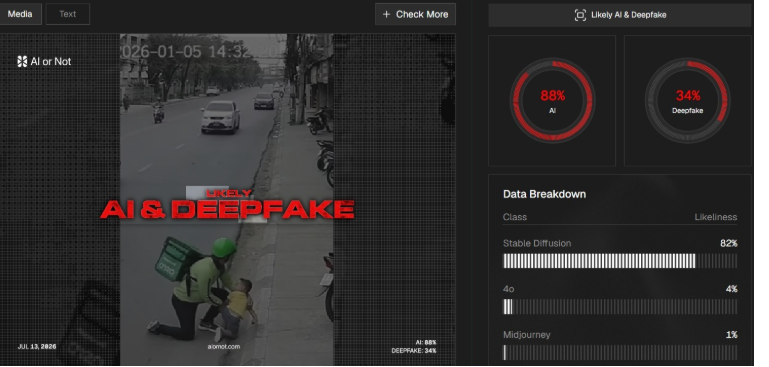
For additional verification, we also examined the video using another AI detection platform, AI or Not. The tool likewise identified the scenes in the viral clip as likely AI-generated, reinforcing our findings.
Conclusion
Our research found that the viral video does not depict a real rescue. It is AI-generated content that has been falsely circulated as footage of a delivery boy saving a child from a speeding truck in Mumbai. There is no credible evidence to support the claim that such an incident actually occurred.

Introduction
The Indian government has developed the National Cybersecurity Reference Framework (NCRF) to provide an implementable measure for cybersecurity, based on existing legislations, policies, and guidelines. The National Critical Information Infrastructure Protection Centre is responsible for the framework. The government is expected to recommend enterprises, particularly those in critical sectors like banking, telecom, and energy, to use only security products and services developed in India. The NCRF aims to ensure that cybersecurity is protected and that the use of made-in-India products is encouraged to safeguard cyber infrastructure. The Centre is expected to emphasise the significant progress in developing indigenous cybersecurity products and solutions.
National Cybersecurity Reference Framework (NCRF)
The Indian government has developed the National Cybersecurity Reference Framework (NCRF), a guideline that sets the standard for cybersecurity in India. The framework focuses on critical sectors and provides guidelines to help organisations develop strong cybersecurity systems. It can serve as a template for critical sector entities to develop their own governance and management systems. The government has identified telecom, power, transportation, finance, strategic entities, government entities, and health as critical sectors.
The NCRF is non-binding in nature, meaning its recommendations will not be binding. It recommends enterprises allocate at least 10% of their total IT budget towards cybersecurity, with monitoring by top-level management or the board of directors. The framework may suggest that national nodal agencies evolve platforms and processes for machine-processing data from different sources to ensure proper audits and rate auditors based on performance.
Regulators overseeing critical sectors may have greater powers to set rules for information security and define information security requirements to ensure proper audits. They also need an effective Information Security Management System (ISMS) instance to access sensitive data and deficiencies related to operations in the critical sector. The policy is based on a Common but Differentiated Responsibility (CBDR) approach, recognising that different organisations have varying levels of cybersecurity needs and responsibilities.
India faces a barrage of cybersecurity-related incidents, such as the high-profile attack on AIIMS Delhi in 2022. Many ministries feel hamstrung by the lack of an overarching framework on cybersecurity when formulating sector-specific legislation. In recent years, threat actors backed by nation-states and organised cyber-criminal groups have attempted to target the critical information infrastructure (CII) of the government and enterprises. The current guiding framework on cybersecurity for critical infrastructure in India comes from the National Cybersecurity Policy of 2013. From 2013 to 2023, the world has evolved significantly due to the emergence of new threats necessitating the development of new strategies.
Significance in the realm of Critical Infrastructure
India faces numerous cybersecurity incidents due to a lack of a comprehensive framework. Critical Information Infrastructure like banking, energy, healthcare, telecommunications, transportation, strategic enterprises, and government enterprises are most targeted by threat actors, including nation-states and cybercriminals. These critical information sectors especially by their vary nature as they hold sensitive data make them prime targets for cyber threats and attacks. Cyber-attacks can compromise patient privacy, disrupt services, compromise control systems, pose safety risks, and disrupt critical services. Hence it is of paramount importance to come up with NCRF which can potentially address the emerging issues by providing sector-specific guidelines.
The Indian government is considering promoting the use of made-in-India products to enhance Cyber Infrastructure
India is preparing to recommend the use of domestically developed cybersecurity products and services, particularly for critical sectors like banking, telecom, and energy, to enhance national security in the face of escalating cybersecurity threats. The initiative aims to enhance national security in response to increasing cybersecurity threats.
Conclusion
Promoting locally made cybersecurity products and services in important industries shows India's commitment to strengthening national security. A step of coming up with the National Cybersecurity Reference Framework (NCRF) which outlines duties, responsibilities, and recommendations for organisations and regulators shows the critical step towards a comprehensive cybersecurity policy framework which is a need of the hour. The government underscoring made-in-India solutions and allocating cybersecurity resources underlines its determination to protect the country's cyber infrastructure in light of increasing cyber threats & attacks. The NCRF is expected to help draft sector-specific guidelines on cyber security.
References
- https://indianexpress.com/article/business/market/overhaul-of-cybersecurity-framework-to-safeguard-cyber-infra-govt-may-push-use-of-made-in-india-products-9133687/
- https://vajiramandravi.com/upsc-daily-current-affairs/mains-articles/national-cybersecurity-reference-framework-ncrf/
- https://m.toppersnotes.com/current-affairs/blog/to-push-cyber-infra-govt-may-push-use-of-made-in-india-products-DxQP
- https://appkida.in/overhaul-of-cybersecurity-framework-in-2024/
