
#FactCheck- AI-Generated Video of Alleged Iranian Attack on US Helicopter Goes Viral with False Claims
Executive Summary
A video is being widely shared on social media showing armed personnel attacking a helicopter. The video is being circulated with the claim that Iranian soldiers shot down a US military helicopter near the Strait of Hormuz amid rising tensions between the United States and Iran. CyberPeace Research Wing research found the claim to be false. The viral video is AI-generated and is being shared with misleading context.
Claim:
An X (formerly Twitter) user shared the video on June 10, 2026, with the caption: “This is great cinema. Breaking News: Iran used a $150 weapon to bring down a $1 billion US military aircraft. For the first time, America has met its real enemy.”
Post link and archive link can be seen below:
https://x.com/TheIncNews/status/2064758088012607544?s=20
https://archive.ph/LUDUz

Fact-Check
To verify the claim, we conducted a keyword search on Google. However, no credible media reports were found supporting this claim.

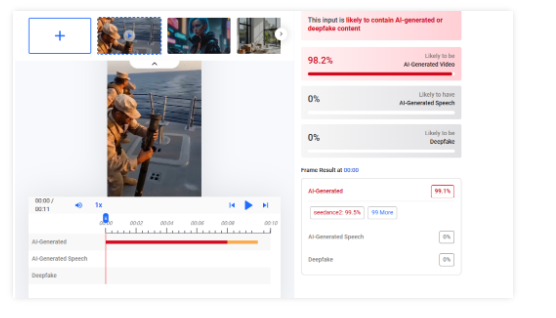
On closely examining the video, we suspected it to be AI-generated. We then analyzed it using the AI detection tool HIVE MODERATION. The results indicated that the video is 98% likely to be AI-generated.
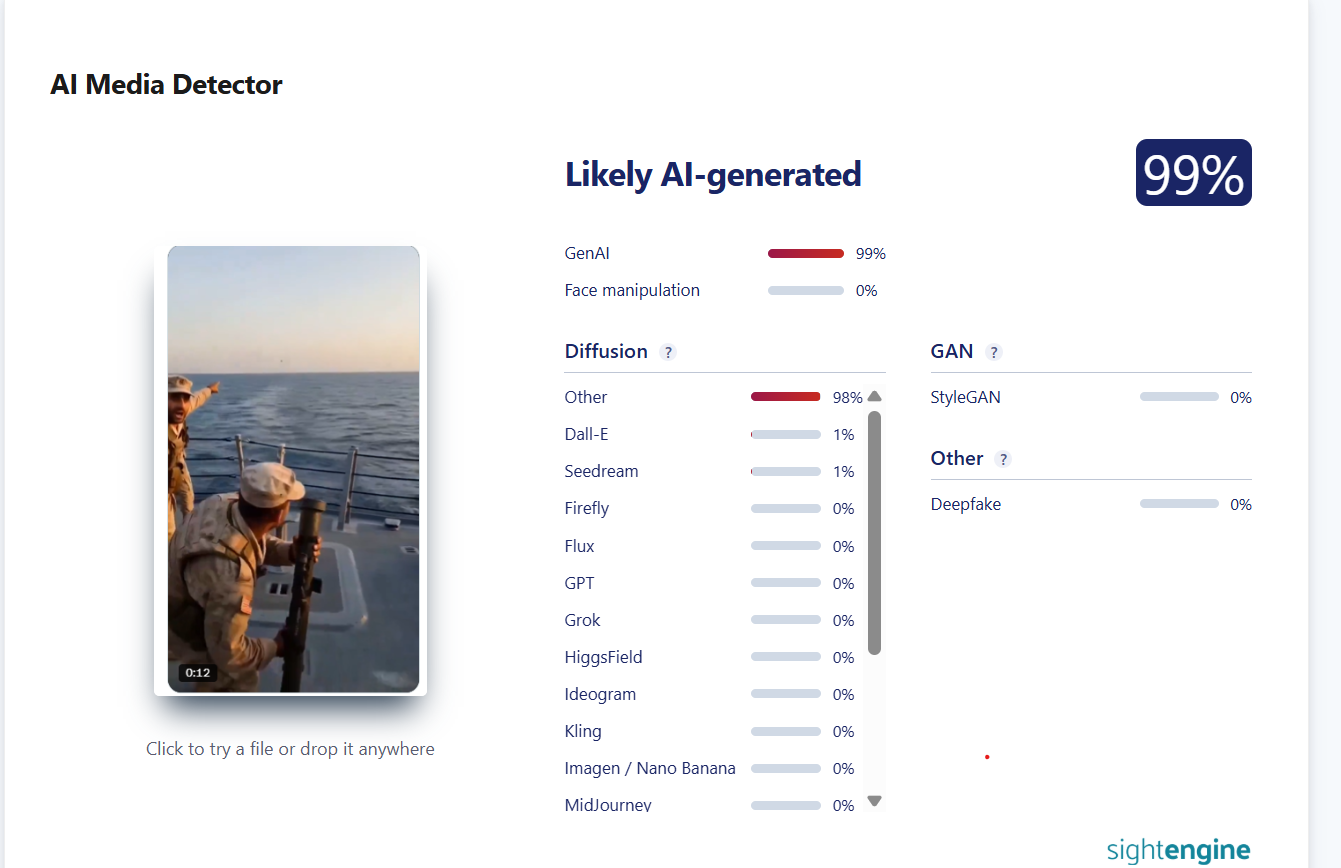
In the next step, we further analyzed the video using another AI detection tool, SIGHTENGINE. The results showed a 99% probability of the video being AI-generated.
Conclusion:
Our research confirms that the viral video is AI-generated and does not depict any real-world incident. The content is being circulated with a misleading and false narrative, falsely linking it to ongoing geopolitical tensions, despite there being no credible evidence or verified reports supporting such a claim.

Related Blogs
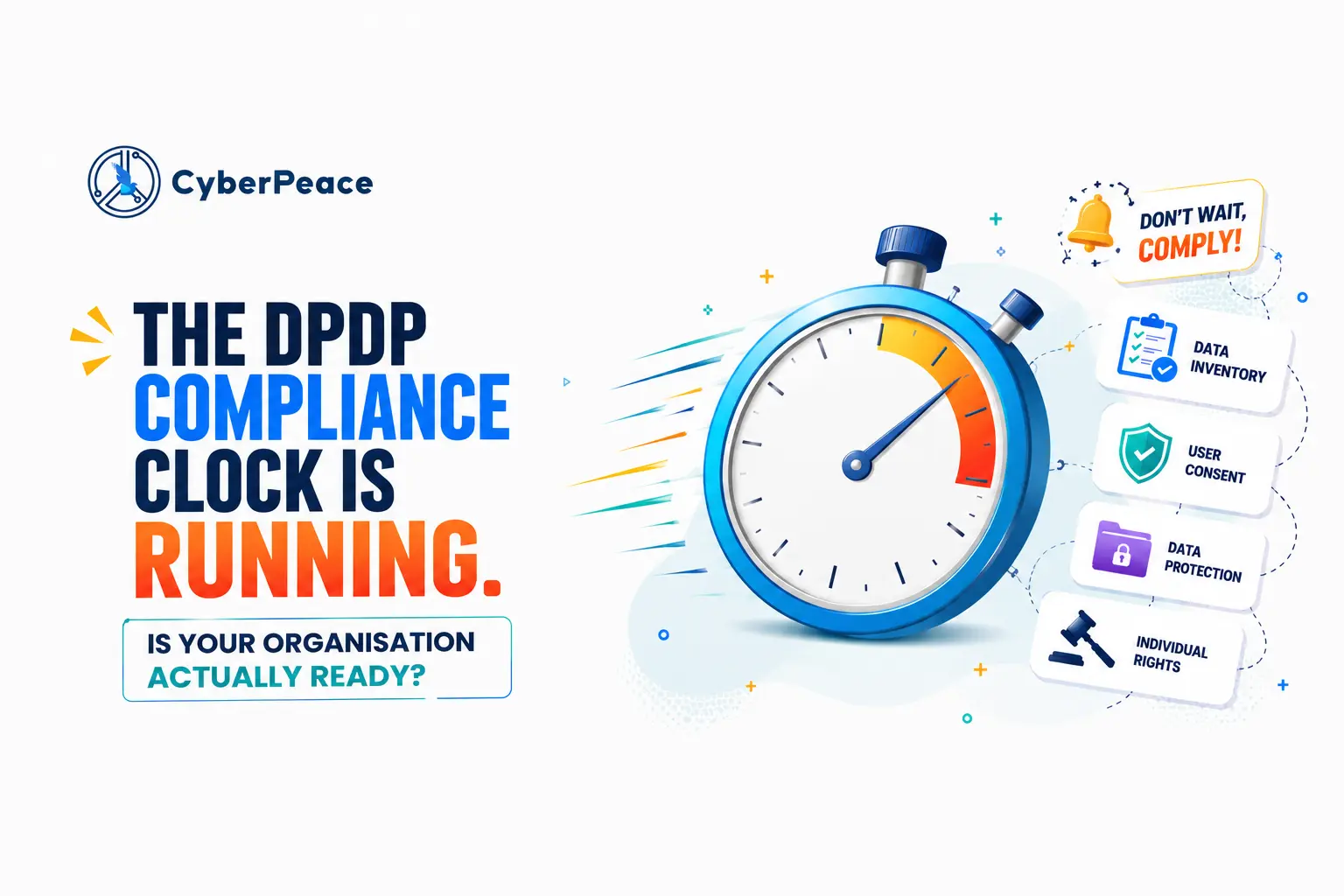
Somewhere in a compliance meeting right now, someone is saying "we have eighteen months, we're fine." That sentence is doing the same thing a snooze button does at 6 a.m.: technically buying time, while quietly making the actual wake up call worse. India's data protection law just started its countdown, and the 18 months everyone keeps citing is not a grace period to procrastinate through. It is closer to a runway before takeoff. Runways exist for one purpose: building up speed until the plane has no choice but to leave the ground. Standing still on one is not a strategy.
What actually got notified, and when
On 13 November 2025, the Ministry of Electronics and Information Technology notified the Digital Personal Data Protection Rules, 2025, giving operational shape to the Digital Personal Data Protection Act that Parliament had passed back in August 2023. Alongside the Rules themselves, MeitY issued a separate Enforcement Notification setting out exactly when different provisions kick in, and a further notification establishing the Data Protection Board of India, headquartered in the National Capital Region with four members. The final Rules followed a genuinely deliberative process, MeitY had floated draft Rules in January 2025 for public consultation and received 6,915 individual inputs from startups, industry bodies, civil society groups, and citizens before finalising the version now in force. The headline structural decision, and the one causing the most confusion in boardrooms, is that the Rules do not commence all at once. They commence in three distinct phases spread across eighteen months, and different obligations become legally binding at each stage.
The phased timeline, laid out plainly
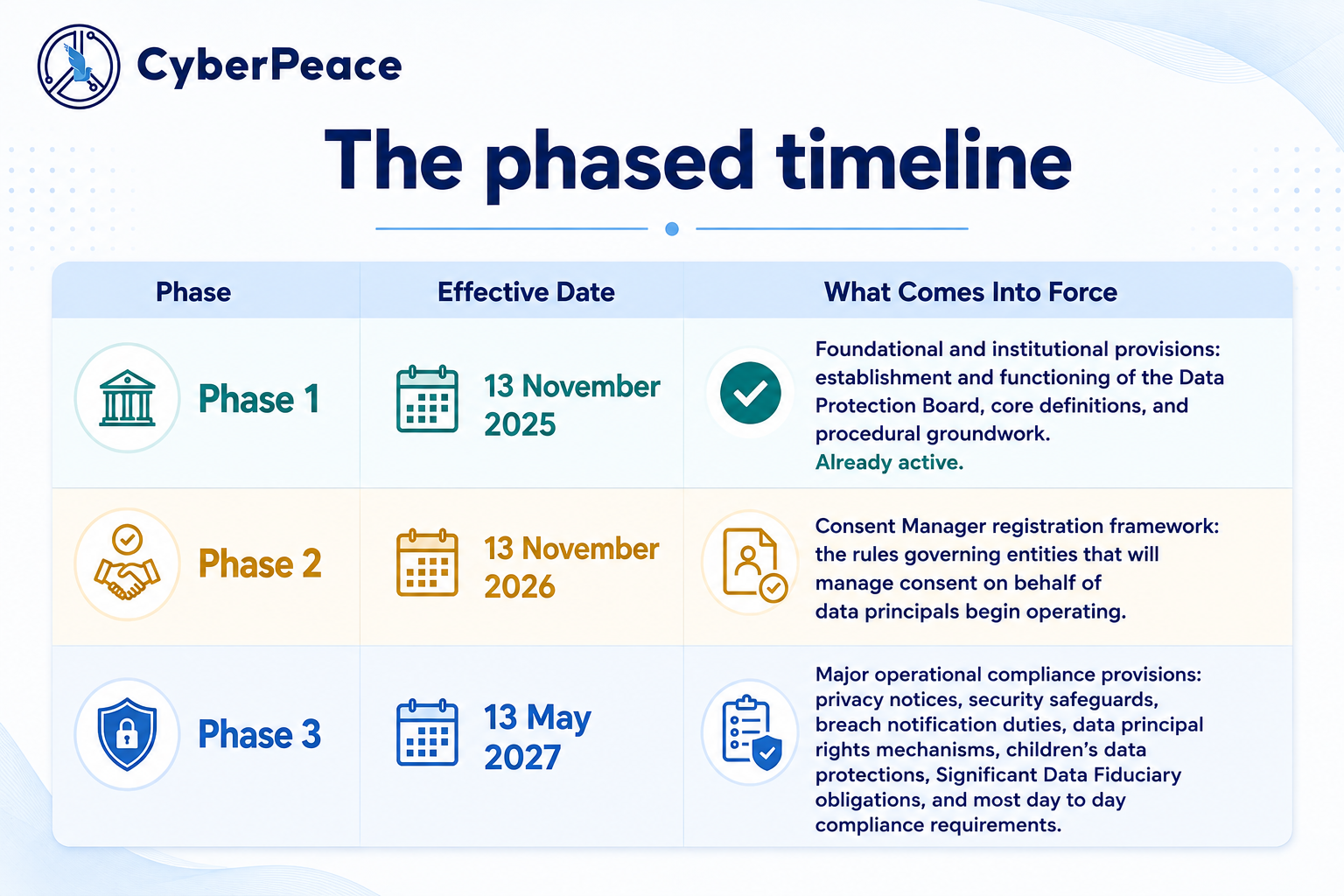
That third date, 13 May 2027, is the one that matters most for the vast majority of organisations, since it is where the bulk of actual operational obligations, the parts that touch product design, customer facing notices, and breach response, become enforceable. Legal commentary tracking the rollout has been consistent that this is described as a hard deadline with no grace period expected once it arrives, since the Data Protection Board is already operational and can begin receiving complaints well before Phase 3 obligations formally take effect.
Why "later" is a genuinely expensive plan
The financial stakes attached to Phase 3 non-compliance are not modest. The Schedule to the DPDP Act sets fixed penalty ceilings rather than turnover linked fines, which sounds gentler than Europe's GDPR model until you look at the actual numbers. Failure to implement reasonable security safeguards that results in a data breach can draw a penalty of up to 250 crore rupees per instance, the single highest tier in the Schedule. Failing to notify the Board or affected individuals after a breach occurs can draw up to 200 crore rupees, as can non-compliance with the Act's specific protections for children's data. Because these are assessed per instance rather than as a single capped exposure, a single incident that trips more than one obligation, say, inadequate safeguards that also delay breach notification, can compound into penalty exposure running into hundreds of crores from one event. All penalties collected go to the Consolidated Fund of India rather than to affected individuals directly, meaning the deterrent is aimed squarely at organisational behaviour, not compensation.
The part everyone keeps underestimating: this is not just a legal department problem
Perhaps the most consequential shift buried inside the DPDP framework is who actually has to own it. Reading the Rules as a checklist for the legal or privacy team alone misses how far the obligations actually reach. Building a compliant consent lifecycle touches product design. Security safeguards touch cybersecurity and IT infrastructure directly. Retention and deletion logic touches data governance and engineering. Third party risk review touches procurement. Breach preparedness touches internal audit and incident response. And increasingly, as organisations deploy AI systems that process personal data, AI governance enters the picture too, since a model trained or fine tuned on personal data inherits the same DPDP obligations as any other processing activity.
That cross functional reality is where most readiness programmes currently fall short. Treating DPDP compliance as a documentation exercise, updating a privacy policy PDF and calling it done, produces the appearance of compliance without the operational substance a Data Protection Board investigation would actually test. A breach response plan that exists only on paper and has never been rehearsed will not hold up against the 72 hour data principal notification window the Rules impose once Phase 3 lands. A consent mechanism bolted onto a website without corresponding backend logic to honour withdrawal requests will not satisfy an actual audit.
What a serious readiness posture looks like right now
Organisations that are ahead of this curve are already treating the eighteen month window as three overlapping workstreams rather than one deadline to hit at the end.
- The first is discovery: mapping what personal data exists, where it flows, who owns each system that touches it, and why it is collected in the first place, since compliance is structurally impossible without first knowing what you are protecting. This stage typically surfaces uncomfortable findings, shadow data sets nobody formally owns, vendor integrations nobody fully mapped, legacy systems still holding data well past any reasonable retention justification.
- The second is build: standing up the actual mechanisms, consent flows that can genuinely honour a withdrawal request end to end, rights request handling that does not depend on a single overworked employee checking an inbox, retention and deletion logic wired into the systems themselves rather than described only in a policy document, and security controls proportionate to the sensitivity of what is being protected.
- The third is proof: generating the internal evidence, audit trails, documented decisions, tested response procedures, that demonstrates governance was real rather than retrofitted after the fact. A Data Protection Board investigation, when it eventually happens, will not be satisfied by a well written policy; it will look for evidence that the policy was actually operational.
The actual question worth asking
The right question was never "when does DPDP become enforceable." Phase 1 already answered that; the law is live, and the Data Protection Board already exists and can act. The better question, the one worth taking into any leadership review between now and May 2027, is simpler and considerably less comfortable: will the organisation actually be ready when each phase's obligations become operational, or will readiness be assembled in a scramble once the deadline stops being theoretical. 18 months sounds long right up until the week it does not, and by the time Phase 3 lands, "we'll get to it" will no longer be a sentence any organisation gets to finish.
References
- Ministry of Electronics and Information Technology, Digital Personal Data Protection Rules, 2025, notified 13 November 2025. Press Information Bureau, "Digital Personal Data Protection Rules, 2025 Notified," 14 November 2025. https://static.pib.gov.in/WriteReadData/specificdocs/documents/2025/nov/doc20251117695301.pdf
- Shardul Amarchand Mangaldas & Co, "Enforcement of the DPDP Act and notification of the DPDP rules." https://www.amsshardul.com/insight/enforcement-of-the-dpdp-act-and-notification-of-the-dpdp-rules/
- S&R Associates, "India's Digital Personal Data Protection Regime Takes Effect." https://www.snrlaw.in/indias-digital-personal-data-protection-regime-takes-effect/
- Khurana & Khurana, "MeitY Notifies Rules Operationalising The DPDP Framework." https://www.khuranaandkhurana.com/update-meity-notifies-rules-operationalising-the-dpdp-framework-in-india
- Exchange4media, "DPDP Act 2025: Penalties for violations can reach Rs 250 crore." https://www.exchange4media.com/digital-news/dpdp-act-2025-penalties-for-confirmed-violations-can-reach-rs-250-crore-149360.html
- Seclore, "DPDP Rules 2025: India's Complete Compliance Guide." https://www.seclore.com/fundamentals/dpdp-rules-2025-compliance-guide/
Introduction
India is operating on digital rails today. Even as UPI is set to hit over 130 billion transactions by 2025, it already makes up around 80% of retail payments flow by volume. That volume is really what it is all about: a single extra transaction is simply another attack surface, and fraud has correspondingly scaled up. FY 2024-25 alone saw an estimated 485 crore in losses to UPI-related fraud through 632,000 reported frauds. The response from the RBI has not been a single rulebook but a layered and dynamic regulatory infrastructure that currently spans banks, NBFCs, payment aggregators, card networks, and, by extension, the fintechs that connect into all of these components. Knowing why the infrastructure is shaped the way it is and what actual enforcement looks like is far more crucial than having a checklist in mind. This write-up moves beyond summarising the rules to outlining the thinking behind them, the latest trends shaping the segment and the reality of an implementation roadmap.
Why Has RBI Cybersecurity Compliance Become Non-Negotiable?
Three forces are converging on regulated entities at once:
1. The threat surface has outgrown legacy controls: Core banking systems were never designed for an ecosystem of APIs, third-party payment gateways, and unregulated fintech partners sitting on top of them. Every integration is a potential entry point, and attackers know it.
2. Financial stability is now a cyber question, not just a credit question: a prolonged outage at a large payment system operator doesn't just hurt one bank's balance sheet; it can freeze retail payments for hundreds of millions of people. RBI treats this as systemic risk, which is why its post-2020 directions lean so heavily on resilience (the ability to keep operating through an attack) rather than just prevention.
3. Enforcement has escalated: The RBI's May 2025 single order penalised five different banks, including levying a 97.80 lakh penalty on ICICI Bank with one part attributable to its late reporting of a cybersecurity incident and another to a lapse in account alert systems; this demonstrates this rise in intensity. Remember, under Sections 46 and 47A of the Banking Regulation Act 1949, the RBI has the power to levy penalties irrespective of the occurrence of an actual breach if an individual fails to comply with procedures like not properly assessing vendor access or reporting incidents late or failing to update crisis plans or timely reports. Now this is a significant development, an issue even in the absence of a full-scale 'hack'.
The Regulatory Architecture: What Actually Applies to Whom
Rather than one framework, regulated entities are governed by several overlapping directions depending on their category:
- Banks: The original RBI Cyber Security Framework requires board-approved cybersecurity policies, 24x7 Security Operations Centres, and defined incident reporting timelines.
- NBFCs: NBFCs were initially governed under the Master Direction on IT Framework for NBFC Sector, which escalates accordingly as per size of asset – the framework underwent substantial change in shape with the RBI notifying Cybersecurity, Technology Risk, Resilience and Assurance Framework directions, 2026 for NBFCs, which lays specific obligations based on tier level (NBFC-Base Layer, Middle Layer, Upper Layer & Top Layer entities) on issues like MIS reporting, fraud analytics & impact of incident reporting.
- PSOs: Non-bank Payment system Operators PSOs have been regulated under the Master Direction on Cyber Resilience and Digital Payment Security Controls, 2024 (July 2024). Card networks, payment aggregators, PPI issuers and other PSOs come under its umbrella, with staged compliance based on the volume/business size (large – NPCI, card networks and the largest PPI issuers will meet requirements on April 1, 2025; medium ones by April 1, 2026; and small ones by April 1, 2028).
- Other Bodies: IT Governance (on all regulated entities broadly) The Master Direction on Information Technology Governance, Risk, Controls and Assurance Practices, 2023, became effective on April 1, 2024, and has set basic benchmarks for information technology (IT) strategy committees, IT risk management processes & IT assurance functions.
Overall trends' information across all these is clear: escalating tier requirements as per size and board-led controls are mandatory; a conscious acceptance that there will inevitably be data breaches in the future; and increasing emphasis on response and recovery.
Governance: Where RBI Compliance Actually Starts
A recurring theme across every RBI direction is that cybersecurity cannot be delegated entirely to the IT department. The Board of Directors is expected to own information security risk, with oversight typically delegated to a board subcommittee that meets at least quarterly. A board-approved information security policy, reviewed annually, must define the following:
- Roles and responsibilities across the Board, senior management, and the CISO
- Processes to identify, assess, monitor, and manage cyber risk
- Employee and stakeholder training and awareness programs
RBI's own 2022 thematic review of IT governance across 20 banks found unmanaged third-party vendor access, with vendors retaining privileged access to core systems long after a project ended at more than half the institutions reviewed. That kind of gap is a governance failure as much as a technical one: it happens because nobody owns the review cycle, not because the firewall is misconfigured.
Key Technical and Operational Controls
Once governance is in place, RBI's expectations translate into concrete control domains:
Infrastructure and access hardening: Network segmentation, endpoint protection, server hardening baselines, and multi-factor authentication for privileged access. Access reviews should be continuous or, at minimum, periodic, enforcing least privilege and separation of duties, not a one-time onboarding checkbox.
Vulnerability and patch management: Regular vulnerability scanning, risk-prioritised remediation, and a documented process for feeding vulnerability data into risk decisions, not just a scanner report sitting in an inbox.
Data security and localisation: Encryption at rest, in transit, and during processing; sound key management; data classification and masking; and adherence to the RBI's data localisation requirements for payment data.
Vendor and third-party risk: This has become one of the sharpest areas of regulatory focus. The 2024 PSO Master Directions explicitly require oversight of "unregulated entities" in the payment chain like payment gateways, third-party service providers, and vendors with due diligence, contractual security clauses, and ongoing monitoring baked in. For a bank or fintech, this means your compliance posture is only as strong as your weakest vendor's; the RBI increasingly holds the regulated entity accountable for its partners' failures, not just its own.
Security operations and incident response: 24x7 SOC capability, threat intelligence integration, and tested incident response plans via tabletop exercises and simulated attacks. A Cyber Crisis Management Plan (CCMP) drafted once and never rehearsed is, in practice, treated by RBI examiners as functionally absent.
Incident Reporting
This is where two separate regulatory clocks run in parallel, and conflating them is a common compliance mistake:
- RBI requirements: Regulated entities will normally have around 2-6 hours of detection to report most security incidents to the RBI with follow-up notifications as and when the nature of the incident unfolds.
- CERT-In's 6-hour rule: The CERT-In Directions dated April 2022 stipulate that every body corporate, which includes any bank, NBFC or payment aggregator, is obligated to report specified categories of cyber incidents to CERT-In within 6 hours of noticing them and not after fully confirming details at an additional 6 hours after noticing them. CERT-In directions also mandated that ICT system clocks are to be synced to NIC/NPL time servers, and system logs are to be maintained for a rolling 180 days within India.
- The Digital Personal Data Protection Act overlay: In the case of a data breach involving personal data, there will additionally be a 72-hour notification obligation from the data fiduciary to the Data Protection Board under the Digital Personal Data Protection Act, 2023, which runs in parallel to, and not in substitution of, the CERT-In time.
The practical consequences: If an SOP for incident response only maps one regime, then it would fail in an actual incident. We need a single intake process whereby multiple notification tracks are automatically triggered at the precise time an incident is detected, given that the inability to report "because we were still figuring it out" does not constitute an acceptable justification for a late notification under either regime.
Why Penetration Testing Sits at the Center of Compliance
RBI's VAPT (Vulnerability Assessment and Penetration Testing) mandate isn't a box-ticking annual scan. It's meant to validate, under real attack conditions, whether the governance and technical controls described above actually hold up. Automated scanning finds known vulnerabilities; penetration testing, ideally combining automated coverage with manual, business-context-aware testing, finds the logic flaws, chained exploits, and privilege escalation paths that scanners miss and that attackers actually use.
For most regulated entities, a realistic testing cadence looks like:
- Semi-annual vulnerability assessments across critical systems
- Annual (at minimum) penetration testing of applications, networks, and infrastructure supporting payment and customer-data systems
- Testing triggered by events before go-live, after major changes, and post-deployment.
- Documented remediation cycles and rescans, with reports mapped directly to the relevant compliance clauses for audit purposes
The Cost of Getting It Wrong
RBI's enforcement history grounds the financial impact of enforcement actions. In addition to the May 2025 fines levied on ICICI, Axis, IDBI, Bank of Baroda and Bank of Maharashtra, the RBI's published Enforcement Guidelines differentiate three levels of severity; procedural breaches such as delayed policy review or late incident notifications usually warrant 10 lakh to 1 crore fines plus formal reprimands and remediation orders with deadlines. Recurring governance breaches go farther than fines, resulting in restrictions on business activities and more stringent supervisory reporting, with egregious breaches leading to inclusion under the RBI's Prompt Corrective Action regime. Penalty orders are also publicly available, and the resulting toll on customer trust, partner trust, and investor confidence often dwarfs the fines.
A Practical Implementation Roadmap
For an organisation building or maturing its RBI compliance programme, a sensible sequence looks like this:
- Establish board-level ownership first: Form or formalise the Board IT/Risk sub-committee, appoint or empower a CISO with real authority, and get the information security policy formally approved, and this is the foundation every RBI examiner checks first.
- Mapping: A mid-sized NBFC, a large payment aggregator, and a scheduled commercial bank face different, overlapping obligations. Get this scoping wrong and you'll either over-engineer or leave gaps.
- Secure third-party access: Audit every vendor with system access, revoke stale privileges, and build vendor security clauses into contracts going forward, not retroactively.
- Build one incident response SOP: Run one compiled playbook that satisfies RBI, Cert-In and DPDP.
- Schedule and actually rehearse tabletop exercises: not just write a CCMP and file it away.
- Institutionalise VAPT as a continuous, risk-triggered programme rather than an annual compliance event, and ensure reports are structured to map directly onto RBI's compliance clauses for audit readiness.
- Track the regulatory calendar actively: 2024–2026 has brought new NBFC directions, PSO phase-ins, and ITG-RC&AP obligations in quick succession, and the pace shows no sign of slowing.
Conclusion
RBI's shift from perimeter-focused prevention to a risk-based, resilience-first model reflects a broader reality: in a digital payments ecosystem processing billions of transactions a month, breaches are not a hypothetical to plan around; they're an operational certainty to plan for. The frameworks discussed here, cyber resilience directions, IT governance mandates, CERT-In's reporting clock and the new NBFC cybersecurity directions aren't separate hurdles to clear individually. They're converging into a single expectation: that regulated entities can detect an incident quickly, contain it, recover fast, and prove with documentation, tested plans, and independent penetration test evidence that they were ready for it in the first place.
For banks, NBFCs, and fintechs operating in India today, that readiness is no longer just a regulatory requirement. It's the baseline cost of operating in the financial system at all.
References
Sources
- Astra Security — RBI Cybersecurity Compliance Checklist for Banks & NBFCs in 2026: https://www.getastra.com/blog/compliance/rbi-cybersecurity-compliance-checklist/
- TaxGuru — RBI Issues NBFC Cybersecurity and Technology Risk Directions, 2026: https://taxguru.in/rbi/rbi-issues-nbfc-cybersecurity-technology-risk-directions-2026-governance-framework.html
- Mondaq — Cyber Resilience and Digital Payment Security Governance (Master Directions, 2024): https://www.mondaq.com/india/fin-tech/1527836/cyber-resilience-and-digital-payment-security-governance-a-step-towards-secured-payments-systems
- TaxGuru — Master Directions on Cyber Resilience & Digital Payment Security Controls for Non-bank PSOs: https://taxguru.in/rbi/master-directions-cyber-resilience-digital-payment-security-controls-non-bank-payment-system-operators.html
- CyberNX — Ultimate Guide on RBI Master Directions for Cyber Resilience: https://www.cybernx.com/rbi-master-directions-guide/
- SIRI Law LLP — A Comprehensive Guide to India's CERT-In 6-Hour Cyber Incident Reporting Mandate: https://sirilawllp.com/a-comprehensive-guide-to-indias-cert-in-6-hour-cyber-incident-reporting-mandate/
- CreativeCyber — CERT-In 6-Hour Incident Reporting SOP for Indian Banks & NBFCs: https://creativecyber.in/resources/cert-in-6-hour-incident-reporting/
- BW Businessworld — RBI Slaps Penalties on ICICI, Axis and Three Others Over Compliance Failures (May 2025): https://www.businessworld.in/article/rbi-slaps-penalties-on-icici-axis-three-others-over-compliance-failures-555643
- FluxForce — RBI Cyber Framework: Banks' Requirements & Penalties: https://www.fluxforce.ai/regulations/rbi-cyber-security-framework-banks
- MYITMANAGER — RBI Cybersecurity Guidelines 2026: What Banks and NBFCs Must Do: https://myitmanager.in/rbi-cybersecurity-guidelines-2026-banks-nbfcs/

Introduction
India currently faces a crucial moment because its digital system experiences rapid growth while cyber criminals take advantage of this development to increase their fraudulent activities. The Department of Telecommunications (DoT) has implemented a new regulatory requirement that mandates all messaging and communication platforms to use SIM-binding technology as their primary security measure. The new rule, which starts on 1st March 2026, requires WhatsApp, Telegram, Signal and other similar applications to operate only when users have their registered SIM card present in their device. The telecom identifier restriction aims to prevent unauthorised access, but it creates significant privacy concerns, together with issues of proportionality and platform governance.
Understanding the SIM-Binding Directive
SIM-binding establishes direct links between communication platform accounts and the SIM cards used for registration. The application will stop working when users take out their SIM card, turn it off, or get a new SIM card. Users must re-authenticate their sessions through the main device because web-based sessions, including WhatsApp Web, will automatically log out after six hours of use.
The Telecommunications Act, 2023 and Telecom Cyber Security Rules serve as the base legal authority for this directive. The regulation requires Telecommunication Identity User Entities (TIUEs), which identify users through mobile numbers, to maintain service access based on verified telecommunications credentials.
Rationale: Addressing Cyber Fraud and Misuse
The policy exists because cyber fraud activities have reached a point where they require a more powerful response. Authorities have stated that messaging applications maintain their operational capacity even after users remove their SIM cards, which allows international scammers to use Indian phone numbers for their fraudulent activities. SIM-binding aims to:
- Restore traceability by linking active accounts to verified SIM-based identities.
- Reduce remote access abuse, which includes both account takeovers and impersonation scams.
- Stop fraudulent activities that require physical device access through the creation of permanent sessions.
- Build a system of accountability that extends throughout the telecommunications industry.
The government introduced this measure as an appropriate solution to deal with systemic vulnerabilities because reported cyber fraud losses in 2024 reached more than ₹22,800 crore.
Security with Responsibility
The system requires digital trust to be established through secure identity verification systems, which include official systems for verification and operational systems that enable governmental agencies to work together.
CyberPeace principles require security measures to maintain three essential conditions, which are:
- They must respond to existing dangers
- Their execution process must be open to public observation
- They need to protect user rights, which include their right to privacy and personal independence
- They must provide equal access while safeguarding against negative impacts on at-risk user groups.
Industry Response and Governance Challenges
The directive has received diverse responses from people who work in different fields. Some platforms are testing SIM presence verification features for their upcoming changes, according to reports, while industry groups representing major technology companies have raised legal issues. They argue that the mandate may exceed the regulatory scope of the DoT and potentially conflict with constitutional protections. The existing tension demonstrates how governments face difficulties because they must protect national security while managing international platform operations and legal systems. The situation requires multiple stakeholders to work together because governments, industry, and civil society need to design policies through their collective input.
Policy Insights and Recommendations
The successful balanced execution of this initiative depends on these two essential elements:
- Clear Implementation Guidelines: Organizations need to establish detailed technical standards together with compliance frameworks, which must be followed during their implementation process across various platforms.
- Privacy Safeguards: The telecom service provider must implement strong data protection measures that protect customer data from unauthorised access through SIM-binding technology.
- User Awareness and Transparency: Users should receive information about SIM-binding effects on their access rights, together with security controls, which will help them build trust and provide informed consent.
- Flexibility for Edge Cases: Provisions should exist for legitimate use cases such as device changes, international travel, and accessibility needs.
- Global Interoperability Dialogue: India should engage with global stakeholders to ensure that such measures do not fragment the digital ecosystem.
Conclusion
The SIM-binding directive establishes India’s defence against cyber threats by solving a specific problem that exists in digital identity verification. The system establishes CyberPeace as its fundamental base through its shift from reactive cybersecurity practices toward preventive digital governance methods.
The system will achieve its desired results only if it effectively manages the three elements of security protection, privacy maintenance, and user convenience. SIM-binding and similar policies require ongoing assessment because their implementation affects both national security and the fundamental principles of trustworthiness, inclusiveness, and ethical digital governance.
References
- https://www.opindia.com/2026/02/sim-binding-to-be-implemented-from-1st-march-what-it-means-and-how-it-will-impact-users/
- https://www.ndtv.com/india-news/sim-binding-rule-set-to-change-how-whatsapp-telegram-work-in-india-from-march-1-11148903#:~:text=Under%20the%20new%20framework%2C%20messaging,is%20re%2Dinserted%20and%20authenticated.
- https://timesofindia.indiatimes.com/technology/tech-news/telecom-departments-sim-binding-rule-to-come-into-effect-from-tomorrow-march-1-what-is-sim-binding-how-it-works-and-what-it-means-for-whatsapp-users/articleshow/128879561.cms
- https://www.deccanherald.com/technology/whatsapp-begins-testing-sim-binding-in-india-3913963
